
 Excavator
294 models
Excavator
294 models  Backhoe Loader
51 models
Backhoe Loader
51 models  Crane
68 models
Crane
68 models  Concrete Mixer
79 models
Concrete Mixer
79 models  Wheel Loader
54 models
Wheel Loader
54 models  Compactor / Roller
45 models
Compactor / Roller
45 models  Motor Grader
42 models
Motor Grader
42 models  Dozer
41 models
Dozer
41 models  Concrete Pump
66 models
Concrete Pump
66 models  Skid Steer Loader
11 models
Skid Steer Loader
11 models  Telehandler
13 models
Telehandler
13 models 


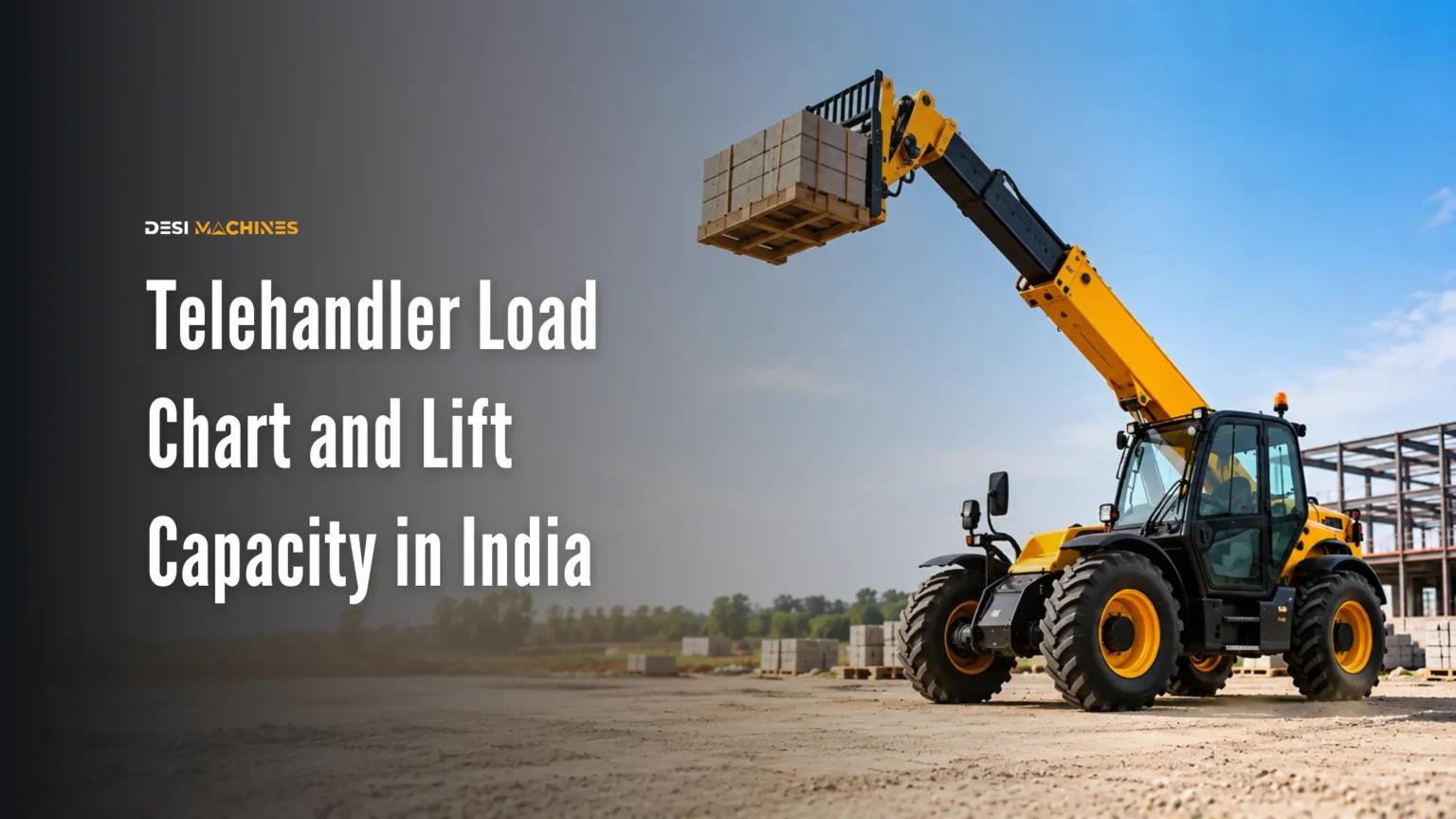
A telehandler load chart is the manufacturer’s table showing how much the machine can safely lift at every combination of boom length and boom angle. It exists because a telehandler’s capacity is not one number. The same machine that lifts 4,000 kg (4 tonnes) with the boom pulled in and low may only handle a few hundred kilos with the boom stretched right out, and the chart is the only place that difference is written down.
Every telehandler sold in India carries one, usually as a laminated sheet or a decal inside the cab. The headline figures published for the machines available here run from 2,721 kg to 7,000 kg of maximum lifting capacity, 7.0 m to 34.7 m of lifting height and 3.8 m to 28.0 m of outreach. This guide explains what those numbers mean, why they never all apply at once, and how to read the chart before you put a load in the air.
What is a telehandler load chart?
A load chart is a grid. Down one side is the height the load is being lifted to. Across the other is the outreach — how far forward the load sits from the front wheels. Where the two meet, the chart gives you a weight. That weight is the most the machine may carry in that exact position.
Three terms do most of the work on the chart, and it is worth being clear about them before you look at one:
- Rated lifting capacity is the maximum the machine can lift, and it applies only with the boom retracted and the load held close in. This is the number on the brochure.
- Lifting height is how high the forks reach with the boom fully extended and raised.
- Outreach is how far forward the forks reach when the boom is extended out towards the horizontal. This is the number that eats your capacity fastest.
The single most common mistake is to read those three headline figures as if they happen together. They do not. The MANITOU MXT 1740 K publishes a maximum lifting capacity of 4,000 kg (4 tonnes) and a maximum outreach of 13,480 mm (13.48 m). It cannot do both at the same moment. At full outreach the safe load is a small fraction of 4 tonnes, and the chart is where you find out exactly what fraction.
How do you read a telehandler load chart?
You read it by fixing the position first and the weight second, never the other way round. Work through it in this order:
- Know the actual weight of the load. Not the estimate, and not the weight of the material alone. Add the pallet, the water in a bag of cement that has stood in the rain, and the weight of the attachment itself if it is not the standard forks.
- Work out how high it has to go. Measure to the floor level where the load is being placed, not to the ground.
- Work out how far forward it has to go. This is the distance from the front tyres to the load once the machine is parked where it can actually stand. On a real site this is usually decided by scaffolding, a trench or a boundary wall.
- Find that height and outreach on the chart and read the weight. If your load is heavier than the figure in that box, the answer is no. Move the machine closer, use a taller machine, or split the load.
- Check which attachment the chart is for. A separate chart applies to each attachment. A jib or a bucket changes the numbers, and a jib changes them a lot.
Most charts also mark a boundary line beyond which the machine must be on its stabilisers, or must not travel with the load raised. Treat that line as a wall, not a suggestion.
Comparing machines? Browse telehandler models, specifications and prices and talk to a dealer near you.
Why does lifting capacity drop as the boom extends?
Capacity drops because the machine tips forward around its front wheels, and how far the load sits in front of those wheels decides how hard it pulls.
Think of holding a brick against your chest. Easy. Now hold the same brick at arm’s length. The brick has not changed, but your shoulder is working far harder, and eventually you tip forward. A telehandler behaves the same way. The front axle is the pivot, the machine’s own weight behind that axle is the counterweight, and the load out front is trying to tip the whole thing over. Double the distance forward and you roughly double the tipping effort from the same load.
This is why operating weight matters so much on a telehandler and why heavier is often better rather than worse. The MANITOU MXT 840 K and the MXT 1740 K both lift 4,000 kg (4 tonnes) at their rated maximum. The 840 K weighs 12,525 kg (12.53 tonnes) and reaches 4,230 mm forward. The 1740 K weighs 15,530 kg (15.53 tonnes) and reaches 13,480 mm forward. That extra 3 tonnes of machine is not waste. It is the counterweight that lets the boom go out three times further at all.
Height alone costs you much less capacity than reach does, because a load lifted straight up stays close to the pivot. This is the reason two machines with the same rated capacity can be built for completely different jobs, which is also what the model numbers are telling you. The complete telehandler guide explains how to decode those model names.
Telehandler lift capacity, height and outreach in India
The table below lists the published maximum figures for every telehandler available in India. Remember what the earlier sections established: these three columns are three separate maximums, not one working position. Use them to shortlist machines, then read the actual chart for the machine you pick.
| Model | Type | Max lifting capacity | Max lifting height | Max outreach | Operating weight |
|---|---|---|---|---|---|
| SANY STH634A | Fixed boom | 2,721 kg (2.72 t) | 10,400 mm (10.4 m) | 7,000 mm (7.0 m) | 6,972 kg (6.97 t) |
| JCB 530-70 | Fixed boom | 3,000 kg (3.0 t) | 7,000 mm (7.0 m) | 3,800 mm (3.8 m) | 7,220 kg (7.22 t) |
| JCB 530-110 | Fixed boom | 3,000 kg (3.0 t) | 11,000 mm (11.0 m) | 7,400 mm (7.4 m) | 9,272 kg (9.27 t) |
| ACE AT 30 | Fixed boom | 3,000 kg (3.0 t) | 11,200 mm (11.2 m) | 7,250 mm (7.25 m) | 9,730 kg (9.73 t) |
| SANY STH844A | Fixed boom | 3,629 kg (3.63 t) | 13,400 mm (13.4 m) | 9,150 mm (9.15 m) | 11,633 kg (11.63 t) |
| JCB 540-70 | Fixed boom | 4,000 kg (4.0 t) | 7,000 mm (7.0 m) | 3,800 mm (3.8 m) | 8,498 kg (8.5 t) |
| MANITOU MXT 840 K | Fixed boom | 4,000 kg (4.0 t) | 7,600 mm (7.6 m) | 4,230 mm (4.23 m) | 12,525 kg (12.53 t) |
| MANITOU MXT 1740 K | Fixed boom | 4,000 kg (4.0 t) | 17,400 mm (17.4 m) | 13,480 mm (13.48 m) | 15,530 kg (15.53 t) |
| SANY STH1056A | Fixed boom | 4,540 kg (4.54 t) | 17,100 mm (17.1 m) | 13,100 mm (13.1 m) | 15,300 kg (15.3 t) |
| MANITOU MRT-X 1645 | Rotating | 4,500 kg (4.5 t) | 15,800 mm (15.8 m) | 13,500 mm (13.5 m) | 13,305 kg (13.31 t) |
| MANITOU MRT-X 2570 | Rotating | 7,000 kg (7.0 t) | 24,800 mm (24.8 m) | 20,500 mm (20.5 m) | 21,300 kg (21.3 t) |
| MANITOU MRT-X 3570 | Rotating | 7,000 kg (7.0 t) | 34,700 mm (34.7 m) | 28,000 mm (28.0 m) | 23,800 kg (23.8 t) |
The MANITOU MXT 840 K is also sold as the MXT 840 K IND with the same published lift figures. Two comparisons in that table are worth sitting with. The JCB 530-70 and the JCB 540-70 share an identical 7,000 mm height and 3,800 mm outreach, and differ only in capacity: 3,000 kg against 4,000 kg. The 530-70 and the JCB 530-110 do the opposite: both lift 3,000 kg, but the 530-110 reaches 11,000 mm instead of 7,000 mm. Same family, three machines, and the choice between them is entirely about which of the two numbers your work needs.
Do fixed and rotating telehandlers use the same kind of load chart?
Both use the same height-and-outreach grid, but a rotating telehandler needs a second chart, because it can turn its boom away from the front of the machine.
A fixed boom telehandler lifts over its front wheels only. Its stability comes from the machine’s own length and weight, and one chart covers it. Across the fixed boom machines available in India, rated capacity runs from 2,721 kg to 4,540 kg, height from 7,000 mm to 17,400 mm and outreach from 3,800 mm to 13,480 mm.
A rotating machine puts the boom on a turret that swings, 360° on the MANITOU MRT-X 2570 and MRT-X 3570, and 400° on the MRT-X 1645. Once the boom points sideways, the tyres and the wheelbase are no longer holding the load the way they do over the front, so these machines work on stabilisers: legs that lower to the ground and take the weight. A rotating telehandler therefore has one set of figures on stabilisers and a much smaller set on tyres, and the chart marks which is which. Working off the wrong half of the chart is one of the quickest ways to put a machine on its side.
The rotating machines also carry the largest numbers in the class by a wide margin. The MANITOU MRT-X 3570 lifts 7,000 kg (7 tonnes), reaches 34,700 mm (34.7 m) high and 28,000 mm (28 m) forward, on an operating weight of 23,800 kg (23.8 tonnes). That is more than three times the weight of the lightest machine in the class, and it is what those reach figures cost. The telehandler brands compared guide sets out which brand offers what in India.
At those heights and weights the question of whether to use a telehandler at all becomes fair. The telehandler versus crane comparison works through where each machine wins.
What reduces the capacity shown on the chart?
The chart assumes conditions that a real site rarely gives you. Several things take capacity away from the figure printed in the box, and none of them appear in the brochure:
- The attachment. Charts are drawn for a specific attachment. Swapping standard forks for a jib, a bucket or a work platform moves the load’s centre of gravity further out and needs its own chart.
- Ground that is not level. Every chart assumes a firm, level surface. A slope tips the load towards the front wheels and takes capacity away before you have lifted anything. Most machines have a spirit level or an indicator in the cab for exactly this reason.
- Soft or made-up ground. A wheel sinking on one side does the same thing as a slope, and monsoon sites in India do this without warning. Timber mats under the wheels or stabilisers are cheap protection.
- Load centre. The chart assumes the load sits at a standard distance out on the forks, usually 500 mm. A long or badly-stacked load with its weight further out is effectively heavier than the weighbridge says.
- Wind. Anything with a large flat face (sheets, formwork panels, an empty pallet stack) behaves like a sail at 15 or 20 metres up.
- Travelling with the load up. Most charts forbid it beyond a low height. A machine that is stable standing still can tip when a wheel drops into a rut.
The habit that covers most of these is simple: keep the load low and close while the machine is moving, park properly, level up, and only then extend. Operator training matters more on a telehandler than on almost any other machine on site, because the mistake that hurts is a judgement call rather than a mechanical failure. The telehandler attachments guide covers what each attachment does to the machine’s reach and balance.
What happens if you ignore the load chart?
The machine tips. It does not bend, warn you or stall. A telehandler working beyond its chart lifts the rear wheels off the ground and goes over the front, usually while the load is at its highest and someone is standing under it.
Modern machines fit a longitudinal load moment indicator, a display that shows how close the machine is to tipping and sounds an alarm near the limit. It is a good safety net and a poor plan. The indicator tells you that you are already at the edge; the chart tells you before you start whether the lift was ever possible.
If the boom stops moving altogether rather than simply lifting less, that is a different question: our guide to telehandler boom problems separates the load moment cut-out from a genuine hydraulic fault.
The practical routine on an Indian site is short. Check the chart before the first lift of a new task, not after something feels wrong. Keep the laminated copy in the cab and readable — a chart worn blank by sun and dust is the same as no chart, and a dealer will replace it. Make sure the operator has actually been shown how to read it, because a chart nobody can read protects nobody.
Cranes work to the same principle with their own charts, and if you handle both machines the guide to reading a crane load chart covers radius, deductions and the safety rules in detail. For what a telehandler is actually best at, see the telehandler applications guide and the telehandler versus backhoe loader comparison.
Ready to pick a machine? Compare telehandler models, lift capacities and prices and connect with a dealer near you.
Capacity is only half the fitting-out question: how much the machine itself weighs, and how wide and tall it is, decides the trailer and the gate. Those figures are set out in telehandler weight and dimensions in India.
Capacity at reach decides what the machine can lift; how long each lift takes is a separate figure, and the published lift and lower times behind telehandler productivity and output per hour show why the boom is rarely what limits a day’s work.
Specifications on this page are taken from our listings at the time of writing and are manufacturer maximum figures, not working capacities at reach — always work from the machine’s own load chart. Prices, specifications and features are indicative, vary by variant, location and date, and should always be confirmed with the official OEM or authorised dealer before any purchase decision. DesiMachines is not liable for decisions taken on the basis of information that may have changed after publication.
Machines, tenders and news for this industry: Material Handling
