
 Excavator
294 models
Excavator
294 models  Backhoe Loader
51 models
Backhoe Loader
51 models  Crane
68 models
Crane
68 models  Concrete Mixer
79 models
Concrete Mixer
79 models  Wheel Loader
54 models
Wheel Loader
54 models  Compactor / Roller
45 models
Compactor / Roller
45 models  Motor Grader
42 models
Motor Grader
42 models  Dozer
41 models
Dozer
41 models  Concrete Pump
66 models
Concrete Pump
66 models  Skid Steer Loader
11 models
Skid Steer Loader
11 models  Telehandler
13 models
Telehandler
13 models 


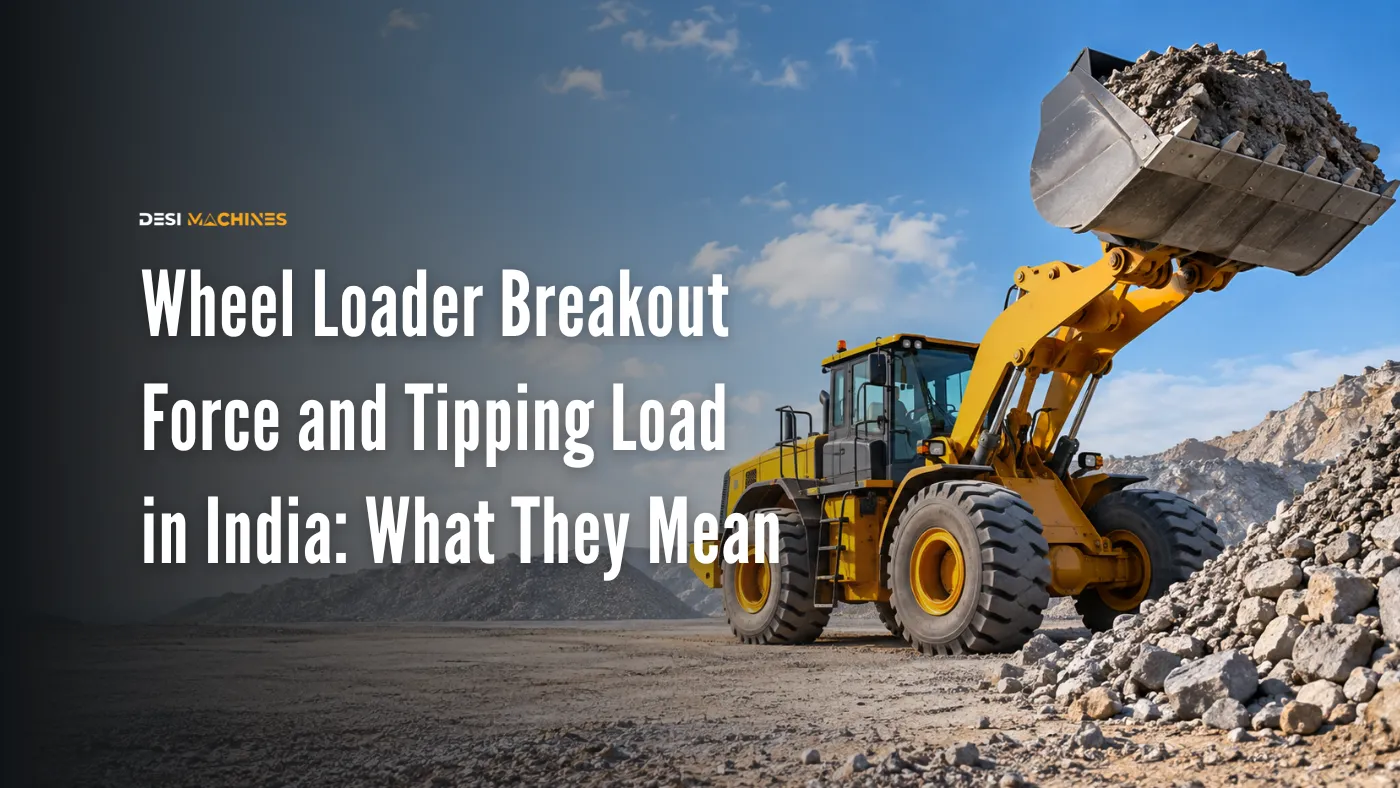
Wheel loader breakout force is the maximum upward force the bucket can push out at its cutting edge, measured in kilonewtons (kN). It is the number that decides whether your bucket fills in one clean pass or comes out half full. Tipping load is a different number: the weight at which the machine begins to lift its rear wheels off the ground, measured in kilograms. Breakout force tells you how hard the machine can dig into a pile. Tipping load tells you how much it can safely carry once that bucket is full.
Most buyers look at bucket size and engine power and stop there. These two numbers decide more of your daily output than either of them. This guide sets out what both figures mean, what they run to on the machines we list, and the one number on the spec sheet that is not the weight you can actually carry.
All figures below come from the product pages on our own site. Of the 54 wheel loaders we list, 52 publish a breakout force and 44 publish both tipping load figures. Every span says how many machines it was built from. For the rest of the machine, start at our complete wheel loader guide.
What is breakout force on a wheel loader?
Breakout force is the force the bucket can exert at its cutting edge when it curls up out of the pile. It comes from the hydraulic cylinders, not from the engine directly. The engine drives the pump, the pump pushes oil into the bucket cylinders, and the force those cylinders produce at the bucket edge is what the spec sheet calls breakout force.
It is published in kilonewtons. A kilonewton is a unit of force, and one kN is roughly 102 kg of push. So a machine quoting 150 kN is applying about 15.3 tonnes of upward force at the cutting edge. That conversion is worth doing in your head, because tonnes mean something on a site and kilonewtons do not.
What breakout force buys you is fill factor, which is how full the bucket comes out. Loose sand fills a bucket at almost any force. A tight face of crushed stone, wet clay, or ground that has been rained on and packed down does not. A machine short of breakout force takes two or three passes to fill a bucket that should have filled in one, and that shows up directly in trucks loaded per day. The hydraulic system and cylinders that produce this force are set out in our parts guide, and the engine side of the equation is covered in our guide to wheel loader engine power and torque.
One point that confuses buyers: breakout force is not the same as digging force on an excavator. An excavator has an arm and a boom pulling a bucket through ground it cuts into, and it publishes two force figures. A wheel loader pushes into a pile that is already loose or into a face it can drive at, and it publishes one. If you are comparing the two machine types, our guide to excavator digging force explains that side.
What is tipping load, and why are there two figures?
Static tipping load is the load in the bucket at which the machine’s rear wheels just begin to lift off level ground. It is a stability limit, not a lifting limit. The machine does not break when you reach it. It tips.
Every wheel loader spec sheet we list publishes it as two numbers, and this is the part buyers miss. A wheel loader steers by bending at a joint in the middle, which is called articulated steering. When the machine is straight, its four wheels sit in a wide, stable rectangle. When it bends to turn, the front end and the load swing out to one side of that rectangle, and the machine becomes easier to tip. So the spec sheet gives you:
- Tipping load, straight: the figure with the machine pointing straight ahead. The higher of the two, and the one that looks better in a brochure.
- Tipping load, full turn: the figure with the machine articulated hard over to one side. The lower of the two, and the one that matters.
The reason the second number is the one that matters is simple. A wheel loader almost never carries a full bucket in a straight line. The whole load-and-carry cycle involves turning away from the pile with the bucket loaded and swinging back to the truck. Our guide to how a wheel loader works covers that centre joint and the cycle in more detail.
How much tipping load does turning cost you?
Across the 44 machines on our site that publish both figures, the full turn tipping load runs between 78.6% and 92.3% of the straight figure, with a middle value of 86.7%. In plain terms, turning costs you about 13% of your stability, and on some machines it costs more than 20%.
That band holds across every size class we list, which is the useful part. Small machines of 8 to 15 tonnes sit at a middle value of 87.3%, medium machines of 15 to 30 tonnes at 87.2%, large machines above 30 tonnes at 86.4%. A big machine does not lose proportionally less when it turns. The penalty is a property of articulated steering itself, not of machine size.
The practical rule that follows is short. If a salesman quotes you a single tipping load figure, ask which one it is. If he quotes the straight figure and you size your daily load against it, you have given yourself a margin that disappears the moment the operator turns towards the tipper.
How much can a wheel loader actually carry?
Not the tipping load. Roughly half of it.
Under ISO 14397-1, the international standard for calculating loader capacity, the rated operating capacity of a wheel loader working with a bucket is 50% of its full turn static tipping load. The standard requires the machine to be tested both straight and fully articulated to each side, and the rated figure is taken from the articulated result. That 50% is the safety margin. It exists because real ground is not level, real buckets are not loaded evenly, and a machine that is braking, turning and carrying at the same time behaves differently from one standing still.
You can check that rule against our own catalogue. Twenty-six of the wheel loaders we list publish both a payload figure and a full turn tipping load, and the mid-size machines that do most of the work in India land almost exactly on half.
| Machine | Full turn tipping load | Published payload | Payload as share of tipping load |
|---|---|---|---|
| JCB 433-5 | 6,791 kg (6.79 tonnes) | 3,396 kg (3.40 tonnes) | 50.0% |
| Liugong 836N | 7,200 kg (7.20 tonnes) | 3,600 kg (3.60 tonnes) | 50.0% |
| JCB 455-5N | 10,975 kg (10.98 tonnes) | 5,490 kg (5.49 tonnes) | 50.0% |
| XCMG ZL55GV | 11,000 kg (11.00 tonnes) | 5,500 kg (5.50 tonnes) | 50.0% |
| Hindustan 2021E | 6,384 kg (6.38 tonnes) | 3,210 kg (3.21 tonnes) | 50.3% |
Across all 26 machines the middle value is 46.1%, a little under half. The machines that pull it down are the very large mining loaders, where the published payload is a bucket payload for a specific material rather than a rated operating capacity, and those sit between 30% and 40%. For the machines a contractor in India is realistically buying, half the full turn tipping load is the number to plan around.
So the arithmetic for sizing a machine runs like this. Take the full turn tipping load. Halve it. That is what you can carry all day. Then check that your bucket, filled with your material, weighs less than that. A 3 cubic metre bucket of wet sand weighs far more than the same bucket of dry aggregate, which is why bucket sizing and fill factor has to be settled alongside these two numbers rather than after them.
Wheel loader breakout force and tipping load by size class
The table below is built from the machines we list, grouped by the same size classes used in our guide to wheel loader size classes. Where a figure is published by fewer machines than the class holds, the count is given.
| Size class | Machines listed | Breakout force | Tipping load, straight | Tipping load, full turn |
|---|---|---|---|---|
| Compact, under 8 tonnes | 2 | 32 to 55 kN (3.3 to 5.6 tonnes of force) | Only one machine publishes tipping load: 4,150 kg straight, 3,679 kg full turn | |
| Small, 8 to 15 tonnes | 13 | 98 to 140 kN (10.0 to 14.3 tonnes of force), 12 machines | 6,500 to 11,630 kg, 8 machines | 6,000 to 10,100 kg, 8 machines |
| Medium, 15 to 30 tonnes | 23 | 152 to 236 kN (15.5 to 24.1 tonnes of force), 22 machines | 12,178 to 21,650 kg, 19 machines | 10,300 to 18,950 kg, 19 machines |
| Large, 30 to 55 tonnes | 11 | 217 to 450 kN (22.1 to 45.9 tonnes of force) | 22,639 to 39,290 kg | 19,565 to 34,700 kg |
| Mining loaders above 55 tonnes, a sub-group of the large class | 5 | 549 to 1,401 kN (56.0 to 142.9 tonnes of force) | 46,323 to 159,823 kg | 39,900 to 137,845 kg |
Reading it for your own site, the medium class of 15 to 30 tonnes is where most Indian quarry, crusher and highway loading work sits, and a machine such as the Volvo L120H at 170 kN sits mid-class. The large class is bulk work: ports, big mine faces, and the sort of duty a Volvo L350H at 450 kN is built for. The mining sub-group runs far above anything a general contractor needs, and the Cat 994K at 1,401 kN is there to show where the top of the range actually is rather than as a machine to shortlist.
See every wheel loader we list in India, with full specifications on each product page.
Does a bigger wheel loader give more breakout force?
More force in total, yes. More force for every tonne of machine you are buying and fuelling, no.
Dividing breakout force by operating weight across the 52 machines that publish both gives between 5.4 and 12.3 kN for every tonne of machine, with a middle value of 8.6. The machines at the top of that range are mid-size: the XCMG ZL33FV at 12.3, the JCB 433-5 at 10.7, the Hyundai HL650I-V at 10.6. The machines at the bottom are the giants, with the Cat 993K at 5.4 and the Cat 992K at 5.5.
That is not a fault in the big machines. A mining loader carries weight for stability and for the bucket it swings, and it is bought for volume moved per hour, not for force per tonne. But it does answer a question small contractors ask often. Buying a size class up does not automatically buy you a machine that digs harder for its money. If your problem is a tight face rather than a slow cycle, a mid-size machine with strong hydraulics may solve it better than a heavier machine with a bigger bucket. If your problem is the number of trips, the answer lies in cycle times and truck matching instead.
How do you check these numbers on a machine you are buying?
Four things, in this order.
Ask which tipping load figure you are being shown. If the sheet gives one number, it is almost certainly the straight figure. Ask for the full turn number in writing. A dealer who cannot produce it is quoting from a brochure rather than a spec sheet.
Halve the full turn figure and compare it to your real load. Weigh a full bucket of the material you actually handle if you can. Sand, aggregate, wet earth and coal all weigh very differently for the same bucket volume.
Watch a fill test before you buy. Put the machine into the hardest pile on the site and watch the bucket come out. A healthy machine with adequate breakout force fills in one pass without the engine bogging down. Two or three passes to fill means either the wrong bucket or not enough force for that material.
On a used machine, treat a weak fill as a hydraulic symptom. Breakout force falls as pump and cylinder condition falls, and a machine that filled in one pass when new can need two after hard years. Our used wheel loader buying guide covers the checks, and a machine that fails a fill test is telling you where to look.
These two figures also change the moment you change the work end. A rock bucket, a light material bucket, a pallet fork or a grapple all shift both the weight and the centre of gravity at the front of the machine, which changes the tipping load and the effective force at the cutting edge. Our guide to wheel loader attachments sets out what each one does, and the rated figures on the spec sheet apply to the standard bucket unless the sheet says otherwise. Lift geometry is a separate question again, handled in our guide to dump height and reach, and a backhoe loader is rated a different way in our guide to backhoe loader lifting capacity.
A note on the figures in this guide
Every number above is read from the product pages on our own site, and a few machines had to be left out.
Two machines, the ACE ALN 300 and the ACE ALN 500, publish no breakout force figure at all, so the spans are built from 52 of the 54 machines we list. Ten machines publish no tipping load, which is why the tipping spans are built from 44.
One machine’s two specification records disagree with each other. The Tata Hitachi ZW225 CEV 5 publishes a straight tipping load of 14,960 kg in one record and 8,264 kg in the other. We have left it out of the published spans rather than choose between them, and we have flagged it for correction. If you are looking at that machine, ask the dealer to confirm the figure in writing.
A last point on comparing brochures. Breakout force is measured to a standard method, but the bucket fitted changes the result, so two machines quoted with different buckets are not directly comparable. Where a figure decides a purchase, ask for the spec sheet that names the bucket the figure was measured with.
Prices, specifications and features are indicative, vary by variant, location and date, and should always be confirmed with the official OEM or authorised dealer before any purchase decision. DesiMachines is not liable for decisions taken on the basis of information that may have changed after publication.
