
 Excavator
294 models
Excavator
294 models  Backhoe Loader
51 models
Backhoe Loader
51 models  Crane
68 models
Crane
68 models  Concrete Mixer
79 models
Concrete Mixer
79 models  Wheel Loader
54 models
Wheel Loader
54 models  Compactor / Roller
45 models
Compactor / Roller
45 models  Motor Grader
42 models
Motor Grader
42 models  Dozer
41 models
Dozer
41 models  Concrete Pump
66 models
Concrete Pump
66 models  Skid Steer Loader
11 models
Skid Steer Loader
11 models  Telehandler
13 models
Telehandler
13 models 


What is the lifting capacity of a backhoe loader?
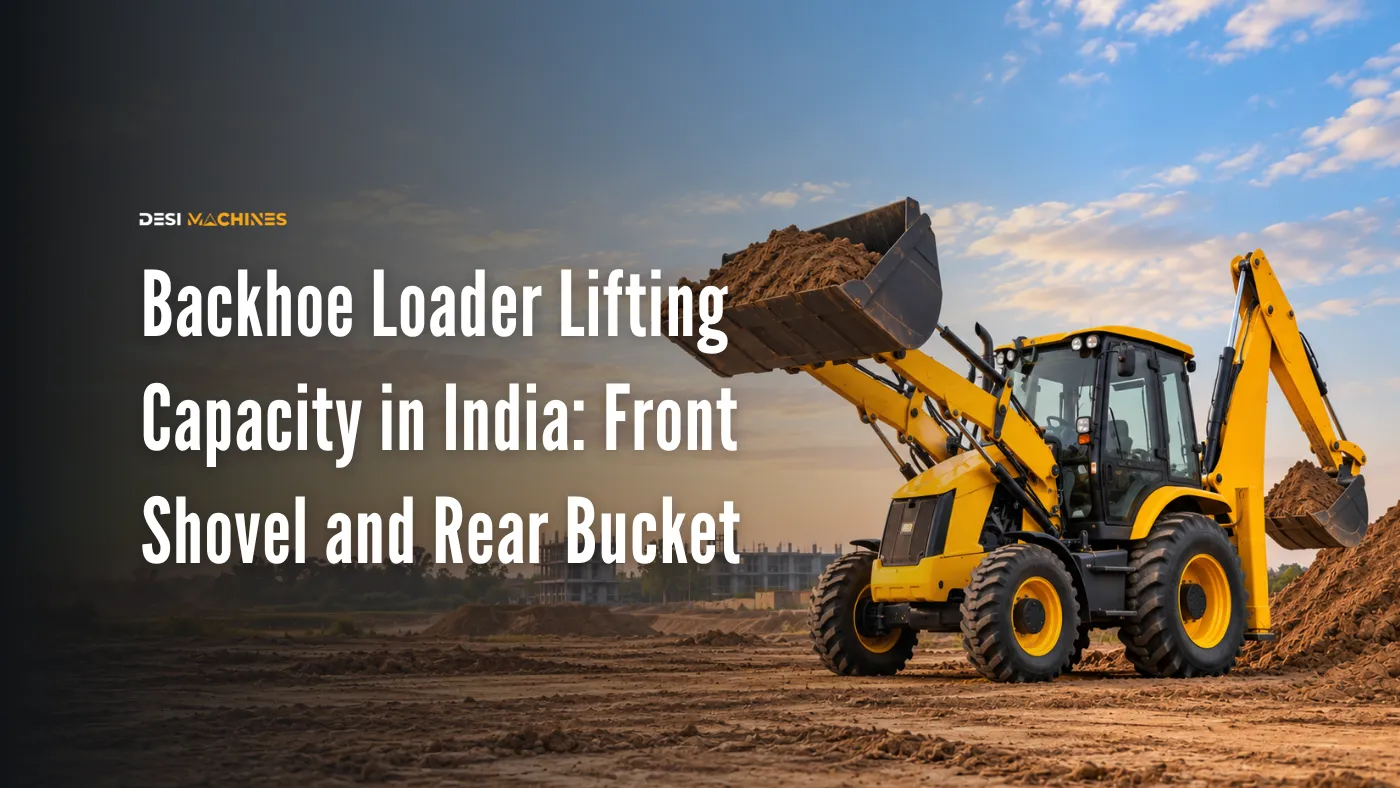
The backhoe loader lifting capacity is the weight a backhoe loader is rated to pick up and hold, and every machine publishes two separate figures for it: a payload for the front shovel and a maximum lift capacity for the rear digging arm. Across the 51 backhoe loaders listed on DesiMachines, the front shovel payload runs from 800 kg to 2,400 kg and the rear bucket lift figure runs from 1,400 kg to 2,547 kg, as published in September 2026.
Those are two different jobs done by two different ends of the same machine. The front shovel carries loose material and the odd heavy item across the site. The rear arm reaches out, picks something up and swings it into place, which is the closer thing to crane work.
Most buyers ask the question as one number. It is not one number, and the two figures do not move together. A machine with a strong front end can have an ordinary rear arm, and the other way round.
How much can the front shovel lift?
The front shovel figure is called maximum payload: the load the loader arms are rated to carry with the shovel. Forty of the 51 machines listed publish it, and the published span is 800 kg to 2,400 kg (0.8 to 2.4 tonnes).
The spread is narrower than that sounds. Eleven machines publish exactly 1,800 kg, and most of the rest sit between 1,800 kg and 2,000 kg. That cluster is the standard full-size backhoe loader sold in India, and it is what you should expect unless a spec sheet tells you otherwise.
The two ends of the range are worth knowing. The floor is the JCB 2DX at 800 kg, a genuinely smaller machine at 5,220 kg with a 0.60 m³ shovel, so a lower payload is what its size predicts. The ceiling is 2,400 kg, published by three Bull machines.
Payload and bucket volume are not the same thing, and this is where first-time buyers lose money. A 1.1 m³ shovel filled with dry sand and the same shovel filled with wet river gravel hold the same volume and weigh very differently. Volume tells you what fits. Payload tells you what the arms will carry. If you regularly load wet material or broken stone, the payload figure is the one that binds. Volume is a separate question, covered in backhoe loader bucket capacity and reach.
How much can the rear bucket lift?
The rear figure is published as maximum lift capacity, and it describes the digging arm working as a lifter rather than a digger. Thirty-nine of the 51 machines publish it, spanning 1,400 kg to 2,547 kg.
Here the spread is misleading until you look at the machines. Every machine except one sits between 1,400 kg and 1,685 kg. The single figure above that band is the JCB 4DX at 2,547 kg, which is also the only machine in the list that publishes anything close to it. We have checked that figure against both spec stores on the product record and they agree, so it is published data and not a typing error, but treat it as one machine’s claim rather than the top of a ladder.
Strip that one machine out and the honest reading is simple: a full-size backhoe loader in India lifts roughly 1.4 to 1.7 tonnes on the rear arm. Seven machines publish 1,400 kg, five publish 1,490 kg and five publish 1,554 kg, so the class is tightly bunched.
Three machines listed publish neither figure: the two BEML BL9H variants and the CAT 424. For those, ask the dealer for the load figures in writing before you plan any lifting work around them.
Why do so many machines show the same lift figure?
Seven machines publishing 1,400 kg and five publishing 1,490 kg is not a coincidence. Backhoe loaders in India are built around a small number of shared axle, boom and hydraulic packages, and several brands buy the same major assemblies. When the arm geometry and the hydraulic pressure are close, the rated lift comes out close.
Backhoe hydraulics on the machines listed run in a fairly tight pressure band, which is the other reason the numbers converge. That side is explained in hydraulic system maintenance.
The practical consequence: lift capacity is a poor way to choose between two full-size backhoe loaders, because most of them are rated within about 200 kg of each other. Dealer support, fuel burn and resale will separate the machines far more than the lift figure will. Those are covered in the backhoe loader guide.
Is the front shovel or the rear arm stronger?
On 48 of the 50 machines that publish both figures, the front shovel payload is the higher number. That matches how the machine is built: the loader arms work close to the machine over the front axle, while the rear arm reaches away from the machine, and reach costs capacity.
Two machines run the other way, and both are JCB. The 2DX publishes 1,490 kg on the rear against 800 kg at the front, and the 4DX publishes 2,547 kg against 1,800 kg. Read those as a reminder that the two numbers come off different tests rather than as proof that the rear end is stronger on those machines.
That is the caution worth carrying into any lift. The two figures are measured at different positions, and neither is a promise about what the machine will hold at full stretch.
What the lift figure on the sheet does not tell you
A published maximum is a best case. Three things reduce it on a real site.
Reach. A backhoe arm lifts most when the load is tucked in close and least when the arm is stretched out. The published figure is a single number with no radius stated beside it, so it does not tell you what the machine holds at the distance you actually need. Ask the dealer for the load chart, which is the table that gives capacity at each reach. Cranes publish these as a matter of course, and the guide to crane load charts explains how to read one.
Ground. Rated capacity assumes firm, level ground. On soft or sloping ground the machine can tip well before the hydraulics give up. Machine weight is what keeps it down, and that is set out in excavator and backhoe weight.
What is between the hook and the load. A chain, sling or hook rated below the load makes the machine’s capacity irrelevant. The weakest item in the chain sets the safe limit.
There is one more honest limit. A backhoe loader is a digging machine. Its arm is designed to pull material towards itself, not to hold a suspended load steady while people work under it.
Can a backhoe loader be used as a crane?
It is done on Indian sites every day, and it is the wrong tool for most of those jobs. A backhoe loader can place a pipe in a trench it has just dug, set a precast slab or shift a transformer across a yard. What it should not do is repeated overhead lifting, lifting over people, or any lift where the load has to be held while someone works beneath it.
The reasons are practical. There is no load chart on most machines, so nobody on site knows the real limit at the reach being used. There is usually no proper lifting eye, so loads get slung off the bucket teeth or the linkage, which is not what those parts are for. And a digging arm has no fine speed control at low load, so the swing is harder to stop precisely than a crane’s.
If the lift is heavy, repeated or over anything that matters, hire a machine built for it. A pick-and-carry crane is cheap to bring in for a day and it comes with a chart that tells you what it will hold. The same argument for excavators is set out in using an excavator as a crane, and the rules on who may operate the machine are covered in the JCB licence in India.
Backhoe loader lifting capacity by model
Figures below are as published on the product records in September 2026. A blank means the machine does not publish that figure.
| Machine | Front shovel payload | Rear bucket max lift | Machine weight |
|---|---|---|---|
| JCB 2DX | 800 kg | 1,490 kg | 5,220 kg |
| JCB 3DX | 1,650 kg | 1,490 kg | 7,200 kg |
| JCB 3DX Plus | 1,800 kg | 1,490 kg | 7,510 kg |
| JCB 3DX Xtra | 1,800 kg | 1,584 kg | 7,600 kg |
| JCB 4DX | 1,800 kg | 2,547 kg | 8,450 kg |
| CASE 770 NX | 1,925 kg | 1,417 kg | 7,600 kg |
| CASE 770 NX Magnum | 1,925 kg | 1,477 kg | 7,700 kg |
| CASE 770 EX Plus | 1,925 kg | 1,545 kg | 7,955-8,015 kg |
| CASE 851 NX | 2,050 kg | 1,477 kg | 7,800 kg |
| Mahindra Earthmaster SX | 1,800 kg | 1,449 kg | 7,517 kg |
| Mahindra Earthmaster SXE | 1,800 kg | 1,403 kg | 7,509 kg |
| Escorts Digmax II | 1,980 kg | 1,554 kg | 8,190 kg |
| Escorts Jungli HT | 1,980 kg | 1,554 kg | 8,400 kg |
| E-Kubota BLX75 | 1,880 kg | 1,554 kg | 7,850 kg (2WD) |
| ACE AX 130 | 1,850 kg | 1,490 kg | 7,500 kg |
| Bobcat B900 | 2,000 kg | 1,685 kg | 7,990 kg |
| Bull Grandia | 2,000 kg | 1,642 kg | 9,700 kg |
| Bull HD76 4WD | 2,400 kg | 1,400 kg | 7,850 kg |
| Bull SD76 BS4 Champion | 2,400 kg | 1,642 kg | 8,010 kg |
| Tata Hitachi Shinrai Prime | 1,920 kg | Not published | 8,120 kg |
| Manitou MBL 745 S | Not published | 1,460 kg | 7,405 kg |
Compare live backhoe loader models and prices and talk to a dealer before you commit to any lifting work.
What to check before you lift on site
Five checks, in the order that matters.
Know the weight of the load. Not a guess. A one cubic metre block of concrete is roughly 2.4 tonnes, which is above what any backhoe loader on this list is rated to lift on the rear arm.
Get the load chart. Ask the dealer for capacity at the reach you will work at, in writing. If nobody can give it to you, plan the job around a crane instead.
Check the ground. Level it, and keep the machine off soft edges and trench sides. Most tipping happens at the edge of a hole the machine dug itself.
Check the slings and hooks. Rated, marked, and not worn. Never sling off bucket teeth.
Keep people clear. Nobody under the load, nobody in the swing path. The operator should be able to stop the swing without hurrying.
Routine care keeps the hydraulics rated in the first place, and that is set out in the backhoe loader maintenance schedule and in backhoe loader parts.
Backhoe loader lifting capacity, in short
A backhoe loader in India carries roughly 1.8 to 2.0 tonnes in the front shovel and lifts roughly 1.4 to 1.7 tonnes on the rear arm, with one machine published well above that. The front figure is the higher one on almost every machine. Neither number tells you what the machine holds at full reach, which is why the load chart matters more than the headline.
Breakout force is the separate figure for how hard the machine pushes into material rather than what it can safely carry, compared model by model in backhoe loader breakout force.
If you are still choosing the machine itself, read the guides to backhoe loader engine power, dimensions and site access and backhoe loader productivity. If the job is really a loading job, compare a skid steer against a backhoe loader first.
Specifications are indicative, vary by variant, location and date, and should always be confirmed with the official OEM or authorised dealer before any purchase decision. DesiMachines is not liable for decisions taken on the basis of information that may have changed after publication.

