
 Excavator
294 models
Excavator
294 models  Backhoe Loader
51 models
Backhoe Loader
51 models  Crane
68 models
Crane
68 models  Concrete Mixer
79 models
Concrete Mixer
79 models  Wheel Loader
54 models
Wheel Loader
54 models  Compactor / Roller
45 models
Compactor / Roller
45 models  Motor Grader
42 models
Motor Grader
42 models  Dozer
41 models
Dozer
41 models  Concrete Pump
66 models
Concrete Pump
66 models  Skid Steer Loader
11 models
Skid Steer Loader
11 models  Telehandler
13 models
Telehandler
13 models 


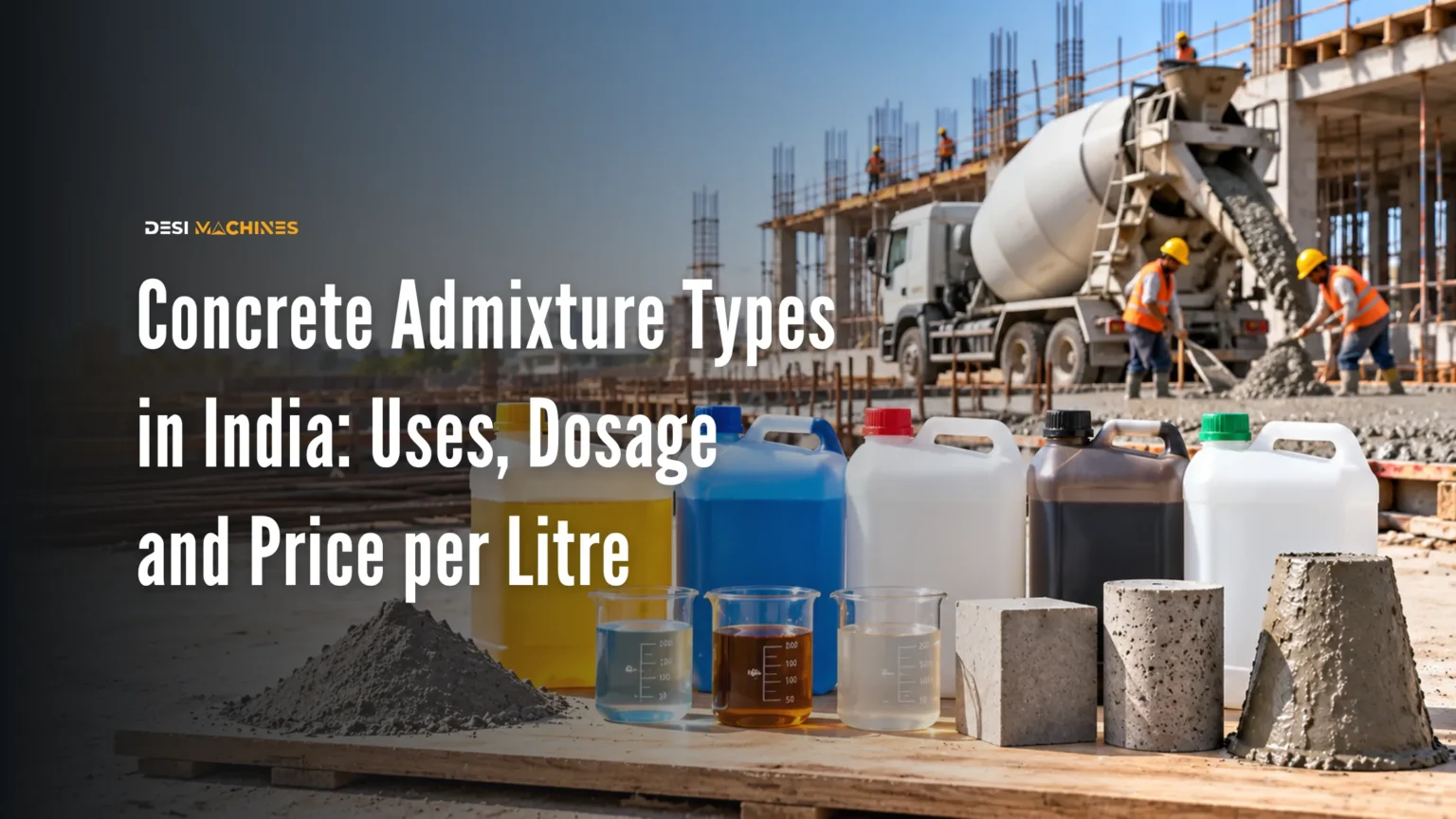
A concrete admixture is a chemical added to concrete while it is being mixed, to change how the concrete flows, sets or hardens. The Indian standard for them, IS 9103:1999, names five types: accelerating, retarding, water-reducing, air-entraining and superplasticising admixtures. Doses are small, usually a few hundred millilitres to about 3 litres per 100 kg of cement, and listed prices on IndiaMART on 29 September 2026 ran from about ₹32 to ₹95 per kg or litre for common plasticisers and superplasticisers.
Admixtures reach most sites in one of two ways: already in the load that a transit mixer brings from a batching plant, or added by the contractor to a site-mixed batch. This guide covers what each type does, how much goes in, what it costs and when a contractor would reach for which one.
What are the types of concrete admixtures?
IS 9103 defines an admixture as a material other than water, aggregate, cement, pozzolana, slag and fibre, added just before or during mixing. So fly ash and slag are not covered by it; IS 456 calls those mineral admixtures. The chemical types are these:
| Type (IS 9103) | What it does | What the standard asks of it |
|---|---|---|
| Accelerating | Speeds up setting and early strength gain | Faster set and higher early strength than plain concrete |
| Retarding | Delays setting, so concrete stays workable longer | Later set than plain concrete |
| Water-reducing (plasticiser) | Same flow with less water, or more flow with the same water | At least 5% less water for the same slump |
| Air-entraining | Puts tiny air bubbles in the concrete | Resistance to freezing and thawing |
| Superplasticising | Very high flow, or a large cut in water | At least 20% less water for the same slump; should be chloride-free |
IS 9103 also recognises a retarding superplasticiser, which keeps concrete flowing for longer and delays its set. Integral waterproofing compounds, sold in small packs at hardware shops, fall under a separate standard, IS 2645, which asks that they cut the water passing through a test mortar to less than half.
What does each admixture do in a transit-mixed or site-mixed pour?
Superplasticisers and plasticisers
These are the admixtures almost every ready-mix load carries. They let the plant keep the water-cement ratio low, which is what gives strength, while the concrete still flows down a chute or through a pump line. A transit mixer can then discharge a slump the pump crew can work with. Two chemical families are common: naphthalene-based (sold as SNF) and the newer polycarboxylate ether (PCE), which cuts more water at a lower dose and holds workability longer.
Retarders
A retarder buys time. It helps on long hauls from the plant, in summer heat, and on large continuous pours where fresh concrete must bond to the last layer before it sets. Without it, a delayed load can start stiffening in the drum.
Accelerators
An accelerator does the opposite. It is used in cold weather, for precast work where moulds must be reused quickly, and for urgent repairs. Older accelerators were based on calcium chloride, which corrodes steel reinforcement. IS 9103 requires makers to declare the chloride content, and IS 456 limits the total chloride in reinforced concrete, so use a product marked chloride-free for RCC.
Air-entraining admixtures
These matter where wet concrete freezes and thaws, which in India means high-altitude sites. On plains work they are rarely specified.
How much admixture is added per bag of cement?
Every maker gives a dose range on its data sheet and asks for trial mixes to fix the exact figure. These are the ranges printed by the makers for products sold in India:
| Type | Example product | Maker’s dose range | Per 50 kg bag |
|---|---|---|---|
| Accelerating | Fosroc Conplast NC | 1.5 to 3.0 litres per 100 kg cement | 750 ml to 1.5 litres |
| Retarding | Sika Plastiment VZ-1 | 0.2% to 0.6% of cement weight | 100 to 300 g |
| Water-reducing | Fosroc Conplast P211 | 0.4 to 0.8 litres per 100 kg cement | 200 to 400 ml |
| Superplasticiser (naphthalene) | Fosroc Conplast SP430 | 0.7 to 2.0 litres per 100 kg cement | 350 ml to 1 litre |
| Superplasticiser (PCE) | Master Builders Solutions MasterGlenium SKY 8233 | 0.5 to 1.5 litres per 100 kg cement | 250 to 750 ml |
| Integral waterproofing | Pidilite Dr. Fixit Pidiproof LW+ | 200 ml per 50 kg bag | 200 ml |
Measure the dose. Do not pour by eye. Most liquid admixtures are mixed into the gauging water or added with the last part of it, never straight onto dry cement. An overdose of a superplasticiser or retarder can delay setting by many hours or cause the mix to bleed and separate.
What does a concrete admixture cost in India?
These are new-product seller listings on IndiaMART, checked on 29 September 2026, mostly for 20 to 250 kg drums. Prices per kg and per litre are shown together, since most admixtures weigh 1.1 to 1.3 kg a litre. Listings that were clearly pack prices shown as per-kg figures, or raw chemicals meant for admixture makers, were left out.
| Type | Listed price (Sep 2026) | Notes |
|---|---|---|
| Plasticiser (water reducer) | ₹55 – ₹95 per kg or litre | Few listings carried a price |
| Superplasticiser, naphthalene type | ₹32 – ₹95 per kg or litre | Conplast SP430 listings at ₹43 – ₹52 per kg; a few listings up to ₹180 |
| Superplasticiser, PCE type | ₹44 – ₹300 per kg or litre (one listing at ₹600) | Widest spread; strength of the product varies a lot |
| Retarder | ₹35 – ₹60 per kg or litre | Two listings higher, at ₹250 and ₹450 |
| Accelerator | ₹40 – ₹200 per kg or litre | Seven listings |
| Integral waterproofing liquid | ₹70 – ₹198 per litre | Pidilite’s own price list: Dr. Fixit LW+ ₹165 for 1 litre, ₹5,680 for 50 litres (about ₹114 a litre) |
Per bag, the cost is small. At the Dr. Fixit dose of 200 ml a bag, the 200 ml pack at ₹37 covers one bag. A naphthalene superplasticiser at 0.5 litre a bag and ₹50 a litre adds about ₹25 per bag of cement. For ready-mix, the admixture is already in the price per cubic metre.
Which admixture should a contractor use?
- Pumping concrete, or a congested slab or column: a superplasticiser, so the mix flows without extra water. Pump lines choke when water is added on site instead, as the guide to concrete pump blockages explains.
- Long travel from the plant, or pouring in May and June heat: a retarder or a retarding superplasticiser.
- Winter pours in the north, precast yards, quick repairs: a chloride-free accelerator.
- Roof slabs, water tanks, basements and plaster: an integral waterproofing compound, on top of good compaction and curing.
- Ordinary site-mixed work where the mix is too stiff: a plasticiser, rather than more water.
If you are hiring a concrete pump or taking ready-mix, ask the plant which admixture is in the load and how long it stays workable. Do not add a second product on site without the plant’s say-so, since not every pair of admixtures works together.
Does an admixture change curing and shuttering times?
An admixture does not replace curing. A retarder or a mix with fly ash gains strength more slowly, and IS 456 asks for at least 10 days of curing on concrete with mineral admixtures or blended cement, as the slab curing period guide sets out. An accelerator speeds up early strength, but formwork should still come off only when cube tests from the same mix show the strength has been reached. The shuttering removal time guide explains the rule.
Which companies make concrete admixtures in India?
Sika, Fosroc, Master Builders Solutions (the MasterGlenium and MasterRheobuild ranges), Pidilite with its Dr. Fixit range, Chryso and MC-Bauchemie all sell admixtures here, along with many regional makers. Pick a product that states compliance with IS 9103 (or IS 2645 for integral waterproofing), declares its chloride content and gives a dose range, and run a trial mix with your own cement and sand.
For the other materials in the mix, see the guide to choosing cement type and grade and the full building materials guide. To compare the machines that carry and place the concrete, browse concrete mixers.
Prices, specifications and fitments are indicative, vary by maker, model, city and date, and should be confirmed with the manufacturer or an authorised dealer before buying. DesiMachines is not liable for decisions taken on the basis of information that may have changed after publication.
Machines, tenders and news for this industry: Ready-Mix Concrete · Building Construction