Excavator
294 models
Excavator
294 models  Backhoe Loader
51 models
Backhoe Loader
51 models  Crane
68 models
Crane
68 models  Concrete Mixer
79 models
Concrete Mixer
79 models  Wheel Loader
54 models
Wheel Loader
54 models  Compactor / Roller
45 models
Compactor / Roller
45 models  Motor Grader
42 models
Motor Grader
42 models  Dozer
41 models
Dozer
41 models  Concrete Pump
66 models
Concrete Pump
66 models  Skid Steer Loader
11 models
Skid Steer Loader
11 models  Telehandler
13 models
Telehandler
13 models 


“How many km will this tyre do?” is the first thing a tipper owner asks a tyre dealer, and the honest answer is: it depends on your truck. Tipper tyre life in km is set by the load on each tyre, the inflation pressure, the haul road and how well the rear duals are matched, so the same tyre can run very different distances on a highway job and in a quarry. Measure it on your own fleet, turn it into cost per km, and replace no later than the 1.6 mm tread-wear mark that BIS standard IS 15636:2012 requires on every commercial vehicle tyre.
Tyres are the running cost owners notice only when a set has to be bought. Diesel is paid every day, so it gets watched. A 6×4 tipper runs on ten tyres, two on the front axle and eight on the two rear axles, and a full change lands as one large bill. Spread over the km those tyres ran, though, it becomes a figure you can manage: rupees per km.
Why nobody can quote you a tipper tyre life in km
A tyre does not wear at a fixed rate. Four things set how fast it goes.
The load on each tyre. A tyre rated for a given load is built to run at that load, at the speed its maker specifies. Overload it and the casing runs hot, the tread scrubs and the life you get drops sharply.
The inflation pressure. An under-inflated tyre flexes more, heats up and wears on the shoulders. An over-inflated one wears in the centre and cuts more easily on sharp stone.
The road. A tipper running aggregate on a tarred highway and one hauling overburden on a broken quarry road are doing two different jobs. Sharp rock, wet haul roads and tight turns in a loading area take tread off fast and leave cuts that end a tyre early.
The pairing of the duals. On the rear axles, tyres run in pairs. If one tyre in a pair is smaller or softer than its partner, the other carries more than its share and wears out first.
So any single km figure you hear is someone else’s truck on someone else’s road. It can be a starting guess. It cannot be a plan.
What the BIS standard says about load and wear
IS 15636:2012, the Bureau of Indian Standards specification for pneumatic tyres for commercial vehicles, covers both diagonal (bias) and radial tyres. Three of its definitions matter to an owner more than anything in a brochure.
| Term in IS 15636 | What it means for you |
|---|---|
| Load index | One or two numbers. The higher one is for the tyre running single, the lower one for the same tyre running in a dual pair. Your rear tyres are duals, so the lower number is your limit. |
| Ply rating | An index of tyre strength tied to its maximum recommended load in a given service. It does not necessarily equal the number of cord plies inside the tyre. |
| Tread-wear indicators | At least six rows of raised marks in the main grooves. They show when the grooves are no longer more than 1.6 mm deep. |
Here is what the dual rating looks like in practice, from the standard’s own table for two common radial truck sizes.
| Tyre size | Load index, single / dual | Maximum load, single / dual |
|---|---|---|
| 295/80R22.5 | 152 / 148 | 3,550 kg / 3,150 kg |
| 315/80R22.5 | 156 / 150 | 4,000 kg / 3,350 kg |
Run the arithmetic for one rear axle with four 295/80R22.5 tyres in duals: four times 3,150 kg is 12,600 kg that the tyres are rated to carry on that axle. If a weighbridge slip shows more than that on the axle, the tyres are overloaded whatever the body volume allows, and their life will show it. The exact rating for your tyre is moulded on its sidewall. Read it there before you load.
How to measure tyre life on your own trucks
You need a notebook or a simple sheet, and the discipline to fill it in every time a tyre goes on or comes off.
| Record this | Why |
|---|---|
| Tyre serial number, brand, size and price paid | So you can tell one tyre from another when you compare |
| Truck number, axle and position (left or right, inner or outer dual) | Steer, drive and dual positions wear differently |
| Odometer reading at fitting and at removal | That difference is the tyre’s life in km |
| Main route or site while it was fitted | Highway and haul-road tyres should not be averaged together |
| Reason for removal | Worn to the indicators, cut, bulge, burst, or removed for a retread |
After one full change, you will know your own tipper tyre life in km by position and by route. After two, you will know which brand, which driver and which site is costing you money.
Turning a tyre price into cost per km
The useful number is the cost per km, not the price. Divide what you paid for the tyre, fitted, by the km it ran.
| Example | Tyre A | Tyre B |
|---|---|---|
| Price paid, fitted | ₹20,000 | ₹24,000 |
| Km run before removal | 40,000 | 60,000 |
| Cost per km | ₹0.50 | ₹0.40 |
| For ten tyres on the truck | ₹5.00 a km | ₹4.00 a km |
These figures are illustrative, chosen to show the method. They are not a quote for any brand or size. The point holds whatever the numbers: the dearer tyre can be the cheaper one per km. On a truck running 6,000 km a month, the gap in this example is ₹6,000 a month.
Put that tyre cost per km next to diesel, the driver and the instalment, and you have the running cost per km that decides whether a trip rate is worth taking. The full set of lines is worked through in dumper business profit per month.
What shortens tipper tyre life
Most early tyre deaths on tippers trace back to a handful of habits, and each one is cheaper to fix than a new tyre.
Loading by eye. A body filled to the top with wet sand or iron ore weighs far more than the same body of dry soil. Check the axle weights now and then, especially when the material changes.
Pressure checked only when a tyre looks low. Check cold, before the first trip, against the figure the tyre maker gives for your load. A dual pair with one soft tyre wears both.
Mismatched duals. Fit pairs of the same size, make and similar wear. A new tyre paired with a half-worn one carries more than its share.
Loading-area damage. Spinning the wheels on loose rock and turning on the spot under load tear the tread. A graded, drained loading area saves tyres, which is why mines keep a motor grader on haul-road duty.
Alignment and suspension. A bent axle, worn bushes or a misaligned steer axle show up as uneven wear on one edge. If one position keeps wearing badly, look at the truck before blaming the tyre.
Storing spare tyres
A spare that sits in the sun behind the yard office is ageing before it is fitted. IS 11178:2023, the BIS recommendations for storing and handling vehicle tyres, notes that rubber deteriorates with sunlight, heat, moisture and dirt, and that ozone from electrical discharge speeds that up. It says truck and bus tyres may be stacked so that the stack does not exceed 1.8 metres, kept off oily or dirty floors on clean wooden strips, and that outside storage is not recommended. Keep spares indoors, away from welding sets and motors.
When to replace, and when to retread
Replace a tyre no later than the point where the tread-wear indicators sit flush with the tread, which IS 15636 sets at grooves no more than 1.6 mm deep. Replace sooner for a cut that reaches the cords, a bulge or blister, sidewall damage or any separation.
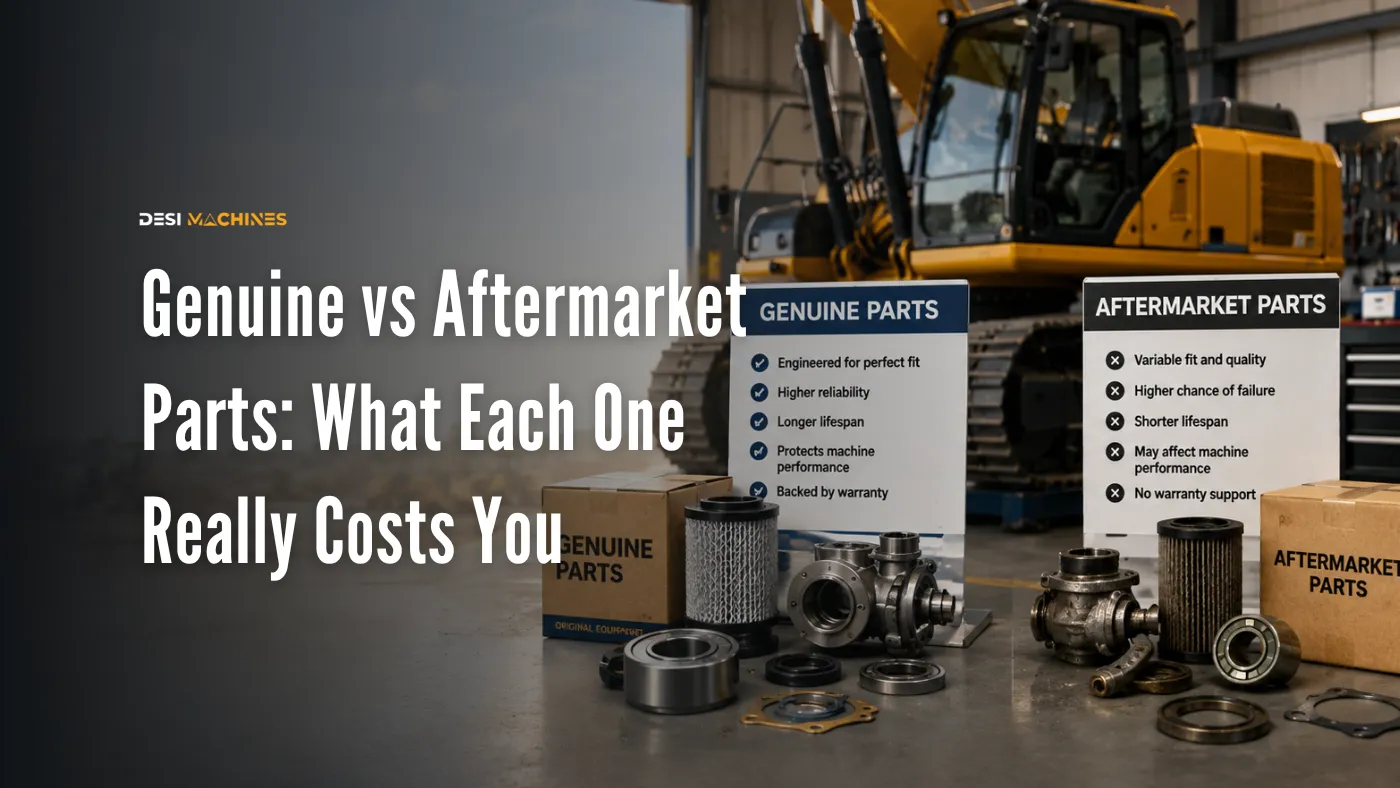
A casing that comes off in good shape still has value, because it can be retreaded. That is a separate decision with its own sums, and it only works if the casing was not ruined by overloading or running flat. If you are pricing tyres for a loader or backhoe on the same site, the construction machine tyre price guide covers those sizes, and whether to buy branded or cheaper parts is weighed in genuine vs aftermarket parts.
The bottom line
Tipper tyre life in km is a number you measure, not one you are given. Load each axle within the tyres’ dual rating, check pressure cold, keep duals matched, record every fitting and removal, and compare tyres by cost per km. When it is time for a new set, ask for the right size and load rating through tyres from a dealer near you, and if a fleet change is due all at once, see what equipment and vehicle finance can spread over the season.
Rates, specifications and prices change, and the ₹ figures in the example are illustrative only. Confirm the load rating and pressure for your exact tyre with the tyre maker, dealer or the vehicle OEM before deciding.