Excavator
294 models
Excavator
294 models  Backhoe Loader
51 models
Backhoe Loader
51 models  Crane
68 models
Crane
68 models  Concrete Mixer
79 models
Concrete Mixer
79 models  Wheel Loader
54 models
Wheel Loader
54 models  Compactor / Roller
45 models
Compactor / Roller
45 models  Motor Grader
42 models
Motor Grader
42 models 
 Concrete Pump
66 models
Concrete Pump
66 models  Skid Steer Loader
11 models
Skid Steer Loader
11 models 


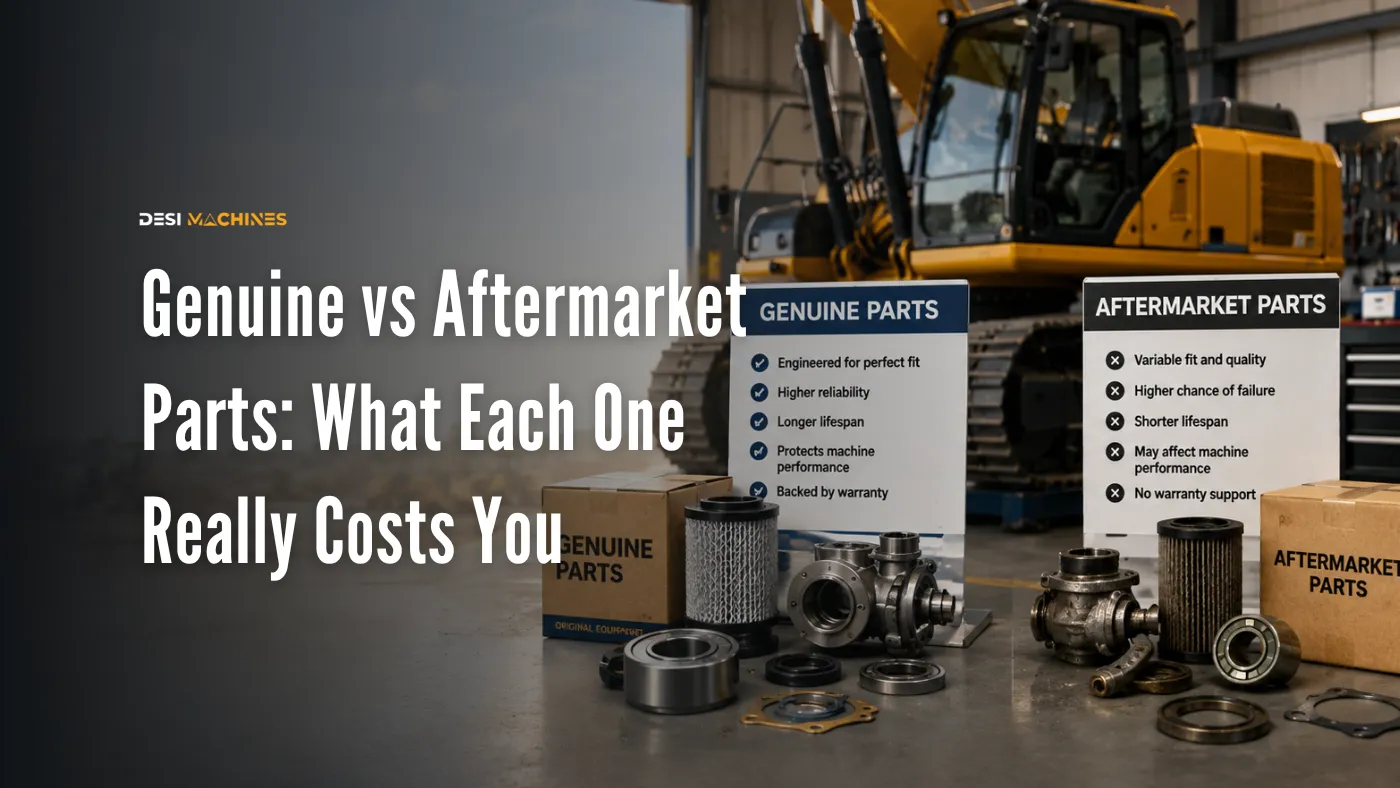
The genuine vs aftermarket parts argument is usually had over the price on the bill, which is the wrong number. The right one is cost per working hour — what the part costs divided by the hours it actually lasts, plus the downtime each change costs you. Judged that way, aftermarket usually wins on high-wear items like bucket teeth, cutting edges, hoses and batteries, and usually loses on engine internals, hydraulic pumps, electronics and anything still under warranty. And aftermarket is not the same thing as counterfeit: one is a legitimate brand, the other is a fake wearing someone else’s box.
Every owner has had the conversation at the parts counter. The genuine filter is one price, the one next to it is a fraction of that, and both look identical in your hand. The dealer says one thing, the mechanic says another, and the decision usually gets made on whichever number hurts less that week.
It deserves better than that, because parts are a running cost you pay for the entire life of the machine, and getting the policy right is worth more than winning any single purchase.
Genuine vs aftermarket parts: the three tiers, not two
Most of the confusion comes from collapsing three categories into two.
Genuine (OEM) parts are supplied by the machine’s manufacturer, in their box, with their warranty. Aftermarket parts are made by other manufacturers and sold under their own brand — some of them large, established firms that also supply components to OEMs. Counterfeit parts are fakes built to pass as genuine, complete with copied markings and packaging.
The third category is what gives the second a bad name. A branded aftermarket hose sold under its own name with its own warranty is a commercial choice you can evaluate. A fake bearing in an OEM-lookalike box is a different problem entirely, and the risks of fake excavator parts are worth reading separately. Everything below is about genuine versus legitimate aftermarket. Counterfeits are not a cost decision.
The only comparison that settles it
Price per part tells you nothing on its own. Divide by the hours the part lasts and the picture changes.
Take a set of bucket teeth as an illustration, using round numbers so the method is clear rather than the specific figures. Suppose a genuine set costs ₹12,000 and gives 900 hours, while an aftermarket set costs ₹7,000 and gives 600 hours.
| Illustrative comparison | Genuine | Aftermarket |
|---|---|---|
| Price of the set | ₹12,000 | ₹7,000 |
| Hours before replacement | 900 | 600 |
| Cost per working hour | ₹13.3 | ₹11.7 |
| Changes per 1,800 hours | 2 | 3 |
On that arithmetic the aftermarket set is genuinely cheaper to run, and the extra changeover is a couple of hours in the yard. Change one assumption — say the aftermarket set gives 400 hours instead of 600 — and its cost per hour rises to ₹17.5, which makes it the expensive option despite the smaller bill. The numbers above are illustrative, so run the same two lines with the prices your supplier quotes and the life your own operators report.
The step most owners skip is the third line: downtime. An extra replacement on a wear item you change in the yard costs little. An extra failure on something that strands the machine mid-shift is a different order of expense, which is why machine downtime costs belong in the comparison whenever the part sits somewhere awkward.
Where aftermarket earns its place
The case is strongest where parts wear predictably, get changed often, and fail visibly rather than suddenly.
Ground-engaging tools are the clearest example — bucket teeth, adapters, side cutters and cutting edges are consumed by the work itself, and a well-made aftermarket set doing 80% of the life at half the price is straightforward arithmetic. Hoses, batteries, general fasteners, lights and mirrors sit in the same bracket. Many owners also run aftermarket filters once the machine is out of warranty, though that is the point where the quality of the brand starts to matter more than the saving.
These are the same items that drive the year-on-year parts line in your excavator maintenance cost, so a sensible aftermarket policy on wear parts moves a real number rather than a trivial one.
Where the saving turns into a bill
Then there is everything the machine cannot work without.
Engine internals, hydraulic pumps and valves, transmission components, turbochargers, electronics and sensors — the parts where failure does not announce itself and the repair is measured in days off site. A hydraulic pump that fails early does not merely cost you a pump; it can push metal through the system and turn a component replacement into a rebuild. The saving on the original purchase disappears in the first hour of that conversation.
The undercarriage sits in an interesting middle. It is a wear item, but it is also the single largest parts expense on a tracked machine, and life varies enormously with the ground you work on — which is why the undercarriage cost breakdown is worth reading before you switch brands on the strength of one quotation.
If you are on the selling side of the counter, the same tiers decide your stock and your margin. The arithmetic is in JCB spare parts business: investment, stock and margin.
Warranty, AMC and the timing question
The decision is not permanent, and it should change as the machine ages.
While the machine is in warranty or under a dealer maintenance contract, genuine parts are the practical default. Fitting a non-genuine part does not automatically cancel a warranty, but it hands the OEM a reason to decline any claim linked to that part, and arguing the point costs you time you would rather spend earning. Keep the invoices either way.
Once the machine is out of cover, the calculation opens up. That is the right moment to start with one wear item, track the life your operators actually get from it, and expand only where the cost-per-hour sum holds up. Owners who switch everything at once rarely know which change helped and which one cost them.
Judge genuine against aftermarket parts by cost per hour
Genuine parts are not a premium you pay for a badge, and aftermarket parts are not a shortcut. They are two different bets on how long a component will last, and the only honest way to settle either one is cost per working hour on your machine, on your sites, with downtime counted.
Set the policy by part class rather than by loyalty: aftermarket where wear is predictable and failure is visible, genuine where a failure takes the machine off site. If you are still building the wider cost picture, our excavator cost of ownership breakdown and the cost per hour method put the parts line in proportion against fuel, finance and operator costs. Comparing machines before you buy is the other half of it — the current range of excavators and backhoe loaders differ in parts availability as much as in specification.
Rates, schemes, specifications and prices change — confirm current terms with the OEM, bank or insurer before deciding. The part prices and hours used above are illustrative arithmetic as of July 2026, not quoted prices.