
 Excavator
294 models
 Backhoe Loader
51 models
 Crane
68 models
 Concrete Mixer
79 models
 Wheel Loader
54 models
 Compactor / Roller
45 models
 Motor Grader
42 models

 Concrete Pump
66 models
 Skid Steer Loader
11 models


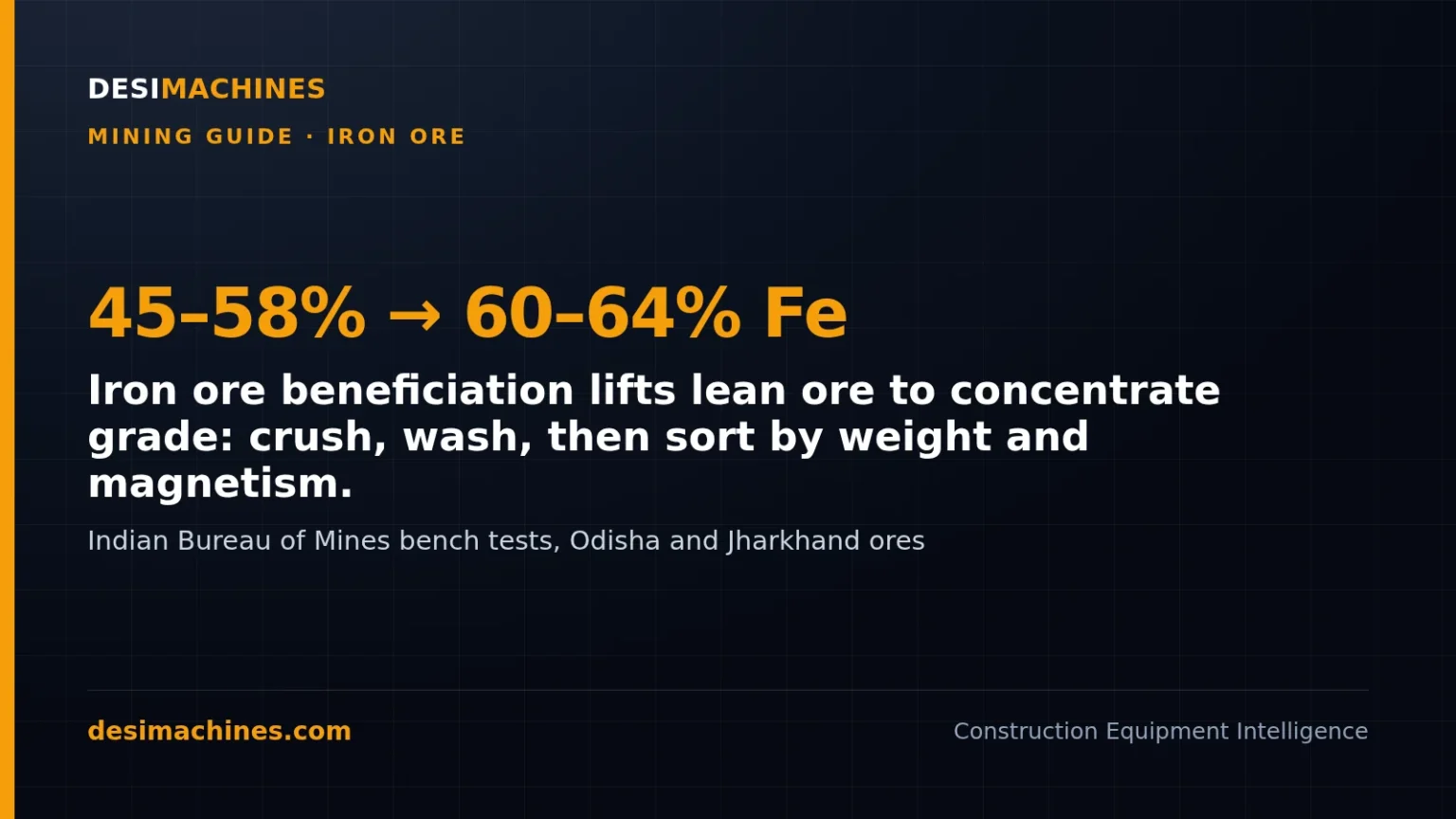
In bench tests the Indian Bureau of Mines (IBM) ran on iron ores from Odisha and Jharkhand, feed carrying 45 to 58 per cent iron came out as concentrate carrying 60 to 64.5 per cent. Iron ore beneficiation is the process that does this: the ore is crushed, sized and washed, then sorted by weight or by magnetism, so the iron minerals are kept and the clay, sand and alumina go to the tailings pond.
That gap matters. IBM’s own summary says marginal ore with 45 to 60 per cent iron, stacked fines below 10 mm and slimes in tailing ponds are locked up in dumps, holding hematite that cannot be used as it is.
This guide walks through the plant in the order the ore travels: what each stage does, which machine does it, how jigs, spirals and magnetic separators tell iron from waste, what grade and yield real Indian samples gave, and where the water and tailings go. It carries no rupee figures. Plant cost depends on tonnage and ore type, and it is a separate question from how the process works.
What is iron ore beneficiation?
Iron ore beneficiation is the physical upgrading of mined ore: the ore is broken, sized and separated so the share of iron in what is sold goes up. Nothing is melted. The plant only splits the rock into a richer part and a poorer part.
Iron ore is a rock, and only part of it is iron mineral. In Indian ore the iron minerals are mostly hematite (iron oxide, Fe2O3, about 70 per cent iron when pure), with goethite and limonite (iron oxides that hold water) and a little magnetite (Fe3O4, about 72 per cent iron). Everything else is gangue, the miner’s word for waste mineral. In the eastern belt the gangue is mainly quartz, which shows up in a lab report as silica, and clay and gibbsite, which show up as alumina.
A beneficiation plant makes two products. The concentrate is the richer part that goes to a pellet plant, sinter plant or steel works. The tailings are the waste, usually pumped as a muddy slurry to a pond.
Three numbers describe how well it worked:
Grade is the iron content, written Fe(T) for total iron, in per cent. Yield is how many tonnes of concentrate come out of every 100 tonnes fed in. Recovery is how much of the iron that went in ended up in the concentrate. A plant can always raise the grade by throwing more away. The skill is raising grade without the yield and recovery falling apart.
Why does Indian iron ore need beneficiation?
Because a lot of what is mined in India is too lean, too fine or too high in alumina to use straight from the pit.
High-grade lumps can go to a steel plant after crushing and screening. The rest piles up in three forms. The first is marginal or sub-grade ore, lumps carrying 45 to 60 per cent iron. The second is fines, the material below 10 mm that every crusher makes and that cannot be charged into a blast furnace as it is. The third is slimes, the very fine mud that older washing plants sent to tailing ponds along with the clay.
Alumina is the special problem in Odisha and Jharkhand. IBM lists gibbsite, boehmite, kaolinite and other clays, and some mica, as the minerals that carry it in eastern Indian ores. Alumina and silica do not turn into iron. In the furnace they become slag, and more slag means more fuel and flux for every tonne of hot metal. Beneficiation is how a miner turns those dumps and fines into something a pellet plant will take.
One more kind deserves a mention: blue dust, a soft powdery hematite found in the eastern belt. IBM describes it as loosely bonded and amenable to beneficiation, and it is fine enough that it goes straight to the wet stages.
The types of mines guide explains how the opencast pits that produce this ore are laid out.
What are the stages of an iron ore beneficiation plant?
Every plant is designed around its own ore, but most follow the same order. Dry stages first, to get the size right, then wet stages, to sort by density or magnetism, then water recovery at the end.
| Stage | Main equipment | What it does |
|---|---|---|
| 1. Feed | Excavators and dumpers in the pit, wheel loaders at the stockpile, a receiving hopper | Brings run-of-mine ore (ore as it comes out of the pit) to the plant at a steady rate |
| 2. Crushing | Jaw crusher (primary), cone crusher (secondary) | Breaks boulders down to a size the screens and washers can handle |
| 3. Screening | Vibrating screens, dry or with water sprays | Splits lumps from fines (below about 10 mm); clean lumps may be sold from here |
| 4. Scrubbing and washing | Drum scrubbers, log washers | Rubs off the clay coating that carries much of the alumina |
| 5. Classification | Hydrocyclones, spiral classifiers | Sorts the wet material by particle size and pulls out the slimes |
| 6. Gravity separation | Jigs (coarser fines), spirals and shaking tables (finer sizes) | Separates heavy iron mineral from lighter quartz and clay |
| 7. Magnetic separation | Wet high-intensity magnetic separator (WHIMS) for hematite; low-intensity drum separators for magnetite | Pulls iron mineral out of fine slurry with a magnetic field |
| 8. Grinding (some plants) | Ball mills | Grinds ore finer when iron and gangue grains are locked together |
| 9. Thickening and filtering | Thickeners, filter presses or disc filters | Takes water out of concentrate and tailings so it can be reused |
| 10. Tailings | Slurry pumps, pipeline, tailings pond | Stores the waste fines where the water can settle out |
Not every plant uses every stage. A simple washing plant may stop at stage 5. A plant treating lean fines for a pellet plant will add grinding and magnetic separation. The crushing stages work the same way as in a stone quarry, and the jaw, cone and VSI crusher guide explains what each crushing stage does.
Figure 1: how ore moves through a typical iron ore beneficiation plant (illustrative)
Read top to bottom. The last two boxes are where most of the water is won back.
How do jigs, spirals and magnetic separators sort iron from waste?
They use two differences between iron mineral and gangue: weight and magnetism.
Weight comes first. Hematite is about twice as heavy as quartz for the same size of grain, roughly 5.3 against 2.65 grams per cubic centimetre. Put both in moving water and the heavy grains sink faster and settle lower. Every gravity machine is a way of using that.
A jig is a tank where water is pulsed up and down through a bed of ore. On each pulse the bed lifts and settles again, and the heavy grains work their way to the bottom while the light ones ride on top and are skimmed off. Jigs suit the coarser fines; one of IBM’s samples was jigged at 1 to 10 mm.
A spiral is a curved trough wound round a centre column. Slurry runs down it. Heavy grains hug the inside of the curve and the light ones are thrown to the outside, and splitters at the bottom catch each stream. Spirals have no moving parts, which is why plants run them in long banks.
A shaking table is a sloped deck with ribs on it, shaken lengthwise while a thin film of water flows across. Heavy grains travel along the ribs to one end; light grains wash over the side. It is slower than a spiral but sharper on fine sizes.
Magnetism is the second difference. Magnetite is strongly magnetic and a simple low-intensity drum magnet picks it up. Hematite is only weakly magnetic, so it needs a wet high-intensity magnetic separator (WHIMS), which builds a much stronger field inside a matrix of steel plates or rods. The hematite sticks to the matrix while non-magnetic quartz and clay wash through.
Before any of this, the hydrocyclone does the sizing. Slurry is pumped into a cone-shaped chamber so it spins. Coarse grains are flung to the wall and leave at the bottom; the finest material, the slimes, leaves through the top with most of the water. That is how a plant decides which material goes to the jig, which to the spiral and which to the slimes circuit.
What grade and yield does beneficiation give on Indian ore?
The results below come from bench-scale tests (laboratory tests on samples, not a running plant) that IBM reported in a 2017 study of eastern Indian iron ores. They show how much the grade rises and how much of the tonnage is given up to get there.
| Sample (district) | Feed Fe(T) | Concentrate Fe(T) | Weight yield | Iron recovery | Process used |
|---|---|---|---|---|---|
| Tantra-Raikela-Bandhal mines, Sundargarh, Odisha | 56.18% | 64.48% | 34.6% | 39.3% | Jigging at 1 to 10 mm |
| Jilling mine, Keonjhar, Odisha | 51.49% | 62.93% | 28.8% | 35.1% | Jigging |
| Sanindpur, Keonjhar, Odisha | 53.50% | 62.38% | 32.4% | 38% | Grinding, tabling, WHIMS |
| Oraghat, Keonjhar, Odisha | 57.12% | 63.53% | 38.2% | 42.5% | Screening, jigging, tabling |
| Low-grade ore, Chaibasa, West Singhbhum, Jharkhand | 45.25% | 60.26% | 24.1% | 32.1% | Multi-gravity separator |
| Crusher-plant fines, Barpada, Keonjhar, Odisha | 58.15% | 64.22% | 63.5% | 69.7% | Gravity and magnetic separation |
Two things stand out. Every sample reached 60 per cent iron or better. And on the leaner samples, only a quarter to a third of the tonnage became concentrate. The rest went to tailings.
Here is the arithmetic, using the first row. Feed 100 tonnes at 56.18 per cent iron, and that is 56.18 tonnes of iron going in. The test gave 34.6 tonnes of concentrate at 64.48 per cent, which holds 34.6 × 0.6448 = 22.3 tonnes of iron. Divide 22.3 by 56.18 and the recovery comes to about 39.7 per cent, close to the 39.3 per cent IBM printed (the small gap is rounding in the assays). You can run the same check on any row: recovery = yield × concentrate grade ÷ feed grade.
That check is worth doing on any test report you are shown. Two rows in the IBM study do not pass it as printed, most likely a typing slip, so they are left out of the table above. If yield, grade and recovery do not agree with each other, at least one of them is wrong.
The last row is the most encouraging. Fines from an ordinary crusher plant, already at 58 per cent, gave up only about a third of their weight to reach 64 per cent with gravity and magnetic separation together. Richer feed is far easier to upgrade than lean feed.
The full set of results is in IBM’s beneficiation studies on iron ores of the eastern India sector, presented at Noamundi in August 2017.
Why can some iron ore not be upgraded by washing alone?
Because in some ores the alumina is locked inside the iron grains, and no physical process can pull it out.
IBM looked at eastern Indian samples under an electron microprobe, a microscope that maps which mineral sits where. In one ore it found specks of gibbsite only 2 to 20 microns across (a human hair is about 70 microns thick) sitting inside individual hematite grains. Its verdict on that ore was blunt: alumina cannot be reduced by physical separation. In other ores the gibbsite sat between the hematite grains, or mostly with the goethite, and finer grinding freed enough hematite to bring the alumina down.
The lesson for anyone planning a plant is to test the ore before choosing the machines. The same district can hold ores that wash easily and ores that never will, and the difference only shows under the microscope and in the test work.
What happens to the water, slimes and tailings?
Almost every wet stage runs on water, and most of it has to be won back.
The thickener is a large round tank where slurry is fed into the centre and allowed to settle. A slow rake moves the thickened mud to an outlet at the bottom, and clear water spills over the rim to be pumped back to the plant. Concentrate goes through a thickener and then a filter, so it reaches the pellet plant as a damp cake that can be handled and stockpiled.
Tailings go by pipeline to a tailings pond, an area closed in by an earth bund (embankment) where the fine solids settle and the water is drawn off the top. The pond grows every year, so its bund is raised in stages, usually with dozers and compactors spreading and rolling the fill. The slimes in older ponds are the same material IBM says still holds valuable hematite.
Water on a mine site is managed as one system. The mine dewatering guide covers how pit water is pumped, settled and released, and the same settling ponds often feed the plant.
Fine concentrate is usually made into pellets because a blast furnace needs gas to pass through its charge, and a heap of fines packs too tight to let it through. Balling the concentrate into pellets and hardening them by firing turns fine concentrate back into a furnace feed. IBM’s study names beneficiation together with pelletisation as the way to put India’s low-grade fines to use.
Which machines work in and around a beneficiation plant?
The plant itself is fixed equipment, but it lives on what the mobile machines bring it and take away.
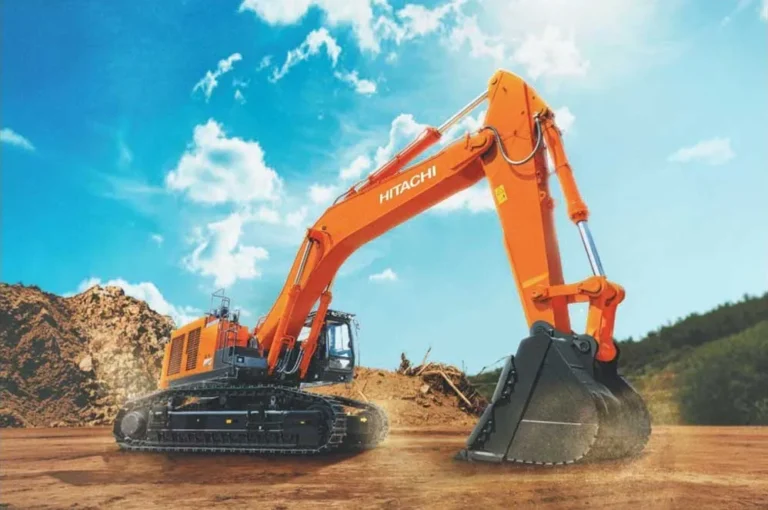
In the pit, mining excavators load the ore into dumpers. The shovel and dumper combination guide explains how the bucket size is matched to the truck. At the plant, wheel loaders build and reclaim the stockpiles, keep the hopper fed and load out the lump product. Dozers push up stockpiles and help raise the tailings bund.
| Machine | Job at an iron ore mine | Bucket capacity | Operating weight |
|---|---|---|---|
| Tata Hitachi ZAXIS 890LCH | Loading ore into dumpers at the face | 4.5 to 6.0 m³ | 84,300 kg (about 84 tonnes) |
| Volvo EC950E | Loading ore into dumpers at the face | 3.9 to 6 m³ | 89,960 to 91,840 kg (about 90 to 92 tonnes) |
| Tata Hitachi ZW 370-5A | Stockpile reclaim and hopper feeding at a larger plant | 4.8 to 8.5 m³ | 31,750 to 32,570 kg (about 32 tonnes) |
| Hyundai HL650I-V | Hopper feeding and load-out at a smaller washing plant | 3 m³ | 17,600 kg (about 17.6 tonnes) |
Iron ore is heavy for its bulk, so a loader bucket that is full by volume can be over its weight limit. Ask the dealer for the bucket that suits ore density, not the one for coal or soil. The full range of mining excavators and wheel loaders is listed with specs, and you can send an enquiry for the class your pit and plant need.
Beneficiation plants sit close to the ore. The IBM samples above come from Keonjhar and Sundargarh in Odisha and West Singhbhum in Jharkhand, and Chhattisgarh and Karnataka are the other big iron ore regions. The mining machinery page lists the machines, tenders and companies active in the sector.
Ore leaves the pit as overburden is stripped away, and the overburden removal guide shows how that is planned. For how the state charges for every tonne of ore that leaves a lease, read the guide to royalty on minerals. Every mining topic we cover is on the mining guide hub.
Planning the pit or stockyard side of an iron ore operation? Compare mining excavators by bucket and weight, and ask for a quote on the size that fits your dumpers.
Test results are quoted from the Indian Bureau of Mines study named above and describe laboratory samples, not plant performance. Machine figures are taken from our listings at the time of writing. Prices, specifications and features are indicative, vary by variant, location and date, and should always be confirmed with the official OEM or authorised dealer before any purchase decision. DesiMachines is not liable for decisions taken on the basis of information that may have changed after publication.
Machines, tenders and news for this industry: Quarry
