
 Excavator
316 models
 Backhoe Loader
54 models
 Crane
68 models
 Concrete Mixer
79 models
 Wheel Loader
54 models
 Compactor / Roller
45 models
 Motor Grader
42 models

 Concrete Pump
66 models
 Skid Steer Loader
11 models


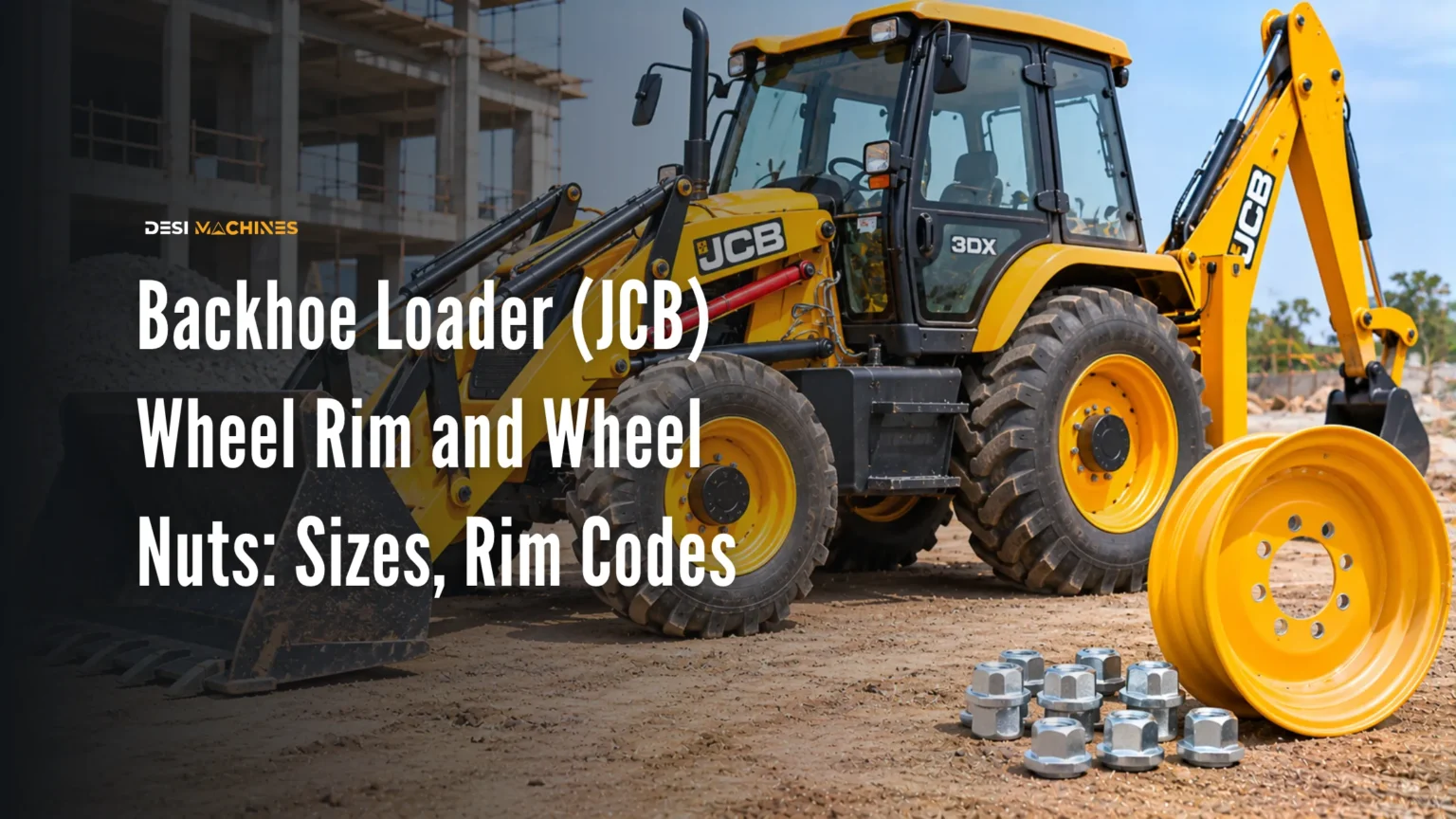
A backhoe loader runs two different wheel rims, not one. On the sizes Indian machines actually use, the front rim is 6 to 9 inches (152 to 229 mm) wide on a 16 or 18 inch wheel, and the rear rim is about 15 inches (381 mm) wide on a 28 inch wheel, so the two are not interchangeable. The wheel rim is the steel ring the tyre is mounted on, and it bolts to the axle hub through a ring of studs and nuts. A backhoe loader is the machine most people in India call a JCB, and the same rim questions come up on every wheeled machine on a site: pick-and-carry cranes, wheel loaders, motor graders, telehandlers, self-loading mixers and pneumatic rollers.
The tyre size tells you only the rim’s diameter. The rim has its own code, and that code carries the width and the profile. This guide sets out both, size by size and machine by machine.
What is the wheel rim on a backhoe loader, and what are its parts?
The rim is the steel ring between the tyre and the hub, and five of its parts matter when you order or inspect one. The rim base, or barrel, is the cylinder the tyre wraps around. At each end of it sits a flange, the raised edge that the tyre’s stiff inner edge, the bead, presses outwards against, and that pressure is what holds the tyre on. Just inside each flange is the bead seat, the narrow shelf the bead sits on, and rust or a dent there is what makes a tubeless fitment leak. The disc, or centre, is the plate welded into the base that carries the stud holes and bolts to the hub. One more hole takes the tube’s valve or the tubeless valve.
Rims come in two builds. A one-piece rim is pressed and welded as a single unit with both flanges fixed, and that is what a backhoe loader uses front and rear. A multi-piece rim has a base that mounts to the hub plus removable parts on one side, either a side ring or a side ring with a lock ring holding it in place, while the opposite flange stays fixed to the base. The big 25 inch earthmover sizes on wheel loaders and graders are built this way, because a 600 mm wide tyre cannot be levered over a fixed flange. For the parts a machine needs beyond the wheel end, the backhoe loader spare parts listing takes a requirement, and the backhoe loader parts and components guide explains what each assembly does.
Rim cross-section: where each part sits
rim width, flange to flange: the first number in the rim code
flange
bead seat
bead seat
rim base
disc with stud holes
lock ring and side ring
(multi-piece rim only)
Rim diameter is measured between the two bead seats, and it is the last number in the tyre size.
What rim size does a backhoe loader take, front and rear?
The rear rim is about 15 inches (381 mm) wide on a 28 inch (711 mm) wheel on almost every machine in the class, and the front rim is either 6.5 inches (165 mm) or 9 inches (229 mm) wide depending on whether the front axle is driven. The tyre sizes behind those rims are settled: of the 51 backhoe loaders listed on DesiMachines, 49 run a 16.9 x 28 rear tyre, 38 run the two-wheel-drive front size and 17 run the four-wheel-drive front size, as set out in the backhoe loader tyre size guide.
Put tyre size and rim together and the table below is the result: the rim column is what BKT publishes for each size on its backhoe loader and industrial patterns, with the alternatives the same sheets list.
Table 1. Backhoe loader tyre sizes and the rim each one calls for
| Position | Tyre size | Recommended rim | Rim width | Rim diameter | Alternative rim |
|---|---|---|---|---|---|
| Rear | 16.9 x 28 (49 of 51 machines) | DW 15 L | 15 in (381 mm) | 28 in (711 mm) | DW 14 L |
| Rear | 14 x 25 | 10.00/1.5 | 10 in (254 mm) | 25 in (635 mm) | none listed |
| Rear | 12 x 24 | 8.5 | 8.5 in (216 mm) | 24 in (610 mm) | 8.0 |
| Front, two-wheel drive | 9 x 16 (38 machines) | 6.50 H | 6.5 in (165 mm) | 16 in (406 mm) | 6.00 G |
| Front, four-wheel drive | 12.5 x 18, also written 12.5/80-18 (17 machines) | W 9 | 9 in (229 mm) | 18 in (457 mm) | 11 |
| Front, smallest machine | 7.5 x 16 | 6.0 | 6 in (152 mm) | 16 in (406 mm) | 6.5 |
This is a general guide based on machine size class. Always confirm the fit with your machine’s operator manual or the manufacturer before buying or fitting.
Two machines show how it reads in practice. The Mahindra Earthmaster SXE is a two-wheel-drive machine with a 9 x 16 – 16 PR front tyre, so its front rim is the 6.5 inch one. The Manitou MBL 745 Ranger is four-wheel drive and its specification names 12.5 x 18 – 12 PR fronts with 16.9 x 28 – 12 PR rears, which is a 9 inch rim at the front and a 15 inch rim at the back on one machine. The most asked-about machine in the class, the JCB 3DX, is listed in both two-wheel-drive and four-wheel-drive form, which is exactly why the front rim has to be read off the machine in front of you and not off the model name.
Because the front rim changes with the drive layout, a two-wheel-drive front rim will not carry a four-wheel-drive front tyre. It is too narrow and too small in diameter. What the front axle has to do is explained in the backhoe loader steering and front axle guide, and tyre sizes, grades and tube or tubeless choices sit with the backhoe loader tyres listing.
How do you read a rim code like DW 15 L or 6.50 H?
The first number in a rim code is the rim’s width in inches, measured flange to flange, and the letters name its profile. The diameter is not in the rim code at all: it comes from the last number of the tyre size. So DW 15 L on a 16.9 x 28 tyre is a 15 inch (381 mm) wide rim of the DW profile, on a 28 inch (711 mm) wheel.
The profile is the shape of the base and the flanges, and it is what decides whether a tyre’s bead will seat correctly. Four families turn up on Indian wheeled machines.
Table 2. Rim code families you will meet, and where
| Code looks like | How to read it | Where it is used |
|---|---|---|
| 6.50 H, 8.5, 7.5 | Width in inches, then a letter for the flange contour on the lettered ones | Truck-type rims: two-wheel-drive backhoe fronts, pick-and-carry crane wheels, roller wheels |
| W 9, DW 13, DW 15 L, DW 20 A | A profile letter group, then the width in inches, sometimes with a suffix letter | Agricultural-type rims: four-wheel-drive backhoe fronts, backhoe rears, pneumatic roller wheels |
| 8.00 TG SDC, 13 SDC, 10.00 VA SDC | Width in inches with a profile group and a further suffix | Motor grader wheels and telehandler wheels |
| 14.00/1.5, 19.50/2.5, 22.00/3.0 | Width in inches, then a flange code after the slash | 25 inch earthmover rims on wheel loaders and grader rears |
Watch for two things here. A rim code with no letters is still a complete code: an 8.5 rim is 8.5 inches wide. The same tyre size can also call for a rim from a different family depending on what the tyre was built for. A 14.9-24 is listed against a DW 13 rim on a backhoe pattern and a W 13 rim on a tractor pattern, same width, different profile. Read the rim off the data sheet for the tyre you are actually buying, not off a general chart. For what the numbers on the tyre itself mean, the OTR tyre code guide covers section width, construction letter and ply rating.
How wide should the rim be for the tyre on it?
There is no single fraction that works across machines, and that is the most common mistake made when someone tries to reason a rim width out from the tyre. Taking BKT’s published recommended rims against its own published section widths across 35 tyre-and-rim pairings on these patterns, the rim comes out at anywhere between 56 and 85 percent of the tyre’s width, and which end you land on depends on the rim family, not on the machine’s size.
Table 3. Rim width as a share of the tyre’s section width, by rim family
| Rim family | Rim width as a share of tyre section width | Example |
|---|---|---|
| Motor grader TG rims | 56 to 60 percent | 13.00-24 tyre, 340 mm wide, on an 8.00 TG SDC rim |
| Truck-type rims | 67 to 70 percent | 11.00-20 tyre, 300 mm wide, on an 8.0 rim |
| Wide-base low-profile rims | 78 to 82 percent | 16.0/70-20 tyre, 405 mm wide, on a 13 SDC rim |
| 25 inch earthmover rims | 79 to 84 percent | 23.5-25 tyre, 595 to 610 mm wide, on a 19.50/2.5 rim |
| Agricultural DW rim, backhoe rear | 85 percent | 16.9-28 tyre, 450 mm wide, on a DW 15 L rim |
A pair of fitments sits outside its family and is worth naming rather than averaging away: a 14.00-25 on a 10.00/1.5 rim works out at 68 percent, and an 18.00-25 on a 13.00/2.5 rim at 65 percent. Both are deliberate narrow-rim fitments, one on a loader pattern and one on a grader pattern.
Respecting that figure matters. A rim narrower than the tyre was designed for lets the sidewalls bulge and flex, which builds heat and shortens the casing’s life. A wider one stretches the bead area and leaves the sidewall less protection against a kerb or a rock. The casing was engineered around one rim width, and the maker publishes it.
Which rim fits which wheeled machine?
Rim width rises with machine class, and from a skid steer to the largest wheel loader it nearly trebles. The table runs machine class, then the tyre size those machines publish, then the rim that size calls for. Every make sold in India sits in the same rows: ACE, Bull, CASE, CAT, BEML, Escorts, JCB, Mahindra, Manitou and Tata Hitachi build to the same tyre and rim sizes, because the sizes come from the tyre standards and not from the machine maker.
Table 4. Tyre size and rim by machine class
| Machine class | Tyre size on the machines listed | Recommended rim | Rim width |
|---|---|---|---|
| Skid steer loader | 10 x 16.5 | 8.25 | 8.25 in (210 mm) |
| Skid steer loader, wider fitment | 12 x 16.5 | 9.75 | 9.75 in (248 mm) |
| Backhoe loader, front (four-wheel drive) | 12.5/80-18 | W 9 | 9 in (229 mm) |
| Backhoe loader, rear | 16.9 x 28 | DW 15 L | 15 in (381 mm) |
| Pick-and-carry crane, front | 11.00 x 20 | 8.0 | 8 in (203 mm) |
| Pick-and-carry crane, rear | 14.00 x 25 | 10.00/1.5 | 10 in (254 mm) |
| Self-loading concrete mixer, larger drums | 16.0/70-20, also written 405/70-20 | 13 SDC | 13 in (330 mm) |
| Telehandler, front | 13.00 x 24 | 8.00 TG SDC | 8 in (203 mm) |
| Motor grader, front | 13.00 x 24 | 8.00 TG SDC | 8 in (203 mm) |
| Motor grader, rear | 17.5 x 25 | 14.00/1.5 | 14 in (356 mm) |
| Wheel loader, 15 to 30 tonne | 17.5 x 25 | 14.00/1.5 | 14 in (356 mm) |
| Wheel loader, larger | 23.5 x 25 | 19.50/2.5 | 19.5 in (495 mm) |
| Wheel loader, largest | 26.5 x 25 | 22.00/3.0 | 22 in (559 mm) |
| Pneumatic roller and soil compactor | 23.1 x 26 | DW 20 A or DW 20 B | 20 in (508 mm) |
This is a general guide based on machine size class. Always confirm the fit with your machine’s operator manual or the manufacturer before buying or fitting.
A note on three of these classes. A pick-and-carry crane carries four front wheels and two rear, so its narrower rim is the one you need four of. A motor grader runs the narrowest rim relative to its tyre of any machine here, which is why grader rims carry their own TG profile, and sizes by grader class are in the motor grader tyre size guide. Self-loading mixers switch rim width at about a 4.0 cubic metre drum, which the self-loading mixer tyre size guide covers by model.
What size are the wheel nuts, and how tight should they be?
Both figures are machine-specific and both come from your operator manual, because the nut size and the torque are set by the hub and the studs rather than by the tyre or the rim. Nothing in a tyre or rim code tells you either one.
What makes a rim fit a particular hub is the bolt pattern, written as a stud count and a PCD, short for pitch circle diameter. The PCD is the diameter of the imaginary circle drawn through the centres of all the stud holes. A rim with the right width and diameter but the wrong PCD will not go on, and there is no way to adapt it safely. Backhoe loader specifications on DesiMachines do not publish stud count or PCD, so the numbers to work from are the ones in the manual or stamped on the rim itself. The same applies to the socket you will need, which is sized across the flats of the nut and is not the same number as the stud thread.
On torque, there is a standard worth knowing about. IS 13941:1994, the Bureau of Indian Standards specification for automotive wheel fasteners and hub caps, requires in clause 2.1 that a wheel fastener survive being fully tightened and loosened 20 times at a torque 30 percent above the manufacturer’s recommendation without showing any sign of crack, fracture or breakage. Read that the right way round: the nut is engineered with a margin above the maker’s figure, and that figure is still the one to use. Treating the margin as headroom to pull harder is how studs stretch and snap.
Three habits prevent most wheel-end trouble. Tighten in a cross or star pattern, not round the circle, so the rim pulls down evenly onto the hub. Work in stages with a torque wrench, not a long bar and bodyweight. Re-check the nuts a few hours after any wheel change, because a new seating settles. A nut that keeps loosening after that means damage: a stretched stud, an oval stud hole, or a bent rim that no longer sits flat on the hub.
Why does a rim crack, bend or leak air?
A rim fails for mechanical reasons, and almost all of them are load, pressure or looseness. Running the tyre under-inflated is the biggest one: the sidewall flexes further on every revolution and works the bead against the flange until the bead seat is damaged. Overloading does the same thing faster. Loose wheel nuts let the rim shift on the studs, which wears the stud holes oval and eventually cracks the disc around them. Impact does the rest: a kerb or a rock catching the flange bends it just enough that the bead no longer seals. On tubeless fitments, rust and scale in the bead seat is a slow leak that no amount of re-inflating will cure.
One rule here is not negotiable. The United States Tire Manufacturers Association’s demounting and mounting procedures of August 2023 state that a tyre must not be fitted to a rim with cracks, significant distortion, signs of fracture or evidence of welded repairs, and that a rim which is damaged, cracked, broken or bent cannot be reworked, welded or otherwise heated: it has to be replaced. The same document puts it plainly, never rework, weld, heat or braze the rim of a tyre, rim or wheel assembly. A welded rim can let go under inflation pressure, and the energy stored in a 28 inch wheel is enough to kill. A multi-piece rim is more dangerous still, which is why those procedures and the matching US workplace rule, OSHA 1910.177 on servicing multi-piece and single-piece rim wheels, both require a safety cage and that nobody stand in the assembly’s path.
When a tyre on a sound rim is the problem rather than the rim, the choice between repairing, fitting a tube and replacing is worked through in the backhoe loader tyre puncture guide.
What makes one rim cost more than another, and what to check before ordering
Size is the biggest driver, because a rim is mostly steel and a 15 inch wide, 28 inch rear rim holds several times the steel of a 6.5 inch front one. After that comes the build, since a one-piece rim is simpler than a multi-piece rim with a side ring and lock ring, then steel thickness and grade, which separates a rim meant for loader duty from one meant for road travel. Profile matters too: a plain truck contour is made in volume while a grader TG or a 25 inch earthmover profile is not. Tubeless fitments need a better finish on the bead seat. Condition and freight finish the list, and a reconditioned rim is not the same item as a new one. Pricing itself is a dealer matter.
Before you order, note five things: the tyre size moulded on the sidewall, the rim code stamped on the rim, the stud count and PCD from the manual, tube-type or tubeless, and one-piece or multi-piece. With those five a dealer can match the part first time. For what moves the price of the tyre that goes on it, see the construction machine tyre price guide, and the wider parts and running costs guides cover the rest of the machine.
Comparing machines rather than parts? Browse the full range of backhoe loaders and ask a dealer to confirm the wheel-end specification for the exact variant.
Rim data in the tables above is BKT’s published recommended and alternative rim for each size, from its XL GRIP (BHL) technical data and its industrial, loader, grader and agricultural pattern sheets; the tyre sizes are those published by the machines listed on DesiMachines at the time of writing. Specifications are indicative, vary by variant, location and date, and should always be confirmed with the official OEM or authorised dealer before any purchase decision. DesiMachines is not liable for decisions taken on the basis of information that may have changed after publication.
Get a wheel rim price from a dealer near you
Tell us your machine and what you need, and we will ask the nearest dealer to reach out to you with a price.