Excavator
294 models
Excavator
294 models  Backhoe Loader
51 models
Backhoe Loader
51 models  Crane
68 models
Crane
68 models  Concrete Mixer
79 models
Concrete Mixer
79 models  Wheel Loader
54 models
Wheel Loader
54 models  Compactor / Roller
45 models
Compactor / Roller
45 models  Motor Grader
42 models
Motor Grader
42 models  Dozer
41 models
Dozer
41 models  Concrete Pump
66 models
Concrete Pump
66 models  Skid Steer Loader
11 models
Skid Steer Loader
11 models  Telehandler
13 models
Telehandler
13 models 


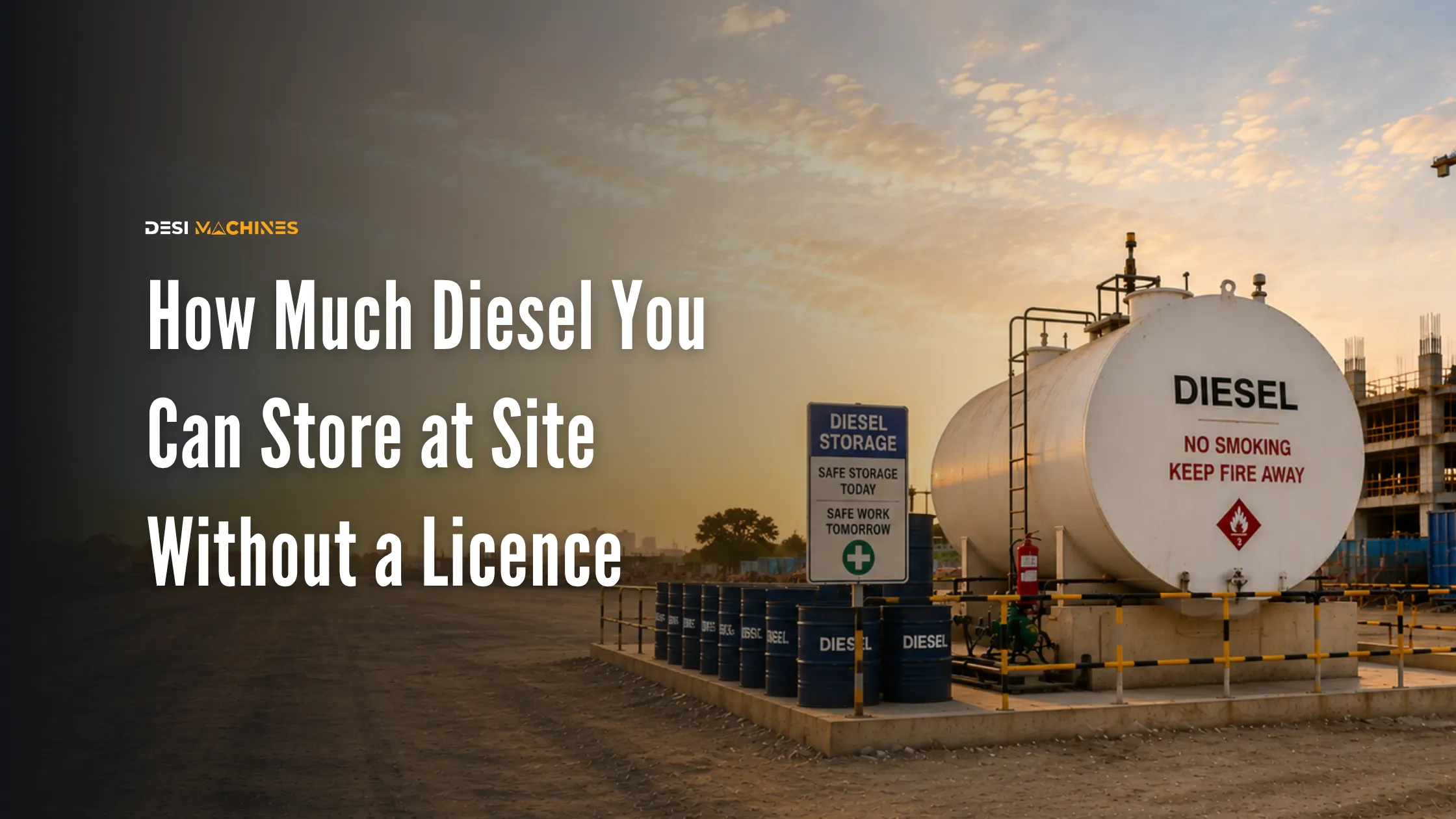
You do not need a diesel storage licence for the first 2,500 litres at any one place, provided no single container holds more than 1,000 litres. That comes from Section 7 of the Petroleum Act, 1934, and both conditions have to be satisfied together. Diesel in the machine’s own tank does not count. Cross either limit and you are into a licence under the Petroleum Rules, 2002, issued by the explosives licensing authority, not by the RTO or the local municipality.
A site tank is one of those things that appears without anyone deciding on it. The job is forty kilometres from the nearest pump, the machines burn more in a day than a jerrycan run can keep up with, so a barrel arrives. Then a second one. Then somebody suggests a proper tank.
Nobody asks what the legal line is until an inspector, a client’s safety audit, or an insurer asks first. It is worth knowing before that, because the line is specific and it is not where most owners guess.
Where the diesel storage licence rule actually comes from
Fuel storage in India is governed by the Petroleum Act, 1934 and the Petroleum Rules, 2002 made under it. This is a central law administered by the explosives establishment, which is why your RTO, your municipal office and your labour department all have nothing useful to say about it.
The Act sorts petroleum into three classes by flash point, which is the lowest temperature at which the liquid gives off enough vapour to flash when ignited:
| Class | Flash point | Typical fuel |
|---|---|---|
| Petroleum Class A | Below 23°C | Petrol |
| Petroleum Class B | 23°C and above, below 65°C | High speed diesel, kerosene |
| Petroleum Class C | 65°C and above, below 93°C | Heavier oils |
High speed diesel is petroleum Class B. That single classification decides every number that follows, and it is why advice written about petrol storage, or about heavy furnace oil, will give you the wrong figure.
One more line is worth knowing. Section 11 takes petroleum with a flash point of 93°C and above outside this part of the Act altogether. Some lubricants and heavy oils sit there. Diesel does not.
The 2,500 litre limit, and the trap inside it
Section 7 of the Act says that a person need not obtain a licence for the transport or storage of petroleum Class B if:
- the total quantity in his possession at any one place does not exceed 2,500 litres; and
- none of it is contained in a receptacle exceeding 1,000 litres in capacity.
Read the second condition again, because it is the one that catches people. It is not a total-volume rule with a container note attached. Both conditions must hold at the same time, and the container limit is where a well-intentioned upgrade goes wrong.
| What you have on site | Within the exemption? | Why |
|---|---|---|
| Twelve 200 litre barrels (2,400 litres) | Yes | Under 2,500 total, no container over 1,000 |
| Two 1,000 litre bowsers (2,000 litres) | Yes | Under both limits |
| One 2,000 litre tank | No | Total is fine, but the container exceeds 1,000 litres |
| Fifteen 200 litre barrels (3,000 litres) | No | Containers are fine, but the total exceeds 2,500 |
The phrase at any one place matters too. Two sites forty kilometres apart are two places. A single yard where the barrels are split between one shed and one corner is one place, and the quantities add up.
There is a reason the Rules cap container size rather than leaving it to total volume. Under the Petroleum Rules, 2002, a “tank” means a receptacle for petroleum exceeding 1,000 litres in capacity. So the moment you put in a container above that size, you are no longer storing fuel in drums — you are operating a tank, and the Rules treat that as a different activity.
The fuel in your machine does not count
This is the exemption owners most often miss, and it is generous. Section 9 of the Act says the owner of a motor conveyance who complies with the law on registration and licensing of that conveyance and its driver, and the owner of any stationary internal combustion engine, does not need a licence for petroleum contained in a fuel tank incorporated in the conveyance or attached to the engine.
Practically: the 400 litres sitting in your backhoe loader’s tank is not part of your stored quantity. Nor is the fuel in the tank attached to your site generator. Only what you are storing counts.
That changes the arithmetic on a mid-sized site more than people expect. A four-machine fleet can be carrying well over a thousand litres in its own tanks before a single barrel is opened, and none of it counts against the 2,500.
Note the condition attached, though. The exemption for a motor conveyance is tied to the machine being lawfully registered with a licensed driver. If your machine is one that should be on the register and is not, you are relying on an exemption whose condition you do not meet. Whether your machine has to be registered at all is worked through in our note on construction equipment registration at the RTO.
What a licence involves once you cross the line
Above the exemption, storage happens under a licence granted under the Petroleum Rules, 2002. Rule 141 provides that licences are granted by the licensing authorities set out in the First Schedule to those Rules, in the forms specified there and on payment of the fee specified there. For the storage categories relevant to a site, that authority is the Chief Controller of Explosives or a Controller authorised by him — the explosives establishment, not a local body.
Two features of the licensing regime are worth knowing before you start:
The form follows the manner of storage. Storing in a tank is a different licence from importing and storing otherwise than in bulk. The Schedule sets thresholds for each — for Class B stored otherwise than in bulk, the licensed category begins above 25,000 litres — and the fee scales with the quantity, calculated per kilolitre with a floor and an annual ceiling.
Licences expire on a calendar, not an anniversary. Rule 142 provides that every licence other than the two short-term forms remains in force until the 31st day of December of the year for which it is granted or renewed. A licence granted in October is not a twelve-month licence. Budget the renewal against the calendar year end.
Alongside the licence sit the storage conditions themselves — approved containers, hazardous-area classification around the storage point, restrictions on hot work nearby. Those apply to how you store, and they are worth reading whether or not you need a licence, because an insurer assessing a fire claim will ask about them. If you are reviewing your cover at the same time, our note on construction equipment insurance sets out what the standard policies actually respond to.
Storing legally is not the same as storing safely
The licence threshold answers one question only: whether the state needs to know about your fuel. It says nothing about whether the fuel will still be there next week.
Owners who go through the trouble of a compliant tank and then lose 8 to 10 percent of throughput to pilferage have solved the smaller problem. The measures that actually protect the fuel — metered dispensing, reconciliation against machine hours, controlling who holds the key — are set out in our note on how to stop diesel theft, and they are worth more to the monthly account than the licence question ever will be.
The same reconciliation does a second job. If you know what each machine should burn per hour, an unexplained gap is visible in days rather than months. Our working figures for that sit in excavator fuel consumption per hour.
A five-minute check on your own yard
Walk the site with these four questions:
Add up every container. Barrels, the bowser, the spare tank behind the shed. Storage at one place is cumulative, and it is the total that is tested, not the largest single item.
Check the biggest container’s capacity, not its contents. The Act caps capacity. A 1,500 litre tank holding 600 litres of diesel still breaches the container condition.
Exclude the machines. Fuel in a machine’s own tank, and in the tank attached to a stationary engine, sits outside the calculation under Section 9.
Decide before you upgrade. The most common way an owner leaves the exemption is by replacing several barrels with one neat tank. That single decision moves you from a regime with no licence to one with a licence, an authority and an annual renewal.
How much diesel can you store without a licence?
The number to remember is 2,500 litres, with no single container above 1,000 litres, and the fuel in your machines sitting outside the count entirely. For most single-machine and small-fleet owners, that is a comfortable amount of headroom — enough to run a remote site for a week without any paperwork at all.
The owners who get caught are rarely the ones storing recklessly. They are the ones who tidied up: swapped a row of drums for a proper tank, put it on a plinth, and crossed a line they did not know was there.
If fuel logistics is what is driving the decision, the underlying question is usually machine productivity rather than storage. Compare excavator models and prices and backhoe loaders to see what a newer machine would do to your consumption per hour, and connect with a dealer before committing capital to a bigger tank.
Rates, schemes, specifications and prices change — confirm current terms with the OEM, dealer, bank or insurer before deciding. Statutory quantities and licensing requirements are summarised here from the Petroleum Act, 1934 and the Petroleum Rules, 2002 as they stood at the time of writing; confirm the current position with the licensing authority or a qualified professional before you rely on it.