Excavator
294 models
 Backhoe Loader
51 models
 Crane
68 models
 Concrete Mixer
79 models
 Wheel Loader
54 models
 Compactor / Roller
45 models
 Motor Grader
42 models
 Dozer
41 models
 Concrete Pump
66 models
 Skid Steer Loader
11 models
 Telehandler
13 models


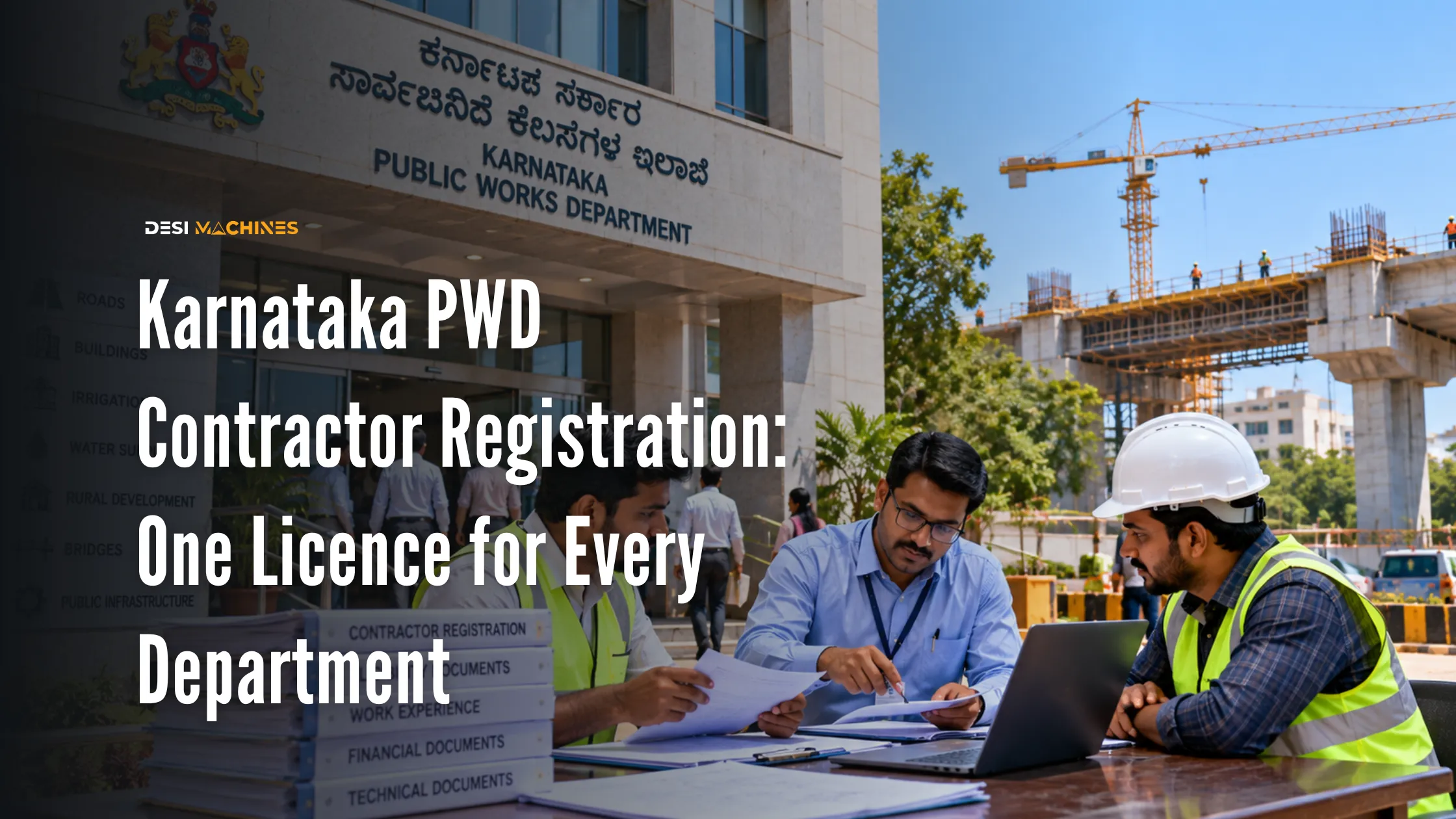
Karnataka PWD contractor registration, which the department and its contractors usually call a licence, runs under Chapter 19 of the Karnataka Public Works Departmental Code, 2014. There are four classes: Class I can tender for works of any amount, Class II up to Rs 5 crore, Class III up to Rs 2 crore and Class IV up to Rs 25 lakh. Each needs one completed work and a five-year turnover sized to the class, plus a solvency certificate. The registration fee is Rs 2,000 to Rs 10,000, the licence lasts five years, and one PWD registration covers the works of every state department in its area. Since 18 February 2025, Class I and II contractors also get a GST-linked unique number and a QR code licence.
Rs 5 crore and Rs 15 crore. Those are the two numbers between a contractor and Class I in Karnataka: one finished work of at least Rs 5 crore, and turnover of more than Rs 15 crore over the preceding five years. Everything else in the rule book is easier to arrange than those two.
The good news is what you get for it. Karnataka runs one list. In many states the irrigation department, the rural works wing and the PWD each keep their own register, as our guide to irrigation department contractor registration shows. Karnataka’s Code says a PWD registration is valid for all government departments and undertakings in its jurisdiction, and no separate registration is needed elsewhere.
Which rules govern Karnataka PWD contractor registration?
The rules sit in clauses 248 to 263 of the Karnataka Public Works Departmental Code, 2014. Clause 248 says these rules supersede the earlier ones issued by Government Order No. PWD CRM 91 dated 27 October 1994. The Code is still the working rule book: in January 2023 the Karnataka High Court applied its clauses 250 and 262 to a Class I contractor’s case.
Later orders changed the route, not the numbers. A Government Order of 11 September 2020 made registration an online service, a Finance Department circular of 2 March 2022 routed civil contractor registration through the PWD, and a Government Order of 18 February 2025 brought in a unique number and QR code licence. We found no order on the department’s site revising the Code’s class limits, fees or eligibility.
Classes, tendering limits and who registers you
Clauses 248, 250 and 251 set the limits, the authority and the area. The limit is on the amount put to tender. Electrical contractors register with the Chief Electrical Inspector, BESCOM or KPTCL instead (clause 249).
| Class | Can tender for works up to | Registering authority | Where you can bid |
|---|---|---|---|
| Class I | Any amount | Chief Engineer (C&B) | Anywhere in Karnataka |
| Class II | Rs 5 crore | Chief Engineer (C&B) | Anywhere in Karnataka |
| Class III | Rs 2 crore | Superintending Engineer, PWD | Districts of the PWD circle where registered |
| Class IV | Rs 25 lakh | Executive Engineer, PWD | The district or division where registered |
Watch the last column. A Class IV registration from one division does not let you bid in the next district, whatever the value of the work.
Eligibility: experience, turnover and solvency
Clause 252 sets a single-work test and a five-year turnover test for each class. Clause 254 adds a solvency certificate from the Deputy Commissioner or a scheduled bank, and fixes the non-refundable fee, paid by challan.
| Class | One completed work of at least | Total turnover, preceding 5 years | Solvency certificate | Registration fee |
|---|---|---|---|---|
| Class I | Rs 5 crore | Over Rs 15 crore | Rs 100 lakh | Rs 10,000 |
| Class II | Rs 1 crore | Over Rs 3 crore | Rs 50 lakh | Rs 5,000 |
| Class III | Rs 50 lakh | Rs 1 crore | Rs 25 lakh | Rs 3,000 |
| Class IV | Rs 5 lakh | Rs 15 lakh | Rs 10 lakh | Rs 2,000 |
For Class I and II, the work must have been done for a central or state government, their undertakings, or bodies they set up. For Class III and below, verified certificates from private and public sector clients may be accepted. Class I may count approved subcontract work paid by cheque or shown in your income tax returns. Our guide to the work experience certificate for tender eligibility covers what gets certificates rejected.
There are two easier doors. Graduate engineers registering in Class III and diploma holders registering in Class IV need not produce work certificates. And a new contractor with no work qualification can be given one or two works by the registering authority, then registered after doing them well, but that first registration cannot be above Class III.
Engineers you must put on the job
Clause 255 says Class I and II contractors must engage a civil engineering graduate for every work of Rs 15 lakh and above, plus an electrical graduate on building works of that size. Class III needs a civil graduate for every Rs 10 lakh work and a civil diploma holder on works of Rs 5 lakh to Rs 10 lakh. If you hold the qualification and can be on site, you need not hire one.
What about machinery?
The 2014 Code does not list machines you must own to register. Equipment comes in at the other end: clauses 260 and 261 let the registering authority demote you, or remove you from the approved list, if you no longer have adequate equipment, technical staff or finances. Individual tenders then set their own plant requirements, and owned or hired machines can both serve. For road repair and drainage work that usually means a backhoe loader such as the JCB 3DX; bulk earthwork needs a crawler excavator such as the Tata Hitachi EX 210 Infra. Before you fund a fleet for a class, see what is actually being tendered on the live government construction tenders board.
How to apply: the form, the documents and the online portal
Under clause 254 you apply in form PWF-14 to the registering authority for your class, with these documents:
- the fee challan
- a residence proof: a certificate from a revenue officer not below Tahsildar rank, or your voter ID, ration card or passport
- the solvency certificate for your class
- a certificate under the Companies Act, for firms and companies
- an income tax clearance certificate
- three passport-size photographs, and photographs of all partners for a partnership firm
The certificate must be issued within 30 days, and the Code says a complete application with the fee makes you eligible. It comes as a registration book, form PWF-16, recording tenders bought and works awarded.
Looking for an application form PDF download? We did not find a downloadable PWF-14 on the KPWD website as of October 2026. The 11 September 2020 order made Contractor Registration (Class 1, 2 and 3) an online service with fee payment, status tracking and no physical contact, under Sakala Services Act timelines. The department’s 2025 user manual says its Contractor Registration/Renewal Portal (CRRP) lets contractors register as Class 1 or 2 and pay fees online. The KPWD website’s main menu carries a “Contractor Registration” link, and the orders themselves are listed on the KPWD government orders page.
The 2025 unique number and QR code licence
The portal used to issue a new number at every renewal or upgrade. Under the Government Order of 18 February 2025, every Class I and II contractor is to obtain a Unique Contractor Registration Number (UCRN) based on the firm’s GST number, with a QR code licence showing name, licence number, validity and class. The fee is Rs 1,000 through a Khajane-2 online challan, and you upload your GST, PAN and challan on the portal. The QR licence order and user manual also stopped the old smart card for Class I and II, and said the facility would be extended to Class III and IV within three months. The number stays the same when you move up a class.
Validity, renewal and late fees
A registration is valid for five years and can be renewed for five more, on the same form PWF-14 and the same conditions as a first application. File at least one month before expiry; the office should decide within 30 days. You need not resubmit work certificates at renewal, but the solvency certificate is due at first registration and once every five years at renewal. Missing documents can get up to 90 days of grace, after which the renewal is cancelled automatically.
| Renewal item | Rule in the 2014 Code |
|---|---|
| Renewal fee | Class II Rs 2,000, Class III Rs 1,500, Class IV Rs 1,000 (the printed list names no Class I figure) |
| Late by up to 1 year | Double the registration fee |
| Late by 1 to 2 years | Three times the registration fee |
| Late by more than 2 years | Registration stands cancelled |
Clauses 256 and 257 are silent on a Class I renewal fee, so ask the registering authority.
Reservation for SC, ST and backward class contractors
Karnataka reserves a share of works contracts under the Karnataka Transparency in Public Procurement Act, 1999, not under the registration rules. A PWD letter of 6 March 2024, issued after a notification of 27 July 2023 amending the Act and its rules, raised the value of works covered by the 24.10% reservation for Scheduled Caste and Scheduled Tribe contractors from Rs 50 lakh to Rs 1 crore. The state government’s 2025 two-year achievements booklet, hosted on the KPWD site, says the 2025-26 Budget raised the limit to Rs 2 crore and extended it to Backward Class Categories 1, 2A and 2B. Check the conditions printed in the tender itself for the ceiling that applies to it. A registered class still caps what you can bid for, and each tender sets its own EMD and bid security.
What can cost you the licence
Registration can be refused only for lack of qualification, breach of the rules or evidence of fraud, and only after a hearing. Clause 260 allows demotion for a failed or poor contract, early defects or three years of poor performance reports.
Clause 262 lists the blacklisting grounds, from fake solvency certificates or bank guarantees to bad work, delay and buying tender forms more than three times without bidding. Who blacklists matters. In Sri C Karigowda vs The Mysuru City Corporation (6 January 2023), the Karnataka High Court held that a city corporation lacked jurisdiction to blacklist a Class I PWD contractor itself. It treated the order as a recommendation to the registering authority, the Chief Engineer (C&B), who had to hear the contractor before deciding. Our guide to blacklisting of contractors covers the wider procedure, and the national picture is in the PWD contractor registration guide.
The bottom line
Pick the class your completed work and turnover support today, not the one you hope to reach. For most machine owners moving into contracting, that means Class IV, or Class III if you are a graduate engineer excused from work certificates. Register with the office for your area, put the five-year expiry in your diary the day the certificate arrives, and keep work certificates from every job, because they are your ticket to the next class. If you are pricing the machines a bigger class will demand, compare equipment loan options before you bid.
Class limits, eligibility, fees, renewal and blacklisting rules here are from Chapter 19 (clauses 248 to 263) of the Karnataka Public Works Departmental Code, 2014; the online and QR licence details are from Karnataka PWD Government Orders dated 11 September 2020 and 18 February 2025; the reservation figures are from a PWD letter dated 6 March 2024 and the state’s 2025 achievements booklet. Rules, fees and procedures change by government order; confirm current terms with your PWD registering authority or an official source before applying. DesiMachines is not liable for decisions taken on information that may have changed after publication.