Excavator
294 models
Excavator
294 models  Backhoe Loader
51 models
Backhoe Loader
51 models  Crane
68 models
Crane
68 models  Concrete Mixer
79 models
Concrete Mixer
79 models  Wheel Loader
54 models
Wheel Loader
54 models  Compactor / Roller
45 models
Compactor / Roller
45 models  Motor Grader
42 models
Motor Grader
42 models  Dozer
41 models
Dozer
41 models  Concrete Pump
66 models
Concrete Pump
66 models  Skid Steer Loader
11 models
Skid Steer Loader
11 models  Telehandler
13 models
Telehandler
13 models 


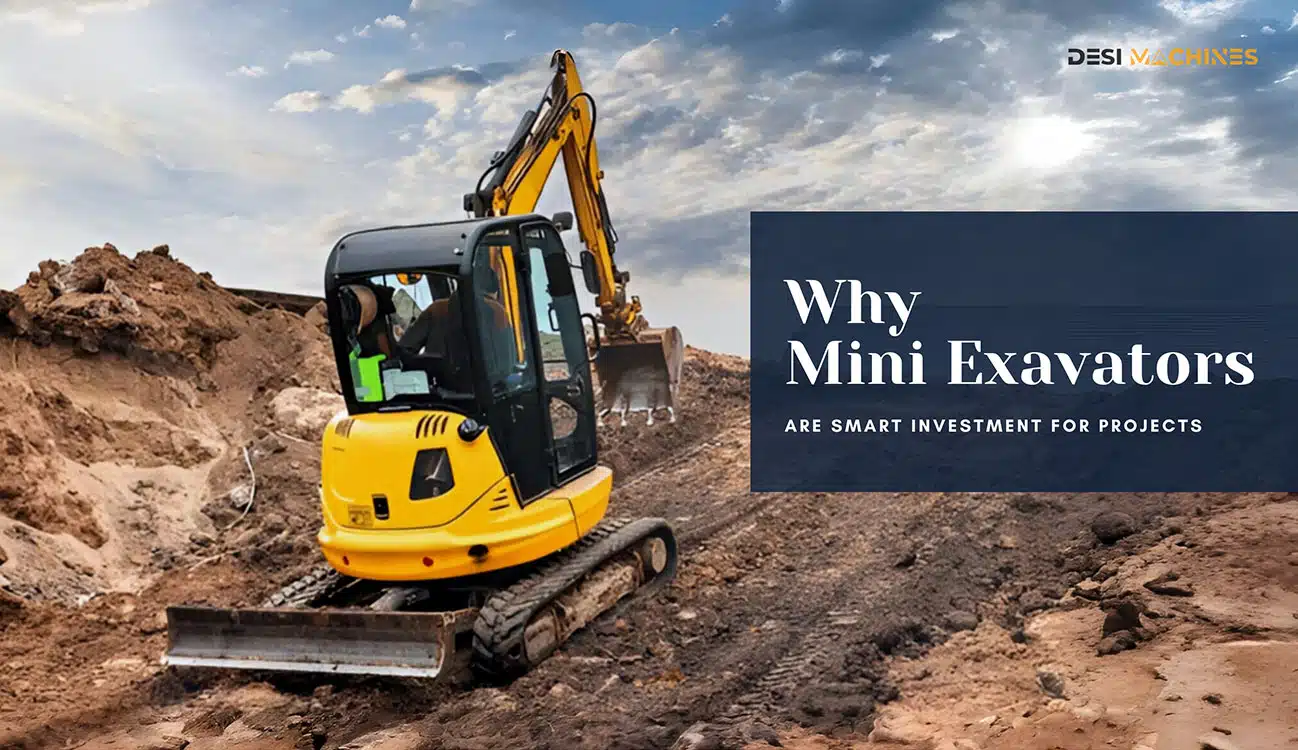
A mini excavator earns its keep on small and mid-scale projects because it costs a fraction of a full-size machine to buy and run, fits sites a 20-tonner cannot enter, and can be towed on a trailer instead of needing a low-bed. For urban plots, trenching, landscaping and utility work it is usually the machine that pays back fastest.
Mini excavators are among the leading products in the construction industry. They are excavators used for small work where precision is needed and space is confined. Mini excavators take up less space and work with precision, which is why they are appropriate for working in urban landscapes. Mini excavators’ expertise is in working in tight and confined spaces, mostly in urban landscapes, in tasks like construction, landscaping, and utilities.
Against their larger counterparts, mini excavators win on versatility, manoeuvrability and compactness, and give up outright power. Mid-size or large excavators are bulky to operate and cannot function well in tight spaces. Mini excavators are very useful and productive in small- and mid-scale construction and landscaping projects. Contractors and landscapers prefer mini excavators when working on small-scale and midsized projects because, in these projects a mini excavator is often the only machine that can get on site at all. Mini excavators perform tasks like digging a foundation, moving materials, trenching for utilities, etc., saving time and labor costs and increasing overall efficiency, hence making them a smart choice for investment.
What are Mini Excavators?
Mini excavators are compact, versatile, and powerful machines that are used for construction, landscaping, and utility works. An excavator’s parts include an undercarriage, a boom, an arm, and a bucket attached to the boom. Other attachments include augers, breakers, grapplers, and hammers, which serve multiple purposes like digging, trenching, and lifting materials. A mini excavator first gained popularity in the 1980s, and since then, it has been evolving in technological aspects. Artificial intelligence and automation are integrated in mini excavators, enabling them to perform better and give maximum output. The hydraulic system is made more advanced to increase efficiency. New features like zero tail swing, greater fuel efficiency, and better operator comfort have been introduced.
Key Benefits of Mini Excavators for Small & Mid-Scale Projects
Mini excavators are a smart investment for small- and mid-scale projects. This can be better understood by the following benefits:
- Compact Size for Tight Spaces: Mini excavators’ key advantage is being small and compact. In job sites where the space is confined, a mini excavator plays a great role. Due to their compact size, mini excavators can fit easily and perform tasks where their larger counterparts, like mid- and large excavators, fail. They are usually ideal for urban landscaping, residential yards, road construction, etc.
- Cost-Effectiveness: Mini excavators are less costly compared to mid- and large excavators due to their small size. For small-scale contractors whose budgets are low and who have less working capital, the mini excavator is a good choice. It also comes with options like rent and hire purchase. The down payments and monthly EMIs are also less. Compared to the low price, it delivers excellent value in terms of fuel efficiency and minimal maintenance.
- Versatility: A mini excavator is very versatile. It can be used for multiple purposes like digging, trenching, material handling, etc. It can be attached with multiple attachments like buckets, augers, breakers, augers, and hammers, which increases its usability. That is why mini excavators are used in construction, landscaping, demolition, and garden-scaping works.
- Increased Efficiency and Productivity: Mini excavators increase productivity and also save time. It reduces manual labor costs, and contractors can do multiple jobs with one machine. Mini excavators also help in speeding up tasks like digging and lifting; hence, projects are completed faster.
- Ease of operation: Mini excavators are very easy to operate and don’t require a highly skilled operator. Modern technological advancements in excavators have reduced much of the manual work, and with intuitive controls and a smaller learning curve, both experienced and new operators can operate the machine with ease.
Before you buy: what to check and what it costs
Compare the current mini excavator models and prices in India before you fix a budget, and read JCB vs Tata Hitachi vs Kubota for how the three most-shortlisted brands differ in practice. Which specifications matter will help you read the spec sheets, and if the machine is only needed for one contract, rental versus purchase is the calculation to run first. A used machine can be the better buy in this class — the inspection checks are in our used equipment guide — and equipment finance shows what the EMI looks like at each price point. For the wider range, see all excavators and the types of excavator machines.
Why a mini excavator suits small and mid-size sites
Mini excavators have proven themselves as the best choice for small- and mid-scale construction projects. Their properties, like compactness, versatility, and power, make them ideal for contractors working in confined and tight spaces. Unlike large excavators, mini excavators excel in precision and maneuverability, which are very much required in urban jobs like digging, trenching, and material handling. For small jobs where budgets are less, a mini excavator is a smart and practical investment for contractors, which improves efficiency and brings success to the project. Nowadays, mini excavators are equipped with advanced technology and are growing in popularity in construction industries.
Prices and model availability on the linked pages are indicative and change with variant, attachments and state registration. Confirm current specifications, prices and terms in writing with our team or OEM before you commit.