
 Excavator
294 models
Excavator
294 models  Backhoe Loader
51 models
Backhoe Loader
51 models  Crane
68 models
Crane
68 models  Concrete Mixer
79 models
Concrete Mixer
79 models  Wheel Loader
54 models
Wheel Loader
54 models  Compactor / Roller
45 models
Compactor / Roller
45 models  Motor Grader
42 models
Motor Grader
42 models 
 Concrete Pump
66 models
Concrete Pump
66 models  Skid Steer Loader
11 models
Skid Steer Loader
11 models 


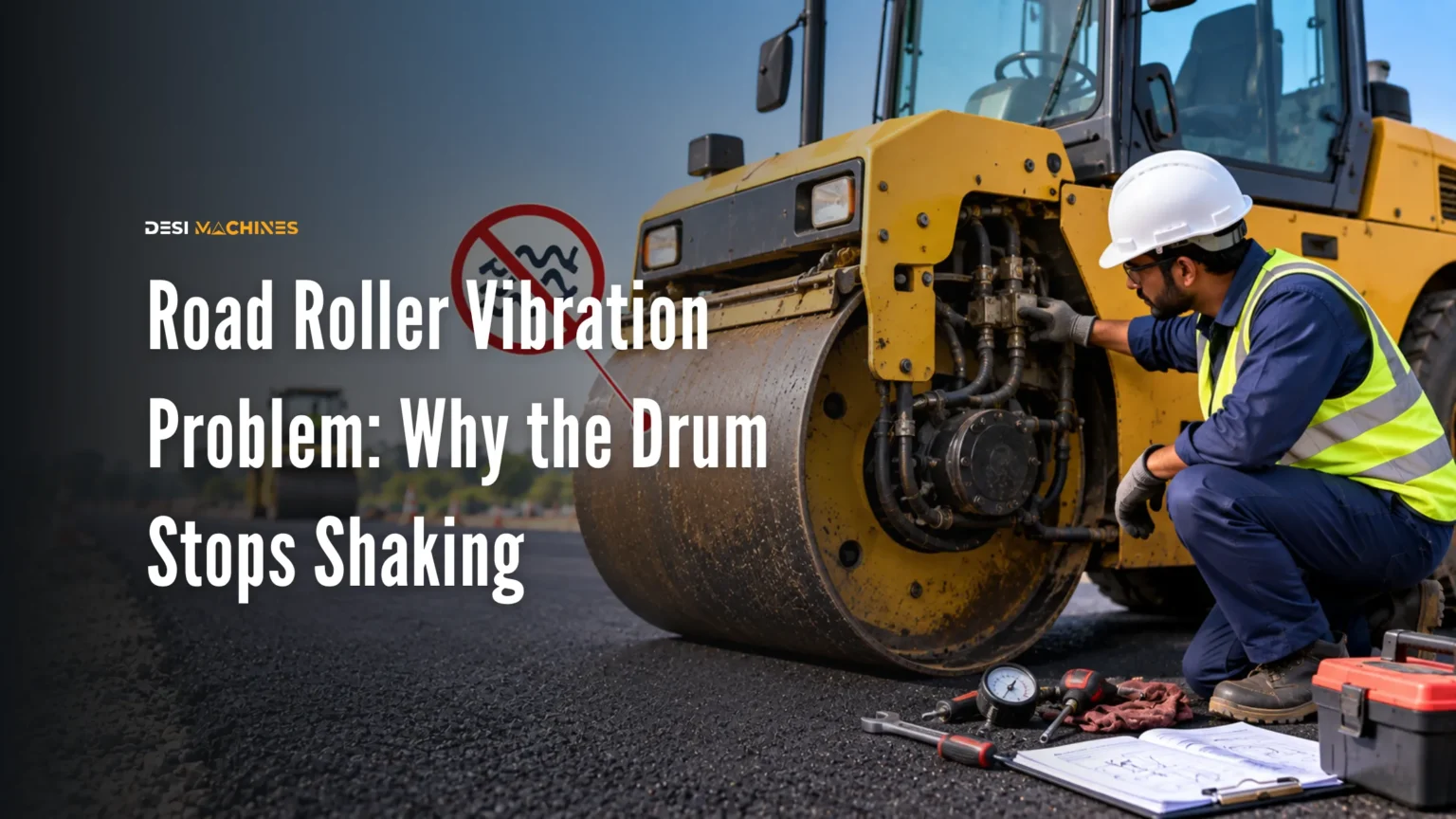
A road roller vibration problem is when the drum of a roller stops shaking while the machine still drives, steers and brakes normally. On almost every roller sold in India the vibration is produced by a separate hydraulic circuit that spins a weighted shaft inside the drum, so the vibration can fail on its own without anything else on the machine going wrong. Very often it has not failed at all: the machine is simply in the wrong vibration setting, or it has switched the vibration off by itself because of the speed it is travelling at.
This guide explains what makes the drum shake, how to tell a real fault from a setting, and what to check first when the vibration stops on site. It is written for an owner or a small contractor standing next to the machine, not for a workshop technician.
What actually makes a road roller drum vibrate?
Inside the drum sits a heavy weight bolted off-centre on a shaft. When that shaft spins fast, the off-centre weight throws the drum up and down thousands of times a minute. That shaking is what pushes compaction energy down into the soil instead of only pressing the top layer. The mechanism itself is covered in more depth in the guide to how a vibratory roller works, and the parts inside the drum are set out in the road roller parts and components reference.
What matters for fault-finding is what spins that shaft. Of the 45 compactors listed on DesiMachines, 37 publish a vibration system description in their specifications. Of those 37, 31 describe a hydraulic or hydrostatic circuit by name — a pump driven by the engine, sending oil to a motor that turns the eccentric shaft. The remaining six describe the vibration mode without naming the drive medium. Not one machine on the list uses a belt, a clutch or a mechanical drive off the gearbox.
That single fact narrows the search enormously. If the drum will not shake, you are almost certainly looking for a hydraulic problem — oil, a pump, a motor, a valve or the electrical switch that tells the valve to open — and not for a snapped belt or a worn clutch plate.
Can a road roller drive normally and still not vibrate?
Yes, and this is the most common shape of the complaint. The reason is that the two jobs run on two different circuits.
Roller specifications list a travel system and a vibration system as separate entries. Forty of the 45 machines publish a travel system description, 37 publish a vibration system description, and 36 publish both. Each is its own pump-and-motor arrangement fed from the same oil tank. So the machine can drive forward and back perfectly on a healthy travel circuit while the vibration circuit beside it does nothing at all.
This is worth saying plainly to whoever operates the machine, because a driver who reports “the roller is fine, only the vibration is not coming” has already given you useful information. He has told you the engine, the oil supply and the hydraulic tank level are good enough to run one circuit. The fault is downstream of that, on the vibration side.
Is the vibration really broken, or is the machine in the wrong setting?
Before anyone opens a spanner, check the setting. Rollers do not have a simple on-off vibration; they have modes, and a machine sitting in the wrong mode can feel dead.
Every one of the 18 tandem rollers on the list that publishes the figure states two vibration stages — 18 out of 18, with no machine publishing one stage or three. On the soil compactor side, all 21 machines publish a paired high/low amplitude figure, which means the same thing in different words: two settings, a hard one and a soft one. Amplitude is how far the drum lifts off the ground on each hit, measured in millimetres.
The low setting is genuinely gentle. On the soil compactors the low figure is often less than half the high figure, and the machine is meant to feel much softer in it. An operator who has left the machine on low after finishing a top layer, and who then reports no vibration on fresh fill the next morning, is describing a setting and not a fault.
There is a second trap in the same place. On 14 of the 21 soil compactors, the low-amplitude setting runs at a higher frequency than the high-amplitude setting — frequency being how many times per second the drum strikes the ground, measured in Hertz (Hz). On five machines the frequency is the same in both settings. On two it is lower: the HAMM HC 119i publishes 1.92 mm and 0.84 mm at 35 Hz and 30 Hz, and the ACE ASD 115 publishes 1.85 mm and 0.8 mm at 40 Hz and 33 Hz. Both figures appear the same way in both of the specification stores behind those listings, so this is how those machines are built rather than a printing error.
The practical point is that the two settings can sound similar and feel very different, or sound different and do similar work. Do not judge the vibration by ear alone. Switch to the high setting, on ground you are allowed to compact, and see whether the machine changes. The published amplitude, frequency and force figures for each class are set out in the road roller parts guide.
When does a roller switch off its own vibration?
Some rollers stop the vibration deliberately, and the operator sees it as a fault. Three cases turn up on machines listed in India.
Above a set travel speed. The Escorts EC 3664 states an automatic vibration cut-off above working speed in its own specification. The logic is sound: shaking a drum while travelling fast damages the machine and does nothing useful to the ground. A driver moving between passes too quickly will find the vibration drops out and comes back when he slows down. Working speeds and travel speeds by class are covered in the guide to road roller speed and gradeability.
Only one drum was ever meant to vibrate. On a tandem roller, both drums do not always shake. The JCB VMT330 states in its specification that only the front drum vibrates. Three HAMM machines on the list describe a two-stage front drum vibration system. If someone stands at the back of one of these and reports no vibration, the machine is behaving exactly as designed.
The machine was never a vibrating roller. All four pneumatic tyre rollers on the list publish no vibration system at all, because they have no drum to vibrate. A pneumatic tyre roller compacts by the weight and flexing of rubber tyres. That is a different way of working, explained in the guide to the pneumatic tyre roller. It matters on a mixed hire fleet, where a machine can turn up that is not the type the site expected.
Ask what the machine is supposed to do before deciding it has stopped doing it. The differences between roller types are set out in the guides to the soil compactor and the tandem roller.
If you are choosing a machine rather than fixing one, compare live road roller and compactor models and talk to a dealer about what each one is built to do.
What should you check first when the vibration stops?
Work from the cheapest and most likely to the most expensive. The table below follows that order. It is a starting point for the person standing at the machine, not a replacement for the manufacturer’s own manual.
| What you check | What you are looking for | Who can do it |
|---|---|---|
| Vibration mode selector | Machine left on the low setting, or between settings | Operator, on site |
| Travel speed | Moving too fast, so an automatic cut-off has switched vibration off | Operator, on site |
| Which drum is meant to vibrate | Front-drum-only machine being judged from the rear | Operator, on site |
| Hydraulic oil level and condition | Level below the mark, milky oil, or a smell of burning | Operator, on site |
| Vibration switch and its wiring | A dead switch, a loose plug, a broken wire at the console | Operator or electrician |
| Hydraulic filter | A choked filter starving the vibration pump of oil | Operator or mechanic |
| Hoses at the drum and the articulation joint | Cracking, shine, damp patches where a hose flexes | Operator or mechanic |
| Vibration pump and motor | Weak or no drum shake with oil and switch both good | Workshop |
| Drum bearings and eccentric seals | Oil weeping from the drum ends, or a rumble that changes when vibration is switched on | Workshop |
The first three rows cost nothing and take a minute. They are also the three that a busy site skips, because a machine that will not shake feels like a broken machine rather than a wrongly set one.
The oil check deserves its own note. Both circuits draw from the same tank, so a low level can leave a healthy travel circuit running while the vibration circuit, which usually needs more flow, starves. Filter and oil intervals for the hydraulic side are covered in the hydraulic system maintenance guide.
Which vibration faults need a workshop?
Two of them, and both are worth catching early.
The first is the vibration pump or its motor. When the oil is at the right level, the filter is clean and the switch works, but the drum still will not shake or shakes weakly, the circuit itself is the suspect. This is not a roadside repair. It needs pressure readings taken against the manufacturer’s own figures, which means a workshop with the right gauges.
The second is the eccentric assembly inside the drum, along with its bearings and seals. The warning sign is not silence but noise: a rumble or growl that changes when the vibration is switched on, or oil weeping from the ends of the drum. This is the most expensive repair on a roller and the one owners leave longest, because the machine keeps working while it gets worse. If you hear it, stop using vibration and get it looked at.
Everything above those two lines is within reach of a competent operator and a local mechanic. Below them, get a written quote before work starts, and ask for the old parts back.
What happens to the job if you keep rolling without vibration?
You lose most of the machine’s compacting ability and you will not see it until the layer is tested or the road fails.
A roller without vibration is a static roller: it compacts by dead weight alone. That works on a thin surface layer, and there are jobs where a static pass is exactly what is wanted, which is why the comparison between static and vibratory rollers matters. It does not work on the fill layers underneath. The shaking is what shuffles soil grains past each other and drives the energy deep, so removing it means the lower part of the layer never reaches the density it was specified for.
The visible cost is passes. A roller with working vibration reaches the required density in a certain number of passes, and that pass count is what sets how much ground the machine covers in a day — the arithmetic is worked through in the guide to road roller productivity and output. Without vibration, the operator either adds passes that will not fix the problem or signs off a layer that has not been compacted properly. On a road job, that is the layer that comes back as a settlement six months later.
So a vibration fault is not a minor complaint to work around until the next service. Stop, check the three free things, and if the vibration is genuinely dead, fix it before the next layer goes down. If the machine is on hire, tell the owner the same day: a roller that will not vibrate is not the machine you hired.
Road roller vibration problems: the short version
The vibration on a road roller runs on its own hydraulic circuit, separate from the circuit that drives the machine, which is why a roller can move perfectly and not shake at all. Before treating it as a breakdown, check the mode selector, the travel speed and which drum was meant to vibrate in the first place, because all three produce a machine that feels broken and is not. After that, work through oil level, the vibration switch, the filter and the hoses. A pump, motor or drum bearing fault is a workshop job, and a rumble that changes when vibration is switched on is the one sound you should never ignore.
Rolling without vibration leaves the lower part of a layer under-compacted whatever the pass count says, so it is worth stopping for. Browse live road roller and compactor models and connect with a dealer, or start with the complete guide to compactors for the rest of the series.
Read next: Road roller parts and components explained and how a vibratory roller works.
If the drum is shaking normally but the surface is tearing, the fault is on the water side rather than the vibration side, and the checks for that are in the guide to the road roller water spray system.
Specification figures in this guide are taken from the machine listings on DesiMachines as of September 2026, and coverage counts state how many of the 45 listed compactors publish each figure. Prices, specifications and features are indicative, vary by variant, location and date, and should always be confirmed with the official OEM or authorised dealer before any purchase decision. DesiMachines is not liable for decisions taken on the basis of information that may have changed after publication.