
 Excavator
294 models
Excavator
294 models  Backhoe Loader
51 models
Backhoe Loader
51 models  Crane
68 models
Crane
68 models  Concrete Mixer
79 models
Concrete Mixer
79 models  Wheel Loader
54 models
Wheel Loader
54 models  Compactor / Roller
45 models
Compactor / Roller
45 models  Motor Grader
42 models
Motor Grader
42 models  Dozer
41 models
Dozer
41 models  Concrete Pump
66 models
Concrete Pump
66 models  Skid Steer Loader
11 models
Skid Steer Loader
11 models  Telehandler
13 models
Telehandler
13 models 


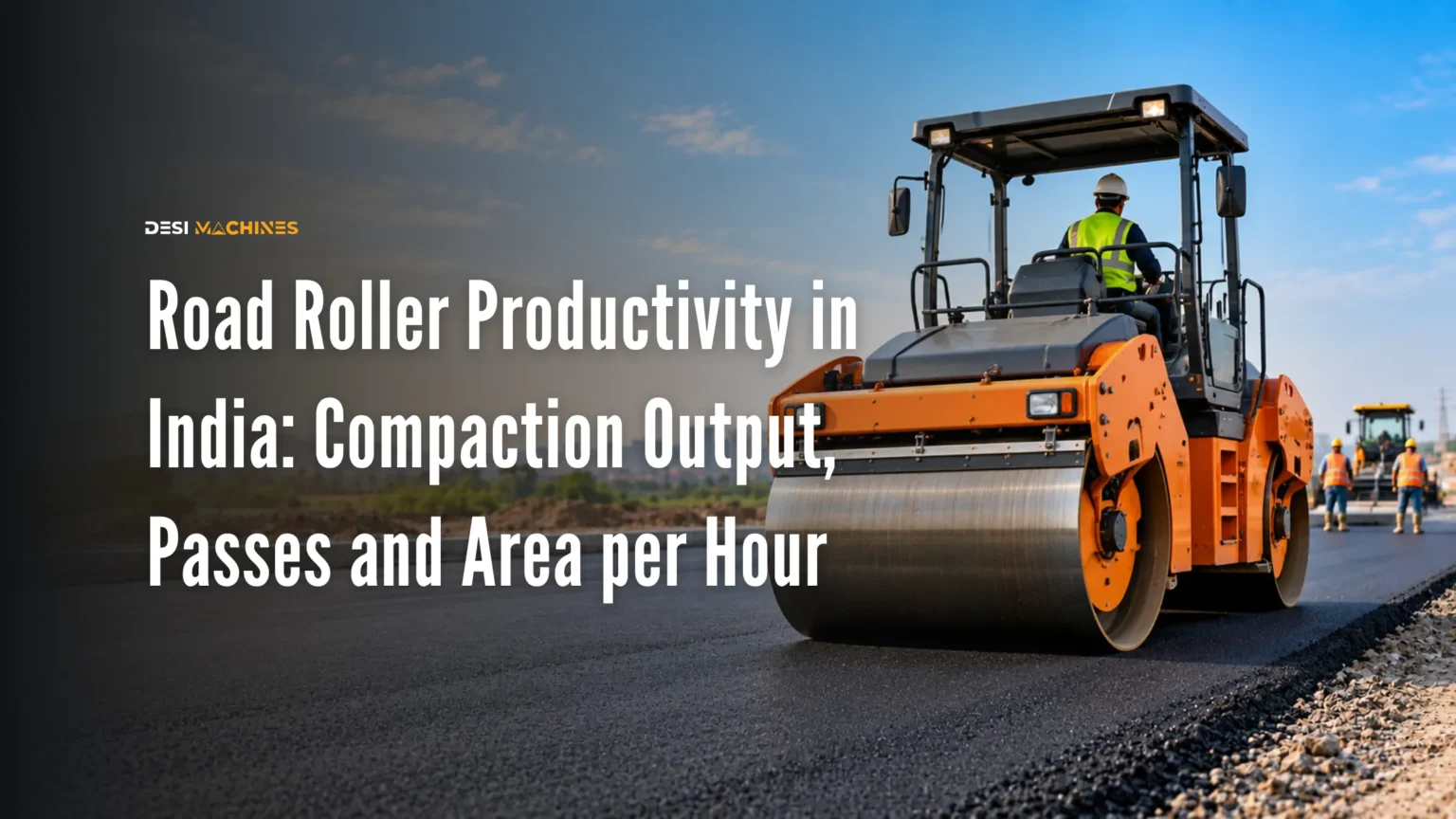
Road roller productivity is the amount of ground a roller compacts to the required density in one hour, measured in square metres per hour (m²/hr). It is not the same as how fast the machine drives. A roller only earns its money when a strip of ground is finished to the density the engineer will accept, so the honest output figure is the compacted area, not the distance covered.
Three numbers decide it: how wide a strip the machine presses, how fast it moves while compacting, and how many times it has to go over the same strip. Get those three right and you can work out, before you bid, how many days a stretch of road will take you. This guide gives you the width and speed figures from the 45 compactors listed on DesiMachines, shows the sum, and works it out for each type of roller.
What is the formula for road roller output per hour?
Output per hour is the compacting width multiplied by the working speed, divided by the number of passes, with an allowance for the time the machine is not actually rolling.
Written out:
Output (m²/hr) = effective width (m) × working speed (km/h) × 1,000 × working-time factor ÷ number of passes
Take each part in turn.
Effective width is the strip the machine presses, minus the bit you overlap on the next run. You always overlap. If you do not, you leave a soft line between two passes, and that line is where the road cracks first. Overlapping by roughly 150 mm (15 cm) leaves a 2,130 mm drum about 1,980 mm of new ground each run.
Working speed is in kilometres per hour. Multiplying by 1,000 turns it into metres travelled per hour.
Working-time factor is the share of the hour the drum is actually rolling. Nobody rolls for 60 minutes in an hour: you turn at the end of each run, you top up water, you wait for the tipper to spread the next layer. Forty-five rolling minutes in the hour, a factor of 0.75, is fair to plan with on a normal road job.
Number of passes is how many times the machine goes over the same strip before the density is right. This is the number that changes everything, and it is the one nobody can tell you from an office.
How wide a strip does a road roller actually compact?
Between 800 mm and 2,370 mm, depending on the type of machine. Every one of the 45 compactors listed here publishes its compacting width, so this part of the sum needs no guessing.
On a single drum or tandem roller the strip is the drum width. On a pneumatic tyre roller, which runs on rubber tyres instead of a steel drum, it is the working width covered by the row of tyres.
| Machine type | Machines listed | Compacting width | What it means on site |
|---|---|---|---|
| Single drum soil compactor | 21 | 2,100–2,150 mm | Almost one standard width. Nearly every soil compactor sold here presses a strip of about 2.1 m |
| Tandem (double drum) roller | 20 | 800–1,750 mm | The widest spread of any class. Baby rollers start at 800 mm, full-size asphalt machines reach 1,750 mm |
| Pneumatic tyre roller | 4 | 1,980–2,370 mm | The widest strip on offer, used for sealing and finishing rather than first compaction |
Compacting width across all 45 compactors listed on DesiMachines, as per the current September 2026 spec sheets.
The soil compactor result is the surprising one. Twenty-one machines, and the drum width runs from 2,100 mm to 2,150 mm: a spread of 50 mm across the whole class. So when you are choosing between soil compactors, width is not what separates them. Weight, vibration and passes are.
Tandem rollers are the opposite. A 1,750 mm machine presses more than twice the strip of an 800 mm one, so on wide open work it finishes in less than half the runs. On a village street or a footpath the 800 mm machine is the only one that fits, and its narrow drum stops being a weakness.
Note that the strip a machine presses is narrower than the machine itself. The overall width and other road roller dimensions run 130 mm to 360 mm wider than the drum, which matters against a kerb but not when you are working out output.
Ready to compare machines side by side? Browse road rollers and compactors with live specifications and talk to a dealer near you.
How fast does a road roller work?
Between 4 and 9 km/h while compacting. That is the working speed, and it is the figure to use in the sum.
Every compactor publishes two speeds. Road roller travel and working speeds run from 5 to 18 km/h for travel and 4 to 9 km/h for work. Travel speed is how fast the machine shifts position when it is not compacting. Using it in an output calculation will give you a number roughly twice what you will actually achieve.
The published working speed is a ceiling, not a target. It assumes a material that responds well and a layer of sensible thickness. On wet clay, or on the first pass over loose fill, going slower puts more blows into every metre and gets you to density in fewer passes. Slower can mean more output, not less, because passes cost more than speed does.
One rule holds on every machine: keep the speed the same on every pass. Compaction is counted in passes, and a pass only counts if it was done like the last one. An operator who speeds up when he gets bored leaves soft patches that nobody finds until the surface fails.
How many passes does a layer need?
Four to eight passes is the normal working range for a 10 to 12 tonne (10,000 to 12,000 kg) soil compactor on a 200 to 300 mm layer. Below four is unusual. Above eight, something about the material or the machine is wrong.
The honest answer is that no one can give you the number from a desk. Passes depend on the soil, how wet it is, how thick the layer is spread and how heavy the machine is. Soil compaction methods and the equipment that suits each soil covers which machine belongs on which material.
The reliable method is a test strip. Compact 20 to 30 metres at the start of the job, check the density after four passes, again after six, again after eight, and see where the readings stop improving. That number is your pass count for that material, and it goes straight into the sum. Run it again if the soil changes.
Machine weight moves this number. On tandem rollers the static linear load, which is the weight pressed onto each centimetre of drum, runs about 9.3 to 14.8 kg/cm on the small machines and 25.8 to 30.9 kg/cm on the full-size ones. That is why a big tandem finishes in three passes what a small one cannot finish in eight. Vibration does the same job a different way: a vibrating drum sends shock waves deeper into the layer, which is how one machine compacts 300 mm of soil in a handful of passes.
How much ground can a road roller cover in a day?
Between roughly 4,400 and 25,000 square metres in an eight-hour shift, depending on the machine and the number of passes. The table below runs the formula for one typical machine of each type.
| Machine | Effective width | Working speed | Passes | Output per hour | Per 8-hour shift |
|---|---|---|---|---|---|
| 11 tonne single drum soil compactor | 1.98 m (2,130 mm drum, 150 mm overlap) | 5 km/h | 6 | about 1,240 m²/hr | about 9,900 m² |
| Full-size tandem roller | 1.58 m (1,680 mm drum, 100 mm overlap) | 6 km/h | 4 | about 1,780 m²/hr | about 14,200 m² |
| 1.2 m mini tandem roller | 1.10 m (1,200 mm drum, 100 mm overlap) | 4 km/h | 6 | about 550 m²/hr | about 4,400 m² |
| Pneumatic tyre roller | 2.37 m (tyres overlap each other) | 7 km/h | 4 | about 3,110 m²/hr | about 24,900 m² |
Worked from published widths and working speeds, at a working-time factor of 0.75 (45 rolling minutes in the hour). Overlap, pass count and working time are planning assumptions you should replace with your own site figures.
The pneumatic figure needs reading carefully. A pneumatic tyre roller covers the most ground per hour because it is the widest machine and it works fast, but it is a sealing and finishing machine, not a machine for compacting a deep layer of fill. Its tyres publish an overlap of 42 mm to 63 mm between them, which is why a single pass covers its full working width with no untouched line down the middle. It is doing a different job from the soil compactor, so the two output figures are not competing.
The mini roller figure is the one small contractors should look at hardest. A baby roller covers a little over 4,000 square metres in a shift. On a village road that is plenty. On a four-lane job it is not, and hiring two of them will not fix it, because the pass count does not change.
Why does one extra pass cost so much output?
Because passes divide the output. Going from six passes to seven cuts your area per hour by about 14 percent. Going from four to five cuts it by 20 percent. Nothing else in the sum moves the number that hard.
Run the same 11 tonne soil compactor at 5 km/h and change only the passes:
| Passes needed | Output per hour | Per 8-hour shift |
|---|---|---|
| 4 | about 1,860 m²/hr | about 14,900 m² |
| 6 | about 1,240 m²/hr | about 9,900 m² |
| 8 | about 930 m²/hr | about 7,400 m² |
Same machine, same speed, same width. Only the pass count changes.
Two extra passes take a third off your day. That is why the test strip at the start of a job pays for itself before lunch, and why spreading the layer thinner and getting density in fewer passes often beats spreading it thick and rolling it forever.
Speed moves the number too. The same machine at 4 km/h gives about 990 m²/hr and at 8 km/h about 1,980 m²/hr. Doubling the speed doubles the output on paper, and on real ground it usually does not, because going faster tends to add a pass.
What slows a road roller down on an Indian site?
The gap between the calculated figure and the day you actually have is nearly always the working-time factor, not the machine.
Short runs are the biggest loss. Every time the machine reaches the end of the strip it stops, changes direction and starts again. On a 30 metre stretch the roller spends more time turning than rolling, and the same machine on a 300 metre run will give you close to double the output with nothing else changed.
Waiting for material is the second. A roller can only compact what has been spread and levelled. If the tipper and the grader are not keeping ahead of it, the roller is parked and the output you planned with quietly halves.
Water stops matter on asphalt work. The drums are sprayed to stop hot mix sticking, and when the tank runs dry the machine leaves the mat. The fuel and water capacities of road rollers decide how long it can stay on the strip before a refill.
Machine condition is the quiet one. A worn drum or a tired vibration system puts less energy into the layer, and the first sign is not a breakdown but a pass count that has crept from six to eight. The parts of a road roller and which of them wear first is worth knowing before the pass count tells you.
Which roller gives the most output for your job?
The one that reaches density in the fewest passes on your material, not the one with the widest drum.
For embankment and subgrade work, a single drum soil compactor is the machine. Every one of them presses about the same 2.1 m strip, so choose on weight and vibration, because those decide the passes.
For asphalt and for finishing, a tandem roller gives you two driven drums and a smoother surface. Here the drum width genuinely changes your output, so match the width to the work you actually win.
For small and confined work, the 800 mm to 1,250 mm machines are the honest choice. Their output looks poor on paper and it is the only output you will get in a lane where a 2.1 m machine cannot turn.
Once you have the machine type, the compactor buying guide sets out what to check before you sign, and the complete guide to compactors covers how the whole family fits together.
Working out output for other machines on the same job? We publish the same calculation for excavator output per hour and for wheel loader productivity, so you can size the whole fleet rather than one machine.
A note on the figures in this guide
The widths and speeds above come from the machines’ own published specifications. The output figures are calculated from them, and every assumption used in the calculation is stated in the table beside it.
A small number of machines were left out of the speed figures rather than allowed to set a bound. The SANY SPR260C-10 PRO publishes a travel speed below its own working speed, which cannot be right for any machine. The ACE ASD 115 and the SANY SSR220C-8H each publish one figure for both speeds, and on the ASD 115 that figure sits more than twice as high as every other soil compactor. The two Escorts EC 5250 machines publish a travel speed roughly double their class. A further seven tandem rollers publish a single figure for both speeds, so it cannot tell you what they compact at. The Ammann ARX 32.2 publishes no working speed at all. All of these have been raised with our team for confirmation with the manufacturer, and none of them sets a figure on this page.
Pass counts and the working-time factor are not specifications and are not published by any manufacturer. They are planning figures drawn from normal road practice, and your own test strip beats every one of them.
Road roller productivity, in short
Output per hour is width times working speed divided by passes, with an allowance for the time you are not rolling. Compacting width runs 2,100 to 2,150 mm on the 21 single drum soil compactors listed here, 800 to 1,750 mm across the 20 tandem rollers and 1,980 to 2,370 mm on the 4 pneumatic machines. Working speed runs 4 to 9 km/h. Passes run four to eight on a normal soil layer and are the only part of the sum you have to measure for yourself.
A typical 11 tonne soil compactor covers roughly 9,900 square metres in an eight-hour shift at six passes. Take it to four passes and the same machine gives you close to 14,900. The machine did not change. The material and the method did, and that is where a compaction job is won.
Compare live road roller models, specifications and prices and connect with a dealer near you.
The same output question for the machine that grades the surface ahead of the roller is answered in our guide to motor grader productivity and output per hour.
All of this assumes the vibration is actually working, because a roller compacting by dead weight alone will not reach density however many passes it makes; if the drum has stopped shaking, start with our guide to a road roller vibration problem.
Prices, specifications and features are indicative, vary by variant, location and date, and should always be confirmed with the official OEM or authorised dealer before any purchase decision. DesiMachines is not liable for decisions taken on the basis of information that may have changed after publication.