
 Excavator
294 models
Excavator
294 models  Backhoe Loader
51 models
Backhoe Loader
51 models  Crane
68 models
Crane
68 models  Concrete Mixer
79 models
Concrete Mixer
79 models  Wheel Loader
54 models
Wheel Loader
54 models  Compactor / Roller
45 models
Compactor / Roller
45 models  Motor Grader
42 models
Motor Grader
42 models  Dozer
41 models
Dozer
41 models  Concrete Pump
66 models
Concrete Pump
66 models  Skid Steer Loader
11 models
Skid Steer Loader
11 models  Telehandler
13 models
Telehandler
13 models 


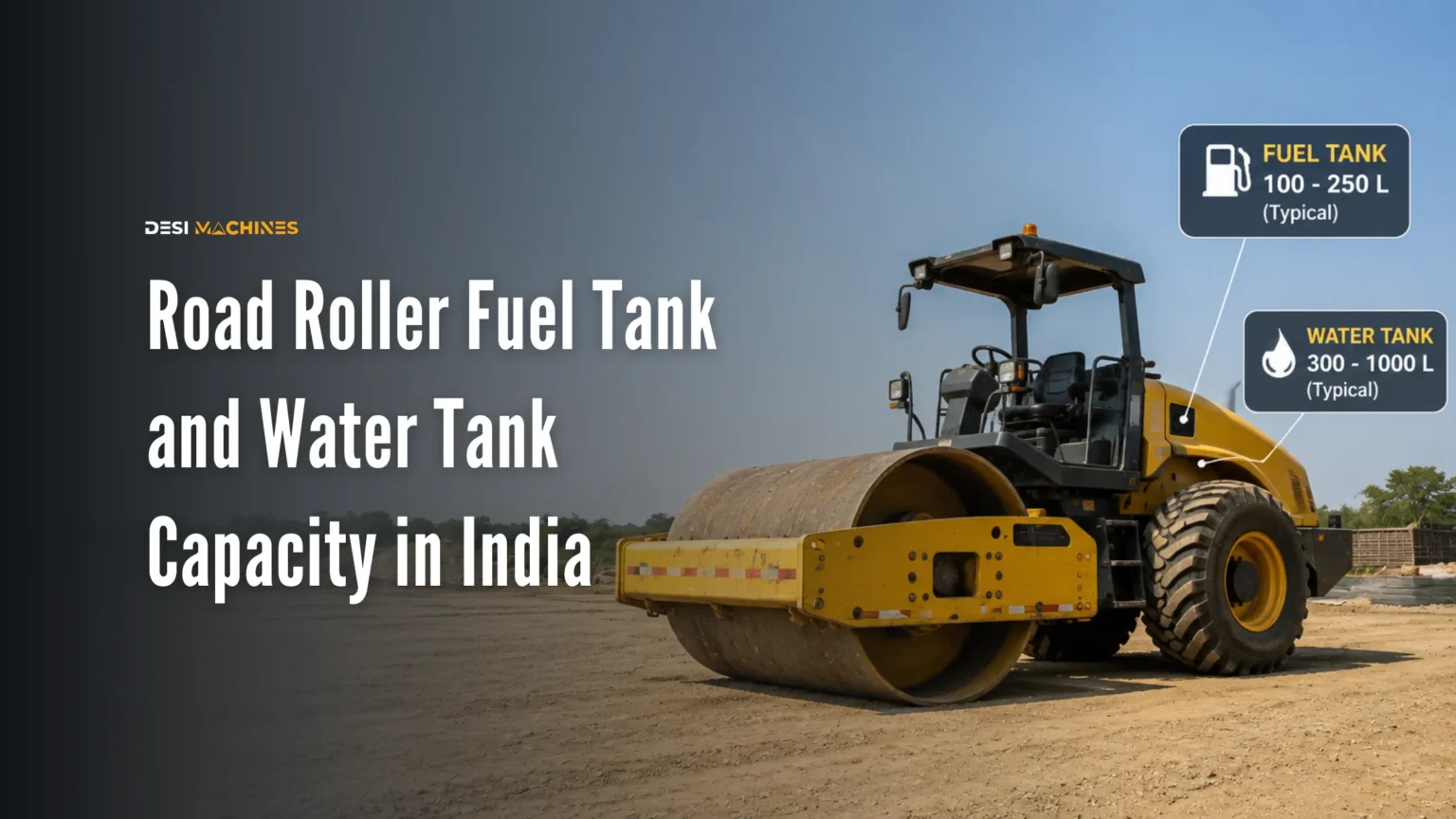
A road roller’s fuel tank holds the diesel that runs the machine, and its water tank holds the water sprayed onto the drums so hot asphalt does not stick to them. Across the 45 compactors listed on DesiMachines, published fuel tanks run from 23 litres on a 1,575 kg walk-behind size machine to 320 litres on a 14 tonne pneumatic roller, and water tanks from 110 litres to 1,000 litres, as per the current August 2026 spec sheets.
These two numbers decide how often the machine stops. On a road job that runs to a paving schedule, a roller that has to leave the mat to refill water is a real cost, and the water tank empties long before the diesel does. This guide gives both capacities for every roller type, explains why single drum soil compactors carry no water tank at all, and shows how to work out your own refill interval.
What is the fuel tank capacity of a road roller?
It depends on the type of roller, and the range is wide. A single drum soil compactor, the machine used on earthwork and sub-base, carries 196 to 315 litres. A tandem roller, used on asphalt, carries anything from 23 to 220 litres depending on its size. A pneumatic tyre roller carries 180 to 320 litres.
The spread inside the tandem class is the one to understand. Tandem rollers run from small 1.5 tonne machines used on footpaths and patch repairs up to 10 tonne machines working behind a paver on a highway, and the tank scales with them. The Dynapac CC800 at 1,575 kg holds 23 litres. The LiuGong 6210E at 10,000 kg holds 220 litres, nearly ten times as much.
Soil compactors have a much narrower band because the class itself is narrow: most of the machines we list weigh between 9.7 and 11.5 tonnes, and they are built for the same job. The smallest published tank in that class is the Volvo SD110 at 196 litres and the largest is the ACE ASD 115 at 315 litres.
Why does a road roller have a water tank?
Hot asphalt sticks to a dry steel drum. As the drum lifts away it tears the surface it has just rolled, leaving a rough patch that has to be repaired. The water tank feeds spray bars along each drum that keep the steel wet, so the asphalt releases cleanly and the mat behind the machine stays smooth.
That is why the water tank is fitted to the machines that roll asphalt and not to the ones that roll earth. Every tandem roller and every pneumatic roller we list that publishes the figure has one. None of the 21 single drum soil compactors publishes a water tank capacity, because those machines compact soil, gravel and sub-base, where nothing sticks to the drum and water would only make the material harder to compact.
On a pneumatic tyre roller the water does a slightly different job. It wets the rubber tyres rather than a steel drum, and many operators use a light diesel or release agent mix instead of plain water, because rubber picks up bitumen more readily than steel does. Follow the manufacturer’s instruction on that rather than site habit.
Road roller fuel and water capacities by type
The table gives the published span for each roller type we list, taken from the machines’ own specification sheets and current as of August 2026. Where a figure is published on only some of the machines in a class, the count is shown.
| Roller type | Machines listed | Operating weight | Fuel tank | Water tank | Hydraulic tank |
|---|---|---|---|---|---|
| Soil compactor (single drum) | 21 | 9,700 to 22,000 kg | 196 to 315 L | Not fitted | 52 to 150 L (12 published) |
| Tandem roller (double drum) | 20 | 1,575 to 10,060 kg | 23 to 220 L | 110 to 1,000 L (18 published) | 40 to 90 L (13 published) |
| Pneumatic tyre roller | 4 | 10,500 to 18,000 kg | 180 to 320 L | 530 to 700 L | 60 to 105 L (3 published) |
The most useful thing in the table is the relationship between the two tanks on an asphalt machine. On the tandem rollers we list the water tank is routinely three to five times the size of the fuel tank, and on pneumatic rollers it is two to three times. That ratio is not accidental: water is consumed far faster than diesel when the spray bars are running continuously in hot weather, so the machine is designed with the bigger tank for the faster-emptying fluid.
Engine oil capacity is published on only 6 of the 45 machines, running from 5 litres on a 2.9 tonne tandem to 14 litres on an 11 tonne soil compactor. That is too thin a sample to give a class figure, so read your own machine’s manual rather than a class average. The construction equipment service schedule covers when those changes fall due.
Hydraulic tank figures are published on 28 of the 45 machines. Where a machine’s specification describes the hydraulic system in words rather than giving a tank capacity, it is counted as not published rather than guessed at, which is why the counts in the table are lower than the machine totals.
How long does a tank of water last on a road roller?
Less time than most first-time owners expect, and it is the water rather than the diesel that sets the rhythm of the day. Spray consumption depends on ambient temperature, how wide the spray bars are set and whether the operator leaves them running between passes, so no single figure fits every job.
The way to get a number you can trust is to measure it once on your own machine. Fill the water tank, note the time, work a normal stretch of mat, and note the time when the low level warning shows. That single measurement gives you a refill interval you can plan the day around, and it will be more accurate than any published figure because it is your machine, your operator and your weather.
Two habits reduce the number of stops. Set the spray to the lightest flow that still releases the asphalt cleanly, because over-spraying cools the mat as well as wasting water. And run the bars only while the drum is on hot material, not while the machine is travelling. Operators who leave the spray on constantly can empty a tank in half the time.
Diesel is the easier one to plan. Ask the dealer what consumption their customers see on work like yours, divide the tank size by that figure, and you have a refill interval. Do not accept a consumption number without asking what duty it was measured on, since a roller working continuously behind a paver and one doing intermittent patch work burn very different amounts.
What to check before filling either tank
A few checks prevent the most common and most expensive mistakes on these machines.
- Use clean water only. Canal, pond or bore water carrying silt blocks the spray nozzles, and a blocked nozzle leaves a dry strip on the drum that tears the mat. Where clean water is hard to get, fill through a cloth filter.
- Check the filters at the tank outlet at the start of each shift. Most machines have a strainer that is quick to pull and rinse.
- Never let the water tank freeze. On hill work in winter, drain the tank and the bars at the end of the shift.
- Fill diesel at the end of the day, not the start. A full tank left overnight leaves less air space for moisture to condense in, which keeps water out of the fuel.
- Do not confuse the fillers. Water in the diesel tank on a modern common rail engine is an expensive repair, and the two caps sit close together on some machines.
The tanks themselves, the spray bars and the pump that feeds them are covered in the road roller parts and components guide, and routine lubrication points are listed in the greasing and lubrication guide.
Does tank size matter when choosing a roller?
It should be a tie-breaker, not a deciding factor. Choose the roller on the work first: the material you are compacting, the layer thickness, the width of the mat and the density you have to reach. The compactor buying guide works through that sequence, and the types of compactors guide explains which machine suits which material.
Once you have two machines of the right class in front of you, tank size is a fair way to separate them, and it matters most where refilling is hard. On a rural road job with no water source within several kilometres, a 1,000 litre tank against a 600 litre one changes how the day runs. On a city job with a tanker on site, it barely registers.
Watch the trade-off, though. A bigger water tank is a heavier machine when full, and on a light tandem roller that extra weight changes the compaction the machine delivers. On the small machines especially, do not treat a larger tank as free.
Ready to compare? Browse the full range of compactors and road rollers with specifications for every model, or read the road rollers guide for how the types differ. If you are hiring rather than buying, the road roller rental guide covers rates and what to check, and the used road roller buying guide covers second-hand checks. Smaller jobs may only need a mini roller.
Concrete machines carry the same pair of tanks for the same reason. For the diesel and water figures on self-loading mixers, which batch concrete on site and so need water for the mix as well as for washing down, see self-loading concrete mixer fuel and water tank capacity.
Tank size is only half the story. What the water actually does once it leaves the tank, and what to check when it stops arriving at the drum, is covered in the guide to the road roller water spray system.
Prices, specifications and features are indicative, vary by variant, location and date, and should always be confirmed with the official OEM or authorised dealer before any purchase decision. DesiMachines is not liable for decisions taken on the basis of information that may have changed after publication.