
 Excavator
294 models
 Backhoe Loader
51 models
 Crane
68 models
 Concrete Mixer
79 models
 Wheel Loader
54 models
 Compactor / Roller
45 models
 Motor Grader
42 models

 Concrete Pump
66 models
 Skid Steer Loader
11 models


A backhoe loader, which most people call a JCB, carries its body panels in five places: the bonnet over the engine, the side panels beside it, the cab doors, the mudguards over the wheels, and small covers such as toolbox lids and steps. A panel that fits one machine will not always fit another with the same badge. Three things decide the fit: the model, the engine’s emission stage (which follows the model year), and whether the machine is 2WD or 4WD.
This guide covers the backhoe loader (JCB) bonnet, doors and mudguards: what each one does, why a bonnet from one year may not fit the next, how tyre size changes the mudguard, what to tell the dealer before you order, and when a damaged panel can be repaired. Glass is a separate subject, covered in the guide to backhoe loader cab glass. There are no prices here, because they depend on the panel, the machine and the seller.
What body panels does a backhoe loader have?
Five groups, and they wear out for different reasons. The bonnet takes the most knocks because it sits at the front, between the loader arms and under the path of the loader bucket.
| Panel | Where it sits | What it protects | What usually damages it |
|---|---|---|---|
| Bonnet (engine hood) | Front of the machine, over the engine, between the loader arms | Engine, radiator, belts and air intake, from rain, dust and falling material | Material dropping off a raised bucket, knocks on site, heat near the exhaust pipe, a worn latch that lets it rattle |
| Side panels and service covers | Sides of the engine bay | The same parts, with an opening for daily checks | Bent edges, worn catches, panels left open and caught by something |
| Cab doors | One or both sides of a closed cab (an open canopy has none) | The operator, from dust, rain and noise | Worn hinges, a door swinging open into an obstacle, a latch that no longer holds |
| Front mudguards (where fitted) | Over the front wheels | The engine bay, lights and loader end, from mud and stones thrown by the tyres | Stones, rough ground, a bigger tyre rubbing at full steering lock |
| Rear mudguards | Over the big rear wheels, beside and under the cab | The cab, the steps and the operator getting in and out | Stones thrown by the rear tyres, cracked brackets, weight put on them |
| Toolbox lids, steps, small covers | Around the cab and chassis | Tools, the battery and the operator’s footing | Rust, broken hinges and locks, bent steps |
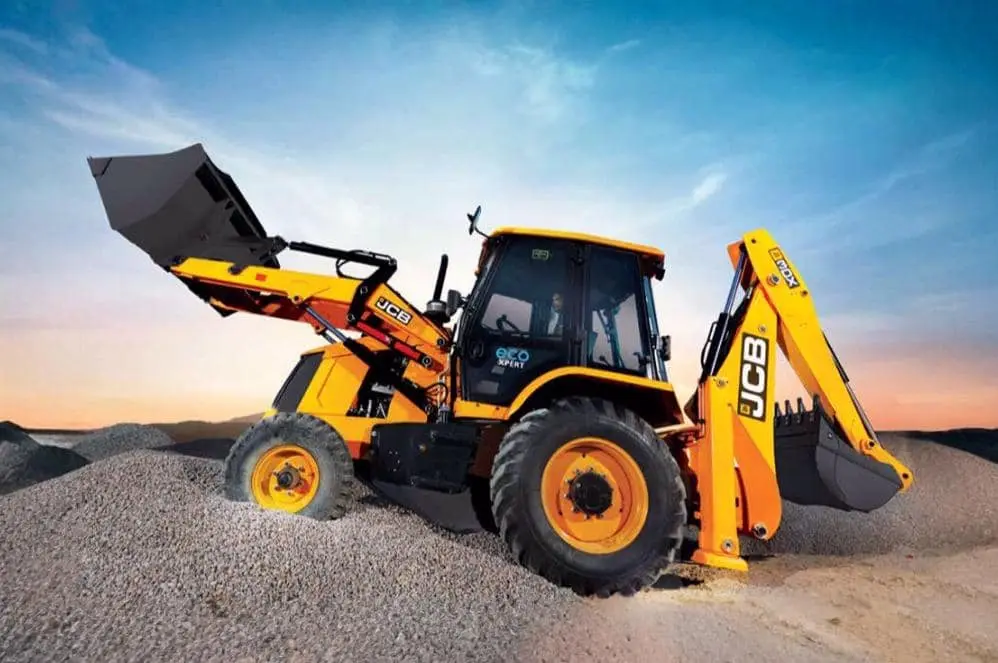
What the photo shows
- The long yellow cover between the loader arms is the bonnet. The black pipe rising from it in front of the cab is the exhaust, so the area round that opening gets hot.
- The closed cab has a door with glass on this side.
- The yellow arch over the rear wheel is the rear mudguard, sitting just under the cab floor.
- The front wheel on this JCB 3DX runs without a mudguard. Some machines have front mudguards and some do not, so check yours before ordering one.
A mudguard’s main job, as Wikipedia’s article on vehicle fenders puts it, is to stop sand, mud, stones and water being thrown up by the turning tyre. The same article notes that “mudguard” is the everyday Indian English word for what Americans call a fender.
Will a bonnet from another model or year fit my backhoe loader?
Often it will not, even when the badge is the same. Makers change the engine bay when they change the engine, and in recent years the engines have changed with each new emission stage.
CASE shows this clearly in its own descriptions. The CASE 770 EX Plus, listed with a CEV BS-IV engine, is described with a “sloping and lockable engine hood”. The CASE 770 NX, listed with a CEV Stage V engine, is described with an “enhanced bonnet” and a “redesigned engine compartment and hood”, and the CASE 851 NX carries the same redesign line. Same maker, same 770 name, different bonnet.
Why does the engine change the bonnet? A Stage V engine carries extra equipment. The JCB 3DX is listed with a 4-cylinder turbocharged engine “with EGR and aftertreatment system DOC and DPF”. EGR sends some exhaust back into the engine, and the DOC and DPF are two units that clean the exhaust after it leaves. All of that has to fit in or near the engine bay. What the stages mean is explained in the guide to BS-CEV emission norms.
Some makers put the stage in the model name, which helps. Bull sells the SD76 BS4 Champion and the Bull SD76 BS5 Super Smart as two models. With most machines, though, you have to find the stage on the machine’s documents or engine plate.
Two more things change from machine to machine. One is how the bonnet opens. The E-Kubota BLX75 has a “two-piece opening hood” so the daily checkpoints can be reached without lifting the main hood, plus cut-outs in the engine side panel. The Bull SD76 BS5 lists “quick access panels” for daily checks. So on one machine “the bonnet” is a single part, and on another it is two. The other is the material. The Manitou MBL 745 S is described with an “unbreakable bonnet”, and the CASE 770 NX Magnum offers a plastic cab roof as an option. Bonnets in general, says Wikipedia’s article on vehicle hoods, are made of the same material as the rest of the body, which may be steel, aluminium or fibreglass. The material decides how a damaged panel can be repaired.
| Machine | Engine stage as listed | What the maker’s description says about the bonnet, panels or doors |
|---|---|---|
| CASE 770 NXe Series | BS-III | Sloping and lockable engine hood |
| CASE 770 EX Plus | CEV BS-IV | Sloping and lockable engine hood; secured engine compartment with lockable hood |
| CASE 770 NX | CEV Stage V | Enhanced bonnet and swing tower structure; redesigned engine compartment and hood |
| CASE 851 NX | CEV Stage V | Redesigned engine compartment and hood |
| CASE 770 NX Magnum | CEV Stage V | Robust new engine hood design with secure locking; plastic roof as an option |
| E-Kubota BLX75 | CEV Stage V | Two-piece opening hood; cut-outs in the engine side panel |
| Bull SD76 BS5 Super Smart | BS-V | Quick access panels for daily checks |
| Manitou MBL 745 S | Not stated | Unbreakable bonnet |
| BEML BL9H 4×2 | CEV-5 | Steel cabin with wide doors and sliding windows |
| BEML BL9H 4×4 | CEV Stage 5 | Cabin with dual doors |
This is a general guide based on machine size class. Always confirm the fit with your machine’s operator manual or the manufacturer before buying or fitting.
If you are choosing between two machines and want to see every specification side by side, the CASE 770 NX vs JCB 3DX comparison is a good place to start.
Do 2WD and 4WD backhoe loaders use the same mudguards?
Not always, because the tyres are different sizes. A mudguard is shaped round a tyre, so when the tyre changes, the mudguard often has to change with it.
The numbers show how common this is. Of the 51 backhoe loaders listed on DesiMachines on 1 November 2026, 38 give a 9.00-16 front tyre and 17 give a 12.5/80-18 front tyre. Six list both: the 9.00-16 on the 2WD backhoe loaders and the wider 12.5/80-18 on the 4WD backhoe loaders. At the rear, 49 of the 51 list a 16.9-28 tyre, but there are exceptions, and the BEML BL9H shows one inside a single model.
The front mudguard has a harder job than the rear one. The front wheels steer, and the front axle is pivoted in the middle so it can rock over uneven ground. Most backhoe loaders on DesiMachines that state a figure give 16 degrees of front axle oscillation (the rocking movement), and the Manitou MBL 745 Ranger states 20. A front mudguard has to clear the tyre at full steering lock and at full tilt. That is why, as the Wikipedia fenders article explains, the opening round a wheel is usually much bigger than the tyre itself. More on the axle is in the guide to backhoe loader steering and the front axle, and the drive difference is set out in 2WD vs 4WD backhoe loader.
| Machine | Drive | Front tyre as listed | Rear tyre as listed |
|---|---|---|---|
| JCB 3DX | 2WD / 4WD (one front size listed) | 9 x 16, 16 PR | 16.9 x 28, 12 PR |
| Mahindra Earthmaster VX | 2WD / 4WD | 9 x 16, 16 PR (2WD) / 12.5 x 18, 12 PR (4WD) | 16.9 x 28, 12 PR |
| CASE 851 NX | 2WD / 4WD | 9 x 16, 16 PR (2WD) / 12.5 x 18, 12 PR (4WD) | 16.9 x 28, 12 PR |
| E-Kubota BLX75 | 2WD / 4WD | 9.00 x 16, 16 PR (2WD) / 12.5 x 18, 12 PR (4WD) | 16.9 x 28, 12 PR |
| Bull SD76 BS5 Super Smart | 2WD / 4WD | 9.00 x 16, 16 PR (2WD) / 12.5/80 x 18, 12 PR (4WD) | 16.9 x 28, 12 PR (industrial) or 14 x 25, 20 PR (heavy duty) |
| BEML BL9H 4×2 | 2WD | 9.0 x 16, 16 PR | 16.9 x 28, 12 PR |
| BEML BL9H 4×4 | 4WD | 9.0 x 16, 16 PR | 14.0 x 25, 12 PR |
| JCB 2DX | 2WD | 7.5 x 16, 16 PR | 12 x 24, 20 PR |
This is a general guide based on machine size class. Always confirm the fit with your machine’s operator manual or the manufacturer before buying or fitting.
One practical warning follows from this. If you fit a bigger or wider tyre than the machine came with, check the mudguard at full lock before you drive off. The guide to backhoe loader tyres explains the sizes and ply ratings.
What should you tell the dealer before ordering a bonnet, door or mudguard?
Enough for the dealer to find the exact part number. “A bonnet for a JCB” is not enough, as the tables above show. Have these ready:
- The make and the full model name, including the variant word (Plus, Super, Xtra, NX, EX).
- The year of manufacture and the engine’s emission stage (BS-III, BS-IV or Stage V), from the invoice, the registration papers or the engine plate.
- The machine’s serial number from its identification plate.
- For a mudguard, whether the machine is 2WD or 4WD and the tyre size printed on the tyre wall.
- For a door or mudguard, which side. Left and right parts are usually different.
- Whether you need only the panel, or the hinges, latch, lock, gas strut, seals and brackets as well.
- Clear photos of the damaged part and its mounting points, and any part number label on it.
Ask the dealer to confirm the part number against the serial number before you pay. That one step catches most wrong orders.
Can a damaged bonnet or mudguard be repaired, or does it need replacing?
Many can be repaired. The material and the place where the damage sits decide it.
A steel panel with a dent can usually be beaten out and repainted, and a crack away from the edges can be welded. A plastic or fibreglass panel with a small crack can sometimes be repaired by a workshop that knows the material. Damage at the hinge, the latch or a mounting bracket is different. That is where the panel carries its load, and a repair there often fails again.
Replace the panel, or at least have it checked, when you see any of these:
- The bonnet latch no longer holds it shut, or the bonnet lifts and rattles when you drive over rough ground.
- A bent bonnet or side panel now touches the fan belt, the radiator or the exhaust pipe.
- A mudguard bracket has cracked and the mudguard has dropped towards the tyre.
- A cab door will not close fully, so dust and rain get into the cab.
Two safety habits matter more than the panel itself. Stop the engine before you open the bonnet, because the fan and belt sit right under it (the fan belt guide explains that part). And never work in the engine bay with the bonnet held up by hand or by a weak strut; use the support the machine provides. Heat round the exhaust opening is covered in the guide to backhoe loader silencer and exhaust parts.
If you are buying a used machine, look at the panels closely. A new bonnet on an old machine can mean a past accident, and a bonnet that does not sit square can mean bent mounts. The used backhoe loader buying guide covers the rest of the checks.
What decides the price of a backhoe loader bonnet, door or mudguard?
Panels are big, model-specific parts, so the price moves with the panel and with what comes with it:
- The model and engine stage. A panel made for fewer machines is made in smaller numbers.
- The material and the build. Steel, plastic and fibreglass are made in different ways, and a two-piece bonnet is two parts.
- What is included. A bare panel costs less than one supplied with hinges, latch, lock, gas struts, seals or sound insulation.
- The finish. A panel supplied in primer still needs painting to match.
- Size and transport. A bonnet or rear mudguard is bulky to pack and send.
- Fitting. Aligning a bonnet so the latch closes cleanly, or fitting a door so it seals, takes time.
Ask for the part and the fitting to be quoted separately, so you can see which part of the bill is which. If you are weighing a second-hand panel, the blog on used JCB spare parts explains what is worth buying used.
Where the facts in this guide come from
The engine stages, bonnet and door descriptions and tyre sizes are taken from the specification sheets and feature lists of the 51 backhoe loaders listed on DesiMachines on 1 November 2026. The definitions of a bonnet and a mudguard come from Wikipedia’s articles on vehicle hoods and fenders. The rest of the machine is explained in backhoe loader parts and components, the cab fittings in backhoe loader cab accessories, and every parts guide sits in the parts and running costs guide.
To compare machines before you buy, browse the full range of backhoe loaders, including the JCB 3DX, JCB 4DX and Mahindra Earthmaster SX, and ask the dealer to open the bonnet and show you the latches and mounts.
Prices, specifications and features are indicative, vary by variant, location and date, and should always be confirmed with the official OEM or authorised dealer before any purchase decision. DesiMachines is not liable for decisions taken on the basis of information that may have changed after publication.
Get a body panel price from a dealer near you
Tell us your machine and what you need, and we will ask the nearest dealer to reach out to you with a price.