
 Excavator
294 models
 Backhoe Loader
51 models
 Crane
68 models
 Concrete Mixer
79 models
 Wheel Loader
54 models
 Compactor / Roller
45 models
 Motor Grader
42 models

 Concrete Pump
66 models
 Skid Steer Loader
11 models


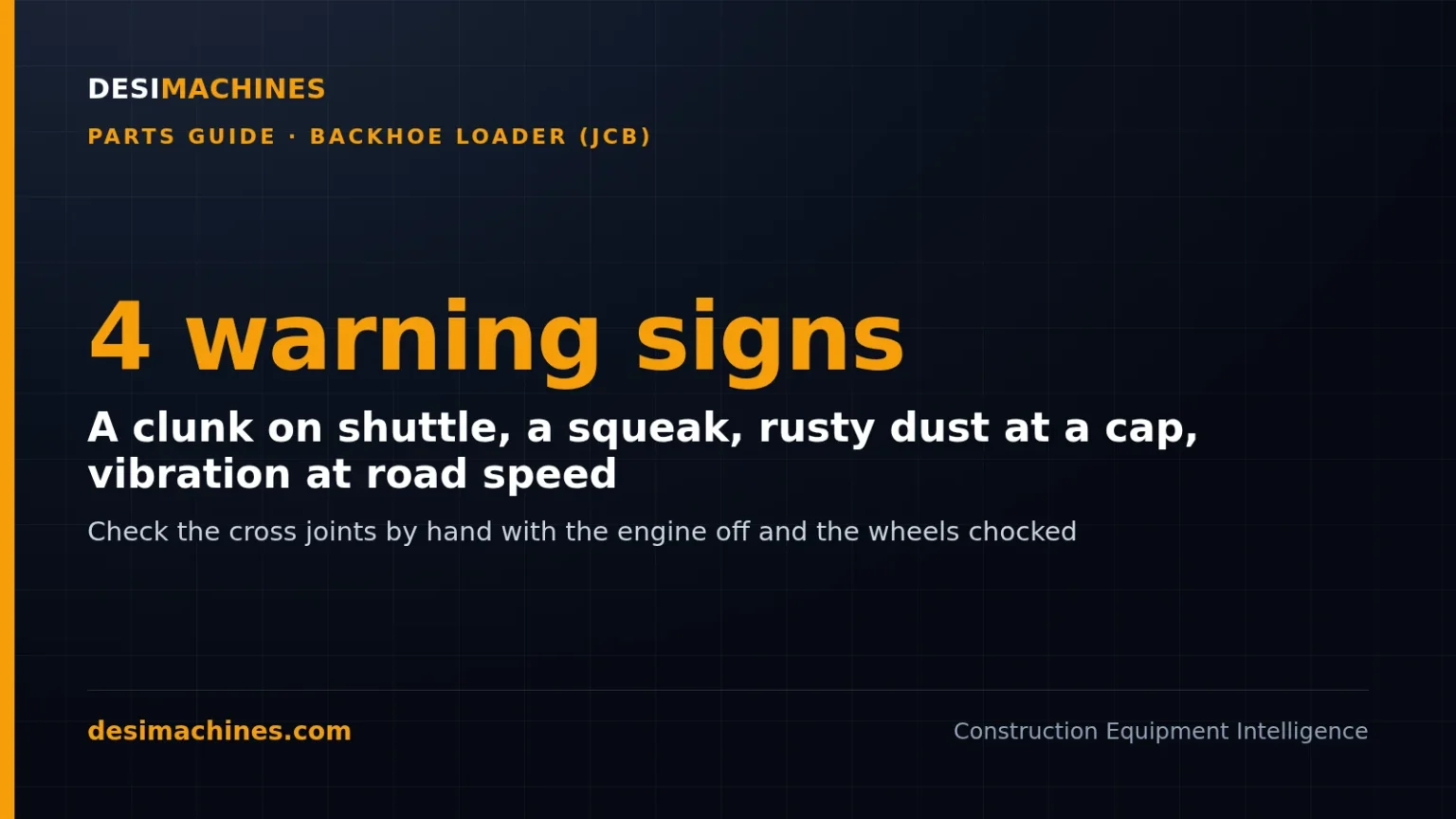
A backhoe loader that clunks under the floor every time you shuttle from forward to reverse, or shakes harder as it picks up road speed, very often has a worn cross joint on its propeller shaft. The propeller shaft is the steel tube that carries drive from the gearbox to the rear axle, and on a four-wheel-drive machine a second one carries it to the front axle.
Most people in India call every backhoe loader a JCB, and nothing here changes with the badge. This guide explains what the shafts do, which machines have one or two, the parts of a shaft, the signs that a joint is wearing out, how to check it by hand, and how to buy the right cross joint. It gives no prices, because those depend on the shaft, the joint size and the seller.
What does a propeller shaft do on a backhoe loader?
It joins two heavy parts that cannot be bolted together. The gearbox hangs in the middle of the frame and the drive axle sits lower down, under the backhoe end, so something has to carry the turning force across the gap and still cope with a small change in angle. That is the propeller shaft.
The names get mixed up on site, so it helps to know them. In British English, as Wikipedia’s article on drive shafts puts it, the shaft from the gearbox to the rear differential is the propeller shaft or prop shaft, and “drive shaft” is kept for a shaft that runs out to a wheel. In India the names are used loosely, and all of them usually mean the same part. A complete prop shaft assembly is the tube, a slip joint and one or more universal joints.
Specification sheets say the same thing in their own words. Of the 51 backhoe loader sheets in the DesiMachines catalogue in October 2026, 18 describe the rear axle as driven by a short shaft from the gearbox. The JCB 3DX, JCB 3DX Plus and JCB 4DX sheets read “driven by short prop shaft from gear box”. The Bull HD76 4WD uses nearly the same words. The Mahindra SX IV says “driven by short drive shaft”. The other 33 sheets do not say how the rear axle is driven, which tells you about the sheets, not about the machines.
How many propeller shafts does a backhoe loader have?
One or two, and the drive type decides it. A wheel loader is different again, because both its axles always drive.
| Machine | Shafts from the gearbox | What the front axle does | Example sheets |
|---|---|---|---|
| Backhoe loader, 2WD | One, to the rear axle | Only steers. No shaft goes forward | Mahindra SX IV and Mahindra VX IV: front axle “non-driven” |
| Backhoe loader, 4WD | Two: a short one to the rear axle and a longer one forward to the front axle | Steers and drives | CASE 770 NX Magnum: separate 2WD and 4WD front axle units |
| Wheel loader | Two, front and rear, both always driving | Drives. Steering comes from the frame bending at the articulation joint | Tata Hitachi ZW225 CEV 5: optional bottom guard “for the propeller shaft and transmission” |
Table 1: Propeller shafts by machine type, with the wording from catalogue specification sheets (October 2026)
The front shaft on a 4WD backhoe is the one people forget. It is longer than the rear shaft and easy to miss at a service. If your machine is 4WD, every check in this guide applies to both shafts. Whether you need four-wheel drive at all is worked through in the comparison of 2WD and 4WD backhoe loaders, and what the front axle does in each case is in the guide to backhoe loader steering and the front axle.
What are the parts of a propeller shaft?
Five parts do the work. The cross joints are the ones that wear.
| Gearbox output flange | Cross joint 1 | Slip joint (splines) | Shaft tube | Cross joint 2 | Axle input flange |
Figure 1: A propeller shaft laid out from the gearbox to the axle
Read Figure 1 from left to right. Drive leaves the gearbox through a bolted flange, turns a corner at the first cross joint, passes through the slip joint and along the tube, turns back at the second cross joint and enters the axle.
The cross joint is a universal joint. Wikipedia’s universal joint article describes it as a pair of hinges set at 90 degrees to each other and joined by a cross shaft. The cross has four arms. Each arm wears a steel cap packed with needle rollers, thin rollers that let the cap swing on the arm under load, and the caps sit in the forked ends of the shaft, called yokes. A shaft with a joint at each end has at least eight needle bearings, four in each joint. A greasable cross has a nipple in its centre.
The slip joint is a splined sleeve, like a set of teeth sliding in a matching groove. It lets the shaft get slightly longer or shorter as the machine moves, and it makes the shaft easier to fit. Where it has a grease nipple, grease it along with the joints.
The tube is hollow steel, made straight and balanced at the factory. Small steel weights welded to it are balance weights. Never knock them off.
A shaft long enough to sag in the middle is split in two and held up by a support bearing, also called a centre bearing, bolted to the frame. Whether your machine has one is shown in its parts book. The flanges at each end bolt the shaft to the gearbox and the axle.
What are the signs of a worn propeller shaft or cross joint?
A cross joint gives plenty of warning. It squeaks when it runs dry, clunks once the bearings have worn loose, and shakes the machine when the wear gets worse. The Wikipedia drive shaft article lists the same four signs for road vehicles: clicking or squeaking from under the vehicle, a clunk when accelerating or going into reverse, vibration, and trouble when turning.
| What you notice | Likely cause on the shaft | What to check |
|---|---|---|
| A single clunk under the machine when you shuttle between forward and reverse, or when you let the clutch take up drive | Play in a cross joint, or worn slip joint splines | The hand check in the next section. Movement between a cap and its yoke means the joint is finished |
| Vibration you feel through the floor and seat that grows with road speed, worst in the top gears | Worn cross joint, a bent or dented tube, a lost balance weight, or a shaft refitted out of line after a repair | Look along the tube for dents and fresh bright marks where a weight used to be. Ask whether the shaft was off recently |
| A squeak or chirp at walking speed that keeps time with the shaft, not with the engine | A dry cross joint | Grease it. If the noise stops, keep it greased. If it comes back within days, the bearing is already damaged |
| Reddish brown dust or rusty streaks around one cap | A cap running without grease, the needles wearing into the cross | Replace the cross. Grease will not repair a cap that has already turned to rust |
| The grease nipple will not take grease, or fresh grease comes out of only some of the four caps | A blocked nipple or a passage choked with old hard grease | Change the nipple and try again. A cap that still stays dry needs the joint changed |
| Oil on the tube near the gearbox or axle end | A leaking seal on the gearbox output or axle input, not the shaft itself | Find the leak before replacing anything on the shaft |
Table 2: Symptoms, likely causes and the first check on a backhoe loader propeller shaft
Not every noise from underneath is the shaft. A growl from one wheel that changes when you turn is more likely a hub, and the guide to backhoe loader wheel bearings covers that check. A whine that rises and falls with road speed and changes between pulling and coasting points to the gears inside the axle, the crown and pinion, and the guide to crown pinion repair explains what that job involves. A shake that follows engine speed even with the machine standing still is more likely the engine on its mounts, covered in the engine mounting guide.
How do you check a propeller shaft for play?
By hand, with the engine off, in about ten minutes. You need a torch and a clean rag.
Park on level ground. Lower the loader bucket and the backhoe bucket flat on the ground, stop the engine, take the key out and put the parking brake on. Chock the wheels as well. On many machines the parking brake works through the axle or on the shaft line itself: the JCB 3DX sheet lists “disc brakes on rear axle input disc”, and the Cat 950L wheel loader sheet lists a parking brake “mounted on the driveshaft”. With the shaft disconnected or broken, a brake like that may not hold the wheels. Never get under a machine that is held up only by its hydraulics.
Then, at each joint in turn:
- Hold the shaft next to the joint and try to twist it one way and the other. A little free movement before it stops is normal backlash in the gears. Watch the joint itself. If the cap moves in the yoke, or the yoke moves on the cross, the joint is worn.
- Grip the shaft near the joint and lift it up and down hard. There should be no knock at all.
- Do the same at the slip joint. Up-and-down movement there means worn splines.
- Check the flange bolts at both ends for tightness, and look for fresh shiny marks around the bolt heads, which show the flange has been moving.
- Run the torch along the tube. Look for dents, cracks near the welds and missing balance weights.
Do this at every service and before you buy a used machine. A worn joint left running can break, and a broken shaft can flail under the machine. It will also hammer the gearbox output and the axle input, which are far bigger repairs. What a gearbox job involves is set out in the guide to JCB transmission repair.
Why does phasing matter when a propeller shaft is refitted?
Because one cross joint working at an angle does not turn smoothly. Wikipedia’s universal joint article explains it: even when the input shaft turns at a steady speed, the output speeds up and slows down twice in every turn, and that causes vibration and wear. A shaft with a joint at each end cancels this out, but only if the two yokes on the tube line up the way the factory set them and the angles at both ends match. That lining up is called phasing.
The slip joint makes it easy to get wrong. Its splines will slide together in many positions, and only one of them is correct. Before anyone pulls a shaft apart, paint a line across both halves of the slip joint and across each flange, and put it back on the same marks. If the shaft started shaking right after a repair, phasing is the first thing to check.
A shaft that has been straightened, re-tubed or had a joint welded should be balanced again before it goes back in. Balancing means spinning the shaft on a machine and adding small weights until it runs smoothly.
How often should you grease the propeller shaft?
As often as the lubrication chart in your operator manual says, and that chart is the only reliable source for your machine. The joints under a backhoe loader are among the grease points most often missed, as the guide to greasing and lubrication notes, simply because you have to crawl under to reach them.
Grease each cross until fresh grease shows at all four caps. That way old grease, dust and water are pushed out. Grease the slip joint too if it has a nipple. After working through water or deep mud, grease the joints at the end of the shift instead of waiting for the next service. A hand grease gun with a flexible hose reaches them most easily; the grease gun guide explains the types.
Some joints have no nipple at all. The Tata Hitachi ZW550 wheel loader lists hermetically sealed universal joints that extend the greasing interval up to 12,000 hours. On a sealed joint there is nothing to grease. Check it for play like any other, and replace it when it wears.
How do you find the right cross joint for your machine?
Cross joints are not one size for all backhoe loaders. They differ by the diameter of the caps, the width across two opposite caps, and the way the caps are held in the yoke, which may be by circlips inside or outside the yoke or by bolted plates. The front and rear shafts on the same 4WD machine can use different joints.
The safe way to buy is in this order:
- Read the part number on the old shaft or joint if it can still be seen.
- Give the dealer the machine model, the serial number from the plate, the year and whether it is 2WD or 4WD, and say whether the joint is from the front or the rear shaft.
- Measure the old cross: cap diameter and the width across the caps, in millimetres, and note how the caps were held. Take the old part to the counter.
This is a general guide based on machine size class. Always confirm the fit with your machine’s operator manual or the manufacturer before buying or fitting.
Check the yokes while the shaft is off. A new cross pressed into a yoke with worn or oval bores will be loose again in weeks. If the slip joint splines are worn or the tube is dented, ask whether the shaft needs repair as a whole instead of a new joint. Other drive and wear parts on these machines are listed in the guide to backhoe loader parts and the guide to wheel loader parts.
Looking at a machine and want to see how the drivelines differ across makes? Compare the backhoe loaders on sale in India, with their specifications side by side.
What decides the price of a propeller shaft or cross joint?
A cross joint on its own is a small part. A complete shaft is a much bigger one. Between them, these things move the figure:
- Whether you need a joint or the whole shaft. Changing only the crosses is the smaller job, as long as the yokes, splines and tube are sound.
- Which shaft it is. The front shaft on a 4WD machine is longer, and its joints may not be the same as the rear ones.
- The joint size. A bigger cross with bigger caps is more steel and more needles, and the cap type has to match the yoke.
- Greasable or sealed. The two are made differently, so they are priced differently.
- Workshop work. Pressing out seized caps, straightening, re-tubing and balancing all add labour, and a shaft that must be balanced needs a workshop with the machine to do it.
Ask the dealer to quote the parts and the labour separately, so you can see which part of the bill is which.
Where the facts in this guide come from
The axle and brake descriptions are taken from the specification sheets of machines in the DesiMachines catalogue in October 2026: JCB 3DX, 3DX Plus and 4DX, Bull HD76 4WD, Mahindra SX IV and VX IV, CASE 770 NX Magnum, Tata Hitachi ZW225 CEV 5 and ZW550, and Cat 950L. The names of the parts, the symptoms and the way a single universal joint speeds up and slows down come from the Wikipedia articles on drive shafts, universal joints and needle roller bearings. How the gearbox itself works is covered in the guide to the backhoe loader transmission, and the full set of parts guides is in the parts and maintenance guide.
For any machine you are thinking of buying, look at the JCB 3DX, JCB 4DX or the full range of wheel loaders, and ask the dealer to show you the shaft joints on the machine before you sign.
Prices, specifications and features are indicative, vary by variant, location and date, and should always be confirmed with the official OEM or authorised dealer before any purchase decision. DesiMachines is not liable for decisions taken on the basis of information that may have changed after publication.
Get a propeller shaft price from a dealer near you
Tell us your machine and what you need, and we will ask the nearest dealer to reach out to you with a price.