
 Excavator
294 models
Excavator
294 models  Backhoe Loader
51 models
Backhoe Loader
51 models  Crane
68 models
Crane
68 models  Concrete Mixer
79 models
Concrete Mixer
79 models  Wheel Loader
54 models
Wheel Loader
54 models  Compactor / Roller
45 models
Compactor / Roller
45 models  Motor Grader
42 models
Motor Grader
42 models 
 Concrete Pump
66 models
Concrete Pump
66 models  Skid Steer Loader
11 models
Skid Steer Loader
11 models 


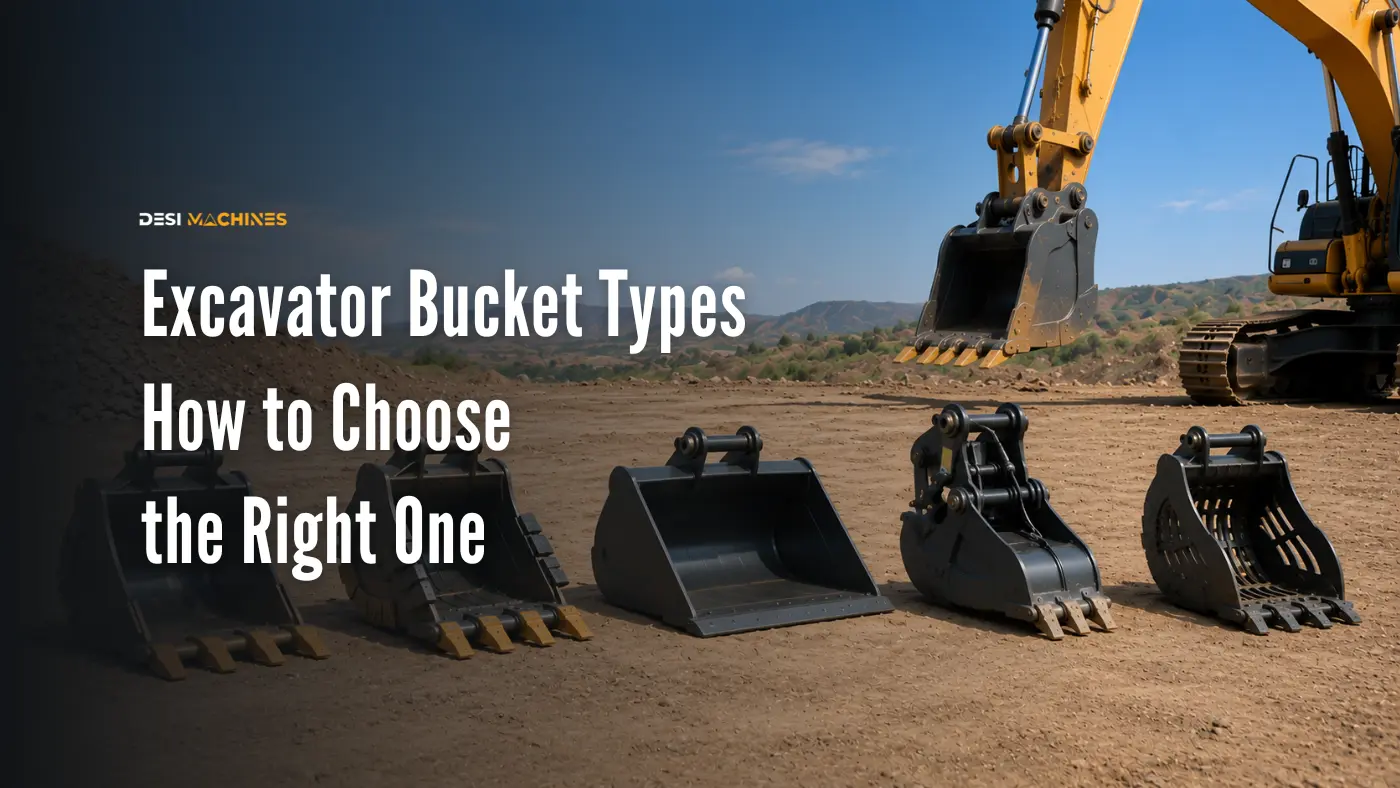
An excavator bucket is the digging tool bolted to the end of the arm, and the type you fit decides what soil or rock the machine can handle and how fast it fills a tipper. The common types are the general-purpose (GP) bucket for everyday soil, the heavy-duty (HD) or rock bucket for hard and stony ground, the wide ditching or grading bucket for cleaning and levelling, the tilt bucket that angles for slopes and drains, and the narrow trenching bucket for pipe and cable lines. Pick the wrong one and the machine works twice as hard for half the output.
In India people often just say “bucket” or ask the dealer for a “balti”, but the size and the build matter more than the name. This guide explains each bucket type in plain words, which material each one is made for, how to match the bucket size to your machine’s tonnage using real figures, and how the teeth and wear parts decide the running cost. If you are new to these machines, start with the complete excavator guide and come back here for the bucket.
What are the main types of excavator buckets?
Most Indian sites run on five or six bucket types, and each one is built for a different job. Fitting the right bucket is the cheapest way to raise a machine’s output, because a bucket that suits the ground fills in one clean pass instead of three scrapes.
General-purpose (GP) bucket
The GP bucket is the one almost every machine leaves the yard with. It has a medium-width mouth and a handful of teeth, and it handles ordinary soil, sand, gravel and loose earth. For trenching, foundation digging and loading tippers on normal ground, this is the default and the right choice most days.
Heavy-duty (HD) and rock bucket
A heavy-duty bucket is a thicker, tougher GP bucket with extra wear plates and stronger teeth. A true rock bucket goes further, with a reinforced base, side cutters and a curved profile that bites into stone and hard murrum. If your work is in rocky ground, quarry floors or old demolition rubble, the HD or rock bucket pays for itself by lasting instead of cracking.
Ditching, grading and cleaning bucket
A ditching bucket (also called a grading, mud or cleaning bucket) is wide, shallow and usually has no teeth, just a smooth cutting edge. It is made for cleaning canals, shaping slopes, spreading soil and finishing the bottom of a trench flat. Because it has no teeth, it leaves a clean surface that a toothed bucket never can.
Tilt and tilt-rotator bucket
A tilt bucket angles left and right by up to about 45 degrees, so the operator can cut a slope or a drain gradient without re-parking the machine. A tilt-rotator adds full rotation on top, turning the bucket into a wrist. These are a bigger investment and stay a specialist choice on Indian sites, but for roadside drains and landscaping they save real time.
Trenching and other special buckets
A trenching bucket is narrow and deep, sized to the pipe or cable it is digging for. Beyond these you will also see the skeleton or sieve bucket that screens rubble from soil, and the grab or clamshell bucket for wells, pits and material handling. We cover the last one in detail in the guide to clamshell buckets and their advantages.
| Bucket type | What it is | Best for | The trade-off |
|---|---|---|---|
| General-purpose (GP) | Medium mouth, standard teeth | Soil, sand, gravel, everyday digging | Wears fast in rock |
| Heavy-duty / rock | Reinforced base, strong teeth, side cutters | Hard ground, murrum, quarry, rubble | Heavier, costs more |
| Ditching / grading | Wide, shallow, no teeth | Canals, slopes, cleaning, levelling | Cannot dig hard ground |
| Tilt / tilt-rotator | Angles and rotates | Drains, slopes, roadside gradients | Costly, specialist |
| Trenching | Narrow and deep | Pipe and cable lines | One width per job |
GP vs heavy-duty bucket: what is the difference?
The difference between a general-purpose and a heavy-duty bucket is the thickness of the steel and the strength of the wear parts, not the shape. A GP bucket is lighter, so it holds a bit more soil for the same machine and burns less fuel per load. An HD bucket carries extra plates on its base and sides and heavier teeth, so it survives stone and shock that would crack a GP bucket in weeks.
The plain rule: match the bucket to the ground, not to the biggest job you might one day do. In soft and normal soil a GP bucket lifts more and costs less to run. In rock, an HD bucket that lasts a year beats a GP bucket you replace every quarter. Many contractors keep both and swap them by site, which is easy once you understand how excavator attachments mount and change over.
Which excavator bucket suits which material?
Choose the bucket by the hardest material you dig regularly, because that is what wears it out. Here is the simple map most Indian operators follow.
- Soft soil, sand, loose earth: a wide GP bucket. It fills fast and the machine flies through the work.
- Mixed soil with stones, murrum, hard clay: a heavy-duty bucket with good teeth. It takes the knocks without cracking.
- Hard rock, quarry floor, boulders: a rock bucket with side cutters, and often a hydraulic rock breaker to loosen the stone first.
- Mud, silt, canal cleaning, slope shaping: a toothless ditching or grading bucket for a clean, level finish.
- Wells, pits, deep handling: a grab or clamshell bucket that grips instead of digs.
Trying to dig rock with a GP bucket is the most common and costliest mistake we see. The teeth round off, the base cracks, and the repair bill dwarfs what the correct bucket would have cost.
How do you choose the right excavator bucket size?
Bucket size is measured by capacity in cubic metres (m³), and it must match the machine’s weight class. Too big a bucket and the machine tips or strains its hydraulics; too small and you waste passes. The factory-fitted bucket is sized for the machine, so use it as your guide, and only go wider for light material or narrower for rock.
The figures below are the standard bucket capacities on live models, dated to keep them honest as ranges get revised.
Bucket capacity is also the first input in the output per hour calculation, so a bucket that never fills costs you far more than the difference in its price.
| Machine class (operating weight) | Typical bucket capacity | Example on-site models |
|---|---|---|
| Mini, about 2 Ton (2,000 kg) | 0.04 to 0.05 m³ | XCMG XE20U, SANY SY20U |
| Mini, about 3.5 Ton (3,500 kg) | 0.10 to 0.13 m³ | SANY SY35U, Kobelco SK35SR |
| Compact, about 8 Ton (8,000 kg) | 0.24 to 0.35 m³ | JCB 81, Kobelco SK80 |
| Mid, about 13 to 14 Ton (13,000 to 14,000 kg) | 0.60 to 0.72 m³ | JCB NXT 140, Komatsu PC130-7 |
| Standard, about 20 to 21 Ton (20,000 to 21,000 kg) | 0.86 to 1.20 m³ | Tata Hitachi EX 210, SANY SY210C-9 |
So a 20-ton class machine like the Tata Hitachi EX 210 carries a bucket of roughly 0.86 to 1.5 m³ depending on the front fitted, while a 2-ton mini manages about 0.04 to 0.05 m³. If you dig lighter material you can fit the wider bucket in each range; if you dig rock, drop a size for strength. To see the full class-by-class picture, read our guide to the types of excavators and how each size is used.
The figures for every size class we list, along with a model-by-model table, are set out in the excavator bucket capacity guide.
What about bucket teeth, wear parts and running cost?
The bucket itself lasts years, but the parts that touch the ground wear out and get replaced. These are the ground engaging tools, and they decide your real bucket cost.
Worn teeth and a battered bucket lip are also the quickest way to read how hard a second-hand machine has worked, which is why they sit high on the checklist in our used excavator buying guide.
Teeth and adapters
The teeth (some operators call them nakhun) are the points that break the ground. They sit on adapters welded to the bucket lip and knock off for replacement when they wear. Keeping sharp teeth on is the single biggest thing you can do for output: worn, rounded teeth make the machine push instead of cut, which burns fuel and strains the hydraulics.
Cutting edges and side wear
A toothless ditching bucket runs a bolt-on cutting edge along its lip that you flip or replace as it wears. Rock buckets add side cutters and base wear plates. How hard and how thick those plates should be is explained in the guide to wear plate for bucket lining. Check all of these when you grease the machine, and change them before they wear into the bucket body, because a worn edge that eats into the shell turns a cheap part into a welding job.
The bucket is only one attachment among several. If you also run a breaker, a ripper or a grab, our guide to excavator attachment costs lays out what each one adds to your budget.
Which excavator bucket should you buy for Indian work?
Buy the bucket for the ground you dig most, and keep a second one for the exception. For a contractor doing everyday soil, trenching and tipper loading, a good GP bucket on a 20-ton class machine is the Indian workhorse; models like the Tata Hitachi EX 210 sit around ₹60–65 Lakh (indicative, as of July 2026), while a value pick such as the SANY SY210C-9 lists near ₹51–57 Lakh (indicative, as of July 2026).
If your work is town plots and boundary walls, a swing-boom mini with a small GP bucket, like the XCMG XE20U at about ₹20–22 Lakh (indicative, as of July 2026), does the job. For rock and quarry, budget for a heavy-duty or rock bucket on top of the machine, and run the numbers on equipment finance before you commit, because the right bucket earns its price back in output while the wrong one just wears out.
Ready to shortlist? Compare live excavator models and prices and get the best current offer with your site’s material and dig depth in hand.
Excavator buckets, in short
The bucket is where the machine meets the ground, so it deserves as much thought as the machine itself. Fit a GP bucket for everyday soil, a heavy-duty or rock bucket for stone, a toothless ditching bucket for cleaning and slopes, and a tilt bucket for drains and gradients. Size it to your machine’s tonnage, keep sharp teeth and good cutting edges on it, and it will fill faster, burn less fuel and outlast the loan. When you are ready to buy, match the bucket to your ground first, then compare excavator models and prices and talk to our team.
Read next: how the rest of the excavator’s components work, and which excavator bucket suits which project in more detail.
If most of your work is shaping ground rather than digging it, the guide to excavator land levelling and grading explains which bucket gives the cleanest finish.
What a tooth point and an adapter cost for each excavator size is set out in the bucket teeth price guide.
Prices, specifications and features are indicative, vary by variant, location and date, and should always be confirmed with the official OEM or authorised dealer before any purchase decision. DesiMachines is not liable for decisions taken on the basis of information that may have changed after publication.