
 Excavator
294 models
Excavator
294 models  Backhoe Loader
51 models
Backhoe Loader
51 models  Crane
68 models
Crane
68 models  Concrete Mixer
79 models
Concrete Mixer
79 models  Wheel Loader
54 models
Wheel Loader
54 models  Compactor / Roller
45 models
Compactor / Roller
45 models  Motor Grader
42 models
Motor Grader
42 models  Dozer
41 models
Dozer
41 models  Concrete Pump
66 models
Concrete Pump
66 models  Skid Steer Loader
11 models
Skid Steer Loader
11 models  Telehandler
13 models
Telehandler
13 models 


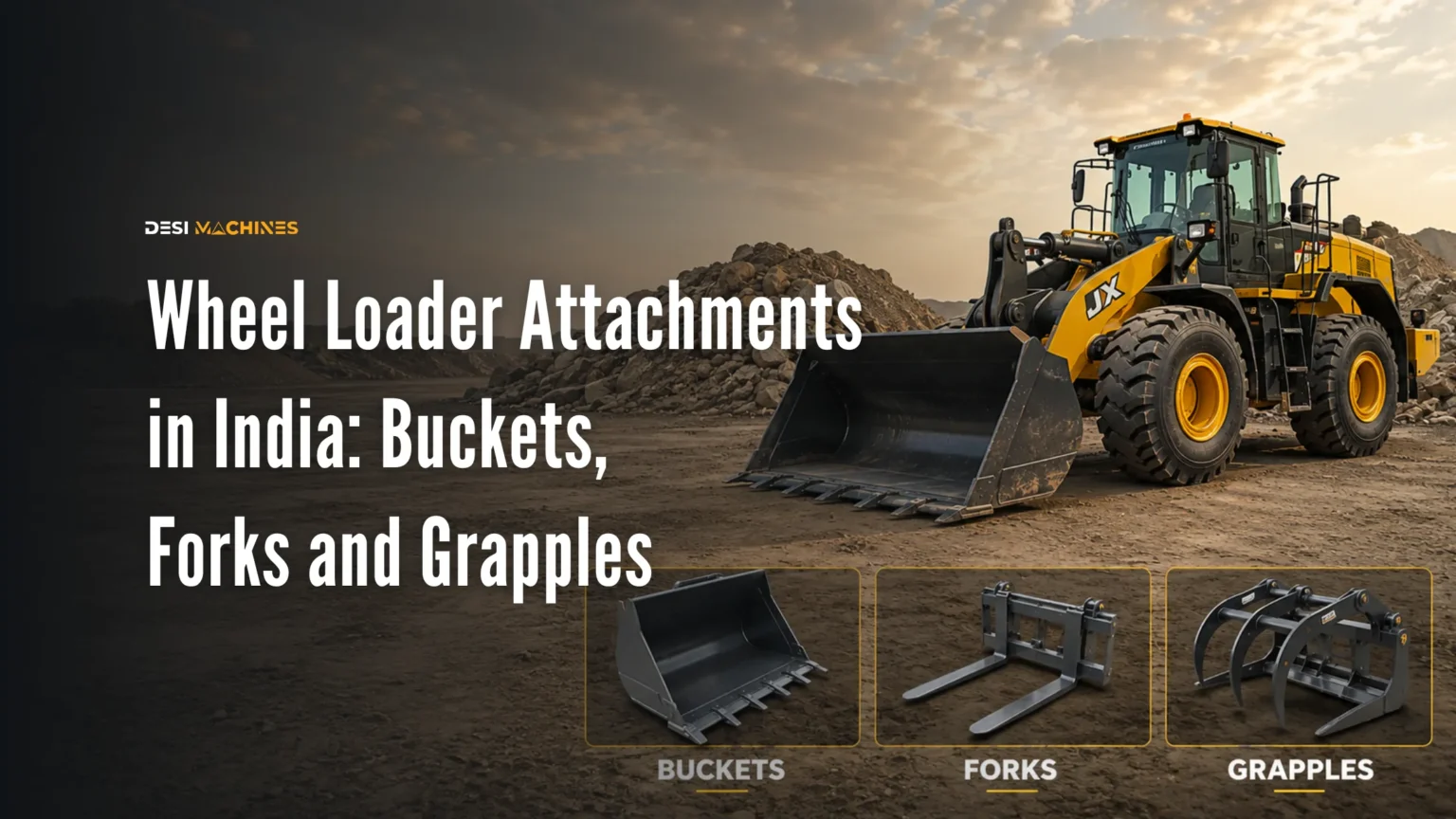
Wheel loader attachments are the tools that mount on the front of a payloader in place of the standard bucket, so one machine can load, carry, grab and lift instead of doing only one job. The common ones in India are general purpose and rock buckets, pallet forks, log and scrap grapples, a snow or dozing blade, a sweeper and a lifting hook or jib.
Every one of the 54 wheel loaders listed on DesiMachines publishes a payload and an operating weight, and both matter here: hanging a heavy attachment on the arms uses up part of what the machine could otherwise carry. Get that trade right and a payloader earns through the year instead of standing idle between loading jobs.
What attachments can a wheel loader use?
A wheel loader can use any tool that fits its coupler and stays inside its payload. In Indian yards and on Indian sites, these are the ones that actually turn up.
General purpose bucket. The one the machine is sold with. It handles sand, aggregate, soil and mixed material, and does the large majority of the work on most machines.
Rock bucket. Thicker shell, heavier cutting edge, usually with bolt-on teeth. Made for quarry muck and blasted rock, where a general purpose bucket wears out at the corners.
Pallet forks. Two tines on a carriage, for cement bags, brick pallets, block bundles and drums. This is the attachment that turns a loader into a yard machine and the one most first-time buyers underestimate.
Grapple. A bucket or fork with a hydraulic clamp on top, for logs, scrap, bamboo and loose waste that a plain bucket cannot hold.
Blade. A straight or angled plate for pushing and levelling, used on site clearance and on approach roads.
Sweeper. A rotating brush for cleaning haul roads, plant yards and municipal work. Common on municipal contracts, rare on private sites.
Lifting hook or jib. A hook mounted on the bucket or on a dedicated carriage, for occasional lifting. It is not a crane, and it should not be treated as one.
The other loader families take a similar spread of tools. If you are comparing machines rather than attachments, our guides to backhoe loader attachments, skid steer attachments and telehandler attachments cover the same ground for those machines.
What is the most common wheel loader attachment?
The general purpose bucket, by a wide margin. Every wheel loader listed on DesiMachines publishes a bucket capacity and a bucket width as standard equipment, and for most owners it stays on the machine permanently.
Bucket sizing is its own subject, because capacity has to match both the material density and the machine’s payload. Our guide to wheel loader bucket types and sizing covers struck against heaped capacity and how to match a bucket to what you are loading, and wheel loader dump height and reach covers whether the loaded bucket will clear the side of your tipper.
For context, the listed machines carry standard buckets from about 1.0 m³ on the smallest compact loaders to 5.2 m³ on the largest 15 to 30 Ton machines, with the mining-class loaders above that running larger again, as per the current August 2026 spec sheets.
How do wheel loader attachments connect?
Through a coupler, sometimes called an attachment plate or a hitch, which is the frame at the end of the loader arms that the tool locks onto.
There are two arrangements. On a pin-on machine the bucket is bolted and pinned directly to the arms. It is the strongest and cheapest arrangement, and it is what most Indian wheel loaders are supplied with, but changing the tool means knocking out pins and is an hour’s work with help.
On a quick coupler machine there is a carrier between the arms and the tool. The operator drives the coupler into the attachment, then locks it, either with two hand levers or hydraulically from the cab. A swap takes a couple of minutes.
Two things to check before you buy any attachment. First, the coupler standard has to match, and there is no single Indian standard, so an attachment built for one make will often not fit another without a change of carrier. Second, if the tool needs hydraulics, as a grapple or a hydraulic sweeper does, the machine needs a third hydraulic line run to the front. Many loaders leave the factory without one and it has to be fitted afterwards.
The best time to settle both is at purchase, when the coupler and the extra line are far cheaper than they are as a retrofit.
Does an attachment change what a wheel loader can lift?
Yes, and this is the part that gets missed. Two separate things move against you.
The attachment’s own weight comes out of the payload. A steel grapple or a fork carriage is heavier than the bucket it replaces, and every kilogram of tool is a kilogram of material the machine can no longer carry.
The load sits further forward. A bucket holds material close to the machine. Forks hold a pallet out at arm’s length, and a load further from the front axle has more leverage trying to tip the machine, so the safe load falls even where the weight has not changed.
| Size class | Machines publishing payload | Published payload | Standard bucket |
|---|---|---|---|
| Compact (1–8 Ton / up to 8,000 kg) | 1 of 2 | 1,800 kg | 1.0 – 1.2 m³ |
| Small (8–15 Ton / 8,000–15,000 kg) | 11 of 12 | 3,000 – 3,950 kg | 1.5 – 2.5 m³ |
| Medium (15–30 Ton / 15,000–30,000 kg) | 12 of 24 | 4,500 – 8,640 kg | 2.2 – 5.2 m³ |
| Large (over 30 Ton / 30,000 kg) | 9 of 16 | 9,500 – 40,800 kg | 3.6 m³ and above |
Figures taken from the published specifications of the 54 wheel loaders listed on DesiMachines, August 2026. Payload is published by fewer machines than bucket capacity is, so where the sheet is silent, ask the dealer for the figure in writing rather than assuming it from the class.
The published payload applies to the standard bucket. For any other tool, ask the dealer for the rated load with that attachment fitted. A reputable supplier will give you a figure; if nobody will put one on paper, treat that as the answer.
How much do wheel loader attachments cost in India?
DesiMachines lists machines rather than attachments, so we do not publish attachment prices, and a made-up figure would be worse than none. What we can give you is a way to get a real number and read it properly.
Ask for a quote against three things, and the prices you get back become comparable. The exact machine, by make and model, because the coupler decides the fit. The working width, which for a bucket should match the machine’s tyre track so the tyres run in cleared ground. The wear parts, because a bucket quoted with a bolt-on cutting edge and replaceable teeth costs more up front and much less over its life than one quoted bare.
Then ask what the wear parts cost on their own and how quickly they are available locally. On a bucket working in rock, teeth and edges are a running cost rather than a one-time one, and a cheap bucket with parts nobody stocks is the expensive option. The same reasoning applies to any component on the machine, and our spare parts guide explains what to check before you fit a part.
If a tool is needed for one job rather than every job, hiring the machine with the attachment already on it is usually cheaper than buying it. Rates and what to check are in our guide to wheel loader hire in India.
Which attachments does your work need?
For most buyers the honest answer is the bucket the machine comes with, plus at most one more tool.
If you load sand, aggregate or soil all day, the standard bucket is the whole answer. Spend the money on the right capacity instead, and on a spare set of cutting edges.
If you work in a quarry or on blasted rock, budget for a rock bucket from the start. A general purpose bucket in that material wears out at the corners and the repair bill arrives sooner than the savings.
If your machine spends part of the year in a yard or on a building site, pallet forks pay for themselves quickly. Unloading cement, blocks and steel is otherwise a second machine’s job.
If you handle logs, bamboo or scrap, a grapple is the difference between doing the work and pushing it around. Confirm the third hydraulic line before ordering.
And if you are choosing the machine itself rather than the tools, start with wheel loader types by size class and how a payloader works, then compare live wheel loader models and prices and ask a dealer to quote the machine and the attachments together. Bought at the same time, they are one negotiation instead of two.
Prices, specifications and features are indicative, vary by variant, location and date, and should always be confirmed with the official OEM or authorised dealer before any purchase decision. DesiMachines is not liable for decisions taken on the basis of information that may have changed after publication.
Machines, tenders and news for this industry: Demolition · Steel, Cement and Process Plants · Material Handling
