
 Excavator
294 models
Excavator
294 models  Backhoe Loader
51 models
Backhoe Loader
51 models  Crane
68 models
Crane
68 models  Concrete Mixer
79 models
Concrete Mixer
79 models  Wheel Loader
54 models
Wheel Loader
54 models  Compactor / Roller
45 models
Compactor / Roller
45 models  Motor Grader
42 models
Motor Grader
42 models  Dozer
41 models
Dozer
41 models  Concrete Pump
66 models
Concrete Pump
66 models  Skid Steer Loader
11 models
Skid Steer Loader
11 models  Telehandler
13 models
Telehandler
13 models 


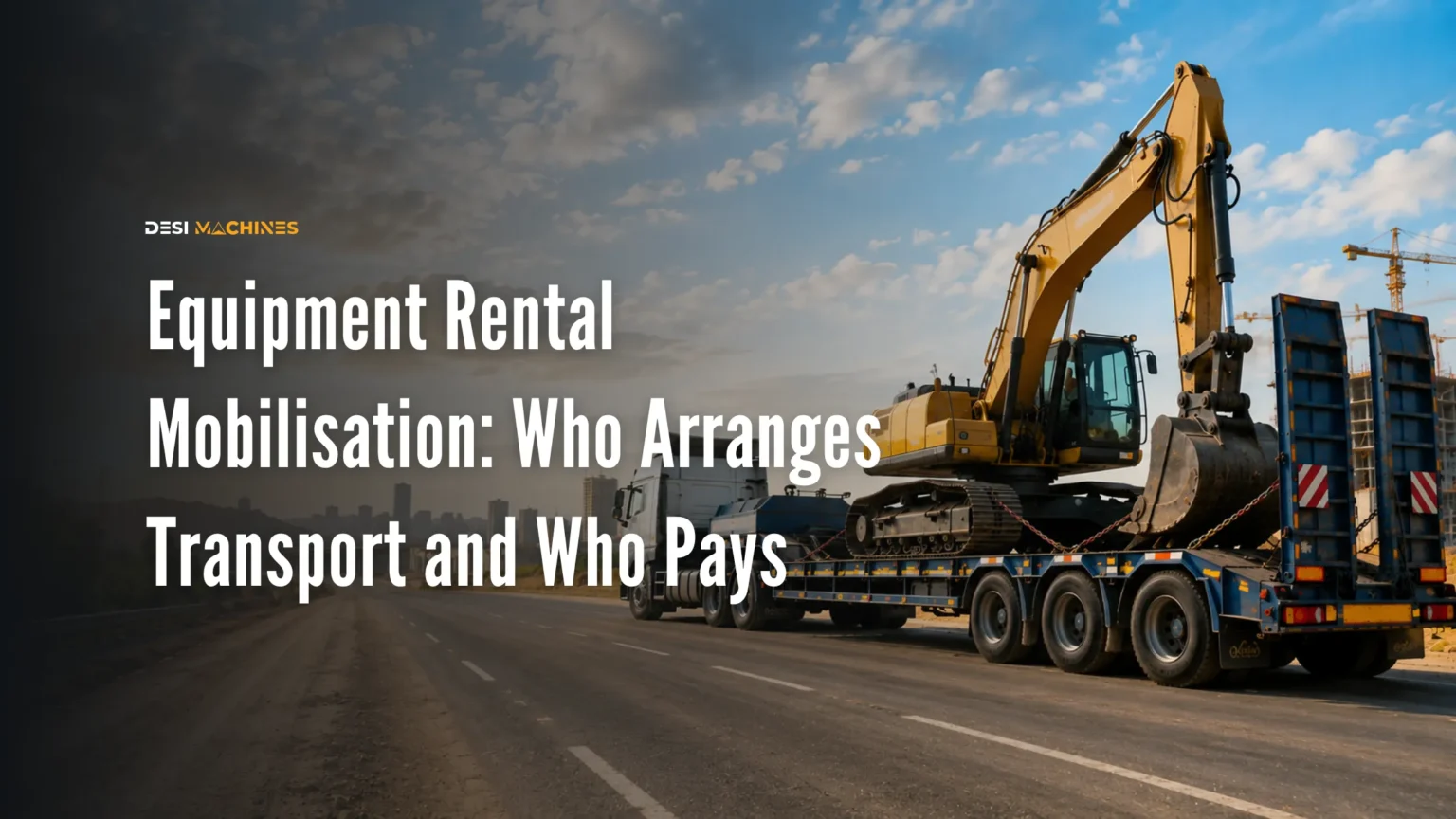
Mobilisation in equipment rental is the job of getting the hired machine from the yard to your site and ready to work. Demobilisation is the same journey back. Together they are a separate line on almost every hire, arranged and billed apart from the machine rate itself, and on a short hire they can cost as much as the machine.
Most disputes on a first hire start here rather than with the rate. The renter assumes the yard is bringing the machine; the yard has quoted a rate that assumes the renter arranges the trailer. This guide sets out who normally does what, what a mobilisation charge covers, and what to settle in writing before the machine leaves the yard.
Who arranges the transport, the yard or you?
On most Indian hires the yard arranges it and bills you, because the yard moves machines every week and has trailer operators it already uses. That is the normal arrangement and usually the cheaper one. It is not automatic, though, and it is not universal.
Three patterns are common:
- Yard arranges, yard bills. The most common. You get one invoice and the yard carries the job of finding a trailer. Ask whether the figure quoted is one way or both ways.
- Yard arranges, you pay the transporter direct. Cheaper on paper, but you are then the transporter’s customer if anything goes wrong on the road.
- You arrange your own transport. Sometimes worth it if you already move machines. The yard will usually still want to approve the trailer and to inspect loading.
Whichever pattern you take, get the rate as a single landed figure covering machine, operator, diesel and transport both ways, with the minimum hours or days stated. A low headline rate with transport added afterwards is not a cheaper machine. The same principle runs through the guide on how to rent construction equipment in India.
Which machines need a trailer and which drive themselves?
This is what really sets the mobilisation cost, and it splits cleanly by whether the machine has wheels or tracks.
| Machine | How it reaches site | What that means for mobilisation |
|---|---|---|
| Backhoe loader | Drives itself on the road | Cheapest to mobilise. The operator drives it over for a local hire |
| Wheel loader | Drives short distances; trailer for any real distance | Road travel is slow and wears tyres, so yards trailer them beyond a few kilometres |
| Self-loading mixer | Drives itself | Low mobilisation cost, one reason it suits scattered small pours |
| Road roller | Usually trailered | Slow on road; trailer both ways on most hires |
| Crawler excavator | Trailer only | Highest mobilisation cost, and the reason one-day hires rarely make sense |
The practical consequence is a rule worth remembering: a machine that drives itself can be hired for a day, a machine that needs a trailer usually cannot. A tracked excavator hired for a single day means paying for a trailer both ways, which can come to as much as the machine for that day. Hire it for a week and the same transport cost is spread thin. This is exactly why the guide to backhoe loader rental treats short hires as normal while the guide to excavator rental in India pushes you towards longer ones.
Which trailer a tracked machine needs depends on its operating weight and width, covered in the guide to choosing a trailer for excavator transport, and the weights themselves in excavator operating weight by size class.
What does a mobilisation charge cover?
Ask for it item by item, because the word covers different things in different yards. A full mobilisation charge normally includes:
- The trailer or truck, and its driver, from yard to site.
- Loading the machine at the yard and unloading at your site.
- Any escort, permits or tolls the movement needs.
- The operator’s travel to site, where an operator is supplied.
What it often does not include, and what you should ask about by name: the return journey, waiting time if your site is not ready when the trailer arrives, a crane if the machine has to be lifted rather than driven off, and the cost of a second attempt if access fails. Each of those is a normal charge; the problem is only ever that nobody mentioned it.
Note that mobilisation advance in a construction contract is a different thing with a similar name: it is money paid to a contractor to start work, not a transport charge. That instrument is explained separately in the guide on what a mobilisation advance really costs to take.
How is mobilisation charged: one way, both ways or per kilometre?
All three are used, and they are not comparable until you convert them to one landed number.
- Both ways as a lump sum. The clearest, and the easiest to compare between yards. Ask for this one.
- One way, with the return billed at the end. Common, and the usual source of a surprise on the final bill.
- Per kilometre. Fair on paper, but check whether the distance is measured from the yard or from your site, and whether the empty return run is counted.
On a monthly hire mobilisation barely registers. On a two or three day hire it can be the largest single item, which is why monthly rates always look cheaper per day. Work out the landed cost per working day, not the headline rate: transport divided across the hire, plus the daily rate. That one calculation settles most rent-or-buy and short-or-long questions on its own.
Comparing what a hire should cost before you talk to a yard? The rental guides for wheel loaders, road rollers and self-loading mixers each cover rates and the checks that go with them.
What is demobilisation and why is it billed separately?
Demobilisation is the return: loading the machine at your site, carrying it back and unloading at the yard. It is billed separately because it happens at a different time and often under different conditions, and because the yard cannot price it exactly until the hire ends.
Two things drive up a demobilisation bill. The first is a site that has changed since the machine arrived, so the trailer cannot reach where the machine now stands. The second is a machine that will not start or move, which turns a straightforward load into a recovery. Both are avoidable if you keep an exit route open for the whole hire and tell the yard early if the machine is giving trouble.
What goes wrong, and who carries it?
Four things account for most mobilisation disputes.
Damage in transit. Establish before the machine moves whether it is insured on the road and by whom. Photograph the machine at loading, with the date visible. This costs nothing and settles almost every later argument.
Access that fails. A trailer that cannot turn into your site is a wasted trip and a chargeable one. Measure the approach, gate and turning space beforehand; the guide to machine dimensions and site access sets out what to check.
Waiting time. A trailer standing at your gate because the site is not ready is billed by the hour. Give the yard a realistic arrival window rather than the earliest one you can imagine.
Machine hours starting too early. Agree whether the hire clock starts when the machine leaves the yard, when it reaches site, or when it first works. On a day hire the difference is real money.
What to agree in writing before the machine leaves the yard
Six lines in a message are enough. Get them confirmed by the yard before the trailer is booked:
- Who arranges transport, and whether the figure is one way or both ways.
- What the mobilisation charge includes, and what is billed extra.
- When the hire clock starts and stops.
- Who insures the machine on the road and on your site.
- Who pays for waiting time or a failed access attempt.
- Who arranges demobilisation, and how much notice the yard needs.
None of this needs a formal contract. A written message that both sides have agreed to is enough to settle a disagreement later, and asking these questions marks you as a serious hirer rather than an inexperienced one.
Mobilisation and transport, in short
Mobilisation is getting the machine to site, demobilisation is getting it back, and both are billed apart from the hire rate. The yard usually arranges it, but confirm that rather than assume it. Wheeled machines like backhoes and self-loading mixers drive themselves and mobilise cheaply; tracked machines need a trailer both ways, which is why short hires of a crawler excavator rarely pay. Ask for the rate as a single landed figure, settle the six points above in writing, and photograph the machine at loading.
To go through the hire process from the start, read the guide on how to rent construction equipment in India, or browse the full equipment rental guide. If the arithmetic is pushing you towards owning instead, compare excavator models and prices and backhoe loader models and prices.
A note on the figures in this guide
This guide describes how mobilisation is normally arranged and billed in the Indian rental market. It deliberately quotes no rupee figures: mobilisation is priced per journey and swings with distance, machine weight, trailer availability, permits and season, so any single number would mislead more than it helped. Ask two or three yards for a landed figure for your own machine, distance and hire length, and compare those.
Tracked machines are the hardest case here. Every dozer listed on DesiMachines is wider than the 2.6 m general road width limit, so taking a dozer on rent always means an over-dimension trailer movement rather than a machine that drives itself to site.
Prices, specifications and features are indicative, vary by variant, location and date, and should always be confirmed with the official OEM or authorised dealer before any purchase decision. DesiMachines is not liable for decisions taken on the basis of information that may have changed after publication.