
 Excavator
294 models
Excavator
294 models  Backhoe Loader
51 models
Backhoe Loader
51 models  Crane
68 models
Crane
68 models  Concrete Mixer
79 models
Concrete Mixer
79 models  Wheel Loader
54 models
Wheel Loader
54 models  Compactor / Roller
45 models
Compactor / Roller
45 models  Motor Grader
42 models
Motor Grader
42 models  Dozer
41 models
Dozer
41 models  Concrete Pump
66 models
Concrete Pump
66 models  Skid Steer Loader
11 models
Skid Steer Loader
11 models  Telehandler
13 models
Telehandler
13 models 


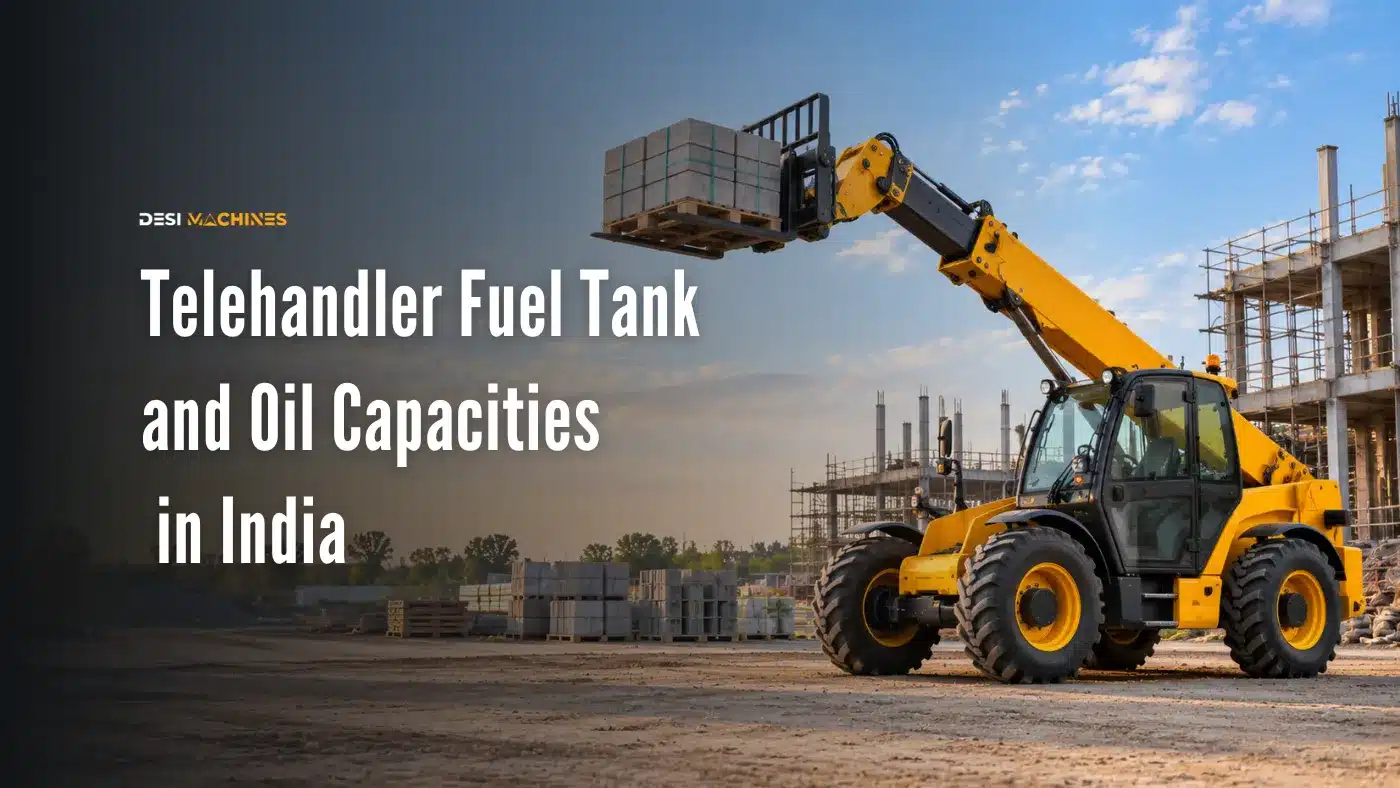
Telehandler fuel tank capacity is the amount of diesel the machine holds when the tank is filled to the top. Across the telehandlers sold in India it runs from 100 litres on the smallest tanks to 320 litres on the largest rotating machines, and ten of the thirteen machines listed here sit in a tight band between 100 and 135 litres. Engine oil is 11 to 14.2 litres, and the hydraulic tank holds 70 to 124 litres.
This page sets out those figures machine by machine, explains what each tank is for, and shows you how to confirm the right quantity for the machine standing in your yard. Telehandlers are often called boom loaders on Indian sites, and the numbers below cover both the fixed-boom machines and the rotating ones. If you are still working out which size suits your job, the telescopic handler guide covers types and sizes first, and the telehandler weight and dimensions guide covers what it takes to move one.
What is the fuel tank capacity of a telehandler?
A telehandler’s fuel tank holds between 100 and 320 litres of diesel depending on the machine. Every one of the thirteen telehandlers listed in India publishes this figure, so this is one of the few specs you can check across the whole class without guessing.
The spread is misleading at first glance, because it is not a smooth ladder. Ten of the thirteen machines sit between 100 and 135 litres. The jump to 320 litres happens on only two machines, both of them large rotating telehandlers. So for most buyers the real choice is not between 100 and 320 litres at all, but between 100, 110 and 135, and those three tanks are close enough that telehandler fuel tank capacity alone will rarely decide a purchase.
At the small end, the ACE AT 30 and the three MANITOU MXT machines carry 100 litres. The three JCB machines carry 110 litres. The three SANY machines carry the largest fixed-boom tank at 135 litres, including the smallest telehandler in the class.
That last point is worth pausing on, and it is covered in its own section below, because it is the thing most buyers get wrong about this spec.
Telehandler fuel tank and oil capacities by machine
The table below lists every telehandler on our books with its published service capacities, sorted from lightest to heaviest. Operating weight and engine power are included because they are what most people expect the tank size to follow.
Table 1: Telehandler fuel tank, engine oil and hydraulic tank capacities in India
<
| Machine | Boom type | Operating weight | Engine power | Fuel tank | Engine oil | Hydraulic tank |
|---|---|---|---|---|---|---|
| SANY STH634A | Fixed | 6,972 kg (6.97 tonnes) | 74 HP (55 kW) | 135 L | Not specified | 70 L |
| JCB 530-70 | Fixed | 7,220 kg (7.22 tonnes) | 74 HP (54 kW) | 110 L | 14.2 L | 120 L |
| JCB 540-70 | Fixed | 8,498 kg (8.50 tonnes) | 74 HP (54 kW) | 110 L | 14.2 L | 120 L |
| JCB 530-110 | Fixed | 9,272 kg (9.27 tonnes) | 74 HP (54 kW) | 110 L | 14.2 L | 120 L |
| ACE AT 30 | Fixed | 9,730 kg (9.73 tonnes) | 74.5 HP (55 kW) | 100 L | Not specified | Not specified |
| SANY STH844A | Fixed | 11,633 kg (11.63 tonnes) | 74 HP (55 kW) | 135 L | Not specified | 124 L |
| MANITOU MXT 840 K | Fixed | 12,525 kg (12.53 tonnes) | 74.5 HP (54.8 kW) | 100 L | 11 L | 120 L |
| MANITOU MXT 840 K IND | Fixed | 12,525 kg (12.53 tonnes) | 74.5 HP (54.8 kW) | 100 L | 11 L | 120 L |
| MANITOU MRT-X 1645 | Rotating | 13,305 kg (13.31 tonnes) | 116 HP (85 kW) | 130 L | 11 L | Not specified |
| SANY STH1056A | Fixed | 15,300 kg (15.30 tonnes) | 120 HP (90 kW) | 135 L | Not specified | Not specified |
| MANITOU MXT 1740 K | Fixed | 15,530 kg (15.53 tonnes) | 74.5 HP (54.8 kW) | 100 L | 11 L | 120 L |
| MANITOU MRT-X 2570 | Rotating | 21,300 kg (21.30 tonnes) | 173 HP (127 kW) | 320 L | 13 L | Not specified |
| MANITOU MRT-X 3570 | Rotating | 23,800 kg (23.80 tonnes) | 211 HP (155 kW) | 320 L | 13 L | Not specified |
“Not specified” means exactly that: the machine’s own specification sheet does not publish the figure. It does not mean the machine has no hydraulic tank. Every telehandler has one, and your operator manual will carry the number even where the sales spec sheet does not. We would rather print “Not specified” than an estimate, because pouring the wrong quantity of oil is an expensive mistake to make on somebody’s guess.
Fuel tank capacity is published on all 13 machines. Engine oil is published on 9, and the hydraulic tank on 8. The telehandler brands comparison covers which manufacturers publish the fullest spec sheets.
Does a bigger telehandler always carry more diesel?
No, and on telehandlers the exception is large enough to catch people out. The SANY STH634A weighs 6,972 kg (6.97 tonnes) and carries a 135 litre tank. The MANITOU MXT 1740 K weighs 15,530 kg (15.53 tonnes), more than twice as much, and carries a 100 litre tank. The smaller machine holds 35 percent more diesel than the machine that is twice its weight.
This is not a printing error. Both figures appear in both of the specification records we hold for those machines, and both are on the live listings. The reason is that tank size follows the engine and the platform, not the lifting capacity. Nine of the thirteen telehandlers in India run a 74 to 74.5 HP engine, from the 6,972 kg SANY right up to the 15,530 kg MANITOU. A telehandler grows by getting a longer boom and a heavier chassis, not by getting a bigger engine, so the fuel it burns per hour barely changes across most of the class.
The MANITOU MXT family shows this clearly. The MXT 840 K and the MXT 1740 K share the same engine and the same 100 litre tank; what separates them is boom reach, and the taller machine lifts to 17,400 mm (17.4 m) against 7,600 mm (7.6 m). Same engine, same tank, very different machine.
The practical lesson: do not read tank size as a measure of how big or capable a telehandler is. Read it as a measure of how long the machine will run before somebody has to walk to the diesel barrel. For choosing the machine itself, the telehandler load chart and lift capacity guide is the spec that actually decides the job.
Why do rotating telehandlers carry so much more fuel?
Rotating telehandlers carry more fuel because they run much larger engines. A rotating telehandler, sometimes called a roto, has a turret that lets the whole boom swing through a full circle without moving the wheels, the way an excavator’s upper body turns. That takes a bigger hydraulic system, and a bigger hydraulic system takes a bigger engine.
The three rotating machines in India carry 130, 320 and 320 litres against engines of 116, 173 and 211 HP. Compare that with the fixed-boom machines, where nine of the ten run a 74 to 74.5 HP engine on a 100 to 135 litre tank. The two largest rotating machines have roughly three times the engine power of a standard fixed-boom telehandler, and close to three times the tank to feed it. In that sense the 320 litre tank is not generous, it is necessary.
Engine oil moves the same way but far less dramatically: 13 litres on the two large rotating machines against 11 to 14.2 litres across the fixed-boom class. A telehandler engine sump does not scale the way the fuel tank does.
If you are weighing a rotating machine against a fixed one, the running-cost gap is wider than the price gap suggests, because you are feeding an engine that is two to three times larger. The telehandler applications guide covers which jobs genuinely need the turret.
How much engine oil does a telehandler take?
A telehandler engine holds 11 to 14.2 litres of oil, based on the 9 of 13 machines that publish the figure. That is a narrow band, and it follows directly from the point made above: most of these machines run the same size of engine, so most of them take a similar amount of oil.
The three JCB machines take 14.2 litres each. The MANITOU MXT machines and the MRT-X 1645 take 11 litres. The two large rotating MRT-X machines take 13 litres, which surprises people who expect a 211 HP engine to need far more oil than a 74 HP one. It does not. Sump capacity is set by engine layout, not by power output.
Two things to keep in mind when you buy oil. First, the published figure is normally the quantity with a filter change included, so buying exactly that amount leaves you nothing for topping up. Second, the grade matters as much as the quantity, and it is printed on the engine or in the manual, never inferred from the machine’s size. The engine and hydraulic oil capacity guide for excavators works through the same reasoning for a machine class where the spread is much wider.
How much hydraulic oil does a telehandler hold?
The hydraulic tank on a telehandler holds 70 to 124 litres, published on 8 of the 13 machines. Six of those eight hold 120 litres, so this is the least varied figure on the page.
The hydraulic system is what does the work on a telehandler. It raises the boom, telescopes it out, tilts the forks and, on a rotating machine, turns the turret and drives the stabiliser legs. On most of these machines it is also the drive system, because seven of the thirteen use a hydrostatic transmission, meaning the engine drives a pump and the pump drives the wheels rather than a gearbox doing it mechanically.
The two ends of the range tell you something useful. The SANY STH634A, the smallest machine here, holds 70 litres. The SANY STH844A holds 124 litres, the largest published hydraulic tank in the class. Between them sit six machines at 120 litres.
One warning that applies to every machine on this page: the tank capacity is not the system capacity. The tank is what you can see and fill. The full system also holds oil in the cylinders, the hoses and the pump, and that is why a complete oil change takes more than the tank figure while a top-up takes less. When a manual gives you two numbers, the larger one is the system.
What about coolant, transmission and axle oil?
Only 3 of the 13 telehandlers publish these figures, and all three are JCB machines. The JCB 530-70, 540-70 and 530-110 each publish 21 litres of engine coolant, 18 litres of transmission oil, 21 litres in the front axle and 11 litres in the rear axle.
Those four fluids are easy to forget because nobody checks them daily, and they are the ones that cause the expensive failures. Axle oil in particular gets neglected for years on Indian sites, and a dry axle on a machine that carries 4,000 kg (4 tonnes) at height does not fail quietly.
The rest of the class does not publish these figures at all, so there is no honest class range to give you. This is a real gap, not an oversight on our part: where a manufacturer does not publish a number, the only source is the machine’s own operator manual or your dealer’s service department. Ask for the figures in writing before you buy, alongside the service interval schedule, and keep them with the machine.
Looking for the right machine? Compare telehandler models, specifications and prices and connect with a dealer near you.
How long does a full tank of diesel last on a telehandler?
It depends on the work, and no manufacturer publishes a litres-per-hour figure for a telehandler, so any fixed consumption rate you see quoted has been estimated by somebody. What the specification sheets do give you is the tank size and the engine size, and those two together tell you more than an invented average would.
Here the two are unusually easy to reason about, because nine of the thirteen machines run the same 74 to 74.5 HP engine. A machine lifting bricks to a first floor a few times an hour barely loads that engine at all. The same machine placing steel at full reach all day, with the stabilisers down and the boom working continuously, holds the engine near full power and will empty the tank in a fraction of the time. Reach is what costs you diesel on a telehandler, not weight.
The only number worth trusting is your own. Fill the tank to the brim, note the hour meter, work a normal day, then refill to the brim and note the hours again. Litres divided by hours gives you the real burn rate for your kind of work. Do it three or four times on different jobs and you will have a figure solid enough to quote in a rate to a client. The backhoe loader mileage and fuel consumption guide works through the same method step by step and explains why machine diesel is measured per hour rather than per kilometre.
One thing to watch: a burn rate that keeps climbing on the same job is a warning. A choked air filter, a tired injector or a dragging brake all show up as extra diesel weeks before they show up as a breakdown.
How do you confirm the capacities for your own machine?
Published figures are the class picture. Your machine is one specific unit, and four things can move it away from the table above.
- Variant and model year. Manufacturers change tank sizes between production years without changing the model name. The MANITOU MXT 840 K and MXT 840 K IND are listed separately for exactly this reason.
- Attachments and options. A machine fitted with extra hydraulic circuits for a bucket, a jib or a work platform can carry more oil than the standard build. The telehandler attachments guide covers what each one demands of the hydraulics.
- Tank versus system. As above, an oil change needs more than the tank figure. Ask the dealer which number he is quoting.
- Refill versus dry fill. A refill after a normal service is smaller than filling a completely drained system, and manuals often print both.
The reliable sequence is simple. Read the plate on the machine for the exact model and serial number, open the operator manual to the capacities page, and confirm with the dealer for anything the manual does not cover. Write the four numbers on a card and keep it in the cab. Every operator who has ever poured 20 litres into a system that wanted 12 will tell you it is worth the five minutes.
For the same figures on other machines, see the skid steer loader fuel tank and oil capacities, the wheel loader fuel tank and oil capacities, the backhoe loader oil and fluid capacities and the hydra crane fuel and oil capacities. If you are choosing between machine types, the telehandler versus backhoe loader comparison weighs them job by job.
Ready to compare machines? Browse fixed boom telehandlers and rotating telehandlers and speak to a dealer near you.
The parts those fluids serve are covered in our guide to telehandler parts and components, including why the axle oil on a telehandler is a brake service item and not only a driveline one.
Capacities and specifications on this page are taken from our listings at the time of writing. Prices, specifications and features are indicative, vary by variant, location and date, and should always be confirmed with the official OEM or authorised dealer before any purchase decision. DesiMachines is not liable for decisions taken on the basis of information that may have changed after publication.
