
 Excavator
294 models
Excavator
294 models  Backhoe Loader
51 models
Backhoe Loader
51 models  Crane
68 models
Crane
68 models  Concrete Mixer
79 models
Concrete Mixer
79 models  Wheel Loader
54 models
Wheel Loader
54 models  Compactor / Roller
45 models
Compactor / Roller
45 models  Motor Grader
42 models
Motor Grader
42 models  Dozer
41 models
Dozer
41 models  Concrete Pump
66 models
Concrete Pump
66 models  Skid Steer Loader
11 models
Skid Steer Loader
11 models  Telehandler
13 models
Telehandler
13 models 


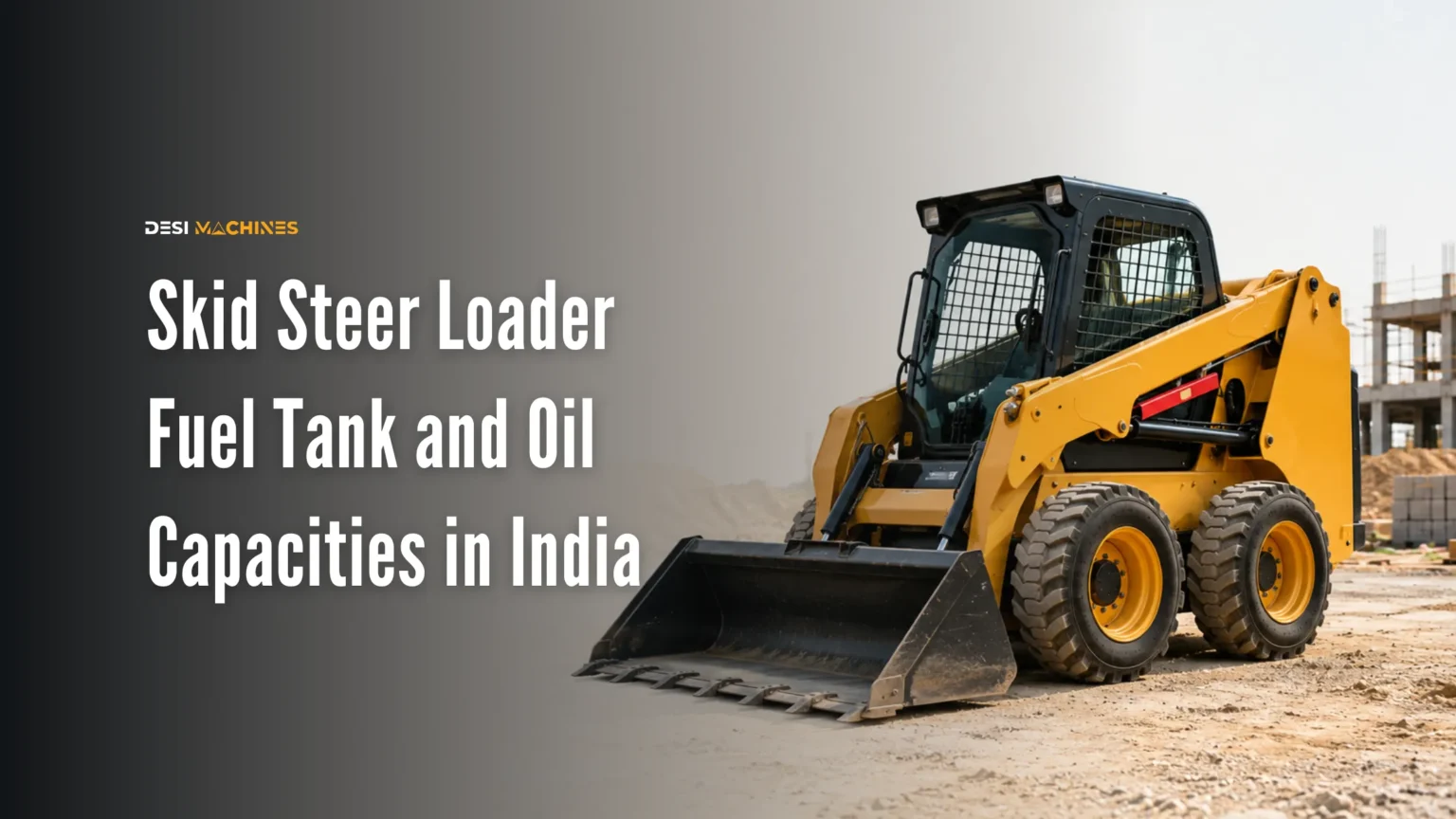
Skid steer fuel tank capacity is the amount of diesel the machine holds when the tank is filled to the top. Across the skid steer loaders sold in India it runs from about 24.6 litres on the smallest machine to 93.7 litres on the largest, and most working machines sit between 47 and 90 litres. Engine oil is roughly 8 to 11 litres, the hydraulic tank holds about 20 to 65 litres, and a skid steer also carries something no other loader on an Indian site has: two small chain cases, one on each side, each holding its own oil.
This page sets out those numbers machine by machine, explains what each figure is for, and shows you how to check the right quantity for the machine standing in your yard. If you are still deciding which machine to buy, the skid steer loader models and specifications guide covers sizes and capacities first.
What is the fuel tank capacity of a skid steer loader?
A skid steer loader’s fuel tank holds between 24.6 and 93.7 litres of diesel depending on the size of the machine. That is close to a four-fold spread, and it matters more than it sounds, because a skid steer works in short bursts all day and nobody wants to stop and fetch diesel at eleven in the morning.
The smallest machine in the class, the Bobcat S70, carries 24.6 litres. It weighs 1,291 kg (1.29 tonnes) and runs a 23.5 HP (17.5 kW) engine, so it is built to fit through a doorway rather than to work a full shift without stopping. At the other end, the Bobcat S590 holds 93.7 litres and the Bobcat S770 holds 90.5 litres.
Notice that the S770 is the heaviest machine in the class at 4,225 kg (4.23 tonnes) and yet its tank is slightly smaller than the S590’s. Tank size does not rise in a straight line with machine size. Manufacturers fit the tank into the space the chassis leaves them, so two machines of similar weight can differ by 10 or 15 litres. Read the figure for the model you are buying rather than assuming a bigger machine always carries more diesel.
Most machines an Indian contractor actually buys land in the middle. The JCB SSL 155 and JCB SSL 135 both carry 84 litres, the L&T S315R carries 80 litres, and the CAT 216B Series 3 carries 58 litres.
Skid steer fuel tank and oil capacities by machine
The table below lists every capacity published for the skid steer loaders available in India, alongside operating weight and engine power so you can see how the numbers move together. Blank cells mean the maker does not publish that figure, not that the machine has no such system.
| Model | Operating weight | Engine power | Fuel tank | Engine oil | Hydraulic tank | Coolant | Chain case (each side) |
|---|---|---|---|---|---|---|---|
| Bobcat S70 | 1,291 kg (1.29 t) | 23.5 HP (17.5 kW) | 24.6 L | — | — | — | — |
| MANITOU 1340R | 2,200 kg (2.2 t) | 49 HP (36 kW) | 47 L | — | 20.3 L | 7.6 L | 8.25 L |
| Bull AV490 | 2,700 kg (2.7 t) | 50 HP (36.8 kW) | 48 L | 9.5 L | — | 7.2 L | 10 L |
| Bobcat S450 | 2,365 kg (2.37 t) | 49 HP (36.4 kW) | 54.5 L | — | — | — | — |
| ACE SS75 | 2,850 kg (2.85 t) | 50 HP (37.3 kW) | 55 L | 8–11 L | 65 L | — | — |
| CAT 216B Series 3 | 2,581 kg (2.58 t) | 51 HP (38 kW) | 58 L | 10 L | 35 L | 10 L | 6 L |
| L&T S315R | 3,275 kg (3.28 t) | 60 HP (44.7 kW) | 80 L | 8 L | 39 L | 13 L | 8.3 L |
| JCB SSL 135 | 2,950 kg (2.95 t) | 56 HP (42 kW) | 84 L | 10 L | 50 L | 15 L | 19 L |
| JCB SSL 155 | 3,050 kg (3.05 t) | 56 HP (42 kW) | 84 L | 10 L | 50 L | 15 L | 19 L |
| Bobcat S770 | 4,225 kg (4.23 t) | 93.3 HP (69.7 kW) | 90.5 L | — | — | — | — |
| Bobcat S590 | 3,069 kg (3.07 t) | 69 HP (51.4 kW) | 93.7 L | — | — | — | — |
Every machine in the class publishes its fuel tank size. Engine oil, hydraulic tank, coolant and chain case volumes are published for six of the eleven, which is normal for this class: the smaller imported machines tend to publish a shorter spec sheet. For a machine whose figures are missing, the operator’s manual that came with it carries all of them, and any authorised dealer can read them off the model and serial number in a minute.
Ready to compare machines on price and specification? Browse the full range of skid steer loaders and talk to a dealer near you.
How much engine oil does a skid steer loader take?
A skid steer engine takes 8 to 11 litres of oil at a full change, including the filter. The L&T S315R is the smallest at 8 litres, the Bull AV490 takes 9.5 litres, the two JCB machines and the CAT 216B take 10 litres each, and the ACE SS75 publishes a band of 8 to 11 litres.
That band on the ACE is not sloppiness. Engine oil quantity changes slightly depending on whether you also change the filter and how much old oil drains out of the galleries, so some makers publish a range. Fill to the lower figure, run the engine for a minute, shut it off, wait five minutes and then check the dipstick. Top up to the mark. Going by the dipstick beats going by the can every time.
These are small engines by construction equipment standards, and the quantities look small next to the 20 or 25 litres a mid-size excavator takes. That is not a reason to stretch the interval. A smaller sump means the same amount of soot and fuel dilution has less oil to hide in, so the oil ages faster, not slower. The construction equipment service schedule sets out the hour marks for each change.
How much hydraulic oil does a skid steer hold?
The hydraulic tank on a skid steer holds 20.3 to 65 litres. The MANITOU 1340R is the smallest at 20.3 litres, the CAT 216B Series 3 holds 35 litres, the L&T S315R holds 39 litres, both JCB machines hold 50 litres, and the ACE SS75 holds 65 litres.
Two different numbers get quoted for hydraulics and they are not the same thing:
- Hydraulic tank is what the reservoir alone holds. This is the figure you use when you top up.
- Hydraulic system is the tank plus the oil sitting in the pump, the pipes, the rams and the coolers. This is the figure you use when you flush and refill the whole machine.
On the CAT 216B Series 3 the tank is 35 litres while the full system is 55 litres, so a complete change needs about 20 litres more than a top-up would suggest. Buy oil against the system figure when you are doing a full change, or you will be sending someone back to the shop halfway through the job.
Hydraulic oil does more work on a skid steer than on most machines its size, because the pump also drives whatever attachment is on the front. Maximum pump flow across the class runs from 37 L/min on the Bobcat S70 to 87.1 L/min on the Bobcat S770. If you run a breaker, a cold planer or a brush cutter, that oil is heating up and shearing all day. Keeping it clean is the single cheapest thing you can do for the machine, and the hydraulic system maintenance guide covers grades, filters and cooling in detail. The skid steer attachments guide explains which attachments demand high flow.
What is a chain case, and why does it need its own oil?
A chain case is a sealed steel box on each side of a skid steer that holds the drive chains running from the hydraulic motor down to the wheel hubs. A skid steer has no axles and no differential. Each side is driven separately, and the chains inside that case are what turn the two wheels on that side together. Running one side faster than the other is exactly how the machine steers, which is why it is called a skid steer.
Those chains run in oil, and each case is filled separately. Across the machines that publish the figure, each side holds 6 to 19 litres:
- CAT 216B Series 3 — 6 litres per side
- MANITOU 1340R — 8.25 litres per side
- L&T S315R — 8.3 litres per side
- Bull AV490 — 10 litres per side
- JCB SSL 135 and SSL 155 — 19 litres per side
The left and right cases always hold the same amount. Two points catch owners out here. First, the figure is per side, so a JCB SSL 155 needs 38 litres to fill both, not 19. Second, the chain case is easy to forget entirely, because nothing on the dashboard tells you the level has dropped. A slow leak from a wheel hub seal drains a chain case quietly, the chains start running dry, and the first sign is a rattle or one side of the machine losing drive.
Check both chain case levels at the plug whenever the machine is greased, and look under the machine for oil on the ground after it has stood overnight. The greasing and lubrication guide covers the walk-round. If you want to understand how the drive and steering work together, the guide to how skid steer loaders work explains the layout.
The chains, sprockets and hub seals inside that case, and the other six part groups on the machine, are named in the guide to skid steer loader parts.
How long does one tank of diesel last on a skid steer?
How long a tank lasts depends on how hard the machine works, and no manufacturer publishes a litres-per-hour figure for a skid steer, so any number you see quoted as a fixed rate has been estimated by someone. What the spec sheets do tell you is the tank size and the engine size, and those two together are a fair guide to how often you will be refuelling.
The engines in this class run from 23.5 HP to 93.3 HP, a spread of about four times, and the tanks run from 24.6 to 93.7 litres, also about four times. So the machines are broadly matched: a bigger engine gets a bigger tank. What changes the answer on your site is the work. A skid steer feeding a mixer at half throttle sips diesel. The same machine running a hydraulic breaker on a demolition job holds the engine near full power for hours, and it will empty the tank in a fraction of the time.
The only honest number is your own. Fill the tank to the brim, note the hour meter, work a normal day, then refill to the brim and note the hours again. Litres divided by hours gives you your machine’s real burn rate on your kind of work. Do it three or four times across different jobs and you will have a figure you can quote in a rate to a client. The backhoe loader mileage and fuel consumption guide works through the same method step by step and explains why machine fuel is measured per hour rather than per kilometre.
One warning worth keeping in mind: a burn rate that climbs on the same job is telling you something. A choked air filter, a tired injector or dragging brakes all show up as extra diesel weeks before anything else goes wrong.
How do you confirm the right capacity for your own machine?
Published skid steer fuel tank capacity and oil figures are a guide. Before you buy oil for a specific machine, confirm the quantity against the machine itself, because the same model name can cover more than one build.
- Start with the operator’s manual. Every machine ships with one, and the refill capacities are usually in a single table at the back. If the manual is missing, the dealer can send a copy against the serial number.
- Check the plate, not just the badge. Serial number plates sit inside the cab or on the chassis rail. A model sold over several years may have changed tank or hydraulic capacity mid-run.
- Buy against the system figure for a full change, the tank figure for a top-up. This is where most of the wasted trips to the shop come from.
- Remember the chain cases are separate and doubled. Two cases, same quantity each, and neither shares oil with the hydraulics.
- Write the numbers on the machine. A small painted board inside the engine cover listing fuel, engine oil, hydraulic tank and chain case volumes saves the next operator a phone call.
The grade and maker of the oil change the price but not the quantity. The spare parts guide explains what to check before you fit a part. For the same figures on other loaders, see the wheel loader fuel tank and oil capacities and the backhoe loader oil and fluid capacities. Farmers running a skid steer on mixed work will also find the skid steer loader for agriculture guide useful.
Looking for the right machine? Compare skid steer loader models, specifications and prices and connect with a dealer near you.
The equivalent figures for telescopic machines are in the telehandler fuel tank and oil capacities guide, where the tanks run from 100 to 320 litres.
If one chain case keeps losing oil, or the machine has started pulling to one side, the guide to skid steer drive problems explains how to trace which side is at fault.
Capacities and specifications on this page are taken from our listings at the time of writing. Prices, specifications and features are indicative, vary by variant, location and date, and should always be confirmed with the official OEM or authorised dealer before any purchase decision. DesiMachines is not liable for decisions taken on the basis of information that may have changed after publication.

