
 Excavator
294 models
Excavator
294 models  Backhoe Loader
51 models
Backhoe Loader
51 models  Crane
68 models
Crane
68 models  Concrete Mixer
79 models
Concrete Mixer
79 models  Wheel Loader
54 models
Wheel Loader
54 models  Compactor / Roller
45 models
Compactor / Roller
45 models  Motor Grader
42 models
Motor Grader
42 models  Dozer
41 models
Dozer
41 models  Concrete Pump
66 models
Concrete Pump
66 models  Skid Steer Loader
11 models
Skid Steer Loader
11 models  Telehandler
13 models
Telehandler
13 models 


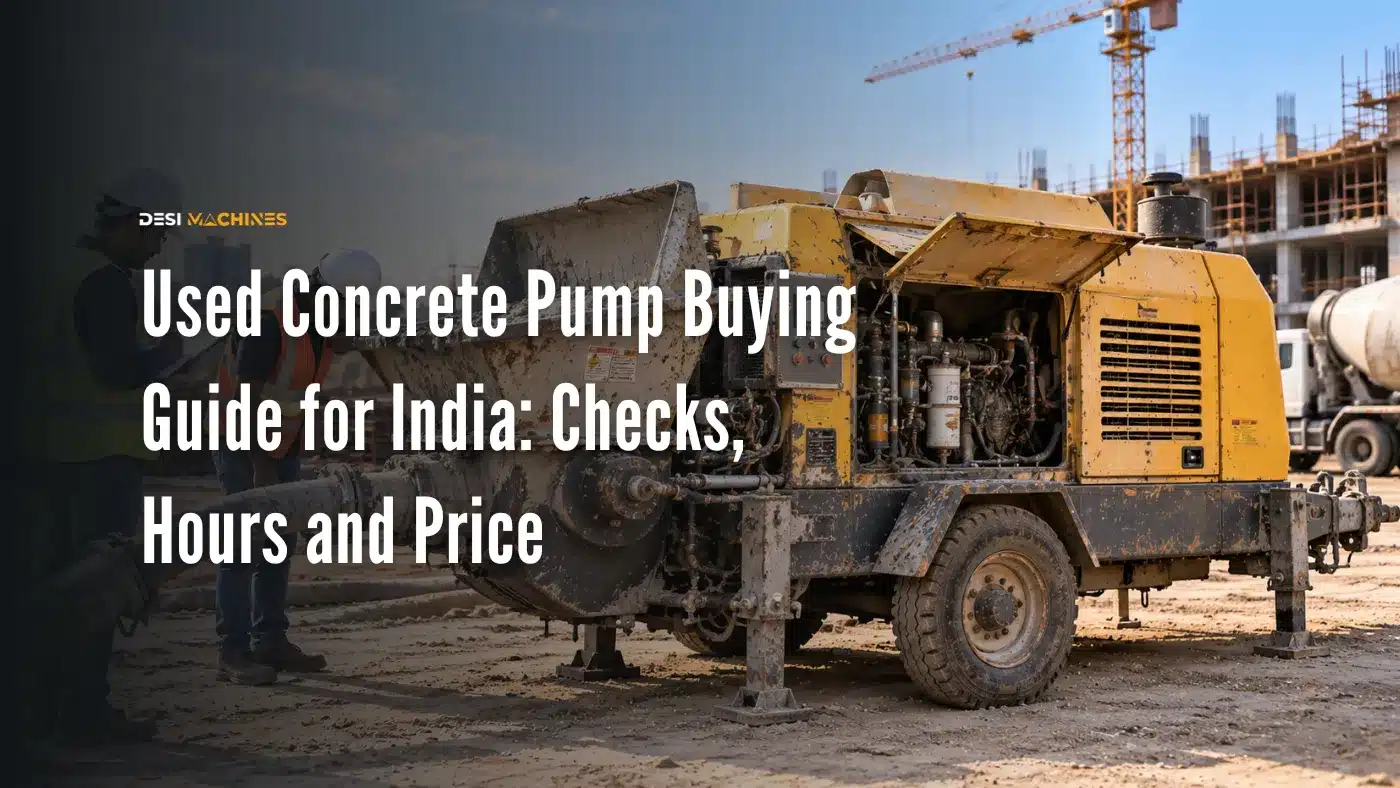
A used concrete pump is a second-hand stationary pump: a skid- or trailer-mounted machine with a diesel engine or electric motor, a hopper that holds the wet concrete, and two pistons that push it through a steel pipeline to wherever the pour is. It has no boom and no truck under it. You lay the pipeline yourself, and the pump does the rest.
The 66 concrete pumps listed on DesiMachines are all of this stationary type, and 51 of them show a price band. New, they run from ₹11–14 Lakh at the smallest to ₹50–65 Lakh at the heavy-duty end (indicative, as of September 2026). A used one is priced down from the band for its own class, and how far down depends far more on how the machine was washed out than on how old it is.
This guide covers what a used pump’s condition actually depends on, why the hour meter is a weaker signal here than on other machines, what the new machines cost so you have an anchor, the papers to ask for, and how to test a pump before you hand over money.
What should you check on a used concrete pump?
Check the wear path first, because on a pump everything that wears sits on one line. The concrete enters the hopper, gets drawn into two delivery cylinders, passes an S-shaped valve, and leaves through the pipeline. Abrasion works along that path in order, so the condition of a few sacrificial parts tells you most of what you need to know.
The two parts that go first are the wear plate and wear ring, the flat plate and the collar where the valve meets the cylinder mouths. They are meant to be replaced. What matters is whether they have been replaced on time or run past their life, because once they go, the valve body and the cylinder mouths themselves start wearing, and that is a much larger bill.
The quickest single test is the water box, the small tank sitting between the concrete cylinders and the hydraulic rams. Open it. Clear water means the piston cups are still sealing. Grey, milky water means concrete is getting past them, and that concrete travels on into the hydraulic side if it is left alone.
The full part-by-part inspection, including the usual wear order and what each warning sign leads to, is set out in the guide to concrete pump parts and components. Work through that list on the machine rather than from a photograph, and use the general used equipment inspection checklist for the engine, hydraulics and electricals that every second-hand machine shares.
Two questions are worth asking before you travel. What mix has it been pumping, and how was it washed out. A harsh, low-slump mix with sharp aggregate wears a pump several times faster than a well-graded pumpable mix does. And concrete left to set inside a cylinder or a pipe overnight is the most expensive avoidable damage on an Indian pumping site.
Why the hour meter tells you less on a pump than on other machines
An hour meter on a concrete pump counts engine hours, not work done, and on this machine those two come apart badly. A pump idles through the wait between loads, through priming, and through wash-out. Two machines showing the same hours can have pumped very different quantities of concrete.
What wears a pump is cubic metres pumped and the abrasiveness of the mix. There is no meter for either. So the hours reading is a starting point, and the number you actually want sits in the seller’s own records: how many pours, of what size, over how long. A contractor who kept job cards can tell you. One who cannot is telling you something too.
This is different from the machines most buyers arrive from. On a used transit mixer you have kilometres on the chassis and hours on the drum, and both are recorded against a registered vehicle. A pump gives you one soft number.
Here is what a spec sheet for a stationary pump does and does not give you, counted across all 66 machines listed:
| What you can look up | Machines publishing it | Range across the listed machines |
|---|---|---|
| Maximum engine power | 66 of 66 | 46 HP (34.6 kW) to 590 HP (440 kW) |
| Hopper capacity | 65 of 66 | 400 litres to 625 litres |
| Machine weight | 43 of 66 | 2,800 kg (2.8 Tonne) to 10,000 kg (10 Tonne) |
| New price band | 51 of 66 | ₹11–14 Lakh to ₹50–65 Lakh (indicative, as of September 2026) |
| Hours run, or concrete pumped | None | Not a model specification. It belongs to the individual machine, and only the owner’s records hold it |
Delivery cylinder size, which sets how big and how costly the wear parts are, is published on all 66 machines and is broken down class by class in the concrete pump parts guide. Output and pressure, the two performance figures a spec sheet leads with, are explained in the guide to concrete pump output and pressure. Both are worth reading before you shortlist, because a used machine is still bought for what it can deliver.
What does a new concrete pump cost in India?
New stationary pumps listed on DesiMachines start at ₹11–14 Lakh and reach ₹50–65 Lakh for the heavy-duty machines (indicative, as of September 2026). You need this ladder before you can judge a used quote, because a used price only means something set against the new price of the same class.
| Model | Engine | Hopper | Weight | New price band |
|---|---|---|---|---|
| Schwing Stetter BP 250 HDE | 60.3 HP (45 kW), electric | 600 L | 2,800 kg | ₹11–14 Lakh |
| Schwing Stetter SP 1000 | 46.9 HP (35 kW), diesel | 400 L | 3,560 kg | ₹15–19 Lakh |
| AJAX ASP 4011 | 66 HP (49.2 kW), diesel | 600 L | 4,000 kg | ₹16–20 Lakh |
| CONMAT SCP 5000 | 65 HP (49 kW) | 625 L | 3,800 kg | ₹17–21 Lakh |
| Schwing Stetter SP 1400 D | 65.2 HP (48.6 kW), diesel | 400 L | 4,500 kg | ₹23–28 Lakh |
| Schwing Stetter SP 1807 | 100.6 HP (75 kW), diesel | 600 L | 4,530 kg | ₹30–36 Lakh |
| Putzmeister BSA 2109 HD | 268 HP (200 kW), diesel | 600 L | 7,900 kg | ₹45–55 Lakh |
| Schwing Stetter SP 8800 | 590 HP (440 kW), diesel | 600 L | 10,000 kg | ₹50–65 Lakh |
One thing to know before you use this ladder: 15 of the 66 pumps are listed at price on request, so no band is published for them. If a seller quotes a used price for one of those machines and calls it a percentage off list, ask which list. There is no public figure to take a percentage of.
Compare the current range of concrete pumps with specifications and prices and connect with a dealer before you commit to a used machine. Sometimes the gap to a new one is smaller than the seller has led you to expect.
How much should a used concrete pump cost?
Work down from the new band for the same class, then adjust for the things that cost real money to put right. We do not publish used prices, because a used price is set by one machine’s history rather than by its model.
Four things move the number, roughly in this order:
- Wear parts recently replaced, with bills. A pump with a fresh wear plate, wear ring and piston cups is worth meaningfully more than the same machine with worn ones, because those parts are the next thing you will buy.
- Whether the pipeline is included, and its condition. Pipes and bends are consumable. A deal that includes thin-walled pipe includes a job you will have to do again.
- Engine hours and service records. Weak on their own, useful when they arrive with job cards and invoices.
- Diesel or electric. An electric pump is cheaper to run where you have a supply and harder to sell on where buyers do not. That narrows its second-hand market.
Ask for the last three service bills and the wear-part replacement dates in writing. If the seller has them, the price discussion becomes a straightforward one. If not, you are pricing an unknown, and the discount has to cover a wear plate, a wear ring, a set of piston cups and the labour to fit them.
Cost and finance work differently on a second-hand machine. The pages on equipment finance and equipment insurance cover what lenders and insurers ask for, and the note on loans for used construction equipment explains why the tenure and the down payment differ on a used purchase.
Which size of used concrete pump should you buy?
Buy for the pour you do most often, not the biggest one you have ever done. A pump that is too large for your regular work costs more to buy, more to run, and wears its parts on the same schedule whether it is working hard or idling.
The small end is covered in the guide to the mini concrete pump: the machines under roughly 4,000 kg (4 Tonne) that suit house slabs, small commercial floors and repair work. The middle of the range handles most contractor work. The heavy-duty machines at the top, running to 590 HP (440 kW) and 10,000 kg (10 Tonne), exist for high-rise and long-distance pumping where the concrete has to be pushed a long way against real resistance.
If the job needs concrete placed at height rather than at distance, a stationary pump is the wrong tool and no discount fixes that. The guide to the concrete pump truck covers when the boom earns its cost, and the overview of concrete pumps and how they work is the place to start if you have not owned one before.
Which papers must come with a used concrete pump?
Ask for the original purchase invoice first, because it is the document that proves who owned the machine and what was paid. Photograph the serial number plate on the machine and check it against the invoice, letter for letter. A mismatch is where you stop.
Then ask for these:
- A GST invoice for the sale to you, from a seller who is registered. This is what lets you claim input credit, and what a lender will want to see.
- Loan closure or a no-objection certificate if the machine was financed. A machine still under hypothecation is not the seller’s to sell outright.
- Service records and wear-part replacement history, ideally from an authorised workshop.
- Warranty status, if any is left, and whether it transfers to you.
A stationary pump is not driven on the road under its own power, so it is not registered the way a transit mixer or a backhoe loader is. If the unit you are buying is a towed trailer version and you will move it on public roads, confirm the position with your own RTO before you buy. Rules on towed units vary by state, and it is a question worth asking rather than assuming.
The step-by-step process for the whole purchase, including payment and handover, is in the guide on how to buy used construction equipment in India.
How do you test a used concrete pump before you pay?
Insist on a working test with real concrete, never a dry run on air. A pump can look and sound healthy with nothing in the hopper and still fail under load, because everything you are buying is about how it behaves against pressure.
Arrange a small load and watch four things:
- Priming. A sound pump takes the grout and then the concrete without repeated blockages. A machine that needs several attempts is telling you about its cylinders or its valve.
- The pressure gauge under load. It should climb steadily and hold. A needle that swings wildly points at air getting in, a worn valve, or a mix problem the seller has not mentioned.
- The changeover. Listen at the end of each stroke. A clean pump swaps cylinders with a firm, even knock. A hesitation, a double knock, or slurry showing at the valve is wear you will be paying for.
- Leaks, under pressure. Grout weeping at pipe joints, oil at hose crimps, water at the box. None of these show up standing still.
Then watch the wash-out at the end. How a seller washes a pump in front of a buyer is the best evidence you will get of how it has been washed for the last five years.
Is a used concrete pump worth buying?
Yes, for a contractor who already pumps concrete regularly and knows what wash-out discipline looks like. A stationary pump is a mechanically simple machine, its expensive parts are designed to be replaced, and a well-kept one has a long working life left in it at a real discount to new.
It is a poor first purchase for someone who has never run one. The failure that hurts is not a worn part, it is concrete set solid inside the machine, and avoiding that is a daily habit rather than a skill you can read up on. If that describes you, hire for a few jobs first and buy afterwards.
Walk away from three things without negotiating: a machine that cannot be tested with concrete, a serial plate that does not match the paperwork, and a seller who will not say what mix it has been pumping. Each of those is cheap for an honest seller to provide.
Ready to compare? See the current range of concrete pumps with specifications and prices for every model listed in India, and connect with a dealer near you. For the ground common to every second-hand purchase, the pillar guide on buying used construction equipment in India covers hours, papers, valuation and where to look. If concrete is your business rather than only your pour, the used self-loading concrete mixer guide is the sister machine most buyers weigh up alongside a pump.
A pump that needs several attempts to take the concrete is usually telling you about its wear parts rather than the mix, and the full picture of why a delivery line chokes and how a plug is cleared safely is set out in concrete pump blockage: why lines choke and how to clear them.
If you are still weighing a used purchase against hiring for each pour, the guide to a concrete pump on rent sets out how pump hire is billed and where the minimum volume bites.
Prices, specifications and features are indicative, vary by variant, location and date, and should always be confirmed with the official OEM or authorised dealer before any purchase decision. Prices shown are taken from our listings at the time of writing. DesiMachines is not liable for decisions taken on the basis of information that may have changed after publication.