
 Excavator
294 models
Excavator
294 models  Backhoe Loader
51 models
Backhoe Loader
51 models  Crane
68 models
Crane
68 models  Concrete Mixer
79 models
Concrete Mixer
79 models  Wheel Loader
54 models
Wheel Loader
54 models  Compactor / Roller
45 models
Compactor / Roller
45 models  Motor Grader
42 models
Motor Grader
42 models 
 Concrete Pump
66 models
Concrete Pump
66 models  Skid Steer Loader
11 models
Skid Steer Loader
11 models 


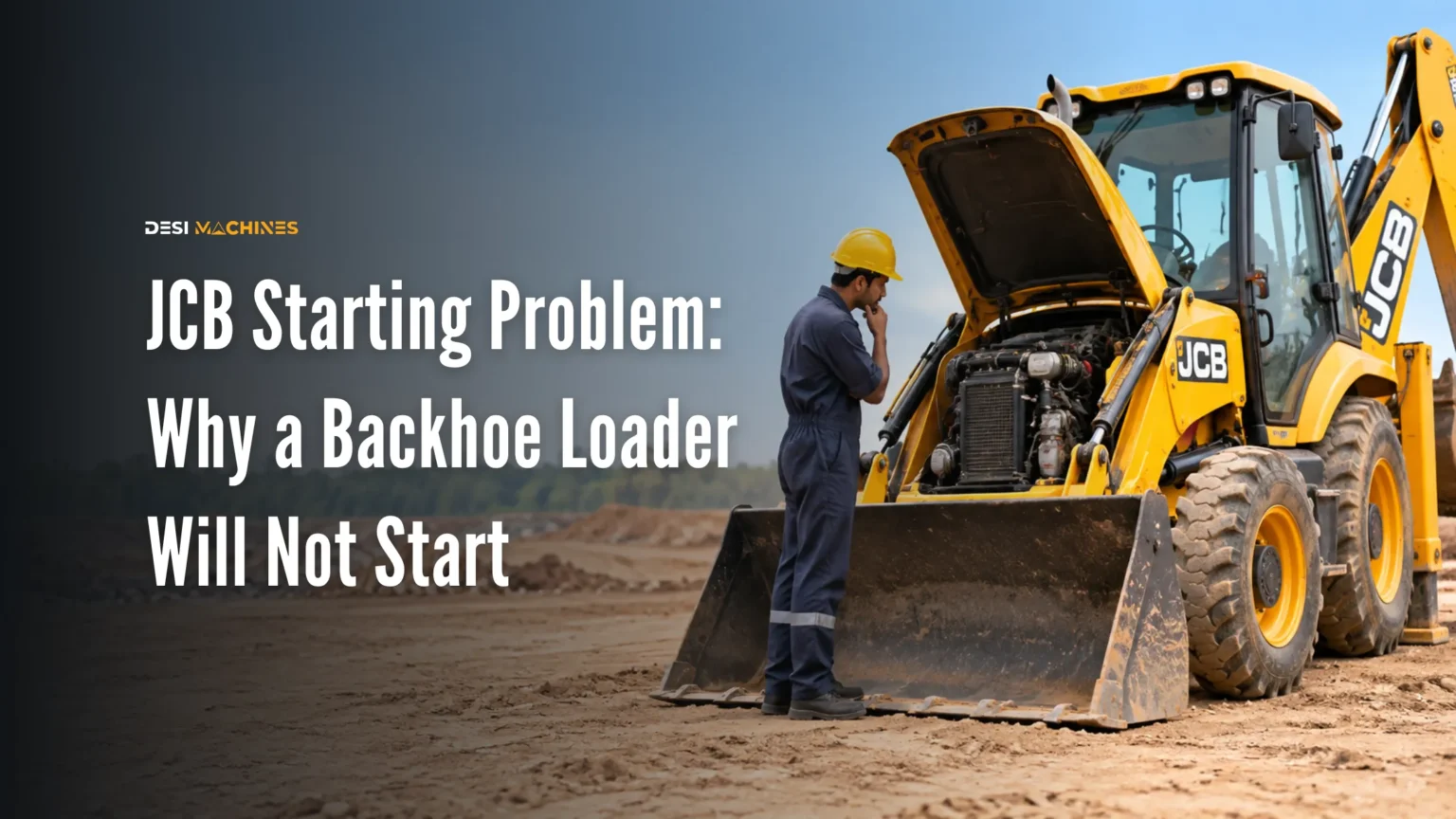
A JCB starting problem is what Indian operators call a backhoe loader that will not start, and on a backhoe it is usually one of five things: a flat or loose-connected battery, the forward-reverse shuttle lever left out of neutral, air or water in the diesel, a tired starter motor, or a cold engine on a winter morning. The order matters. A backhoe is a wheeled machine with a gearbox, so it has one failure that a tracked excavator simply cannot have: the machine refuses to turn over because the transmission is not in neutral, and nothing at all is broken.
This guide works through the fault by symptom, in the order a mechanic would, and tells you which checks you can safely do yourself on site and which ones need a dealer. Every count quoted below comes from the published specification of the 51 backhoe loaders listed on DesiMachines, current as of September 2026.
What should you check first when a backhoe loader will not start?
Check the gear lever and the battery, in that order, before you touch anything else. Between them they account for most no-start calls on a backhoe, and both are free to check.
Put the forward-reverse shuttle lever in the middle position (neutral), put the parking brake on, and try again. If the machine now turns over, the fault was never a fault. If nothing happens, open the battery box and look at the two terminals: a white or green powder on the posts, or a clamp you can twist by hand, will stop a healthy battery from turning a starter. Tighten and clean before you go any further.
Only after those two should you start thinking about diesel, the starter motor or the engine itself. Working in this order saves the most common wasted dealer visit on Indian sites, which is a mechanic driving out to move a lever.
Table 1: What the symptom tells you
| What happens when you turn the key | Most likely cause | Can you fix it on site? |
|---|---|---|
| Nothing at all, no click, no dash lights | Flat battery, loose or corroded terminal, isolator switch off | Yes, usually |
| Dash lights come on but the starter does not turn | Shuttle lever not in neutral, or the starter solenoid | Lever yes, solenoid no |
| One loud click, then nothing | Weak battery under load, or a worn starter | Battery yes, starter no |
| Starter turns the engine slowly | Battery down on charge, or thick cold oil | Yes |
| Engine turns over normally but never fires | No diesel reaching the pump, air in the fuel line, blocked filter | Sometimes |
| Fires, runs a few seconds, dies | Blocked fuel filter, water in the tank, air leak on the suction side | Sometimes |
| Hard to start cold, fine once warm | Cold-start aid not working, weak battery, thin compression | Partly |
Why will a backhoe not crank unless the gear lever is in neutral?
Because a backhoe loader drives on wheels, and a machine that can drive itself forward must never be able to start in gear. All 51 backhoe loaders listed publish a transmission entry, and 45 of them describe a shuttle transmission – a gearbox with a single lever that picks forward or reverse without using a clutch. Twenty-six of them go further and name an integral torque converter, the fluid coupling that lets the machine push into a pile of soil without stalling.
A shuttle box has a neutral position in the middle, and the starter circuit is wired through it. Turn the key with the lever in forward and the circuit stays open, so the starter never receives current. On most machines the dash will light up perfectly normally, which is exactly what makes this fault so confusing: everything looks alive and nothing turns.
A tracked excavator has no gearbox of this kind at all. It steers and travels on hydraulic motors, so its equivalent safety catch is the hydraulic lock lever, not a gear position. That is why the excavator not starting fault tree looks different from this one, and why a mechanic who works mostly on tracked machines can spend twenty minutes on a backhoe before checking the lever.
Two habits prevent the whole problem. Park in neutral with the parking brake applied every time you shut down, which is also the correct start-up procedure set out in the guide to operating a backhoe loader safely. And if a machine on your yard develops a habit of needing the lever wiggled, tell the dealer – the shuttle switch and its wiring are a wear item, and the anatomy of that gearbox is set out in backhoe loader parts and components.
Why does nothing happen at all when you turn the key?
No click and no dash lights means no current is reaching the starter circuit, so this is a battery or a connection problem nine times out of ten, not an engine problem.
Of the 51 machines listed, 49 publish a battery specification and 48 of those describe a single 12 volt system. That matters on site for one practical reason: a 12 volt backhoe can be jump-started from a truck or a car, which a 24 volt machine cannot. Which machines run which system, and what the Ah figure on the case actually buys you, is set out in the guide to 12V and 24V batteries on construction machines.
Work through it in this order. Are the terminals clean and tight? Is the battery isolator switch (where the machine has one) turned on? Do the headlights come on brightly, or dimly, or not at all? Bright lights with a dead starter points away from the battery and towards the shuttle lever or the solenoid. Dim lights point at the battery.
Those checks fail the same way every time. A fault that moves, affecting one circuit and not the next, or appearing only after rain or when the boom swings, is wiring rather than battery, and the guide to wiring kits and harnesses explains where a loom chafes, corrodes and gets cut about.
The commonest reason a backhoe battery is flat on a Monday morning is that it is a road-going machine: work lights, cabin fan and beacon left switched on overnight will empty a battery that an excavator, parked with everything off, would have kept. If a machine goes flat repeatedly after a full day’s work, the charging side is the suspect rather than the battery, and the red charging lamp and the published alternator ratings are covered in backhoe loader warning lights and dashboard symbols. If the battery is past saving, ask for a replacement battery for your model and we pass the request to a dealer near you.
Why does the starter turn but the engine will not fire?
If the engine spins at a normal speed and never catches, the electrical side has done its job and the problem is diesel: either it is not arriving, or it is arriving with air or water mixed into it.
Check the simple things first. Is there actually fuel in the tank, and is the gauge honest? A backhoe fuel tank holds a lot – the published tank capacities are listed in backhoe loader oil and fluid capacities – so a gauge reading a quarter can still be sitting above a blocked pickup. Next, look at the water separator bowl under the filter. Water in the diesel is the single most common fuel fault on Indian sites, because tanks are filled from barrels and drums that collect condensation through the monsoon.
After that the answer depends on your engine, and it is worth knowing which kind you own before you call anyone. Most of the machines listed run a mechanically injected diesel, where a blocked filter can be changed and the fuel system bled by hand at the roadside by anyone who has been shown how. A minority run electronically controlled common-rail engines, where fuel delivery is managed by a control unit and diagnosis needs the dealer’s equipment rather than a spanner. Which norm and which engine each machine carries is set out in backhoe loader engine power, and the norms themselves are explained in the guide to BS and CEV emission norms.
One warning that applies to every machine on the list. Do not keep cranking. Thirty seconds of continuous cranking is enough to overheat a starter motor, and a starter is a far more expensive repair than the fuel filter you were trying to diagnose. Crank for ten seconds, wait a minute, try again. How a self motor wears out, and the signs that it or the alternator is failing, are set out in the guide to the JCB self motor and alternator.
Why does the engine start and then stop again?
An engine that fires, runs for a few seconds and dies is being starved rather than being denied – it found enough diesel in the line to run on and then could not draw more.
The usual causes are a blocked fuel filter, water sitting in the bottom of the tank, or an air leak on the suction side between the tank and the pump. Air leaks are the hardest of the three to find, because the machine will restart happily and die again each time, which makes it feel electrical. A filter that has never been changed on schedule is the first thing to rule out, and the change intervals are in the backhoe loader maintenance schedule.
If it dies the moment you touch the throttle rather than at idle, mention that to the dealer. It changes the diagnosis, and it is the kind of detail that gets lost when a machine is reported simply as “not starting”.
Why is a backhoe harder to start on a cold morning?
Cold thickens the engine oil, so the starter has to turn a stiffer engine, and it weakens the battery at the same time. A battery that manages fine in May can fail on a January morning in Punjab or Rajasthan without having got any worse.
Here is a gap worth knowing about before someone quotes you a figure. Not one of the 51 backhoe loaders listed publishes any cold-start specification at all – no glow plug rating, no pre-heater, no cold-start aid, no starter motor rating and no fuse detail appears in the published specification of any machine on the list. So if you are told your machine has a particular heater or plug rating, that number is not coming from the machine’s published specification, and the place to confirm it is the operator manual for your own machine or the dealer’s parts department in writing.
What you can do without any of that: park the machine facing away from the wind, keep the battery terminals clean through winter, use the correct oil grade for your region rather than the one the last mechanic had in his van, and give the machine time. If a cold engine needs a longer crank than it did last winter, treat that as an early warning about the battery or compression rather than as a seasonal quirk.
What should you never do when a backhoe will not start?
Four things do real damage, and all four are common.
Do not tow-start or push-start it. A shuttle transmission with a torque converter does not transmit drive backwards from the wheels the way a tractor gearbox does, so towing will not turn the engine, and you risk the transmission and anyone standing nearby.
Do not spray starting fluid or ether into the air intake. It will often produce a start, and on a diesel it can crack a piston ring or bend a rod, turning a filter job into an engine rebuild.
Do not keep the key turned for long spells, for the starter reason above. And do not bridge or bypass the neutral switch to “get it going” – that switch is what stops a machine starting in gear and driving into whoever is standing in front of it.
What should you have ready before you call the dealer?
A no-start call is diagnosed on the phone far more often than people expect, and the difference between a same-day fix and a wasted visit is usually the quality of the description.
Have these ready: the machine model and its hour-meter reading; exactly what happens when you turn the key, in the words of Table 1 above; whether the dash lights come on; whether the headlights are bright or dim; which warning lamps are showing; when it last ran properly and what it was doing; when the fuel filter was last changed; and whether any water came out of the separator bowl.
Say plainly whether the machine is on a site or in the yard, and whether it is blocking work. It changes how the visit is scheduled. If the machine is under warranty or a service contract, say so at the start of the call rather than the end.
A note on one figure in our own listings
Because this guide asks you to read your machine’s battery specification, one published figure needs flagging rather than quoting. The JCB 3DX Plus listing publishes its battery as 11 volt, and the same 11 volt value appears in the second specification store on all six JCB backhoe listings. Eleven volts is not a battery rating; a 12 volt battery sitting at 11 volts is a flat one. Every other machine on the list publishes 12 volt, and the JCB backhoes are 12 volt machines.
That figure has been flagged for correction and is deliberately left out of the counts above, which is why this guide says 48 of 49 rather than 49 of 49. If you are checking a 3DX against its published specification, read the voltage as 12 and confirm the battery’s Ah rating with the dealer.
JCB starting problem: the short version
Move the shuttle lever to neutral and apply the parking brake, then check the battery terminals. Those two checks are free and they solve most no-start calls on a backhoe loader, because 45 of the 51 machines listed run a shuttle transmission whose neutral position sits in the starter circuit.
If the dash is dead, work on the battery and its connections. If the starter turns but nothing fires, work on the diesel: fuel level, water in the separator, then the filter. If it fires and dies, suspect the filter or air on the suction side. Never tow-start it, never use ether, never crank for more than ten seconds at a time, and never bypass the neutral switch.
Compare live backhoe loader models and prices to see the published battery, engine and transmission specification of each machine, and connect with a dealer who can support it.
Read next: backhoe loader warning lights for what each dashboard symbol means, the maintenance schedule for the service intervals that prevent most of these faults, and the complete backhoe loader guide for everything else. If you also run tracked machines, excavator not starting covers the same ground for excavators, and 2WD vs 4WD explains the drivetrain difference behind the gearbox.
Specifications quoted here are taken from our listings at the time of writing and describe the 51 backhoe loaders listed as of September 2026. Prices, specifications and features are indicative, vary by variant, location and date, and should always be confirmed with the official OEM or authorised dealer before any purchase decision. DesiMachines is not liable for decisions taken on the basis of information that may have changed after publication.
