
 Excavator
294 models
Excavator
294 models  Backhoe Loader
51 models
Backhoe Loader
51 models  Crane
68 models
Crane
68 models  Concrete Mixer
79 models
Concrete Mixer
79 models  Wheel Loader
54 models
Wheel Loader
54 models  Compactor / Roller
45 models
Compactor / Roller
45 models  Motor Grader
42 models
Motor Grader
42 models  Concrete Pump
66 models
Concrete Pump
66 models  Skid Steer Loader
11 models
Skid Steer Loader
11 models  Telehandler
13 models
Telehandler
13 models 


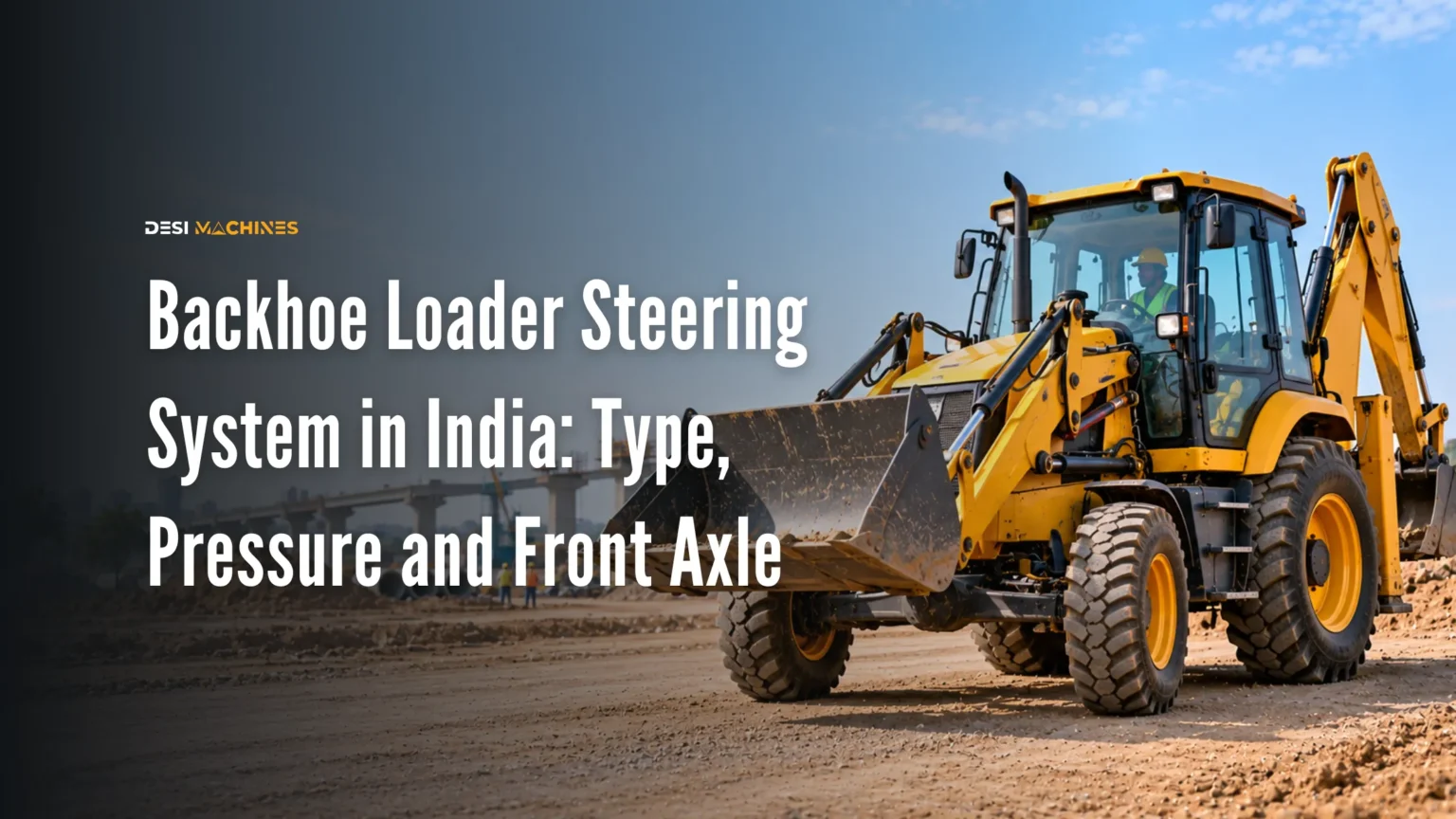
A backhoe loader steering system in India works at between 110 and 160 bar (about 112 to 163 kg/cm²), which is roughly half of what the same machine’s digging hydraulics run at. That gap is the whole point. Steering needs steady, controllable pressure rather than brute force, so it is fed as a protected slice of the hydraulic system and never has to fight the loader arm for oil. Of the 51 backhoe loaders listed here, all 51 publish a steering type, 45 publish a front axle description and 35 publish a steering working pressure.
This guide explains what those entries mean, what an oscillating front axle does on broken Indian ground, and which parts of the specification sheet are worth reading before you sign for a machine.
What type of steering does a backhoe loader have?
A backhoe loader steering system steers the front wheels only, using hydraulic power rather than a mechanical linkage from the wheel. That is true of every machine sold here. There is no mechanical shaft running from your steering wheel down to the front axle on these machines. You turn the wheel, that movement meters oil to a cylinder on the front axle, and the cylinder pushes the wheels across.
All 51 machines publish a steering type, but they do not all answer the same question with it. Sorting the published entries gives four groups.
| What the specification says | Machines | What it tells a buyer |
|---|---|---|
| Names a hydrostatic system | 16 | Wheel drives an oil metering unit, no mechanical link |
| Names another specific mechanism (dedicated pump, equal-turn linkage, multi-mode) | 16 | Useful, but the detail varies by maker |
| Names hydraulic power steering with a manual fallback | 7 | Says what happens if the engine stops |
| Says only “Power Steering” | 12 | Confirms it is not manual, and nothing else |
That last row matters more than it looks. Twelve machines, roughly one in four, publish a steering entry that tells you the machine has power steering and stops there. It does not say hydrostatic or hydraulic, it does not say whether there is a dedicated pump, and it does not say what happens on a failure. A field being filled in on every machine is not the same as a field answering your question on every machine.
>/DIV>
Hydrostatic or hydraulic: what is the difference on site?
Both are hydraulic in the ordinary sense. The difference is in how your hands reach the wheels.
In a hydrostatic system the steering wheel turns a metering unit, sometimes called an orbital valve, which measures out a set quantity of oil for every degree you turn. The wheel is connected to the front axle by hoses and oil, not by a shaft. Sixteen of the machines listed here describe their steering this way.
In the other named arrangements there is still a mechanical element in the path, such as a track rod linking the two front wheels, with hydraulic assistance doing the heavy work. The JCB 3DX family, for example, publishes a power track steering rod system giving equal turn on both sides.
For most Indian buyers the practical difference is small. Both are light at the wheel, both steer the front axle, and both will turn the machine inside the same space. Where it starts to matter is fault-finding and parts. A hydrostatic system has a metering unit behind the steering wheel that can wear and start to feel vague or allow the wheel to creep round on its own. A linkage system has track rod ends and pins that wear mechanically and can be seen and felt. If you are buying used, knowing which one you are looking at tells you where to put your hands during the inspection.
That priority arrangement is the part worth understanding. Several machines here state it outright in their specification, describing hydraulic actuation with priority for smooth control. It means the steering is served first and the digging services get what remains. You feel the benefit when you are turning and lifting at the same time and the wheel stays light.
How much pressure does backhoe loader steering run at?
Thirty-five of the 51 machines publish a steering working pressure. Twenty-seven of them publish a figure that is clearly separate from the machine’s main hydraulic pressure, and those twenty-seven run from 110 bar to 160 bar (about 112 to 163 kg/cm²).
| Pressure | Machines | Examples from the listings |
|---|---|---|
| 110 bar (112 kg/cm²) | 5 | Bull HD76 2WD, Bull HD76 4WD, Bull CH76 Challenger |
| 120 bar (122 kg/cm²) | 4 | Escorts Digmax II, Digmax Super, Jungli HT |
| 125 bar (127 kg/cm²) | 1 | JCB 2DX |
| 140 to 145 bar (143 to 148 kg/cm²) | 8 | CASE 770 NX, CASE 851 NX, Mahindra SX Smart 50 |
| 150 bar (153 kg/cm²) | 4 | Mahindra Earthmaster SX, SXE and VX |
| 160 bar (163 kg/cm²) | 5 | JCB 3DX, 3DX Plus, 3DX Super, 3DX Xtra, JCB 4DX |
Put that beside the main hydraulics and the design becomes obvious. Backhoe loaders in India run their main digging hydraulics at roughly 230 to 270 bar, as set out in the guide to hydraulic system maintenance. So the steering circuit typically works at somewhere between half and two thirds of what the loader arm works at. Steering is about precision, not force. A lower, steadier pressure is easier to control and gentler on hoses and seals that are being worked every few seconds all day.
A caution on the remaining eight machines. Eight listings publish a steering working pressure of 225 to 245 bar, and in every one of those cases the figure is the same as, or within a few bar of, that machine’s own published main system pressure. Five Manitou MBL 745 variants publish 225 bar for both. The Bull SD76 BS5 Super Smart publishes 230 bar for both. On machines that report the two circuits separately the steering figure is always well below the system figure, so these eight look like the main system pressure repeated under the steering heading rather than a measurement of the steering circuit. They are left out of the range above. If you are shortlisting one of them, ask the dealer to confirm in writing which circuit the number refers to.
What is an oscillating front axle and why does it matter?
The front axle on a backhoe loader is not bolted rigidly to the machine. It is pivoted at its centre, so it can rock like a see-saw while the body of the machine stays level. That rocking movement is called oscillation.
Of the 45 machines publishing a front axle description, 26 describe this pivot, and every one of them that states an angle states the same figure: 16 degrees, usually written as plus or minus 16 degrees, meaning 16 degrees of rock in each direction.
Here is why it earns its place. Drive a rigid four-wheeled machine across a rut and one wheel lifts clear of the ground. That wheel now carries no weight, so it grips nothing, and everything the machine is doing is being held up by three corners. With a centrally pivoted front axle the axle simply tilts and both front wheels stay down. The specification sheets say this plainly, several of them describing a steer axle centrally pivoted with oscillation for maximum ground contact in undulated conditions.
On a levelled urban site you will rarely notice it. On a village approach road, a half-cut trench line or a wet field edge, it is the difference between a machine that tracks straight and one that skips and scrabbles. It also protects the machine, because a rigid axle would feed every bump straight into the chassis.
One practical consequence catches people out. Because the front axle can rock, you must never rely on the front wheels to hold the machine steady while you dig. That is the job of the stabiliser legs at the back and the loader bucket at the front, both set down firmly before the boom moves.
Is the front axle driven on a backhoe loader?
It depends entirely on whether the machine is two wheel drive or four wheel drive, and this is where the front axle specification earns a careful read.
On a 2WD machine the front axle only steers. Eight listings describe exactly that, using words such as non-driven, non-powered or steer axle. The rear axle does all the driving.
On a 4WD machine the front axle both steers and drives, and four listings describe it as a drive and steer axle. Several makers name the axle unit itself, with CNH PS1300 appearing on 2WD versions and Carraro units on 4WD versions of the same model.
That difference is visible from across the yard, because a driven front axle needs a bigger tyre to put the power down. The full fitment by model is set out in the guide to backhoe loader tyre sizes, and whether the extra drive is worth paying for on your ground is worked through in the comparison of 2WD and 4WD backhoe loaders.
Four wheel drive also widens the turn slightly, because the front axle sweeps through a bigger arc. The published turning circles, and the two different ways makers measure them, are covered in the guide to backhoe loader dimensions and site access.
Can you steer a backhoe loader if the engine stops?
On some machines, yes, with effort. Seven listings publish full power front wheel hydraulic power steering with manual capability in the event of engine or hydraulic power failure. That means if the engine dies while you are moving, the steering wheel still turns the wheels, but you are now pushing oil around by hand and it becomes very heavy.
The other 44 listings do not state what happens on a failure. Silence in a specification is not a promise either way, so treat it as unknown and ask the dealer directly rather than assuming.
This is worth asking about for one reason above all: a backhoe loader is a road machine. It drives itself between sites at speed, unlike a tracked excavator that has to be carried. Losing assistance at 30 km/h on a public road is a different event from losing it at walking pace in a compound. How these machines behave on the road, and the rules that apply, are covered in the guide to backhoe loader speed and road travel. For background on how hydraulic assistance works in general, the technical overview of power steering is a reasonable starting point.
What the specification sheet will not tell you
Three gaps are worth knowing about before you use these figures to choose between machines.
Six machines publish no front axle description at all. Five Manitou MBL 745 variants and one BEML machine leave the field empty. Those same five Manitou listings are also among the twelve that say only “Power Steering”. A thin specification sheet is not evidence of a poor machine, but it does mean you have less to compare, so ask for the axle detail in writing.
Steering is not listed as a serviceable item on its own. The machines publish an oil capacity for the rear axle but not for the steering circuit, because the steering shares the main hydraulic oil. That means steering health is really hydraulic health. Filter and oil intervals are in the backhoe loader maintenance schedule and the fill quantities are in the guide to oil and fluid capacities.
A few entries carry obvious typing errors. Three Mahindra listings write the oscillation angle with a temperature symbol rather than a degree symbol. The number is right and the machines are included above, but it is a reminder that a specification sheet is typed by a person. Where a figure decides your purchase, get it confirmed on the quotation.
What to check on the steering and front axle before you buy
On a new machine the useful questions are short. Ask which steering type it is, whether there is a manual fallback, and what the steering working pressure is. If the sheet says only “Power Steering”, ask for the rest.
On a used machine, check by hand and by feel:
- Play at the wheel. With the engine running, turn the wheel gently to each side. The wheels should start moving almost immediately. A large dead zone points to a worn metering unit or worn linkage.
- Creep. Hold the wheel still and watch the front wheels. They should not drift on their own.
- The steering cylinder. Look along the rod for scoring, pitting or oil weeping at the seal. Wet is bad.
- The pivot. Rock the machine or drive one front wheel up onto a brick and watch the axle tilt. It should move freely and quietly. Knocking means worn pivot pins or bushes.
- Grease points. Several makers state that the front axle pivot is greased remotely. Find the nipple and check it has actually been used.
- Four wheel drive. If the machine is 4WD, engage it and confirm the front wheels genuinely pull. You are paying for that axle.
Do all of this on a short road run rather than standing still, and read it alongside the full used backhoe loader buying checklist. A soft front tyre will imitate a steering fault, so check tyre pressures first.
If you are still deciding which machine suits your work, the full range is on the backhoe loader listings, and the component-by-component explanation is in the guide to backhoe loader parts and components.
Backhoe loader steering: the short version
Every backhoe loader steering system here works the front wheels hydraulically, at a working pressure of 110 to 160 bar on the machines that report it separately, which is roughly half the pressure the digging hydraulics see. Sixteen machines name a hydrostatic system, seven state a manual fallback if the engine stops, and twelve say only that power steering is fitted. The front axle pivots at its centre through 16 degrees each way so both front wheels stay on the ground over rough approaches, and on a 4WD machine that same axle also drives.
Read next: backhoe loader dimensions and turning circle, then 2WD against 4WD. Both build directly on the front axle.
Specifications quoted here are taken from the machine listings on this site and are indicative, as of September 2026. Figures vary by variant, model year and dealer fitment. Confirm any specification that decides your purchase with the manufacturer or your dealer in writing. DesiMachines is not liable for changes made after publication.
Frequently Asked Questions (FAQ)
Every backhoe loader sold in India steers through its front wheels only, using hydraulic power. Of the 51 machines listed here, 16 describe a hydrostatic system in which the steering wheel turns an oil metering unit with no mechanical shaft to the axle, 16 name another specific mechanism such as a dedicated steering pump or an equal-turn track rod, 7 state hydraulic power steering with a manual fallback, and 12 say only that power steering is fitted.
It is a front axle pivoted at its centre so it can rock like a see-saw while the machine body stays level. Of the 45 machines publishing a front axle description, 26 describe this pivot, and every one that states an angle states 16 degrees of movement in each direction. It keeps both front wheels on the ground over ruts and broken approaches, so the machine keeps its grip instead of lifting a wheel clear.
Between 110 and 160 bar, about 112 to 163 kg per square centimetre, on the 27 machines that publish a steering working pressure separately from their main system pressure. That is roughly half to two thirds of the 230 to 270 bar the main digging hydraulics run at, because steering is about precision rather than force.
Only on a four wheel drive machine. On a 2WD backhoe loader the front axle only steers, and eight listings describe it as non-driven or non-powered. On a 4WD machine the same axle both steers and drives. A driven front axle needs a larger front tyre, which is the quickest way to tell the two apart in a yard.
On some machines, but it becomes very heavy. Seven listings publish hydraulic power steering with manual capability in the event of engine or hydraulic power failure, meaning the wheel still turns the wheels without assistance. The other 44 do not state what happens on a failure, so ask the dealer rather than assuming, particularly because a backhoe loader travels on public roads under its own power.
