
 Excavator
294 models
Excavator
294 models  Backhoe Loader
51 models
Backhoe Loader
51 models  Crane
68 models
Crane
68 models  Concrete Mixer
79 models
Concrete Mixer
79 models  Wheel Loader
54 models
Wheel Loader
54 models  Compactor / Roller
45 models
Compactor / Roller
45 models  Motor Grader
42 models
Motor Grader
42 models 
 Concrete Pump
66 models
Concrete Pump
66 models  Skid Steer Loader
11 models
Skid Steer Loader
11 models 


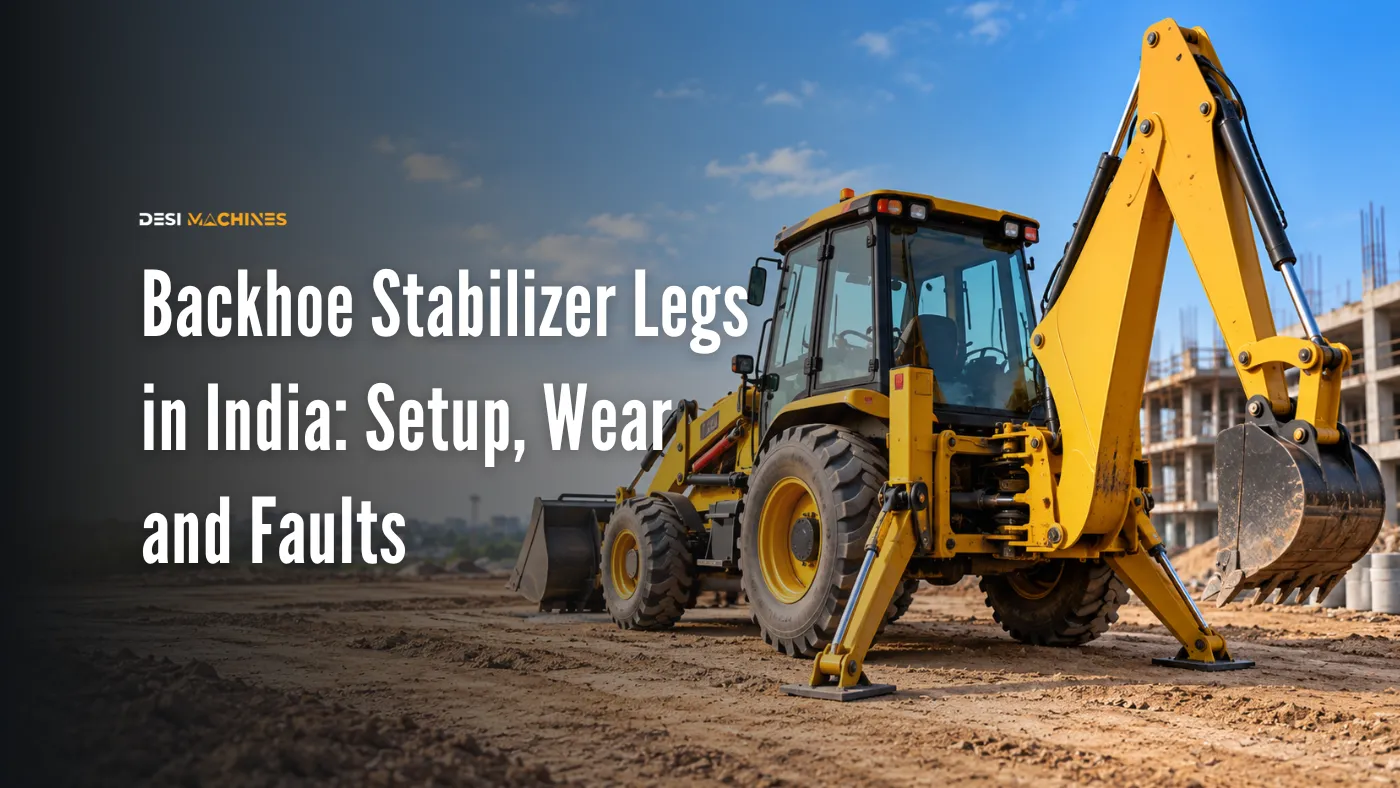
A backhoe stabilizer is one of the two hydraulic legs at the back of a backhoe loader that drop to the ground and take the machine’s weight before it starts digging. Their job is simple: hold the machine still. With the legs down and the front loader bucket resting on the ground, the backhoe loader stops sitting on four rubber tyres and starts sitting on a solid four-point base. Everything the digging end does — the depth it reaches, the load it can lift, how straight the trench wall comes out — is measured with those legs down.
Most first-time owners learn the boom and the bucket in the first week and never think about the legs again until one starts sinking into wet ground or drifts down on its own overnight. This guide covers how to set the machine up on them, what wears out, and what a spec sheet will and will not tell you. Both spellings are common — stabilizer and stabiliser mean the same thing, and on Indian sites operators usually just call them the legs.
What is a backhoe stabilizer and what does it do?
A backhoe stabilizer is a hydraulic leg mounted on each side of the rear of the machine, behind the back wheels. Each leg is a steel arm with a hydraulic cylinder — a tube with a piston inside that pushes out when oil is fed into it — and a flat foot, called a pad or shoe, at the bottom. The operator drops both legs from levers in the rear-facing seat until they press into the ground and take weight off the rear tyres.
The reason this matters comes down to what a backhoe loader is standing on the rest of the time. The 51 backhoe loaders listed on DesiMachines weigh between 5,220 kg and 9,700 kg (5.2 to 9.7 tonnes), from the JCB 2DX at the small end to the Bull Grandia at the large end, and all of that weight normally rests on four inflated tyres and a front axle that is deliberately allowed to rock. Seventeen of those 51 publish a front-axle oscillation figure, and every one of the 17 says 16°. Oscillation means the front axle is free to tilt across the machine so both front wheels stay on uneven ground — exactly what you want when driving and exactly what you do not want when digging.
So when the bucket pulls back into hard soil, an unsupported machine squats on its rear tyres, rocks on that pivoting front axle, and slides backwards a little at a time. The stabilizer legs remove all three. They lift the rear tyres until they are barely loaded, lock the back of the machine to the ground, and give the digging forces something solid to push against.
The front loader bucket does the same job at the other end. Lowering the loader bucket flat on the ground before you dig is not optional on a backhoe loader — it is the fourth point of the base. A machine on two legs and two front tyres will still rock.
What are backhoe stabilizer pads and feet?
The pad, or foot, is the flat plate at the bottom of each leg, and it is the only part of the stabilizer that touches the ground. It is also the part that wears fastest and gets replaced most often. Two types are common on Indian machines.
Steel pads with a gripping edge are the standard fit. The underside carries a bar or a set of teeth that bites into soil, so the leg does not slide when the machine is working on a slope or on loose murram. These are what you want for trenching, pipeline work and any digging on open ground.
Rubber or flat street pads are the alternative, and they matter more in India than most buyers expect. Any job inside a town — a water connection across a paver-block road, a cable trench beside a footpath, a drain repair on a bitumen surface — will chew the surface to pieces under a steel gripping pad. A rubber pad spreads the load and leaves the road intact. On many machines the pad is a flip-over design: one face is steel, the other rubber, and the operator rotates it to suit the job.
Whichever type is fitted, the pad is a wear item. A worn pad goes thin at one edge and takes on a wedge shape, and once that happens the leg no longer sits flat. A wedged pad puts a sideways load into the leg and the cylinder every time it takes weight, and that is how a cheap replacement turns into an expensive one.
How do you set up a backhoe loader on its stabilizers?
Getting the setup right takes about a minute and saves years of wear. Work through it in the same order every time.
Park the machine square to the trench, not at an angle. Put the gearbox in neutral and apply the parking brake — on almost every backhoe loader we list that is a hand-operated disc brake on the rear axle, and it must be on before you leave the forward seat. Swing the seat to face the rear. Lower the front loader bucket until it is flat on the ground and take a little weight on it; the front tyres should stay on the ground but stop carrying the full front end.
Now lower both stabilizer legs together, or one immediately after the other, until the pads are firmly down. Keep going until the rear tyres are just unloaded but still touching the ground. That is the setting most operators get wrong in both directions. Too little and the machine still rocks. Too much and you have lifted the rear wheels clear into the air, which puts the whole rear weight through two pads and two cylinders and makes the machine far more likely to shift suddenly if one pad sinks.
On a slope, extend the downhill leg further than the uphill one so the machine sits level across its width. A backhoe loader that is level digs a straight trench wall; one that is leaning digs a sloping one, and you find out at the end of the day when the pipe does not sit right. And on soft or waterlogged ground — a paddy field edge, a monsoon site, fresh backfill — put a thick timber sleeper or a steel plate under each pad to spread the load. That one habit prevents most of what gets reported as a stabilizer fault.
Can you dig with a backhoe without putting the stabilizers down?
You can make the machine move, but you should not do it, and on anything harder than loose sand it will cost you money quickly. Every published digging figure for a backhoe loader assumes the legs are down on level ground, so the moment they are up the machine is working outside the condition it was rated in.
Four things go wrong. The machine rocks and slides, so the trench wall comes out rough and you dig the same metre twice. The bucket takes side loads the boom and dipper cylinders were never designed for, because a rocking machine pulls the arm off line. The king post — the vertical casting the whole backhoe end swings on — and its pins carry that shock instead of the ground, and once a pin and its bush wear out of round, greasing no longer fixes it. And the rear tyres take a beating from repeated squatting and scuffing, which on a backhoe is a serious bill.
The one honest exception is a light tidy-up move with the arm close in and very little load. Even then, the loader bucket goes down at the front. If you are pulling against real resistance, the legs go down.
What does the spec sheet tell you about the stabilizers?
Almost nothing, and it is worth saying that plainly rather than letting a buyer hunt for it. Across all 51 backhoe loaders listed on DesiMachines, not one publishes a stabilizer figure of any kind in either of the two spec stores behind the product pages — no leg spread, no pad size, no cylinder bore, no down-force rating. Manufacturers treat the legs as standard equipment and do not spec them, in the same way they do not spec the seat.
What the sheet does give you is a set of figures that only make sense because the legs exist. These are the ones to read.
| Spec sheet figure | Published on | Range across the 51 machines | What it tells you about the legs |
|---|---|---|---|
| Maximum digging depth | 51 of 51 | 3,020 mm to 5,360 mm (3.0 to 5.4 m) | Measured with the stabilizers down on level ground. With the legs up you will not reach it. |
| Machine weight | 51 of 51 | 5,220 kg to 9,700 kg (5.2 to 9.7 t) | This is the load the two pads and the loader bucket have to hold still. |
| Maximum lift capacity (rear) | 38 of 51 | 1,400 kg to 2,547 kg | A rated lift at the back assumes the machine is standing on its legs, not its tyres. |
| Hydraulic system pressure | 51 of 51 | 180 bar to 270 bar | The stabilizer cylinders run off this same circuit, so a leg fault is often a circuit fault. |
| Maximum pump flow | 51 of 51 | 70.4 L/min to 148 L/min | Flow sets how fast the legs drop. Slow legs at idle are usually normal; slow legs at working revs are not. |
| Stabilizer spread, pad size, cylinder size | 0 of 51 | Not published | Measure it on the machine, or ask the dealer to confirm it in writing. |
The digging-depth line is the one to take away. The JCB 2DX publishes 3,020 mm and the JCB 4DX publishes 5,360 mm, and both numbers were recorded with the legs down and the machine level. The full set of depth, reach and bucket figures is in the guide to backhoe loader bucket capacity and dig depth, and the rear lifting side in backhoe loader lifting capacity.
How wide the machine sits with the legs out matters on a village street or a single-lane approach, and no sheet carries it. Measure pad edge to pad edge with both legs fully extended and write it on the inside of the cab door. Travelling width and turning circle are published, and those are in backhoe loader dimensions and site access. The legs also have to be raised and held before the machine moves off, which is one of the four transport locks on a backhoe loader that need checking before road travel.
Why do backhoe stabilizer legs sink, drift down or move slowly?
Three complaints cover almost every stabilizer problem, and they have different causes. Sinking happens while you work and is usually the ground. Drifting down happens while the machine is parked and is usually a seal or a valve. Slow movement happens on demand and is usually flow or pressure. The table sorts them out.
| What you see | Most likely cause | What to do |
|---|---|---|
| Pad sinks into the ground while digging | Soft or waterlogged ground, load concentrated on a small pad | Put a timber sleeper or steel plate under each pad. Not a machine fault. |
| Legs slowly drop overnight with the machine parked on them | Worn seals inside the stabilizer cylinder, or a leaking holding valve | Park with the legs up and the buckets down. Get the cylinder seals and valve checked. |
| One leg goes down noticeably slower than the other | Restricted or damaged hose, partly blocked valve section, or air in that circuit | Check the hose run for kinks and chafe first, then the valve. Do not force it with revs. |
| Both legs slow, and other functions slow too | Pump, oil level or oil condition — a whole-circuit problem | Check oil level and filters before touching the legs. |
| Leg jerks or judders coming down | Air in the circuit, or a scored cylinder rod | Cycle the legs a few times fully up and down. If it stays, inspect the rod. |
| Machine still rocks with both legs firmly down | Loader bucket not lowered at the front, or worn pivot pins at the leg mounts | Lower the front bucket. If it still rocks, check the leg pivot pins for play. |
| Leg sits at an angle, pad not flat | Pad worn to a wedge, or a bent leg from a past side load | Replace the pad. A bent leg is a workshop job, not a site repair. |
The drifting case is the one owners tend to live with, and it is worth fixing early: a cylinder that leaks past its seals is also a cylinder that is not holding the machine properly under load, so a machine that settles overnight is a machine that is quietly moving while you dig.
The legs, their pivots and their feet are also grease points, and a machine greased properly outlasts one that is not by years. Where they sit in the daily and weekly round is set out in the backhoe loader maintenance schedule, and the method itself — grade of grease, how much, how to tell a joint is dry — is covered in greasing a construction machine.
How do you check the stabilizers on a used backhoe loader?
The stabilizers tell you more about a used machine’s history than almost any other part, because they show what ground it worked on and whether the operator took shortcuts. Spend five minutes on them.
Start with the machine cold and the legs up. Look at both cylinder rods where the chrome shows. Bright, smooth chrome is good; deep scoring, pitting or rust means the seals are next. Oil sitting on the rod or running down the tube is a leak that has already started.
Check the pads from the side. Even wear across the face is normal. A wedge shape, or one pad much thinner than the other, tells you the machine has been set down badly, and often that it has been worked on a slope without levelling. Then look at the leg mounting points on the chassis for cracked paint around the welds, and at the pivot pins for a bright metal ring or visible movement when the leg is loaded. Play at the mounts is a real repair, not a service item.
Then run the test that settles it. Start the machine, drop both legs, take weight until the rear tyres just unload, shut it down and walk away for fifteen minutes. A good machine will be exactly where you left it. One that has settled at a corner has a seal or valve problem you now know about before you pay for it. Work both legs up and down a few times as well and watch whether they move at the same speed.
The rest of the used-machine walk-around — hours, papers, tyres, king post play and what all of it means for price — is in the used backhoe loader buying guide, and the individual parts and what they do are set out in backhoe loader parts and components.
Backhoe stabilizers in short
The legs are the cheapest part of a backhoe loader to look after and one of the most expensive to ignore. Drop both of them and the front loader bucket every time you dig, take the rear tyres to just-unloaded and no further, level the machine across a slope, and put a plate or a sleeper under the pads on soft ground. Replace a pad as soon as it wedges, and park with the legs up. The spec sheet will not help you here — none of the 51 machines publishes a stabilizer figure, so the leg spread is something you measure once and write down. What the sheet does tell you is that the digging depth, the rear lift and the reach you are paying for all assume those legs are doing their job.
Ready to compare machines? Browse the full range of backhoe loaders with live specs and dealer contact, or start from the backhoe loader guide for engine size, weight, fuel use and the rest of the buying picture. If you are choosing between drive types first, read 2WD vs 4WD backhoe loader, and if you are hiring rather than buying, see backhoe loader rental in India.
Prices, specifications and features are indicative, vary by variant, location and date, and should always be confirmed with the official OEM or authorised dealer before any purchase decision. DesiMachines is not liable for decisions taken on the basis of information that may have changed after publication.

