
 Excavator
294 models
Excavator
294 models  Backhoe Loader
51 models
Backhoe Loader
51 models  Crane
68 models
Crane
68 models  Concrete Mixer
79 models
Concrete Mixer
79 models  Wheel Loader
54 models
Wheel Loader
54 models  Compactor / Roller
45 models
Compactor / Roller
45 models  Motor Grader
42 models
Motor Grader
42 models  Concrete Pump
66 models
Concrete Pump
66 models  Skid Steer Loader
11 models
Skid Steer Loader
11 models  Telehandler
13 models
Telehandler
13 models 


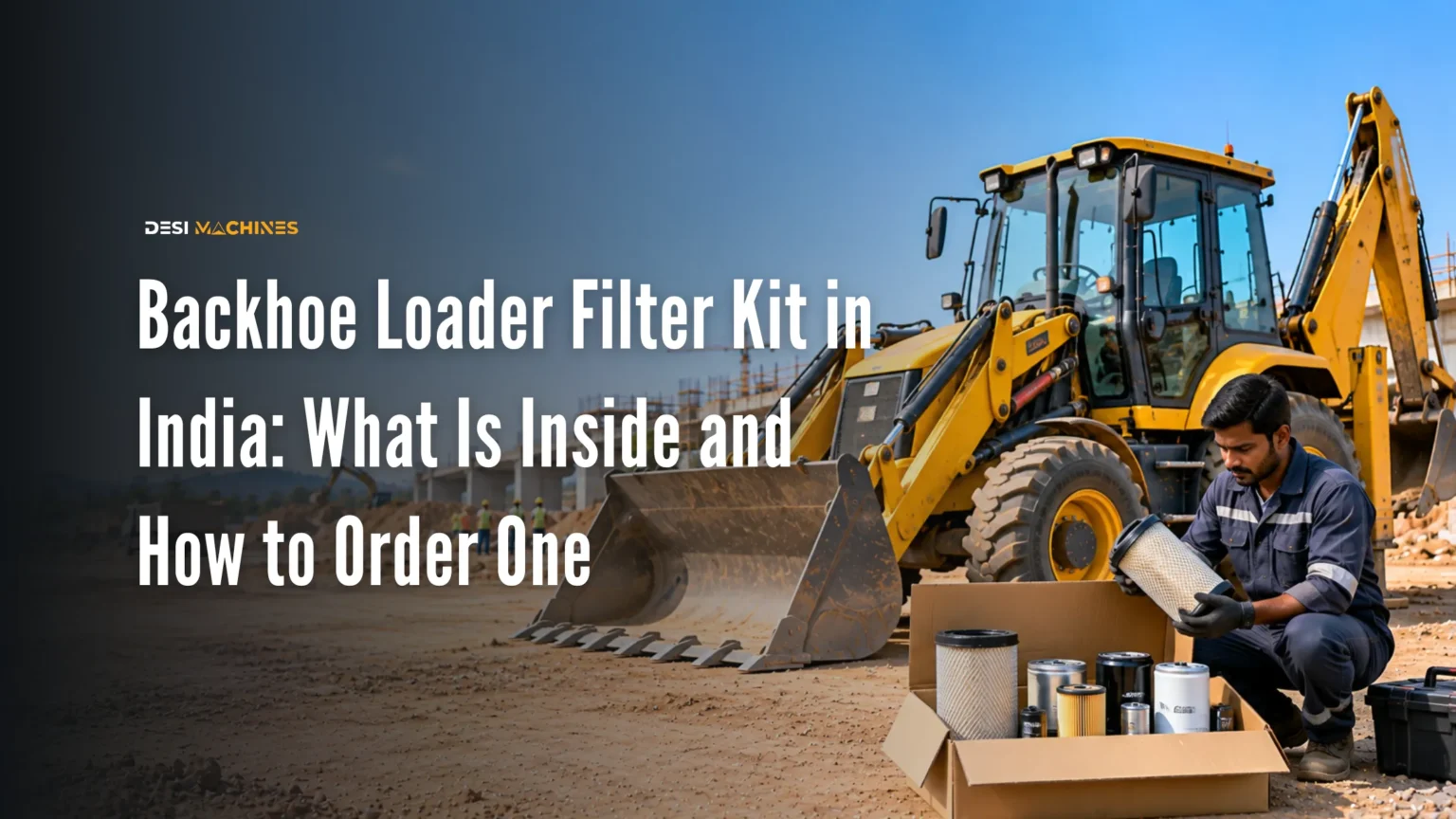
A backhoe loader filter kit holds five or six filters: an engine oil filter, one or two fuel filters, an air cleaner with a main and a safety element, a hydraulic filter, and on most machines a transmission filter as well. Which exact part numbers you need is decided by the engine under the bonnet, not by the name painted on the side, and that is the single thing most first-time owners get wrong at the parts counter.
Of the 51 backhoe loaders listed at the time of writing, 50 publish their engine model, and between them they run thirteen different engine makes. Two machines wearing the same badge can take different filters if they were built to different emission stages. This guide explains what sits in a kit, why the engine decides it, and exactly what to tell the parts shop so you get the right box first time.
What filters does a backhoe loader have?
Six filter positions cover almost every backhoe loader sold in India. A filter is simply a barrier that traps dirt before it reaches something expensive.
Where the six filters sit on a backhoe loader
Reading them one by one:
- Air cleaner. Almost always two elements, one inside the other. The outer one does the work; the inner safety element is a second barrier that catches dust if the outer one splits. Dust is the fastest way to wear out a diesel engine in Indian conditions.
- Engine oil filter. A spin-on canister that catches metal and carbon before the oil goes back round the engine.
- Fuel filter. Diesel from a drum carries grit. The filter stops it reaching the injection pump, which is one of the costliest parts on the machine.
- Fuel water separator. A bowl below the fuel filter that lets water settle out of the diesel. Water in a common-rail system does damage that dirt does not.
- Transmission filter. The gearbox has its own oil and its own filter. An excavator has neither.
- Hydraulic filter. Cleans the oil that runs the loader arm, the backhoe and the stabilisers.
The parts and components of a backhoe loader are worth reading alongside this, because a filter only makes sense once you know what it is protecting.
Why does a backhoe loader need more filters than an excavator?
Because a backhoe loader is built on a tractor. It has a clutch, a gearbox with forward and reverse gears, a drive axle and road wheels. An excavator has none of that: it moves on tracks driven straight by hydraulic motors.
That tractor half brings its own oil, and its own filter. Of the 51 listed backhoe loaders, 49 publish a transmission oil capacity, and it runs from about 14 litres to 19.5 litres. Engine oil capacity on the same machines runs from 8 litres to 15 litres. So the gearbox on a backhoe often holds more oil than the engine does, which surprises most first-time owners.
If you also run a tracked machine, the filters on an excavator are a shorter list for exactly this reason. The two guides are worth reading together if you own both.
Why does the engine decide the filter, not the badge?
This is the part that costs people money. The machine is assembled by one company; the engine inside it is very often built by another. The filter is made to fit the engine.
Across the 50 listed backhoe loaders that publish an engine model, thirteen different engine makes appear:
| Engine make | Machines | What this means for parts |
|---|---|---|
| Kirloskar, including its KOEL badge | 17 | The most common backhoe engine on the list; filters are widely stocked |
| Mahindra | 9 | Own-engine machines; order through the Mahindra network |
| JCB | 5 | JCB builds its own engines and its own filters |
| Ashok Leyland | 4 | Truck-engine parentage, so filters are easy to find |
| Kubota | 3 | Imported design; confirm availability before you buy the machine |
| CNH Industrial | 3 | Shared across CASE and New Holland machines |
| Escorts, Tata, Perkins | 2 each | Check the engine plate; part numbers differ by variant |
| Cat, FPT, ACE | 1 each | Single listings; order against the engine number |
Read that table as a warning about assumptions. Two machines from different makers can share the same Kirloskar engine and take the same oil filter. One machine can be sold in two variants with different engines and take two different filters. The badge tells you almost nothing; the engine plate tells you everything.
How do CEV Stage IV and Stage V engines change the fuel filter?
Construction equipment in India follows the CEV emission ladder, which stands for Construction Equipment Vehicle. It is a separate ladder from the BS emission norms that govern cars and trucks, and it has moved quickly. Of the 51 listed backhoe loaders, the split is:
| Emission stage | Machines | Fuel system |
|---|---|---|
| CEV Stage V | 24 | Usually common-rail; finest fuel filtration, water separator expected |
| CEV Stage IV | 11 | Tighter filtration than Stage III |
| CEV Stage III | 10 | Mostly older mechanical injection; coarser filters |
| Stage II | 1 | Oldest machine on the list |
| Not published | 5 | Read the engine plate on the machine itself |
Why this matters: a common-rail engine sprays diesel through very fine injector holes at very high pressure. It cannot tolerate the grit and water an older mechanical pump would shrug off. So a Stage V machine gets a finer fuel filter and almost always a water separator bowl, and fitting an older, coarser filter because it screws on is a genuine way to ruin an injection system.
Five of the 51 machines publish no emission stage at all. On those, do not guess. The stage is stamped on the engine plate, and it also decides where the machine can legally work, since many tender and metro sites now specify a minimum CEV stage.
What does the hydraulic filter do, and why do some machines need a better one?
The hydraulic filter cleans the oil that does the digging. Dirty oil wears the pump, and the pump is the most expensive single item in the hydraulic system.
How hard that filter has to work depends on the pump. Of the 51 listed machines, 22 describe a gear pump or a fixed-displacement open-centre system, and 16 describe a variable-displacement or load-sensing piston pump. A gear pump is a simple, tolerant thing. A piston pump has fine clearances and swash plates, gives better fuel economy and smoother control, and is far less forgiving of dirty oil. If your machine has one, the filter is not a place to save money.
Six of the listed machines, all JCB, publish their filtration layout directly rather than their pump type: filtration through a suction strainer and a return line filter. That is the normal arrangement on a backhoe. The strainer is a coarse mesh at the tank outlet that stops large debris reaching the pump, and it is cleaned rather than replaced. The return line filter is the fine one, and it is the one in your kit. Seven machines publish neither, so check the machine.
Filters are only half of hydraulic health. Looking after the hydraulic system and knowing when a hydraulic hose is due covers the rest.
Should you buy a filter kit or loose filters?
A kit is one box holding every filter for one service. Loose filters are bought one at a time.
A kit wins on three counts. You cannot forget the inner air element, which is the one people skip. The part numbers are already matched to your engine, so there is no guessing at the counter. And a dealer usually prices the box below the sum of its parts.
Loose buying makes sense in two cases: when only one filter is actually due, and when you are topping up a kit because your machine has an extra filter the standard box does not include. The second case is common on 4WD machines and on machines with a fitted breaker circuit.
The genuine, OEM and aftermarket question applies to filters more than to most parts, because a filter that merely fits is not the same as a filter that filters. Our guide to genuine, OEM and aftermarket spare parts sets out how to judge that, and it is worth reading before your first service.
Buying your first machine, or replacing one? Compare backhoe loader models and specifications and speak to a dealer about what a service kit costs before you sign.
When should each filter be changed?
Short answer: the air cleaner as often as your site demands, and everything else on the hour meter. Filters are the cheapest part of a service and the most expensive thing to skip.
Intervals differ by maker and by machine, so read them off your own operator handbook rather than off a general rule. Our backhoe loader maintenance schedule sets out the daily, 250-hour and 500-hour checks in detail, and the wider construction equipment service schedule covers the same ground across machine types.
Two India-specific notes. In heavy dust, on a haul road or a crusher site, the air cleaner will need attention long before the book says so, and the restriction indicator on the housing is what should decide it rather than the calendar. And in the monsoon, drain the water separator bowl daily, because water condenses in a half-empty fuel tank overnight.
A choked filter also shows up as a running fault. If a machine is hard to start, a blocked fuel filter is one of the first things to check.
What should you tell the parts counter?
Bring six things and you will get the right box first time.
- The machine make and model, with the variant, for example a 2WD or 4WD version.
- The engine make and model number, read off the engine plate, not off memory.
- The emission stage, Stage III, Stage IV or Stage V.
- The machine serial number, because makers change filter part numbers mid-production.
- Which service you are doing, so the counter gives you the right kit rather than the largest one.
- Any fitted attachment circuit, such as a breaker line, which can add a filter.
Photograph the engine plate once and keep it on your phone. It settles most of this list in one picture, and it is equally useful when you sell the machine.
Worth knowing while you are there: filter changes go hand in hand with oil and coolant. The oil and fluid capacities of a backhoe loader tell you how much to buy, and which coolant a machine takes is a separate decision that people often get wrong at the same service.
What does a backhoe loader filter kit cost in India?
There is no public price list for filter kits, and any single figure you see quoted online is almost certainly for one filter on one engine rather than for a kit. Kits are quoted per machine, because the contents change with the engine and the emission stage, and dealer pricing varies by region.
Ask your dealer for a written quotation against your engine model and serial number, and ask for it as a kit price and as a line-by-line price. Comparing the two tells you whether the kit is genuinely cheaper. Ask what the inner air element costs separately, since that is the one most often left out of a cheap quote.
For a sense of what the machines themselves involve, current backhoe loader listings and specifications set out the models on sale, and the wider backhoe loader guide covers buying, running and comparing them.
Ready to compare machines? Browse backhoe loader models, specifications and dealers and send an enquiry for a service-kit quotation along with the machine price.
The short version
A backhoe loader takes five or six filters, and the list is longer than an excavator’s because a backhoe has a gearbox and a drive axle. The engine decides the part numbers, and across the 50 listed machines that publish one, thirteen engine makes are in play, with Kirloskar the most common at 17. The emission stage decides how fine the fuel filter has to be, and 24 of the 51 listed machines are now CEV Stage V. Buy the kit rather than loose filters, photograph the engine plate, and never skip the inner air element.
Specifications quoted here are taken from our listings at the time of writing. Prices, specifications and features are indicative, vary by variant, location and date, and should always be confirmed with the official OEM or authorised dealer before any purchase decision. DesiMachines is not liable for decisions taken on the basis of information that may have changed after publication.