Excavator
316 models
 Backhoe Loader
54 models
 Crane
68 models
 Concrete Mixer
79 models
 Wheel Loader
54 models
 Compactor / Roller
45 models
 Motor Grader
42 models

 Concrete Pump
66 models
 Skid Steer Loader
11 models


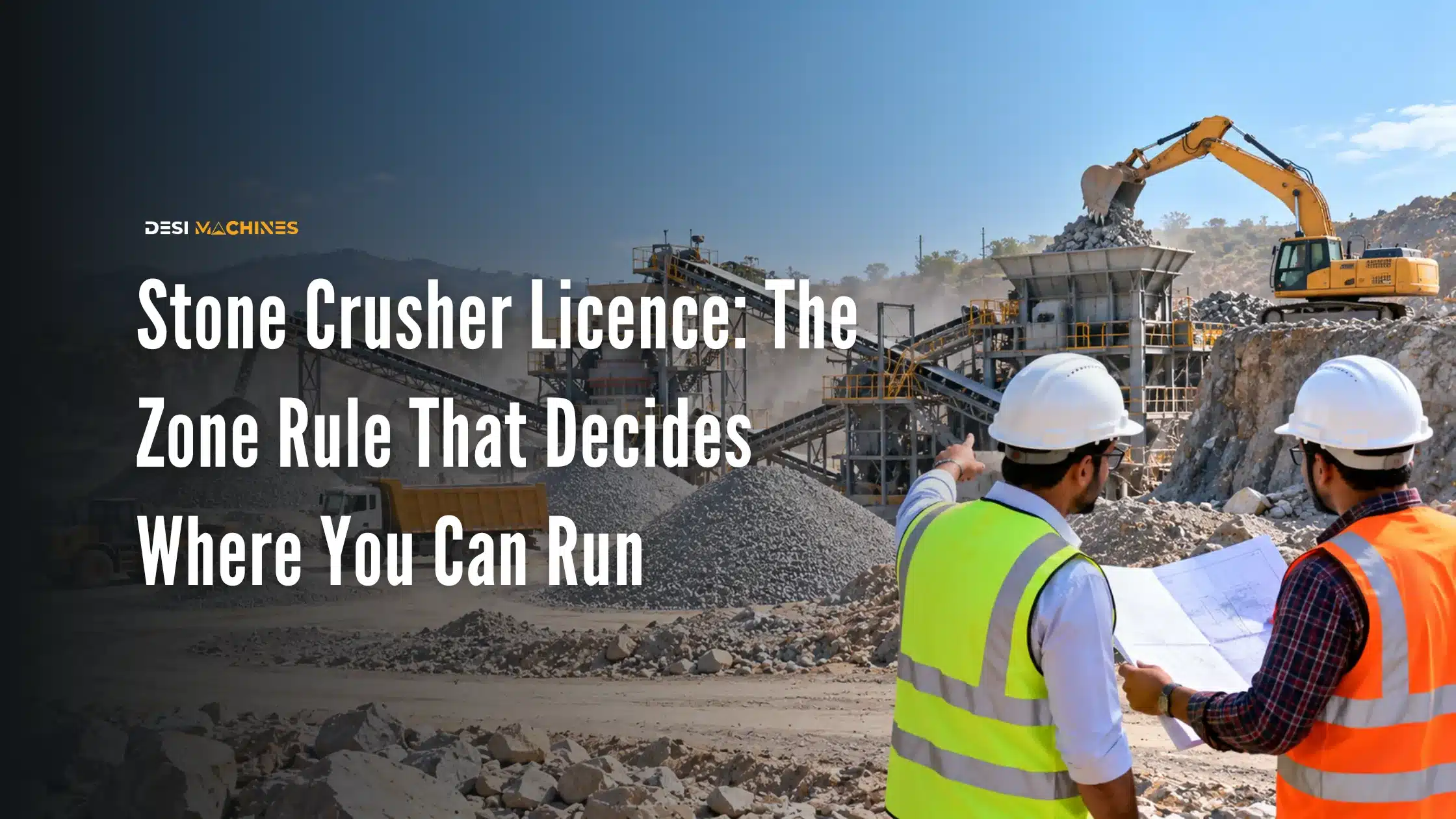
A stone crusher licence is a decision about land, not paperwork. The machine is perfectly legal to buy and own, and in most states it becomes illegal the moment it runs outside a declared zone. Under the Karnataka Regulation of Stone Crushers Act 2011, as amended in 2013 and 2020, the licence now runs twenty years and renews for ten, is issued by a district authority chaired by the Deputy Commissioner only after the state pollution control board’s consent for operation, and is available only inside a safer zone defined by distances from highways, roads, villages, schools, temples and municipal limits. Buy the plot before you read those distances and the licence is the thing you will never get.
Here is the contradiction that catches first-time crusher owners. Nobody needs permission to purchase a crushing plant, and no dealer will ask you for one. The approval you need is not for the machine at all. It is for the ground it stands on, and it is refused on the basis of things you cannot change after buying: how far the plot sits from a road, a school, a temple, a river, a village boundary.
Karnataka is the clearest worked example because its rules sit in a published Act rather than scattered circulars, and because the law itself came out of litigation. The Karnataka Regulation of Stone Crushers Act 2011, in force from 7 September 2011, was enacted after the High Court of Karnataka, by an order dated 10 July 1998 in Writ Petition No. 17078 of 1997, directed the State Government to frame a policy regulating the stone crushing business by prescribing reasonable conditions including guidelines, licences and their renewals.
The Act has since been amended twice, and both amendments matter more than the original text. Karnataka Act 64 of 2013, in force from 26 December 2013, replaced the safer-zone distances, made consent for operation from the Karnataka State Pollution Control Board a condition of the licence, and replaced the district committee with a District Stone Crushers Licensing and Regulation Authority. Karnataka Act 28 of 2020, in force from 30 March 2020, stretched the licence to twenty years, allowed transfers and rewrote the penalties. The text with both amendments appended is in PRS Legislative Research’s copy of the Act. The original 2011 figures are kept below where they explain why older plants sit where they do.
The definition the Act uses is deliberately wide. A stone crusher is any power driven machinery of any size which crushes stone. Size is not a way out.
The safer zone, and why it is the whole game
The Act’s central idea is that crushers are confined to zones the district declares, and the declaration follows fixed minimum distances. A licence is granted only on the condition that the crusher is not established outside a safer zone.
Since 2013 the safer zone may not be located within these limits, with the 2020 amendment splitting the road line into major district roads and other roads:
| Distance from | Minimum (as amended 2013 and 2020) |
|---|---|
| National Highways or State Highways | 200 m |
| Major district roads | 100 m |
| Other roads | 50 m |
| Revenue village, temples, schools | 500 m |
| Municipal corporation, city municipal corporation or town municipal council | Outside the boundary |
| Land each crusher unit must stand on | At least 1 acre |
The 50 km gap between safer zones and the river, forest and cultivable-land buffers were not carried into the 2013 section. The original 2011 distances, replaced that year, were far wider:
| Must be away from (2011 text, replaced in 2013) | Minimum distance |
|---|---|
| National Highways, habitations, temples, schools, rivers | 2 km |
| State Highway | 1.5 km |
| Link roads | 500 m |
| Municipal corporation limits | 8 km |
| District headquarters limits | 4 km |
| Taluk headquarters boundary | 2 km |
| Inhabited village, recorded forest, private cultivable land | 1 km |
| Another safer zone | 50 km radius |
| Minimum area of the unit | 1 acre |
Read the 2011 text’s 8 km from municipal corporation limits and 2 km from habitations together and the commercial problem appeared immediately. Crushed aggregate is a low-value, high-weight product; haulage is a large share of what the customer pays. That version of the law pushed the plant away from exactly the demand that makes it profitable, and cartage was the price of compliance. That tension, not the licence fee, is what decides whether a site works.
The 2013 distances are far shorter, so the pressure now comes from the municipal boundary and the 500 m village, temple and school line rather than from kilometre-scale buffers. Haulage still decides the margin, and the zone still has to be declared before any plant can be licensed in it.
The 2011 text’s 50 km rule between zones was the one most people missed: it was a distance between declared zones, not between crushers, and it kept the number of viable locations in a district small. The 2013 section dropped it. Under the 2011 text the licensing authority declared safer zones by notification, sent the proposal to the pollution control board for certification, could proceed if the board did not respond within three months, and could relax a condition in exceptional circumstances for reasons recorded in writing. Since 2013 the authority declares zones by notification with the revenue, forest and pollution control officers, and must declare the zone for an existing crusher within one month and in any case within three months of the application.
A unit already running when the law arrived in 2011 was given a route: apply within three months of the safer zone being declared, continue operating until the application is decided or three months pass, and on grant of the licence shift to the safer zone within six months.
The licence term, and the renewal clock
The licence is now valid for twenty years and renewable for ten more. Karnataka Act 28 of 2020 set that term, replacing the five years fixed in 2013 and the original three, and every licence granted before it is deemed to run twenty years from its original grant, subject to an annual regulation fee. The application for renewal has to reach the licensing authority three months before the licence expires. On receiving an application for grant or renewal, the authority inspects the location, verifies the conditions and grants or rejects it within three months.
The 2020 amendment softened that deadline. An application made one month before expiry may still be accepted for valid reasons on payment of an additional fee, and a renewal rejected only because it was filed late can be revived on a penalty of Rs 2 lakh.
Under the original three-year term, a three-month renewal lead time was a short cycle for an asset with a long payback; at twenty years the term outlasts most plants, so the recurring risks are now the annual fee and the conditions. Put the renewal date in the same calendar as your loan schedule rather than in a drawer. A lapsed licence does not pause the plant politely; it exposes it to the closure powers described further down.
The fee is set by the rules rather than the Act, which prescribes only that an application be accompanied by such fees as may be prescribed. No honest figure can be quoted here, and a crusher business plan built on a guessed licence fee is a business plan with a hole in it. Ask the district office for the current notified fee in writing.
Two figures are fixed in the Act itself since 2020: a non-refundable processing fee of Rs 25,000 to apply for a licence transfer, and the Rs 2 lakh penalty to revive a renewal rejected for late filing. A Karnataka district mines and geology page lists a stone crusher application fee of Rs 5,000 and a fee of Rs 100 per horsepower of the plant (page last updated in 2021, no rule cited), so treat those as indicative and confirm the current figure with the district office in writing. The annual regulation fee the 2020 amendment introduced is to be prescribed by rules.
Who actually signs: the district committee and the NOCs
No single officer decides this. Since 2013 each revenue district has a District Stone Crushers Licensing and Regulation Authority, which issues licences and regulates the business; it replaced the District Stone Crushers Regulation Committee of the 2011 text, which assisted the licensing authority and supervised licensed premises. Its composition tells you who can stop you.
The Deputy Commissioner chairs it. The Superintendent of Police, the Chief Executive Officer of the Zilla Panchayat, the Deputy Conservator of Forest, all the district’s Assistant Commissioners and the Environmental Officer of the Karnataka State Pollution Control Board are members, and a Deputy Director or Senior Geologist from the Department of Mines and Geology is the member-secretary, who receives every application. The 2011 committee also seated the Assistant Director of Fire Force, the Assistant Director of Factories and Boilers, the Labour Officer in charge of the district and the District Health Officer.
Under the 2011 text, no-objection certificates from the departments concerned came first, including the state pollution control board, forest and revenue. Since 2013 the licence is issued only on production of the Karnataka State Pollution Control Board’s consent for operation, which the applicant obtains after the authority certifies that the site complies with the safer zone. Each unit must also abide by the pollution control measures the board prescribes from time to time, conform to the Noise (Regulation and Control) Rules 2000, and comply with the Air (Prevention and Control of Pollution) Act 1981 and the Environment Protection Act 1986.
The 2013 amendment added physical conditions too: a 15 to 20 feet wall or GI sheet barrier on the three sides facing the highway, road, village, temple or school, on top of the air pollution controls, and a green belt to hold back dust.
That last group is a separate approval track, not a sub-clause of the licence. The consent to establish and consent to operate from the state pollution control board has its own sequence, its own timing and its own money consequences, and the order in which you take it matters. Starting civil work before consent to establish is the classic and expensive mistake.
Stone crushers sit in the Central Pollution Control Board’s Orange category under its direction of 12 February 2025, as the board recorded in its reply to the National Green Tribunal in OA 141 of 2026, which is why both consent to establish and consent to operate are needed.
Where the stone itself comes from is a third track again. A crusher that feeds off its own quarry needs the mineral side settled through a quarry lease and has to account for royalty on the mineral extracted. Buying boulder from a leaseholder instead changes your cost structure but does not remove the obligation to know the source is lawfully worked.
Inspection, cancellation and the power to cut your power
The Deputy Commissioner, or an officer authorised by them, inspects every licensed crusher at least once a year. A licence may be cancelled on the authority’s own motion for reasons recorded in writing, or on a complaint that the licence was granted contrary to the Act or that the licensee has breached its conditions, and no cancellation may be ordered without giving the licensee an opportunity of being heard.
The direction power is the one worth reading twice. The licensing authority may issue written directions that include closure, prohibition or regulation of a crusher, and the stoppage or regulation of the supply of electricity, water or any other service to it. A crusher without power is scrap with a loan against it, and that is an administrative order rather than a court process.
The Act also creates a Victim Relief Fund, credited with licence fees, fines and penalties, from which relief is paid to people claiming health harm from a crusher. Under the 2011 text, claims came in within three months of the harm occurring, the committee determined relief within three months, and it could direct the licence holder to pay a further amount within two months, failing which the licence was cancelled. The 2013 amendment rewrote the section, and an unpaid amount the authority orders is now also recovered as arrears of land revenue before the licence is cancelled. In other words a health complaint from a neighbouring village can reach your licence, not just your wallet.
Penalties sit at the end, and the 2020 amendment rewrote them. Running a crusher without a licence now carries imprisonment up to two years or a fine up to Rs 2 lakh or both, plus up to Rs 5,000 for each day it continues. Contravening licence conditions carries up to a year or a fine of Rs 25,000 or both, plus up to Rs 500 a day, and that offence can be compounded by the district’s mines and geology officer. A breach of the rules still carries up to a year or Rs 5,000 or both, with a continuing fine up to Rs 500 for each day it goes on after a first conviction. Even at Rs 2 lakh the fines are modest; the closure and electricity powers are what actually bite.
Appeals lie to the Regional Commissioner of the region, within thirty days of the order being communicated, to be disposed of after hearing both sides within three months. Late appeals may be admitted on sufficient cause shown.
Sequencing a stone crusher licence against your spending
Sequence the spending to match the approvals. The order that protects you is: confirm the notified safer zones in your district, secure land inside one, establish the mineral source, obtain consent to establish, then commit to the plant and the feeding machines.
Owners who do it the other way round buy the crusher first because a good deal appeared, then look for land, and discover that the plots they can afford sit inside the road, village or municipal exclusions. At that point the asset is financed and idle, which is the single most expensive position in this trade.
The earning side of the same decision is worth modelling before the compliance side is cleared, so the two can be weighed together. The stone crusher business profit breakdown covers the output, cost and margin arithmetic, and the feeding fleet is usually the larger capital line: compare excavator models and prices (a 20-tonne machine such as the Tata Hitachi EX 200 Infra at about ₹56–62 lakh, November 2026) for the loading and boulder-handling side before the plant order is placed, and look at how machine finance is structured for a business whose licence now runs twenty years but carries an annual fee.
Who makes the jaw, cone and mobile crushers themselves is set out in stone crusher manufacturers in India, and the wage line for the plant crew in crusher operator salary in India.
Treating the licence as a property question
Treat a stone crusher licence as a property question with a compliance wrapper. The distances are not negotiable in practice, the zones are fixed by notification rather than by application, the term is twenty years, and three separate authorities have to be satisfied: the licensing authority under the state crusher law, the pollution control board, and whoever controls the mineral.
Karnataka’s figures above are Karnataka’s. Maharashtra, Tamil Nadu, Assam and other states regulate crushers through their own instruments, with different distances, different authorities and different fees, which is why the state-qualified search is the right search. Use this as the shape of the problem, then get your own state’s current notification and fee in writing from the district office before any money moves.
If supplying aggregate to government work is the plan, keep an eye on current tenders and supply opportunities so the plant is sized against real offtake rather than hope.
Karnataka alone cleared a ₹20,000 crore package for nearly 5,900 km of highways and link roads in November 2026 (Karnataka road package), the kind of demand a plant in the state is sized against.
Rates, schemes, specifications and prices change, and crusher licensing is a state subject in which distances, fees, authorities and conditions differ between states and are revised by notification. The provisions described here are from the Karnataka Regulation of Stone Crushers Act 2011 as amended by Karnataka Acts 64 of 2013 and 28 of 2020, with the original 2011 figures marked where they are kept for context. Confirm current requirements with the district licensing authority, the state pollution control board or a qualified professional before buying land or a plant.