Excavator
294 models
Excavator
294 models  Backhoe Loader
51 models
Backhoe Loader
51 models  Crane
68 models
Crane
68 models  Concrete Mixer
79 models
Concrete Mixer
79 models  Wheel Loader
54 models
Wheel Loader
54 models  Compactor / Roller
45 models
Compactor / Roller
45 models  Motor Grader
42 models
Motor Grader
42 models  Dozer
41 models
Dozer
41 models  Concrete Pump
66 models
Concrete Pump
66 models  Skid Steer Loader
11 models
Skid Steer Loader
11 models  Telehandler
13 models
Telehandler
13 models 


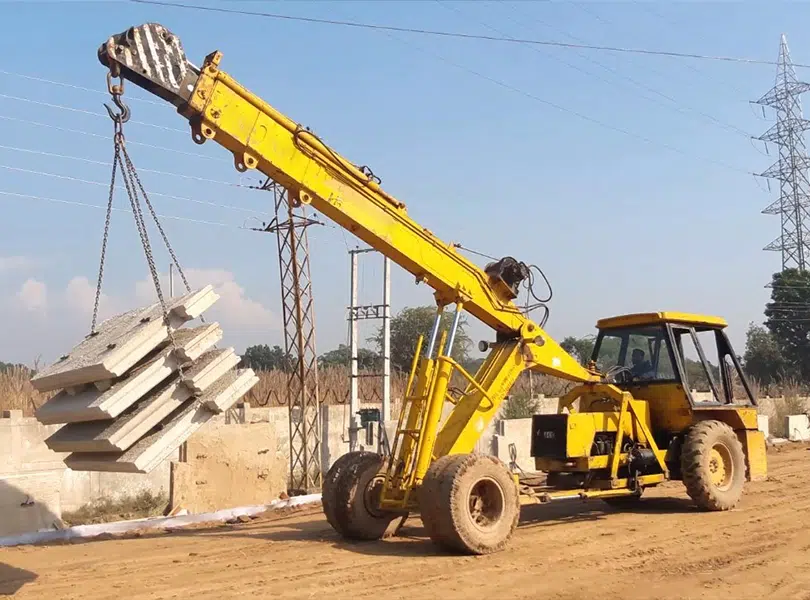
Five grades, five markets. A paver block business is a small concrete factory, and the grade you can hold week after week decides which buyers you are allowed to quote to at all. IS 15658:2006 ties it together: M-30 at 50 mm thickness for garden paths and building premises, M-40 at 80 mm for city streets, M-55 at 120 mm for container terminals and port yards. A paver is an article of cement under HSN heading 6810 and carries 18 per cent GST, so your pricing has to carry that from the first quotation.
What a paver block business actually sells
You are not selling concrete. You are selling a guaranteed compressive strength in a shape that locks into its neighbours, delivered in a quantity a contractor can lay in a week.
That distinction decides everything downstream. A buyer laying a residential driveway cares about colour and price. A buyer paving a container yard cares about whether your blocks will still be flat after three years of loaded trailers. The second buyer pays more, orders in far larger lots, and will walk away the first time a consignment fails a test.
Most new owners set up to serve the first buyer and then discover the margin is in the second.
The grade table that decides who can buy from you
IS 15658:2006, the Bureau of Indian Standards specification for precast concrete blocks for paving, is the document your customer’s engineer will be holding. Its Table 1 maps grade to traffic category to minimum thickness, and it is the single most useful page in the whole business.
| Grade | Strength at 28 days | Minimum thickness | Where it is used |
|---|---|---|---|
| M-30 | 30 N/mm² | 50 mm | Building premises, landscapes, parks, domestic drives, paths and patios |
| M-35 | 35 N/mm² | 60 mm | Pedestrian plazas, car parks, housing colonies, low-volume rural roads |
| M-40 | 40 N/mm² | 80 mm | City streets, market roads, utility cuts on arterial roads |
| M-50 | 50 N/mm² | 100 mm | Bus terminals, industrial complexes, factory floors, service stations |
| M-55 | 55 N/mm² | 120 mm | Container terminals, ports, dock yards, mine access roads, airport pavements |
Read it as a business plan rather than a specification. Each row is a different customer, a different order size and a different level of quality control. The standard defines the traffic categories by commercial vehicle count too: light traffic is up to 150 commercial vehicles a day over 30 kN laden weight, medium is 150 to 450, heavy is 450 to 1,500, and very heavy is above that.
The standard also caps the product range. Minimum block thickness is 50 mm, maximum is 120 mm, and 60, 80, 100 and 120 mm are the recognised standard thicknesses. A mould outside that range is a mould you will struggle to sell from.
Where the money goes before the first block is sold
We are not going to print a plant price, because the honest answer is that it depends on a decision you have not made yet: hand-operated, semi-automatic or fully automatic, and how many moulds you buy. A figure quoted without that context is the kind of number that gets a loan sanctioned and a business stranded.
What we can do is name every head the money disappears into, so nothing surprises you:
The vibro-press and its moulds are the obvious one, and moulds are a recurring cost rather than a one-time one because they wear. A pan mixer sized to the press. A batching arrangement for cement, sand, aggregate and dust. Curing space, which is land, water and shade rather than machinery, and which new owners consistently under-provide. Material handling in the yard, which is where a small wheel loader earns its keep once you are turning over more than a few thousand blocks a day. A connected power load the state board will actually sanction. And working capital, because your buyer takes delivery long before he pays.
Curing is the head to watch. It is the cheapest line in the list and the one that decides whether you hold M-40 or quietly slip to M-30.
How the margin is built, per square metre
Paver blocks are quoted per square metre, not per piece, and the arithmetic is unforgiving because the inputs are commodities everybody can price.
Start with the cement content your grade needs, add sand and aggregate at your landed rate, add colour oxide only on the wearing layer if you are making two-layer blocks, then add power, labour, mould depreciation and breakage. Breakage is the line nobody budgets for and everybody pays. Divide by the square metres that mix yields at your thickness, and you have a floor price.
Quarry dust deserves a mention here because it is both an input and a trap. It works as feed for making solid blocks and paver blocks and as the bedding layer under them, and it is far cheaper than river sand, but the difference between quarry dust and manufactured sand is real and substituting one for the other without testing is how a consignment fails.
Then sit the floor price next to what the market is paying in your district. If the gap is thin at M-30, that is a signal to move up the table rather than to cut cement.
The two tests that fail a consignment
IS 15658 sets obligatory requirements, and two of them account for most rejections.
Water absorption is the first. Measured as the average of three units, it must not exceed 6 per cent by mass, and an individual sample should stay within 7 per cent. A block that drinks water will spall in a wet winter, and a departmental engineer knows it.
Dimensional tolerance is the second, and it is the one a small unit fails without realising. Interlocking only works if every block matches. Worn moulds, inconsistent compaction time and blocks pulled off the vibro-press too early all push the dimensions out, and at that point the pavement will not key together no matter how strong the individual block is.
Efflorescence, the white bloom that surfaces after laying, is judged visually. The standard also specifies tests for abrasion resistance and tensile splitting strength, which is what an institutional buyer will ask a third-party laboratory to run before he releases a large order.
GST: you are selling an article of cement, not a brick
This is the line new owners get wrong most often, and it costs real money.
A concrete block or paver block is an article of cement under HSN heading 6810 and is taxed at 18 per cent. A red clay brick or a fly ash brick sits in a separate scheme at 6 per cent without input tax credit or 12 per cent with it. Two products that compete for the same rupee in the same project, six percentage points apart. The full picture of which material sits where, with the HSN heading for each, is set out in our guide to GST and HSN codes on building materials, and the rate schedules themselves are published by the Central Board of Indirect Taxes and Customs.
The practical consequence is that your 18 per cent is recoverable by a registered buyer and simply a cost to an unregistered one. Builders and departments will not blink. A homeowner paving his own compound will, and will ask you for a cash rate. Decide in advance how you answer that, because a habit formed in the first year is hard to undo later.
Who the buyer is, and how he pays
Three buyers, three payment behaviours.
Retail and small contractors pay fastest and order least. Builders and developers order in useful volume and pay against progress, which means your cash is tied up in blocks sitting in their yard. Government and municipal work is the largest and slowest of the three, and it is where the IS specification stops being advisory and becomes a contract condition. Road, drain and footpath contracts put out by urban local bodies and state departments are a steady source of block demand, and the current ones are listed on our live tenders and project opportunities page.
If you are weighing this against other machine-led routes into the industry, our round-up of construction business ideas in India sets out the alternatives side by side, and the stone crusher business piece covers the one that sits directly upstream of you in the materials chain.
The bottom line
A paver block unit is a quality-control business wearing a manufacturing costume. The machine decides your capacity, but curing discipline and mould condition decide your grade, your grade decides your customer, and your customer decides your margin. Start by picking the row of Table 1 you intend to serve, then buy the plant that reaches it, rather than the other way round.
If the plant and yard equipment are being financed, work out the repayment against realistic monsoon-season output rather than peak months. Compare equipment finance options and rates before committing, and if the laying side of the work interests you as well, plate and soil compactor models and prices are where that kit starts.
Grades, test limits and traffic categories here are taken from IS 15658:2006 and GST rates from Notification No. 9/2025 as applied from 22 September 2025. Rates, standards, schemes and prices change, and the correct classification of a particular product depends on its exact description, so confirm current terms with the OEM, dealer, bank or your own tax adviser before deciding.