Excavator
294 models
 Backhoe Loader
51 models
 Crane
68 models
 Concrete Mixer
79 models
 Wheel Loader
54 models
 Compactor / Roller
45 models
 Motor Grader
42 models
 Dozer
41 models
 Concrete Pump
66 models
 Skid Steer Loader
11 models
 Telehandler
13 models


The makers put the first big DPF service at 5,000 to 6,000 engine hours: Cummins sets ash cleaning of its particulate filter at 5,000-hour intervals on its Tier 4 off-highway engines, and Kubota says its Stage V engines now go 6,000 hours between ash cleans. Until then the filter cleans itself by burning off soot, which costs diesel and some time but no invoice. There is no single DPF cleaning cost to print, because the bill depends on which of four jobs your filter needs: a regeneration on the machine, a service regeneration by the dealer, an off-machine ash clean or exchange, or a new filter when the old one is damaged.
CEV Stage V has applied to new construction machines in India from 1 January 2025, as JCB India’s own Stage 5 FAQ puts it, and on wheeled machines it brought a new filter into the exhaust. The guide to BS and CEV emission norms explains the rule itself, and the silencer and exhaust parts guide shows where the DOC and DPF sit in the exhaust line. This piece covers the running cost they added.
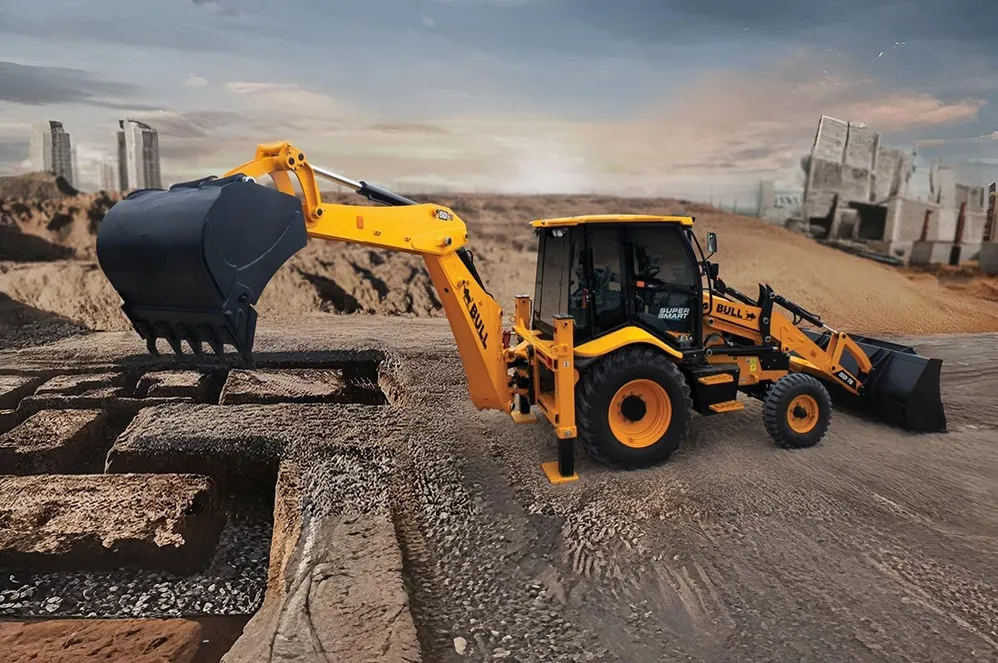
Which machines carry one matters. JCB India’s FAQ says all wheeled diesel machines, such as backhoe loaders, telehandlers, loaders and compactors, must comply with Stage 5, while metal tracked or crawler machines such as excavators are exempted. The JCB 3DX lists a JCB 430 Stage 5 engine with a DOC and DPF, and the Hamm HC 119i compactor lists a CEV Stage V Ashok Leyland engine with DOC, DPF and SCR.
Why we do not print a single DPF cleaning cost
We list no DPF as a part, and no engine maker publishes an Indian cleaning rate we can stand behind. More to the point, “the DPF needs cleaning” can mean four jobs: an hour of diesel, a dealer engineer at your site, the filter off the machine, or a new filter. Any single rupee figure would be wrong for most readers. What follows is what each job is made of and when it falls due.
Soot burns off, ash does not
A DPF catches two things. Soot is carbon from burnt diesel, and it can be burnt away inside the filter by heat. That burning is called regeneration. Ash is what is left from engine oil that gets burnt in the cylinders, and no amount of heat removes it.
Cummins says it plainly in its particulate filter guide: “The regeneration process only removes carbon from the filter”, and the only maintenance its filter needs is “to remove ash from the DPF which is a result of lube oil consumed by the engine.” Perkins, in its note on cleaning your particulate filter, adds that this ash “is considered a hazardous material” and is disposed of the same way as used lubricating oil. That is why ash cleaning is a workshop job, done with the filter off the machine.
Automatic, manual and service regeneration: what each costs you
JCB India’s page on the types of regen and what you should do describes three kinds. What follows is what each one costs an owner.
| Type | What you see | What it costs you |
|---|---|---|
| Automatic regeneration | HEST (high exhaust temperature) lamp on while you work; engine sound may change | Some extra diesel. You can keep working, but JCB asks you to avoid repeated stopping and starting until it finishes |
| Manual (stationary) regeneration | Amber regen lamp, after auto regen is interrupted or does not clean enough | Machine parked, engine raised to 1,500 rpm on backhoe loaders and compactors, for up to 60 minutes. Diesel plus an hour of lost work |
| Service regeneration (often called forced regen) | Red regen lamp flashing; engine will not rise above idle | Only a JCB service engineer may do it. A service visit, and the machine stands until the engineer arrives |
Each step down the table costs more, and a service regeneration usually starts as automatic ones cut short. An operator who switches off whenever the HEST lamp comes on is working towards the red lamp.
Ash cleaning intervals in hours, by maker
This is the scheduled part of the DPF cleaning cost, and the makers do not agree on one figure.
| Maker | What its own document says |
|---|---|
| Cummins (Tier 4 off-highway engines) | Ash cleaning by an authorised technician “at 5,000-hour intervals”. Its wider filter guide says up to 6,000 hours, depending on duty cycle, oil consumption and the oil used |
| Kubota (Stage V DPF engines) | Ash cleaning interval “extended to 6,000 hours”, with the note that the actual interval may differ with usage |
| Perkins | Cleaned at set intervals that depend on the engine model and hours run; on some engines cleaning is not an option and the filter is replaced |
| John Deere (700L dozer parts guide) | DPF interval listed as “As Required” |
| JCB India (Stage 5 FAQ) | No hour figure. Says the DPF is “not a filter to replace” and is kept clean by regeneration |
To put the hours in context: a machine that runs about 2,000 hours a year would reach a 5,000-hour mark in its third year. On a JCB backhoe loader, ask the dealer for the ash interval written in your operator manual, since the India FAQ does not give one. If you are pricing filters or service parts, you can ask for backhoe loader spare parts through authorised dealers.
Cleaning, exchange or a new filter
When the ash clean falls due, the filter usually does not get cleaned while you wait. Perkins says filters “are not usually cleaned on site”. The distributor takes yours in for cleaning and fits a filter that was cleaned earlier, so the machine is back at work after a swap. JCB India runs the same idea through JCB Reman: its page lists DPFs and SCR filters for Stage V machines, cleaned to “as new” condition, and says Reman parts can save up to 50% against buying new components.
| Route | When it applies | What the bill is made of |
|---|---|---|
| Clean your own filter | Ash interval reached, filter undamaged | Removal and refitting, the cleaning, and the days the machine waits |
| Exchange (cleaned or Reman filter) | Same, when you cannot wait | The exchange charge against your old filter, removal and refitting; little waiting |
| New filter | Cracked, melted or will not clean; some engines have no cleaning option | The full part price plus fitting |
JCB India’s FAQ says a DPF generally does not need replacing “unless it has suffered extreme damage or it will not clean well at all.” So when someone quotes a new filter, ask what damage they found, and ask for an exchange price beside it.
What brings the bill forward
Most early DPF bills come from how the machine is run. Long idling never lets the exhaust get hot enough for automatic regeneration, and interrupted regens push the filter towards a service visit. Cummins warns that excess use of the regeneration inhibit switch “will result in need to service/replace DPF.”
Oil is the other lever, because oil is where the ash comes from. An engine that burns more oil fills the filter with ash sooner, which ties DPF cost to engine health. The engine overhaul cost breakdown covers what a tired engine costs to put right. JCB says BS6 diesel below 10 ppm sulphur is mandatory on all Stage 5 machines and recommends CK-4 engine oil for them. Fuel and oil that do not meet the manual cost you in filter life later.
Then there is downtime. A manual regeneration takes an hour of the working day; a wait for a service engineer or a workshop clean can take days. The guide to what machine downtime really costs shows why the idle days often cost more than the invoice.
The bottom line
On a CEV Stage V machine the DPF is a running cost you can plan. Let automatic regeneration finish, do a manual regen when the amber lamp asks, and treat a red lamp as a service call. Note the ash-clean hour mark from your own manual, since the makers’ figures range from 5,000 and 6,000 hours to “as required”. When the clean falls due, ask for a clean-and-exchange price beside the new-filter price, with the downtime for each.
If you are choosing a new Stage V machine, compare backhoe loader models and prices and ask the dealer for the DPF service terms, the ash interval and the exchange arrangement before you sign.
Rates, schemes, specifications and prices change — confirm current terms with the OEM, dealer, bank or insurer before deciding. Intervals and terms quoted here are from the Cummins, Kubota, Perkins, John Deere and JCB India documents named, and differ by engine and machine.