
 Excavator
294 models
 Backhoe Loader
51 models
 Crane
68 models
 Concrete Mixer
79 models
 Wheel Loader
54 models
 Compactor / Roller
45 models
 Motor Grader
42 models

 Concrete Pump
66 models
 Skid Steer Loader
11 models


Eighteen of the 22 excavators of 100 tonnes and above listed on DesiMachines name an automatic lubrication system in their feature lists. An automatic lubrication system for excavator pins and the slew ring is a small pump, a grease tank and a set of metering blocks that push measured shots of grease into each joint on a timer, while the machine keeps digging. On a 20-tonne machine the same system is usually an option, and on a mini excavator the nearest thing is a grease bank: a row of nipples that you still fill with a gun.
People also call it auto-lube, auto-greasing or central lubrication. This guide explains how the system works, the main types, which points it feeds, which machines come with one and the checks it still needs every day. The manual side, meaning grease points, grades and how often to use the gun, is covered in the construction equipment lubrication guide. There are no prices here, because the cost depends on the system type, the number of points and the machine.
How does an automatic lubrication system work?
It does the job of the person with the grease gun, using a pump that runs by itself. Wikipedia’s article on automatic lubrication systems lists the same few parts in every design: a reservoir with a pump, feed lines, metering valves or injectors, and a control system that switches the pump on and off. On a construction machine they look like this.
| Part | What it does on the machine |
|---|---|
| Grease tank and pump | Holds the grease and pushes it into the system. The pump is driven by an electric motor or by the machine’s own hydraulics. On a mining machine the tank is large: the Komatsu PC2000-8 lists a 200-litre grease tank. |
| Controller | A timer that runs the pump for a short spell and then rests it, over and over through the shift. Larger systems can also be monitored, for example by a pressure switch that tells the controller when grease has reached every point. |
| Main line | One hose that carries grease from the pump to the metering blocks. |
| Metering block or injector | Splits the grease into fixed small shots, one for each point. |
| Feed lines | Thin hoses from the block to each pin, bush or bearing, fitted where the grease nipple would be. |
Figure 1. The path grease takes in an automatic lubrication system
The parts and their order follow Wikipedia’s description of an automatic lubrication system and Groeneveld-BEKA’s description of a progressive system. Some designs use an injector at each point in place of a metering block.
The difference from hand greasing is the rhythm. A person greases once a shift, so a pin gets one big dose and then slowly runs dry until the next round. The pump gives the same pin small amounts at regular intervals all through the shift, so the film of grease between the pin and its bush never runs out.
Wikipedia gives the other reasons owners fit one. The amount is measured and the same every time, where a gun can give too much or too little. Too much grease can damage bearing seals and needs cleaning up; too little wears the parts faster and shortens their life. And because the points are greased while the machine runs, nobody has to reach a hard-to-get pin on a working machine.
What are the types of automatic lubrication system?
The types differ in how the grease is shared out between the points. Two independent sources describe the same family: the Wikipedia article above, and the system-type pages of Groeneveld-BEKA, a European maker of lubrication systems for trucks, construction and mining machines.
| Type | How it shares out the grease | Where you meet it |
|---|---|---|
| Single-line progressive | One line feeds divider blocks. Each piston, as it moves, pushes grease that moves the next piston, so every point gets its shot in turn. | Mobile machines and attachments. Groeneveld-BEKA sells progressive systems for hydraulic breakers. |
| Single-line parallel (injector) | One pressurised line feeds an injector at each point. Each injector works on its own and can be set to give more or less. | Machines whose points need different amounts. The Liebherr R 9100 G6 lists automatic single-line lubrication. |
| Dual-line | Two main lines take turns: one builds pressure while the other vents. | Hundreds of points spread over a long distance, served by one pump. |
| Multi-line (pump to point) | Each pumping element in the pump feeds one point directly, with no metering block. | Smaller systems. Groeneveld-BEKA offers one for self-fitting on small construction machines. |
| Single-point lubricator | A self-contained unit that feeds one point, usually a bearing. | One hard-to-reach or unsafe bearing. |
The progressive design has one habit every operator should know. Because each piston moves the next in a chain, a single blocked line can stop the whole block. So when several joints run dry at the same time, look first for one blocked line.
Wikipedia also notes that grease systems are the kind used on mobile machines such as trucks, mining and construction equipment, while oil systems suit fixed machinery like a factory machine tool.
Which points does it grease on an excavator?
The front joint pins and the swing circle. That is how Tata Hitachi describes the system on its mining excavators such as the Tata Hitachi EX 3600-6: it lubricates the front joint pins and swing circle automatically, which ends the daily round with the gun. BEML says much the same for the BEML BE1000-1, where grease goes to the hinge pins and the swing circle bearings.
In plain words, the front joint pins are the pins of the boom, arm and bucket and the ends of the cylinders that move them. Each is a steel pin turning inside a steel sleeve, and the pins and bushes guide explains how they wear. The swing circle is the big ring bearing that the upper body turns on, covered in the excavator slewing ring guide.
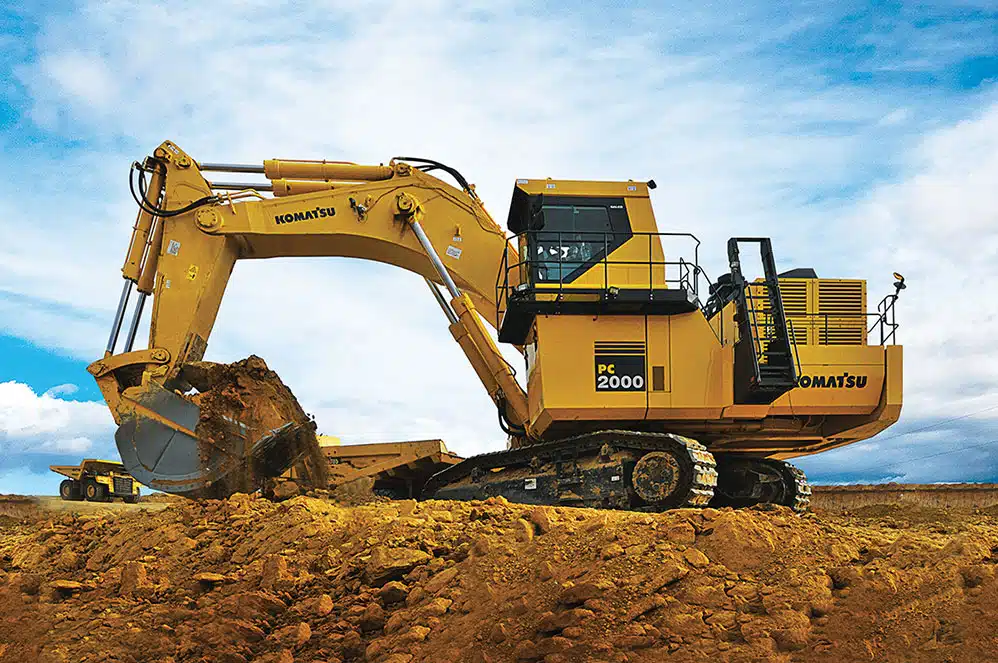
Not every point is always on the circuit. Check the machine’s lubrication chart in the operator’s manual to see which points the system feeds and which are left for the gun. A point that is not plumbed in gets nothing from the pump, however full the tank.
Which excavators and machines come with automatic lubrication?
Mostly the big ones. The pattern below comes from the feature notes of machines listed on DesiMachines, read in October 2026. No machine carries lubrication in its specification table. It shows up only in the feature list, and the wording there tells you whether the system is automatic, an option, or simply a grouped set of grease nipples.
| Machine and class | What the feature list says | Examples |
|---|---|---|
| Mini excavator, 2 to 3 tonnes | A grease bank: nipples grouped in one place, filled with a gun | Bobcat E27 |
| Medium excavator, 20 to 25 tonnes | Grouped grease points as standard; an automatic system as an option on some | Volvo EC210D (grouped points); SANY SY240C-9HD SPARC and Liebherr R 920 Litronic (automatic as an option) |
| Large excavator, 35 to 50 tonnes | An option on some, standard on others | Tata Hitachi ZAXIS 370LCH Ultra (option); Tata Hitachi ZAXIS 490H Ultra (automatic greasing system) |
| Excavator, 70 to 100 tonnes | “Auto-lube ready” on some, standard on others | CAT 374 (auto-lube ready); Liebherr R 992 E (standard); BEML BE1000-1 (automatic) |
| Mining excavator, 100 tonnes and above | 18 of 22 name an automatic system | Komatsu PC2000-8, Tata Hitachi EX 1200V, Liebherr R 9100 G6 |
| Large wheel loader | Factory auto-lube | Cat 990K |
| Large motor grader | Automatic greasing system | Komatsu GD955-7 |
| Stationary concrete pump | Automatic greasing with an electric pump and grease tank on the bigger models; optional on smaller ones | AJAX ASP 5009 (fitted) |
| Transit mixer | A central greasing strip: grouped nipples, filled with a gun | Schwing Stetter AM 9 (C2) |
What is fitted varies by model, variant and year, so confirm it with the manufacturer or an authorised dealer for your exact machine before you buy or fit anything.
The four mining excavators in the last excavator row that do not name a system are not proof that they lack one. Their feature lists are simply silent, so ask. And where a listing says “auto-lube ready”, as the CAT 374 does, read it as a machine prepared to take a system. Ask the dealer whether the pump and lines come with the machine or are extra.
Why does it follow size so closely? A mining excavator works long shifts in dust, its front pins are big and many, and the higher ones can only be reached by climbing onto the machine. Greasing them by pump while it keeps working saves labour and keeps people off a running machine. On a 20-tonne excavator the daily round with the gun is a short job, so an automatic system there is optional.
To see every machine in the top class side by side, browse the mining excavator models and prices and ask the dealer what each one carries.
Is centralised lubrication the same as automatic lubrication?
Not always, and the words cause real confusion in brochures. Wikipedia treats “centralised lubrication system” as another name for an automatic one. Machine makers often use “centralised” for something simpler: all the grease nipples brought together on one block, so that you fill them from one spot with a gun.
Bobcat’s grease bank on the E27 works that way. It gathers the points for the slew bearing and slew pinion in one easy-to-reach place, and you still bring the gun. The “central greasing strip” on transit mixers is the same idea. A grease bank saves walking and climbing. It does not take away the daily job.
An automatic system always has a pump, a tank and a controller. If a brochure says “centralised lubrication” and mentions none of the three, treat it as a grease bank until the dealer tells you otherwise.
What checks does an auto-lube system still need?
Less work is not zero work. These are the habits that keep it doing its job:
- Check the grease tank level at the start of the shift, and refill it before it runs low. Once the tank is empty, no point gets anything.
- Fill it with the grease the system maker names. Each pump is built for a stated range of grease, measured on the NLGI scale, where a lower number means a softer grease. Groeneveld-BEKA lists systems that pump NLGI 000 to NLGI 2 grease, and some of its single-line systems take only the softer NLGI 00 or 0. The stiffer grease you use in a hand gun may not flow through a system built for soft grease.
- Walk round the machine and look for a small fresh ring of grease at each joint. A dry, shiny pin means that point is not getting fed.
- Look over the feed lines near moving parts, especially around the arm and bucket, for cut or crushed hoses and loose fittings.
- If the controller shows a warning, find the cause before the next shift. On a progressive system, several dry joints at once usually means one blocked line.
- Grease by hand every point the system does not feed, as the lubrication chart says.
Keep a hand gun on the machine for those points and for the day the system is down. The grease gun guide explains the types, and the construction equipment lubricants pages list greases and oils by maker.
Can you fit an automatic lubrication system to an older machine?
Yes. Lubrication-system makers sell systems for fitting to existing machines, and Groeneveld-BEKA, for one, describes a multi-line system designed for self-fitting on small construction machinery. A hydraulic breaker is a special case. Its chisel needs grease the whole time it works, and Groeneveld-BEKA makes a small progressive unit that mounts straight onto the breaker. The hydraulic rock breaker guide explains how the breaker and its chisel work.
Before you agree to a retrofit, get clear answers to a few questions:
- How many points will be on the system, and which ones are left for the gun?
- Is the pump electric or driven by the machine’s hydraulics, and how big is the tank?
- Who sets the controller’s run and rest times, and can it warn you of a blocked line?
- Does fitting it change anything in the machine’s warranty?
What drives the price of an automatic lubrication system is mostly its size and type. More points mean more metering blocks and more feed line. An injector or dual-line system has more parts than a small multi-line unit. A bigger tank, a hydraulic pump, a controller with warnings and the fitting labour all add to the bill. That is why two quotes for “auto-lube” on the same machine can be far apart: they are often quoting for different systems. For a quote on parts for your machine, try the excavator spare parts section.
For the other parts that wear on these machines, the parts and running costs guides cover each one. If you are choosing a new machine and want auto-lube fitted from the factory, compare excavator models and prices and ask each dealer which lubrication system is standard.
Machine facts are taken from each machine’s own feature list on DesiMachines, read in October 2026. System types follow Wikipedia’s Automatic lubrication system article and Groeneveld-BEKA’s published system descriptions. Prices, specifications and features are indicative, vary by variant, location and date, and should always be confirmed with the official OEM or authorised dealer before any purchase decision. DesiMachines is not liable for decisions taken on the basis of information that may have changed after publication.
Get an automatic lubrication system price from a dealer near you
Tell us your machine and what you need, and we will ask the nearest dealer to reach out to you with a price.