
 Excavator
294 models
 Backhoe Loader
51 models
 Crane
68 models
 Concrete Mixer
79 models
 Wheel Loader
54 models
 Compactor / Roller
45 models
 Motor Grader
42 models

 Concrete Pump
66 models
 Skid Steer Loader
11 models


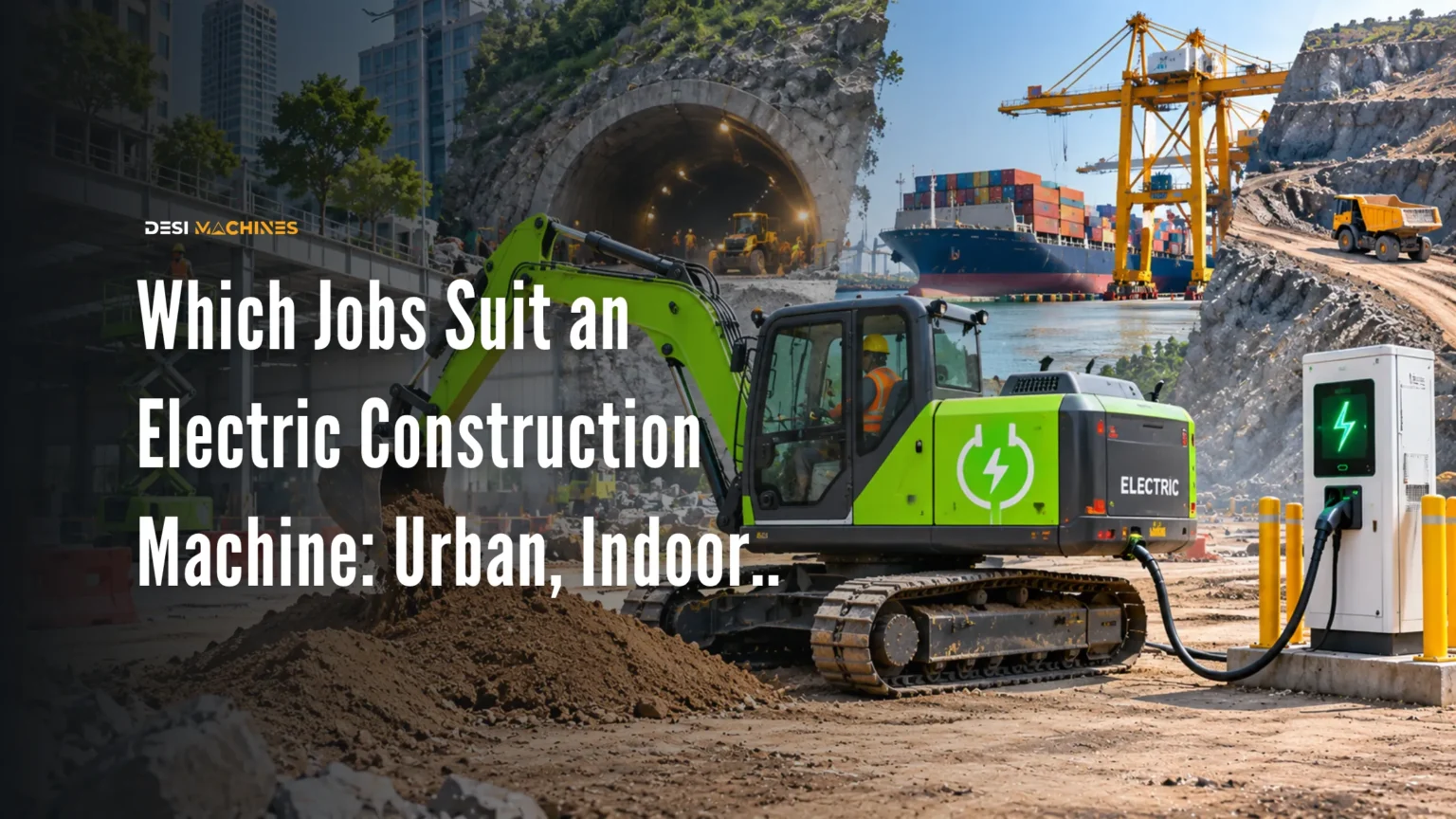
An electric construction machine suits a job where the site can give it two things: a power point that stays in one place, and a reason to want no exhaust and very little noise. Group the work by those site conditions rather than by machine type, and the question of whether electric fits stops being a guess.
The machine class matters less than people expect. A 2.7 tonne (2,750 kg) mini excavator and a 250 tonne (250,000 kg) mining shovel can both be electric, and both are, on our listings. What separates the jobs they suit is not size. It is whether the power comes to the machine or the machine has to carry it, and whether the site has an independent reason to keep an engine off the plot. This guide walks through the working conditions one at a time: built-up city work, indoor and enclosed spaces, tunnels, ports and yards, mine benches, fixed sites, and the jobs that still rule electric out.
What does a site have to offer before electric makes sense?
Electric construction equipment uses fall into six broad groups, and the rest of this page works through them one at a time. All six rest on the same five site features, and those five do the deciding. A job that has three or four of them is worth costing out. A job that has none is a diesel job, however keen you are on the idea.
- A power point that stays put. Either a mains connection on the plot or a charging point the machine can come back to. Without one of those, nothing else on this list matters.
- Work that must not produce exhaust. Enclosed space, a building in use next door, food or pharma premises, a client who writes emission conditions into the contract.
- A noise limit or a neighbour. Night work in a residential area, a hospital or school boundary, a site where the complaint stops the job before the schedule does.
- Short, repeated cycles with natural pauses. Load a truck, wait for the next one. Those pauses are when a battery machine tops up and a diesel machine just idles.
- A machine that works one patch all day. The less a machine moves between locations, the easier its power problem is.
Notice what is not on the list: fuel saving. Lower running cost is real, and our electric vs diesel excavator running cost comparison works the arithmetic through properly. But it is the weakest of the reasons, because it takes years to repay and the conditions above either apply on day one or they do not.
What kinds of electric machine can you actually put on these sites?
Fewer than the trade press suggests, and they sit in a narrow band of the market. Our catalogue carries eleven machine categories. Electric machines appear in exactly two of them: excavators and concrete pumps. There is no electric wheel loader, backhoe loader, roller, crane, telehandler or dozer on our listings at all.
Counted on 2 November 2026, that comes to 27 machines: 14 electric excavators, and 13 stationary concrete pumps driven by an electric motor. Their rated power runs from 16.5 kW on the smallest to 1,050 kW on the largest, a span of roughly 64 times. Thirteen of the 27, almost half, are pumps that are bolted down and never move at all. That shape tells you most of what you need to know about which jobs are ready today.
| Machine | Operating or machine weight | Rated power as listed | How it takes power | Source |
|---|---|---|---|---|
| LiuGong 9027FE EV | 2,750 kg (2.75 tonne) | 21.1 HP (16.5 kW) | Listing gives an electric motor rating and no traction battery | DesiMachines product page, read 2 November 2026 |
| LiuGong 908FE EV | 7,600 kg (7.6 tonne) | 63 HP (47 kW) | As above | DesiMachines product page, read 2 November 2026 |
| LiuGong 922FE Battery | 24,100 kg (24.1 tonne) | 140 HP (105 kW) | Listed fuel: Battery. Battery type: LFP | DesiMachines product page, read 2 November 2026 |
| LiuGong 922FE Cable | 22,000 kg (22 tonne) | 140 HP (105 kW) | Listed fuel: Cable, so a trailing cable from a supply | DesiMachines product page, read 2 November 2026 |
| SANY SY215EP | 21,900 kg (21.9 tonne) | 201 HP (150 kW) at 1,800 rpm | Listed fuel: Electric. Water-cooled PMS motor | DesiMachines product page, read 2 November 2026 |
| LiuGong 926FE EV | 26,000 kg (26 tonne) | 201 HP (150 kW) | Listing gives an electric motor rating only | DesiMachines product page, read 2 November 2026 |
| SANY SY375EP | 37,800 kg (37.8 tonne) | 269 HP (200 kW) at 1,650 rpm | Listed fuel: Electric. Water-cooled AC PMS motor | DesiMachines product page, read 2 November 2026 |
| LiuGong 939FE EV | 39,000 kg (39 tonne) | 325 HP (250 kW) | Listing gives an electric motor rating only | DesiMachines product page, read 2 November 2026 |
| Volvo EC500 Electric | 50 tonne class | Not published in its specification table | Connector type: Grid | Volvo CE India electric machines page, read 2 November 2026 |
| Liebherr R 992 E and R 998 SME-E | Mining class | 544 HP (400 kW) at 1,491 rpm | Listed fuel: Electric. Asynchronous squirrel-cage motor | DesiMachines product pages, read 2 November 2026 |
| BEML BE1000E-1 | 95,000 kg (95 tonne) | 536 HP (400 kW) at 1,483 rpm | Listed fuel: Electric. Crompton Greaves or KEC induction motor | DesiMachines product page, read 2 November 2026 |
| BEML BE1800E | 175,000 kg (175 tonne) | 2 x 402 HP (2 x 300 kW) | Listed fuel: Electric. Two induction motors | DesiMachines product page, read 2 November 2026 |
| Liebherr R 9250 G6 | 250,000 kg (250 tonne) | 1,408 HP (1,050 kW) at 1,500 rpm | Listed fuel: Electric. Three-phase AC squirrel-cage motor | DesiMachines product page, read 2 November 2026 |
| Stationary concrete pumps, 13 listed | 2,800 kg to 10,000 kg (2.8 to 10 tonne) | 60 HP (45 kW) up to 536 HP (400 kW) | Electric motor, installed in one spot and wired in | DesiMachines stationary concrete pump listings, read 2 November 2026 |
Two things in that table are worth a second look. The first is the 922FE Battery and 922FE Cable pair: the same 22 tonne class machine, the same 140 HP (105 kW) rating, offered two ways, because the maker knows the site decides which one works. The second is the Volvo EC500 Electric, whose connector type Volvo CE India publishes as Grid. A 50 tonne class machine does not carry its energy. It is plugged in.

How the power actually reaches the machine, and how long a top-up takes, is set out in our guide to charging an electric excavator on site. This page is about which jobs are worth connecting in the first place. The full set is on the electric excavator category page, and the most advanced electric excavators round-up covers the global models that have not reached Indian listings yet.
Does a city job with neighbours suit an electric machine?
This is the strongest case in India today, and the reason is not emissions. It is permission to work.
A built-up plot has a supply connection on it or very near it, often before the earthwork even starts. It has neighbours who can stop the job with a complaint. And it frequently has a night-work window, because the road cannot be closed by day. A machine that runs quietly is a machine that can work those hours. Volvo CE’s own description of its electric range makes exactly this claim: that low noise levels let the machines work at night and in crowded urban areas, and that zero exhaust during operation opens up indoor work. That is the maker talking about its own products, but the logic holds for any electric machine, and it is the argument that wins work a diesel machine is not allowed to do.
The machines that fit are the compact and mid classes. A LiuGong 908FE EV at 7.6 tonne or a SANY SY215EP at 21.9 tonne is the right size for a basement, a service trench or a city plot. Our building construction equipment page covers the wider machine mix such a project needs. For the compaction end of city work, where noise complaints are just as common, see electric road rollers and compactors.
The honest limit: a city plot still has to get the connection sanctioned and the cable routed safely, and on a cramped plot that is real work, not a formality.
Can you work inside a building or an enclosed space?
Indoors is the condition where electric is not merely better but close to compulsory, because a diesel engine inside a closed building is a ventilation problem before it is anything else.
The jobs are specific: interior demolition and strip-out, slab breaking inside an existing structure, warehouse and factory floor work, basement digging under a completed podium, and material handling inside a shed. Here the comparison is not electric against diesel. It is an electric machine against doing the work by hand or hiring forced ventilation for the duration.
Two notes on machine choice. The mini class exists for this reason: a 2,750 kg LiuGong 9027FE EV fits through openings a standard machine cannot, and its 16.5 kW motor is a modest electrical ask. And much enclosed work is lifting and moving rather than digging, which is why electric forklifts, electric pallet trucks and stackers and electric scissor lifts have been standard indoor equipment for far longer than electric excavators have existed. Our demolition equipment page covers the attachment side of enclosed demolition work.
What about tunnel and underground work?
Underground, the case is the same as indoors but larger, because the mine or tunnel is paying to push fresh air in. Every kilowatt of diesel power below ground adds to the ventilation and cooling the works must provide, so taking the engine out cuts a bill that a surface site does not even have.
Underground work is a deep subject with its own machine classes, its own charging problem and its own rules, so we cover it separately in electric machines underground. For the surface and portal side of tunnel contracts, our bridge and tunnel construction equipment page lists what the rest of the job needs.
One practical point belongs here rather than there. A tunnel has a grid connection by definition, because the ventilation fans, lighting and pumps all run off it. So the hardest condition on the list, a power point that stays put, is already satisfied before the machine arrives. That is why underground work is ahead of open-site work on electric adoption rather than behind it.
Do ports, yards and container terminals suit them?
Yes, and for a reason that has nothing to do with the environment: a yard is a fixed, fenced, paved site with heavy power already installed and a shift pattern with gaps in it.
Container yards, inland container depots, scrap and recycling yards and steel stockyards all run the same machine over the same few hundred metres, day after day, with breaks between vessels or rakes. Those breaks are charging windows. The paving means cable management is practical. And the site’s own substation usually has capacity, because cranes and reefer points are already on it.
For material handling inside a yard, the forklift and stacker classes above apply directly. For the heavier machine work, a cable-fed or grid-connected machine such as the Volvo EC500 Electric is built for exactly this duty: a large machine working one area, not travelling. Our port equipment and material handling equipment pages cover the full machine list for these sites.
Which mining jobs suit a mains-fed machine?
The large open-cast bench, where the machine works a face for months and a power line can be run to it. This is the oldest electric application in Indian earthmoving and it predates the current battery conversation by decades.
Our listings show what this class looks like. The BEML BE1000E-1 at 95 tonne carries a 400 kW induction motor; the BEML BE1800E at 175 tonne carries two motors of 300 kW each; the Liebherr R 9250 G6 at 250 tonne is rated 1,050 kW. Nothing about these machines is portable in the sense a backhoe loader is portable. They are assembled on site, fed from the mine’s own supply, and they stay.
So the condition that decides a mining job is simply whether the pit already has the electrical infrastructure and whether the face will be worked long enough to justify extending it. Where it does, the mining excavator listings and our mining machinery page are the place to start. Where the work is a short contract on a scattered set of small pits, it is a diesel job.
Why is a fixed site the easiest electric job of all?
Because a machine that never moves has no power problem left to solve. It is wired in on the day it is installed and that is the end of the matter.
That is the reason 13 of the 27 electric machines on our listings are stationary concrete pumps, and why that half of the catalogue is far deeper than the excavator half. A Putzmeister BSA 1406 E eSmart runs a 100 HP (75 kW) electric motor with a 600 litre hopper and a listed maximum theoretical output of 57 m3/h. At the other end of the range, the Schwing Stetter SP 8800 Electric is rated 536 HP (400 kW), and the Aquarius 1003 E sits at the small end on 60 HP (45 kW). You pick by output and pressure, the same as with a diesel pump; the power source is not the variable.
The same logic covers batching plants, crushing and screening installations and plant rooms. Anything that arrives on a low-bed, gets levelled and then works from one position is a candidate. Our RMC plant equipment page covers the installed-plant side, and the full pump range sits on the concrete pump listings.
Which jobs still rule an electric machine out?
Four conditions, and any one of them is usually enough to settle it.
No grid within reach. A canal alignment, a rural road contract, a borrow pit, a greenfield site before the connection is sanctioned. A generator can charge a machine, but then you are burning diesel to make the electricity and carrying the losses of doing it twice over. The charging guide covers when that is still worth doing.
Work that moves every few days. Linear projects walk the machine along the alignment. Each move means a new power arrangement, and the arrangement is the slow part, not the transport.
All-day continuous digging with no pauses. Mass earthmoving runs a machine hard from morning to evening with the only break being the operator’s. A battery machine wants those gaps. Where the duty cycle has none, the comparison turns against it, and our electric vs diesel guide works through what changes inside the machine when it does.
Service reach too thin. An electric drive has fewer parts to go wrong, but the parts it does have are not repairable by the fitter who knows diesel engines. On a site a long way from a dealer branch, that risk is the whole decision.
None of these is a permanent verdict. Three of the four are infrastructure problems, and infrastructure changes. The fourth, the duty cycle, is a property of the work itself.
What does each condition give you, and what does it ask back?
Read this as a pair of columns, not a verdict. Every condition that favours an electric machine also asks something of the site, and the trade is different in each row.
| Working condition | What electric gives the job | What the site has to give back |
|---|---|---|
| Built-up plot, night or restricted hours | Permission to work hours a diesel machine cannot; no complaint risk from engine noise | A sanctioned connection and a safe cable route on a cramped plot |
| Indoor and enclosed work | No exhaust in the air the crew breathes; no forced ventilation hired in for the machine | A supply inside the building, and a machine small enough for the openings |
| Tunnel and underground | Cuts the ventilation and cooling the works pays for all day | Charging or cable arrangements that work in a confined heading |
| Port, depot and yard | Fixed route, paved ground, existing heavy supply, natural gaps for charging | Substation capacity confirmed before the machine is ordered |
| Open-cast mine bench | Very large machine sizes available; no fuel logistics to the face | Power line to the face and a face worked long enough to justify it |
| Fixed installation, such as a pump or plant | Simplest case of all; wired in once and forgotten | Almost nothing beyond the installation itself |
| Remote site with no grid | Little or nothing. This is the row that rules it out | A generator and the fuel to run it, which defeats the purpose |
Which of these conditions does your own site meet?
Count them honestly for the next job rather than for the fleet. If the plot has a connection, a reason to keep exhaust off it and a duty cycle with pauses in it, an electric machine is worth pricing, and our electric machine buying checklist is the next page to read. If it has a connection but you want to know what the power will cost per hour, the ownership cost method sets out the arithmetic and where each input comes from.
If the honest answer is that the site has none of the five, there is no shame in a diesel machine: our excavator listings cover the full range, and the question is worth asking again on the next contract rather than settled for good. For either route, our equipment finance options cover how the purchase is funded, and the electric construction machines guide is the index to every machine type we have written up.