Excavator
294 models
 Backhoe Loader
51 models
 Crane
68 models
 Concrete Mixer
79 models
 Wheel Loader
54 models
 Compactor / Roller
45 models
 Motor Grader
42 models

 Concrete Pump
66 models
 Skid Steer Loader
11 models


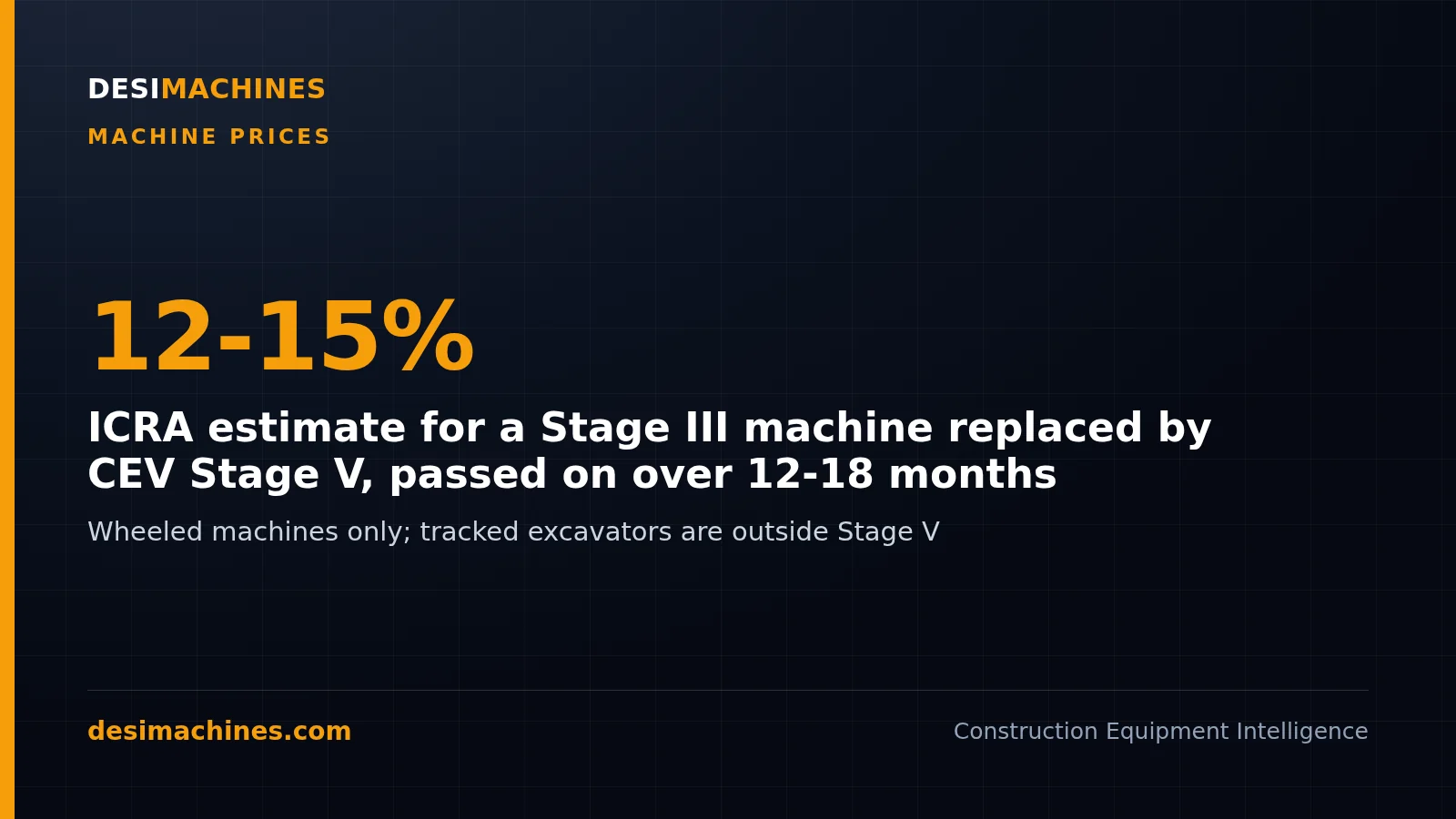
Two dated policy changes sit behind the construction machine prices in India you are being quoted this quarter: a safeguard duty on imported flat steel, levied at 12% from 21 April 2025 and stepping down to 11.5% and then 11% under the Finance Ministry’s 30 December 2025 notification, and the CEV Stage V emission norms that took effect on 1 January 2025. The rating agency ICRA put the Stage V transition at a 12-15% cost rise for machines coming straight off Stage III, passed to buyers over 12-18 months, and it reaches wheeled machines only, so a crawler excavator carries the steel cost but not the emission cost.
What has pushed construction machine prices in India up?
Both changes landed within four months of each other, and they work on different parts of the machine. One raises what the maker pays for the metal the machine is built from. The other raises what the maker pays for the engine and the cab that sit on top of it.
Neither is a market swing you can wait out. Both are written into notifications with dates and rates in them, which is unusual and useful: you can read the schedule yourself instead of taking a salesman’s word for why the figure moved.
What is the safeguard duty on steel imports?
The Central Board of Indirect Taxes and Customs issued Notification No. 01/2025-Customs (SG) on 21 April 2025, putting a provisional safeguard duty of 12% on imports of non-alloy and alloy steel flat products for 200 days. The Director General of Trade Remedies had found a recent, sudden, sharp and significant surge in those imports.
The Ministry of Finance then made it definitive. Notification No. 02/2025-Customs (SG) of 30 December 2025 imposes the duty for three years on a declining schedule, linked back to the provisional levy:
| Period | Safeguard duty |
|---|---|
| 21 April 2025 to 20 April 2026 | 12% |
| 21 April 2026 to 20 April 2027 | 11.5% |
| 21 April 2027 to 20 April 2028 | 11% |
The goods covered fall under tariff headings 7208, 7209, 7210, 7211, 7212, 7225 and 7226 of the Customs Tariff Act, 1975: hot rolled coils, sheets and plates, plate mill plates, cold rolled coils and sheets, metallic coated and colour coated coils and sheets. There are price-based escapes. Where the CIF import price meets or exceeds a specified threshold, which runs from USD 675 a tonne on hot rolled coils to USD 964 a tonne on colour coated sheets, the duty does not apply. Imports from listed developing countries are also outside it, with product-dependent exceptions for China, Vietnam and Nepal. The full text is in the Government of India notification on the safeguard duty.
The construction equipment industry argued against this duty while it was being investigated. The association that represents the makers, ICEMA, told the investigation that the levy would disrupt the supply chain and the cost base of equipment manufacturing, that steel is a critical raw material and that the specialised high-tensile and performance grades the industry needs are not produced in India in sufficient volume or specification. It also said steel prices had already moved by ₹10,000 a tonne during the investigation period, and that with the duty in force input costs would rise further, pushing makers to consider raising prices. That account was reported by SteelOrbis in April 2025 and by Mobility Outlook on 24 April 2025.
What changed with CEV Stage V emission norms?
CEV Stage V took effect on 1 January 2025. It tightens particulate matter and particle number limits enough that makers have to fit diesel particulate filters, and the AIS-160 safety requirements came in alongside it, adding roll-over, tip-over and falling-object protective structures to the cab.
ICRA’s January 2025 note, carried by NBM&CW, sized the effect. Stage V applies to wheeled equipment, which is 65-70% of industry volumes, and non-wheeled equipment stays outside the scope. On price, ICRA estimated a 12-15% rise in CEV prices with the cost passed on to customers over 12-18 months, and split that by starting point: a machine going directly from Stage III to Stage V faces 12-15% or more, while one going from Stage IV to Stage V faces 4-6%.
That split matters more than the headline figure. If you are replacing a Stage III machine with its Stage V equivalent, you are absorbing the whole jump in one purchase. The mechanics of the norms themselves are set out in our guide to BS-CEV emission norms, and the earlier engine transition is covered in BS4 vs BS6 engine differences.
How much of a machine’s price is steel?
No published source gives it. We looked for a figure for steel as a share of an Indian machine’s ex-factory price and could not find one in the notifications, in ICRA’s note, or in the reported account of ICEMA’s submissions to the investigation. ICEMA stated that steel is a critical raw material and named the grades it cannot source domestically, but it did not publish a percentage.
So the honest position is that you cannot compute the pass-through yourself. A 12% duty on imported flat steel is not a 12% rise in a machine’s price, and nobody who tells you the two numbers are the same has a source for it. What you can do is treat the two drivers separately, because they do not reach the same machines.
What it means for the price you are quoted
A wheeled machine carries both costs. A tracked machine carries only the steel cost, because Stage V does not reach it. That is the most useful thing to know when you are comparing a backhoe loader against a crawler excavator for the same job this quarter.
Below are six of our better-known catalogue models with the range on each one today. These are our ranges as of October 2026, published as the baseline for later comparison. Our catalogue holds no earlier dated range for any of these models, so we are not claiming a rise on any individual machine, and we are not forecasting one.
| Model | Type | Range, Oct 2026 (indicative) | Cost drivers that reach it |
|---|---|---|---|
| JCB 3DX | Backhoe loader, wheeled | ₹28.5-31.5 Lakh | Steel and Stage V |
| JCB 3DX Plus | Backhoe loader, wheeled | ₹33.3-36.8 Lakh | Steel and Stage V |
| Tata Hitachi Shinrai Prime | Backhoe loader, wheeled | ₹31.4-34.7 Lakh | Steel and Stage V |
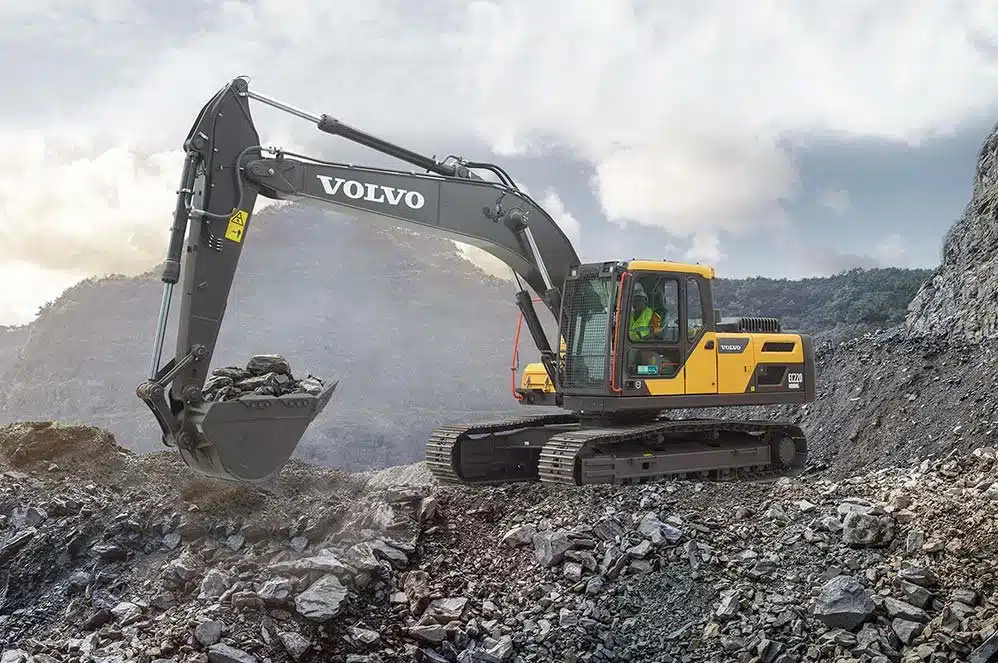
| Tata Hitachi EX 200LC Prime | Crawler excavator, tracked | ₹56.1-62.0 Lakh | Steel only |
| SANY SY215C-9LC SPARC | Crawler excavator, tracked | ₹50.4-55.7 Lakh | Steel only |
| JCB NXT 205 | Crawler excavator, tracked | ₹49.4-54.6 Lakh | Steel only |
Figures are ex-showroom and indicative, as of October 2026, and vary by variant, state and attachments. Work the monthly figure out before you commit rather than after: the equipment loan EMI calculator takes a price, a tenure and a rate, and our equipment finance team can tell you what margin money a lender is asking for on each class right now. Compare the current backhoe loader models and prices against the excavator range before you fix on one.
What to ask when you get a quote
Five questions do most of the work, and all of them are answerable on the spot.
Which CEV stage is this machine built to? A Stage IV machine and a Stage V machine are not priced on the same basis, and ICRA’s 4-6% and 12-15% bands tell you roughly how far apart they should sit. Ask it first, because every other comparison depends on the answer.
Is the figure ex-works or ex-showroom, and what is outside it? Transport to site, first-year insurance and registration where the machine is registrable are real money, and a tracked machine has no on-road price at all, so a trailer move has to be costed in separately.
When was the price list this quote comes off issued? If it predates the latest revision you are being quoted a figure that is about to move, which is worth knowing either way.
How long does the quote hold? Get the validity in writing. A quote with no expiry date is not a quote.
And what changed since the last revision, and why? A maker that has repriced for Stage V hardware or for steel can usually say so. One that cannot explain the movement is worth a second look.
The bottom line
The two things that moved machine costs in 2025 are both on the record with dates attached: a safeguard duty on imported flat steel running at 12%, 11.5% and 11% across three years to 20 April 2028, and CEV Stage V from 1 January 2025 at an estimated 12-15% for a Stage III replacement. Neither is a reason to rush a purchase. Both are a reason to ask which stage you are buying, and to compare quotes stage against stage rather than figure against figure.
If you are pricing a machine this quarter, start from the backhoe loader range or the excavator range, run the number through the EMI tool, and ask our team to confirm the final quote and the current margin-money requirement before you commit.
Rates, schemes, specifications and prices change — confirm current terms with the OEM, dealer, bank or insurer before deciding. Prices shown are indicative ranges taken from our listings at the time of writing, vary by variant, location and date, and DesiMachines is not liable for decisions taken on the basis of information that may have changed after publication.