
 Excavator
294 models
Excavator
294 models  Backhoe Loader
51 models
Backhoe Loader
51 models  Crane
68 models
Crane
68 models  Concrete Mixer
79 models
Concrete Mixer
79 models  Wheel Loader
54 models
Wheel Loader
54 models  Compactor / Roller
45 models
Compactor / Roller
45 models  Motor Grader
42 models
Motor Grader
42 models  Dozer
41 models
Dozer
41 models  Concrete Pump
66 models
Concrete Pump
66 models  Skid Steer Loader
11 models
Skid Steer Loader
11 models  Telehandler
13 models
Telehandler
13 models 


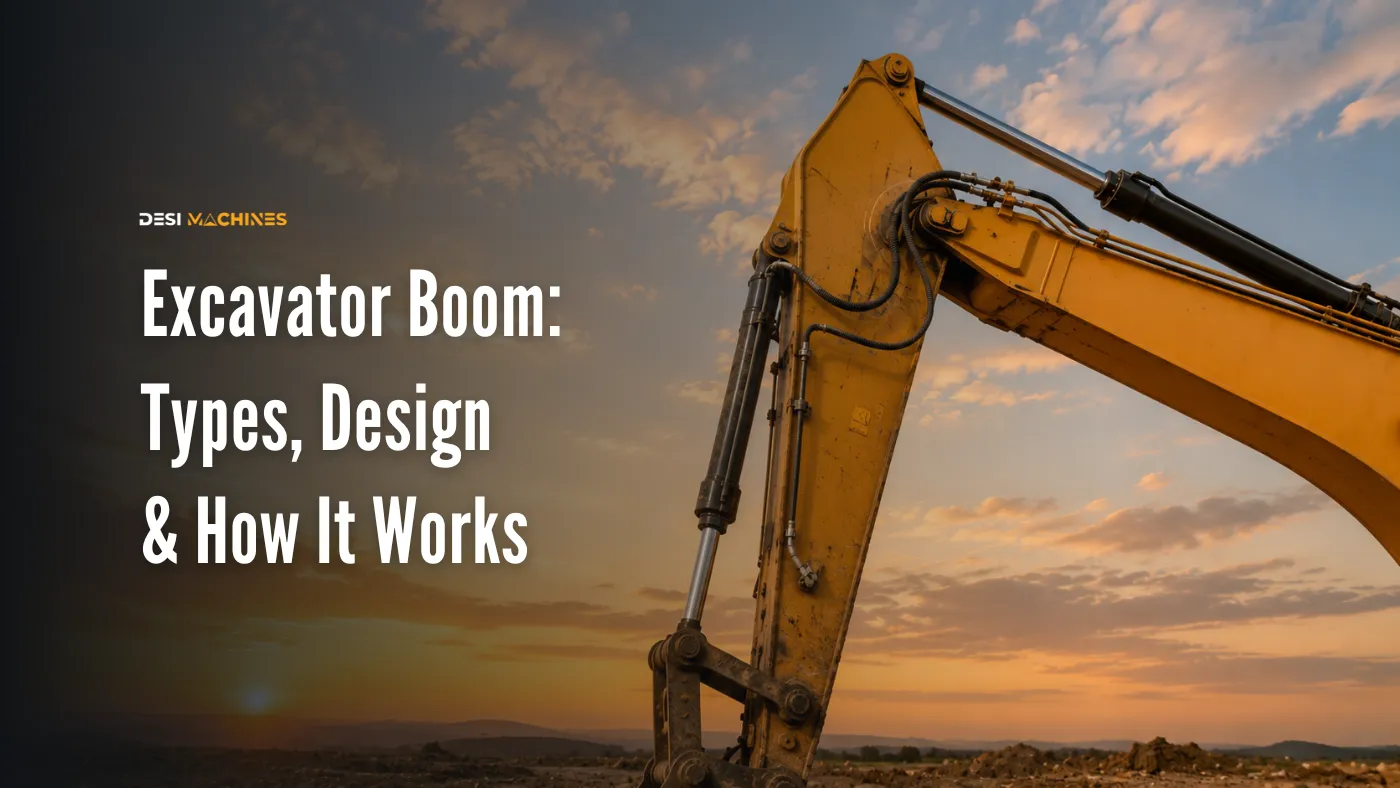
An excavator’s boom sets three limits on the machine: how deep it digs, how high it loads a tipper and how close it can work to a wall. The boom is the main steel arm that rises from the machine’s body and carries the rest of the digging gear. Every dig uses three parts: the boom lifts, the arm (also called the stick or dipper) reaches, and the bucket cuts the soil. Of the three, the boom is the biggest, the strongest and the costliest to repair, because the full weight of every lift passes through it on its way into the machine.
In India most people call any digger a JCB or a Poclain, but whatever the sticker says, it is the boom fitted at the factory that sets those limits. This guide explains the boom in plain words: what it does, the types you can get, how the hydraulics move it, which boom suits which job, and how to keep one out of the welding shop. If you are completely new to these machines, start with the complete excavator guide and come back here for the boom.
What does the boom on an excavator actually do?
The boom’s job is to raise, lower and place the whole digging set while carrying the weight of every load back into the machine’s body. When the bucket lifts a tonne of wet soil, that tonne travels up the arm, through the boom, and into the slew ring (the big bearing that lets the upper body spin) before the tracks finally take it. A weak or cracked boom breaks this chain, which is why no other part of the machine is built as heavily.
The boom also sets the machine’s working shape. A steeper boom digs deeper close to the tracks. A longer boom reaches further but lifts less. Every excavator model is a balance between these two, and that balance is fixed by the boom the factory fits.
Boom vs arm (stick): the difference in one line
The boom is the lower, heavier arm bolted to the machine’s body; the arm, which mechanics also call the stick or the dipper, is the second, lighter arm that connects the boom to the bucket. Buyers mix the two up all the time when ordering spares, and the wrong name at the parts counter costs a wasted trip. The easy way to keep them straight is to name them from the machine outwards: boom, then arm, then bucket.
What are the types of excavator booms?
Indian machines use four main boom types: mono, two-piece, swing and long-reach, and each one changes what the machine is good at. The Wikipedia article on excavators sorts booms into the same families, with the mono boom as the most common and the base-hinged swing boom found mainly on compact machines. Here is each type in plain words.
Mono boom (the standard one)
A mono boom is a single curved, welded steel box. It is the simplest and strongest design, which is why almost every 20-ton (20,000 kg) class machine in India ships with one. Trenching, foundation work, loading tippers: for the everyday digging that pays a contractor’s EMI, the mono boom is the default and rightly so.
Two-piece boom
A two-piece boom adds a joint partway along, so the operator can change the boom’s shape for the job in front of him. It trades some simplicity for flexibility: useful on varied town work, but it costs more and has extra pins to grease. On Indian sites it stays a niche choice.
Swing boom (the mini excavator special)
A swing boom pivots left and right at its base, separately from the cab’s own rotation. That lets the machine dig flush along a boundary wall or a house plinth without re-parking. It is standard on most mini excavators, and it is one big reason town contractors buy a mini instead of a bigger machine for plot work.
Long-reach boom
A long-reach boom pairs a longer, lighter boom with a longer arm so the machine can work far from where it stands, with reach stretching past 10 m (33 ft). Rivers, ponds, canals and soft slopes are its home ground, because the machine stays on firm bank while the bucket works out in the muck. The trade-off is a smaller bucket and gentler digging. We have covered these machines separately in the guide to long boom excavators.
There is a fifth, special family: high-reach demolition booms that stretch a breaker or shear several floors up a building. Those are engineered-to-order fronts, not something you pick off a price list.
| Boom type | What it is | Best for | The trade-off |
|---|---|---|---|
| Mono boom | One welded, curved steel box | Everyday digging, trenching, loading | Fixed geometry |
| Two-piece boom | Boom with an extra joint | Varied town jobs in tight spaces | Costlier, more pins to maintain |
| Swing boom | Boom that pivots at its base | Digging beside walls and boundaries | Found mainly on mini machines |
| Long-reach boom | Longer, lighter boom and arm | Rivers, canals, slopes, desilting | Smaller bucket, gentler digging |
How does an excavator boom work?
The boom works on hydraulics: the engine drives a pump, the pump pushes oil under pressure, and the oil forces one or two hydraulic cylinders to raise or lower the boom. A hydraulic cylinder is simply a steel tube with a rod inside; pump oil in and the rod pushes out, release it the other way and the rod pulls back. Everything the boom does comes from that push and pull.
The parts that move it
Four parts do the work. The boom cylinders lift the structure. The control valve is the tap that routes oil when the operator moves the joystick. Which joystick that is depends on the machine’s control pattern, set out in the excavator joystick controls guide. The pins are the thick steel shafts each joint turns on. The bushings are the replaceable sleeves around each pin that take the daily wear so the costly parts do not. When people talk about a boom “getting loose”, it is almost always worn pins and bushings, not the steel itself.
The table lays out the digging front from the machine outwards: what each part hangs on and which cylinder moves it.
| Part (machine outwards) | Hinged on | Moved by | Its job in a dig |
|---|---|---|---|
| Boom | Boom foot pin on the upper body | Boom cylinder: one on many minis, a pair on most 20-ton machines | Raises and lowers the whole front |
| Arm (stick or dipper) | Pin at the boom tip | Arm cylinder, mounted on top of the boom | Pulls the bucket in and pushes it out |
| Bucket | Pin at the arm tip | Bucket cylinder, working through a link | Curls to cut the soil and hold the load |
Why do big machines use two boom cylinders?
Two cylinders share the load across the boom’s width, so the lift stays straight and the steel does not twist under a heavy bucket. Most 20-ton class machines use a pair for exactly this reason, while many minis manage with a single cylinder because their booms are far lighter. It is one of those quiet design details that decides how a machine ages. The boom is also only one piece of a bigger hydraulic system; the same pump and oil run the arm, the bucket and the swing, so a healthy boom starts with a healthy hydraulic circuit.
Which boom type should you choose for Indian work?
Choose the boom by the job you do most, not by what looks impressive in the yard. The type of excavator and the type of boom go together, so think of them as one decision.
For everyday digging, trenching and tipper loading, the mono-boom 20-ton class is the Indian workhorse. A Tata Hitachi EX 210 Infra Super+ works out to ₹60–65 Lakh, while a Tata Hitachi ZAXIS 220LC sits a little above it at ₹65–67 Lakh (both indicative, as of October 2026). For tight plots and boundary-wall digging, a swing-boom mini is the answer: the XCMG XE20U is the cheapest excavator we list, at ₹20–22 Lakh, and the SANY SY20U is a step up at ₹22–24 Lakh (indicative, as of October 2026). Canal, river and desilting contracts point you to a long-reach front. And bulk mining work moves to far bigger booms on far bigger machines, with the Volvo EC950E at ₹4.5–5.0 Crore (indicative, as of October 2026). Two machines in the same tonne class can still be lakhs apart, so check the model you actually want rather than reading one band across the whole segment.
A long-reach or bigger-boom machine costs more up front, so run the EMI numbers on equipment finance before you commit to one. The right boom earns its price back in work; the wrong one just carries interest.
Ready to shortlist? Compare live excavator models and prices and get the best current offer before the season’s contracts are signed.
How do you keep an excavator boom healthy?
A boom rarely fails overnight. It fails from skipped grease, ignored hairline cracks and rough habits, usually in that order.
Daily checks before the first dig
Grease every boom pin and bushing to the maker’s schedule, and do it before work, not after. Grease is cheap; a pin is not. While greasing, look along the welds for hairline cracks, watch the cylinder rods for oil weep, and feel for play in the joints. A pin that knocks today is a bushing job this month or a bore-welding job next year; the difference is thousands of rupees against lakhs.
Habits that crack a boom
Side-swiping soil with the bucket, dragging a load sideways, hammering hard ground with the bucket teeth and lifting beyond the chart all twist the boom in ways it was never designed for. The other silent killer is running a breaker too big for the machine: a hydraulic rock breaker sends its shock straight up the arm and boom, so match every attachment to the machine’s class. Our guide to excavator attachments explains how to pair them safely.
What should you remember about the excavator boom?
The boom is the excavator’s backbone: it lifts the arm and bucket, carries every load into the machine, and fixes what the machine can and cannot do. Mono booms do India’s everyday digging, swing booms squeeze minis into town plots, long-reach booms clean rivers and canals, and good greasing keeps all of them out of the welding shop. Buy the boom for the work you actually have, and it will outlast the loan you took for it.
Read next: how the rest of the excavator’s components work, from the slew ring to the final drives. And when you are ready to put money on a machine, compare excavator prices across brands and talk to our team with your site’s numbers in hand.
A long boom trades bucket size for reach, which is exactly what canal and riverbed work needs; the machines and their reach figures are listed in the guide to excavators for dredging and canal desilting.
Finding a hairline crack while you grease is where this guide stops and another one starts: excavator boom repair covers the six places booms and arms crack, how to confirm one, and when welding beats a replacement boom.
Prices, specifications and features are indicative, vary by variant, location and date, and should always be confirmed with the official OEM or authorised dealer before any purchase decision. DesiMachines is not liable for decisions taken on the basis of information that may have changed after publication.