
 Excavator
294 models
Excavator
294 models  Backhoe Loader
51 models
Backhoe Loader
51 models  Crane
68 models
Crane
68 models  Concrete Mixer
79 models
Concrete Mixer
79 models  Wheel Loader
54 models
Wheel Loader
54 models  Compactor / Roller
45 models
Compactor / Roller
45 models  Motor Grader
42 models
Motor Grader
42 models  Dozer
41 models
Dozer
41 models  Concrete Pump
66 models
Concrete Pump
66 models  Skid Steer Loader
11 models
Skid Steer Loader
11 models  Telehandler
13 models
Telehandler
13 models 


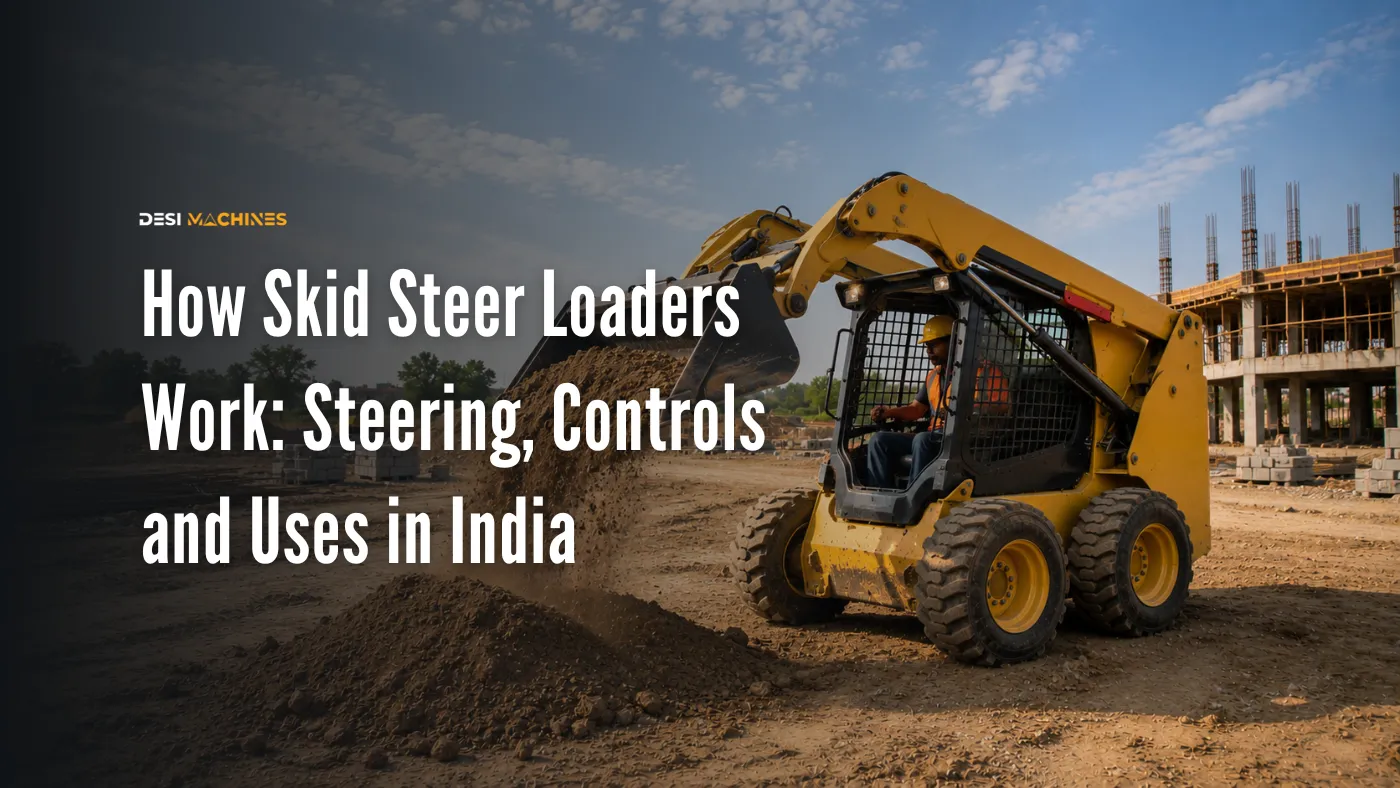
A skid steer loader is a small, four-wheel loading machine that turns on the spot by spinning the wheels on one side faster than the other, instead of turning a steering wheel. The wheels on the left and the wheels on the right are driven separately, so the machine can pivot in its own length. On Indian sites people often just call it a skid steer, and the tracked version the CTL.
That one idea, driving each side on its own, is the whole reason the machine exists. It is why a skid steer can work in a space barely wider than itself, clear a cattle shed, load a tipper in a narrow lane, or dig a small footing where a bigger loader would never fit.
This guide explains, in plain terms, how a skid steer actually works, why it is called a “skid” steer, how you drive it with no steering wheel, whether wheels or tracks suit your ground, and what one costs in India today.
What is a skid steer loader used for?
A skid steer loader is used for loading, digging, levelling, cleaning and material handling in tight spaces where a bigger machine cannot turn. It is a small machine built for small, awkward, everyday jobs rather than bulk earthmoving.
On Indian sites and farms you will see one doing work like this:
- Loading and shifting. Scooping sand, gravel, malba (rubble) or grain and loading it into a tractor-trolley or tipper.
- Site clean-up. Clearing debris after construction, pushing loose material into a heap, back-filling around a foundation.
- Shed and farm work. Cleaning cattle sheds, moving feed, lifting bales, levelling a yard. The compact size fits through farm gates.
- Light digging and grading. With a bucket or a backhoe attachment it can dig small trenches and level the ground for a floor.
- Road and civic work. Sweeping, breaking small patches of concrete, and handling material in lanes too narrow for a backhoe.
What it is not built for is heavy, open-ground work. If you are loading trucks all day from a big stockpile, a wheel loader or a backhoe loader moves far more material per hour. The skid steer earns its keep on versatility and tight access, not on volume.
How does a skid steer loader work?
A skid steer works on hydraulics and independent-side drive. The engine does not turn the wheels directly. Instead it drives hydraulic pumps, and those pumps send oil to motors that spin the wheels, and to cylinders that raise the loader arms and tilt the bucket. Almost everything the machine does is powered by oil under pressure.
There are two drive systems working together, and it helps to keep them separate in your mind:
The travel system (moving the machine). The left wheels are driven by one circuit and the right wheels by another. Push both sides forward and the machine goes straight. Drive one side forward and the other side backward, and the machine spins in place. This independent-side control is what lets a skid steer turn in its own length.
The loader system (moving the arms). Two lift arms carry the attachment at the front. Hydraulic cylinders raise and lower these arms, and another cylinder tilts the bucket to scoop or dump. The operator works both from the seat.
Each of those two systems is a set of parts you will one day have to order by name, and the guide to skid steer loader parts lists them group by group.
Because the wheels do the steering, the machine has no steering wheel and no turning front axle at all. Fewer moving parts in the steering means less to break, which is one reason skid steers hold up well in rough Indian conditions. If you want to see the same hydraulic thinking on a bigger machine, the wheel loader working guide explains how arms and buckets are powered on a larger loader.
Why is it called a “skid steer”?
It is called a skid steer because it turns by making its wheels skid, or drag, across the ground rather than by pointing them in a new direction. On a car, the front wheels turn left or right to steer. On a skid steer, all four wheels always point straight ahead. To turn, the machine simply spins one side faster than the other, and the tyres scrub sideways across the surface. That scrubbing is the “skid”.
Engineers call this differential steering (steering by a difference in speed between the two sides). It is the same idea that turns an army tank or a JCB-style tracked machine. The upside is a tiny turning circle. The downside is that the scrubbing wears tyres faster and can tear up a soft or finished surface, which matters if you are working on grass, a paver floor or wet soil.
So the name is not marketing. It literally describes how the machine moves: it steers by skidding.
How do you steer and control a skid steer with no steering wheel?
You steer a skid steer with hand levers or joysticks, one for each side, plus foot pedals or thumb controls for the loader arms and bucket. There is a short learning curve, but most operators pick it up in a day or two.
Older and simpler machines use a hand-and-foot layout: two hand levers control travel (left lever for the left wheels, right lever for the right wheels), and foot pedals lift the arms and tilt the bucket. Newer machines use two joysticks that do everything, which is less tiring over a long shift.
If the machine has joysticks, ask the seller which control pattern it is set to:
- ISO pattern. Left joystick drives and steers; right joystick works the loader arms and bucket.
- H pattern. Each joystick drives one side (like the old hand levers) and also works part of the loader.
Tracked excavators use a different pair of pattern names, ISO and SAE, for the same idea; the excavator joystick controls guide explains those and how to identify the one your machine is set to.
Neither is “better”, but an operator trained on one will fumble on the other, so keep your fleet on the same pattern. Many modern skid steers let you switch between patterns from a screen, which is worth having if different operators run the machine.
One safety point that is not optional: a skid steer is entered from the front, over the attachment. Never climb in with the arms raised, and always lower the bucket to the ground before you step off. The machine will move the instant the levers are touched.
Skid steer wheels or tracks: which is better for your ground?
Choose wheels for hard, dry, finished surfaces and tracks for soft, wet or muddy ground. A wheeled machine is the true skid steer; the tracked version is really a compact track loader (CTL), but on site both get called skid steers and the choice comes down to the ground you work on.
| Point | Wheeled skid steer | Tracked (CTL) |
|---|---|---|
| Best ground | Hard, dry, paved, finished surfaces | Soft, wet, sandy or muddy ground |
| Grip / flotation | Sinks and slips in mud | Spreads weight, floats over soft soil |
| Price | Lower to buy | Higher to buy |
| Running cost | Cheaper; tyres are quick to change | Rubber tracks cost more to replace |
| Speed on hard ground | Faster on roads and yards | Slower, wears tracks on abrasive surfaces |
| Turning damage | Scrubs and marks soft surfaces | Gentler footprint, less rutting |
The simple rule: if your work is mostly on made-up roads, yards and hard stands, buy wheels. If you work on farms, in fields, on unmade ground or through the monsoon, the extra cost of tracks pays for itself in machines that keep working when a wheeled one is stuck.
What attachments can a skid steer loader use?
A skid steer can run dozens of attachments because the front carries a standard quick-coupler that swaps tools in a minute. The bucket you buy it with is only the start. A single skid steer, with the right attachments, does the work of several separate machines.
The front plate uses a quick-hitch (quick-coupler), a standard mounting that lets the operator drop one tool and pick up another without leaving the seat on many machines. Common attachments used in India include the general-purpose bucket, a 4-in-1 bucket, pallet forks for lifting bags and bales, an auger for digging post holes, a rock breaker (hydraulic hammer), a sweeper broom, a grapple, and a trencher.
This is what makes the machine worth its price for a small contractor: one base machine and a shed of attachments covers loading, digging, breaking, drilling and cleaning. The full range and the points to check before buying are covered in the skid steer attachments guide. Buckets and forks are usually priced separately from the machine and are quoted on request based on the model and the size you need.
How much does a skid steer loader cost in India?
A skid steer loader in India costs roughly ₹13 Lakh for the smallest machine up to about ₹32 Lakh for the largest (indicative segment range, as of September 2026), depending on the brand, engine size, lift capacity and whether it runs on wheels or tracks. Smaller machines sit at the lower end; larger, higher-capacity and premium-brand machines reach the top.
To give a real sense of the market, these are the price ranges we list for a few models available in India. Each range is wide because one model covers several variants and attachment packages, so a smaller machine at the top of its range can cost more than a bigger machine at the bottom of its:
| Model | Indicative price (as of September 2026) |
|---|---|
| Bobcat S70 (compact) | ₹13–15 Lakh |
| ACE SS75 | ₹16–23 Lakh |
| JCB SSL 135 | ₹17–23 Lakh |
| L&T S315R | ₹19–23 Lakh |
| Bobcat S770 (large) | ₹30–32 Lakh |
Treat these as a starting point, not a final quote. These are ex-factory figures; what still moves the final number is the variant, the attachments you add and the cost of getting the machine to your site. If you plan to keep the machine busy most days, it is worth understanding your equipment finance options before you commit, because the EMI, not the sticker price, is what your cash flow actually feels.
Comparing skid steer models? Browse live skid steer loader prices and specifications in India and get the best current offer near you.
Is a skid steer loader right for you?
Buy a skid steer if your work is varied, in tight spaces, and spread across loading, cleaning, light digging and material handling. Its strength is doing many small jobs with one machine, in places a backhoe or wheel loader cannot reach.
Do not buy one if your work is bulk earthmoving or all-day truck loading from a big stockpile. That is a wheel loader’s or backhoe’s job, and a skid steer will only tire you out trying to keep up. On a farm the balance is different again, and skid steer loaders for agriculture sets out which jobs actually pay there. Match the machine to the work, not to the lowest price.
If a skid steer fits, decide wheels versus tracks from your ground, keep every machine on the same control pattern, and budget for the attachments that turn it into a whole toolkit. From there, compare real models and prices: the skid steer loader guide lists the brands and specifications for India, and the wider complete guide to loaders shows where it sits against wheel loaders, backhoes and telehandlers.
For the service numbers behind the machine — diesel, engine oil, hydraulic oil and the two chain cases that make skid steering possible — see the guide to skid steer loader fuel tank and oil capacities.
Ready to choose your machine? Browse skid steer loader models, prices and specifications in India and get the best current offer near you.
If you are still choosing between the two machine types rather than between models, skid steer vs backhoe loader compares them on digging depth, width, road speed and price in India.
If your machine has stopped driving straight, the guide to skid steer drive problems works through the one-side and both-side faults in the order worth checking them.
Those two chains and the two drive motors behind them are also the first things to check on a second-hand machine, because they are the most expensive part to put right. The used skid steer loader buying guide covers the drive test and the chain case check in full.
Prices, specifications and features are indicative, vary by variant, location and date, and should always be confirmed with the official OEM or authorised dealer before any purchase decision. DesiMachines is not liable for decisions taken on the basis of information that may have changed after publication. Price figures are taken from our listings at the time of writing.
Machines, tenders and news for this industry: Steel, Cement and Process Plants

