
 Excavator
294 models
Excavator
294 models  Backhoe Loader
51 models
Backhoe Loader
51 models  Crane
68 models
Crane
68 models  Concrete Mixer
79 models
Concrete Mixer
79 models  Wheel Loader
54 models
Wheel Loader
54 models  Compactor / Roller
45 models
Compactor / Roller
45 models  Motor Grader
42 models
Motor Grader
42 models  Dozer
41 models
Dozer
41 models  Concrete Pump
66 models
Concrete Pump
66 models  Skid Steer Loader
11 models
Skid Steer Loader
11 models  Telehandler
13 models
Telehandler
13 models 


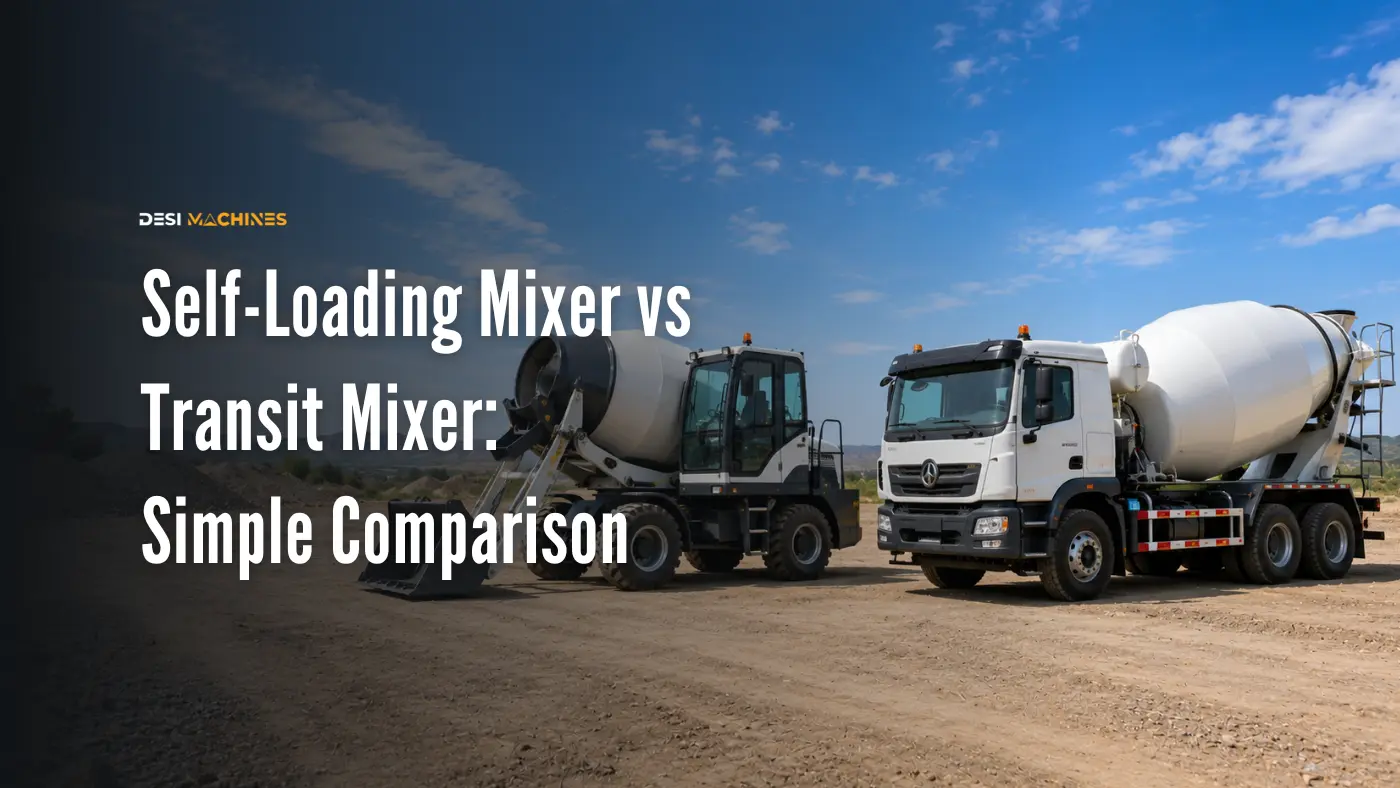
A self-loading concrete mixer (SLCM) is a machine that loads, weighs, mixes and pours concrete on its own, driving around the site on four wheels like a small vehicle. A transit mixer is a drum mounted on a truck that only carries ready-mixed concrete from a batching plant to the pour, keeping it turning so it does not set on the way. The one-line difference: a self-loading mixer makes concrete at your site, while a transit mixer only delivers concrete made somewhere else.
For an Indian contractor, that difference decides your whole concreting plan: your cost per cubic metre, how many people you need, and whether you depend on a ready-mix (RMC) plant nearby. This guide compares the two in plain words, explains how each one works, and shows which suits which kind of site, with live India prices. If you are new to this equipment, start with the guide to types of concrete mixers and come back here for the comparison.
What is the difference between a self-loading mixer and a transit mixer?
The core difference is where the concrete is made. A self-loading mixer is a complete mini batching plant on wheels: it scoops sand and aggregate with its own loader bucket, weighs the mix, adds cement and water, mixes it in a rotating drum, and drives to the spot to pour. A transit mixer has no loader and no weighing; it is a delivery drum that receives already-mixed concrete from a fixed plant and simply keeps it moving so it stays fresh.
Neither machine changes which cement you should have bought. That choice is covered in the guide to the best cement in India, which works through OPC 43 and 53 grade, PPC and PSC.
Because of that, the two machines answer different questions. The self-loading mixer answers “how do I make good concrete on a site with no plant nearby?” The transit mixer answers “how do I move large volumes of plant-made concrete to my pour?” The step before both, deciding whether a job should use plant concrete or site-mixed concrete at all, is covered in RMC vs site mix concrete. Here is the comparison at a glance.
| Point | Self-loading mixer (SLCM) | Transit mixer |
|---|---|---|
| Main job | Makes concrete on site | Delivers ready-mixed concrete |
| Needs an RMC plant? | No, it batches on its own | Yes, it carries plant concrete |
| Moves on its own? | Yes, self-propelled on wheels | Yes, but the drum needs a truck |
| Typical batch or drum size | About 2 to 4.8 m³ per batch | About 6 to 9 m³ drum load |
| Best site | Scattered, remote, medium pours | Large, steady, plant-fed pours |
| People needed | Fewer, one operator does most | Plant crew plus driver |
How does a self-loading concrete mixer work?
A self-loading mixer does the whole job of a small batching plant in one machine. The operator drives it to the material stockpile, and the front loader bucket picks up sand and aggregate and tips it into the machine’s own weighing hopper. The machine weighs each material, adds cement from its cement hopper and water from its tank, and tips everything into a rotating drum that mixes it as the machine drives to the pour. At the pour, the drum swings out and discharges the concrete where you want it.
Because one machine and one operator do loading, batching, mixing and pouring, an SLCM cuts down the labour and the coordination a site needs. This is why it has become so popular on Indian projects that are spread out or far from a ready-mix plant: rural roads, canals, small bridges, factory sheds and housing plots. Models like the Ajax Argo 2000 and the Schwing Stetter SLM 4600 are common sights on such sites. We also cover the wider family of on-site batching machines in the guide to the volumetric mixer.
How does a transit mixer work?
A transit mixer is the drum you see turning on the back of a truck on the highway. It does not make concrete. A fixed batching plant loads fresh, ready-mixed concrete into the drum, and the drum keeps rotating slowly the whole way to the site so the concrete does not separate or set. At the site, the driver reverses the drum’s rotation to push the concrete out down a chute.
Whether that rotation comes from the truck’s own engine or from a small engine on the mixer is set by the drum drive on a transit mixer, which most units offer as a choice at order time.
The transit mixer is built for volume and distance. When a large pour, like a raft foundation, a flyover deck or a high-rise slab, needs a steady supply of a consistent, lab-controlled mix, a line of transit mixers running from a plant is the right tool. These come as bare drum units and as complete truck-mounted machines such as the Tata LPK 2821.K RMC. Common drum sizes on Indian roads are 6, 7, 8 and 9 cubic metres, and the bigger the drum, the fewer trips a big pour needs. The full picture, including drum sizes and RMC logistics, is in the dedicated transit mixer guide.
What are the pros and cons of each machine?
Neither machine is better in general; each wins on the site it was built for. Weigh these before you commit.
Self-loading mixer: strengths and limits
Its big strength is independence. It makes concrete where there is no plant, needs fewer people, and moves itself around a scattered site, so it suits rural roads, canals and factory work. The limits: each batch is small (about 2 to 4.8 cubic metres), so it is slow for a very large continuous pour, and the mix quality depends on the operator loading the right materials, not on a lab. For steady medium-sized work far from a plant, though, it is hard to beat.
Independence only helps if the machine can physically reach the pour, which is set by its dimensions: the guide to self-loading mixer dimensions and site access shows that width barely varies across the class, while height and rated climb vary a lot and are what actually stop a machine at the gate.
Transit mixer: strengths and limits
Its strength is volume and consistency. Fed by a batching plant, a fleet of transit mixers can pour hundreds of cubic metres of a lab-controlled mix in a day, which is exactly what a high-rise slab or a bridge deck needs. The limits: it makes nothing on its own, so it is useless without a plant nearby, and you keep paying the plant for every cubic metre. Once the plant is more than about an hour away, the concrete risks setting before it arrives, and the whole model stops working. Beyond the mixers, the equipment around an RMC plant includes wheel loaders feeding the aggregate bins.
Self-loading mixer vs transit mixer: which costs more?
The two machines are priced and paid for in different ways, so compare the whole concreting cost, not just the sticker.
A self-loading mixer is bought outright as a single machine. Self-loading mixers run from about ₹27–54 Lakh (indicative, as of July 2026) depending on batch size and brand: a small Ajax Argo 2000 is around ₹33–35 Lakh (indicative, as of July 2026), while a larger Conmat CSLM 4200L is around ₹42–45 Lakh (indicative, as of July 2026). After that, your concrete cost is just your own material and diesel.
A transit mixer is often only one part of the bill. A complete truck-mounted unit such as the Mahindra Blazo X 28 is around ₹33.5–37.5 Lakh (indicative, as of July 2026), but you still pay the RMC plant for every cubic metre of concrete it delivers. Standard transit drums are quoted on request, because the final price depends on the truck they are mounted on. So the transit route makes sense when a plant is nearby and pours are large; the self-loading route makes sense when you would otherwise have no plant at all. Whichever way you lean, run the EMI on equipment finance before you buy.
Which should you choose for your site?
Choose by three things: how far you are from a ready-mix plant, how big and how steady your pours are, and how much labour you can spare.
- Pick a self-loading mixer if your sites are scattered or rural, no RMC plant is within easy reach, your pours are small to medium, and you want fewer people and full control over your own mix. This is the common choice for village roads, canals, small bridges and factory work.
- Pick a transit mixer if you are near a ready-mix plant, your pours are large and continuous, and you need a lab-controlled mix delivered fast. This is the standard for city high-rises, flyovers and big foundations.
- Many contractors keep both: an SLCM for the out-of-town jobs and transit mixers for the plant-fed city work.
Compare live self-loading mixer models and prices and transit mixer models, and talk to our team with your site’s distance and pour size in hand.
Self-loading mixer vs transit mixer, in short
The choice comes down to one question: do you need to make concrete on site, or only to deliver it? A self-loading mixer makes concrete anywhere, so it suits scattered, remote and medium jobs with less labour. A transit mixer only carries plant-made concrete, so it suits large, steady pours near a ready-mix plant. Match the machine to your distance from a plant and the size of your pours, and it will earn back its price. When you are ready, compare concrete mixer models and prices and speak to our team.
Read next: the full transit mixer guide and how a volumetric mixer compares.
If you are looking at a second-hand machine, the used self-loading concrete mixer buying guide covers what to check inside the drum and how to read the hours.
If drum size is what you are still weighing up, the transit mixer capacity guide sets out what each cubic metre of concrete weighs and the truck rating it needs.
If you only need the machine for one job, hiring is the cheaper route — the self-loading mixer on rent guide covers hire rates, batch sizes and what to check before you accept delivery.
If you choose the self-loading machine, remember it has to bring its own water to the pour as well as its own diesel. The fuel and water tank capacity guide gives both figures model by model, and explains why the water tank is usually the tighter constraint on an Indian site.
Once you have chosen the machine, the next question is what it produces in a day: see self-loading mixer productivity, batches per hour and output.
If you want the self-loading machine broken down part by part, see the guide to self-loading concrete mixer parts and components.
Prices, specifications and features are indicative, vary by variant, location and date, and should always be confirmed with the official OEM or authorised dealer before any purchase decision. DesiMachines is not liable for decisions taken on the basis of information that may have changed after publication.