
 Excavator
294 models
Excavator
294 models  Backhoe Loader
51 models
Backhoe Loader
51 models  Crane
68 models
Crane
68 models  Concrete Mixer
79 models
Concrete Mixer
79 models  Wheel Loader
54 models
Wheel Loader
54 models  Compactor / Roller
45 models
Compactor / Roller
45 models  Motor Grader
42 models
Motor Grader
42 models  Dozer
41 models
Dozer
41 models  Concrete Pump
66 models
Concrete Pump
66 models  Skid Steer Loader
11 models
Skid Steer Loader
11 models  Telehandler
13 models
Telehandler
13 models 


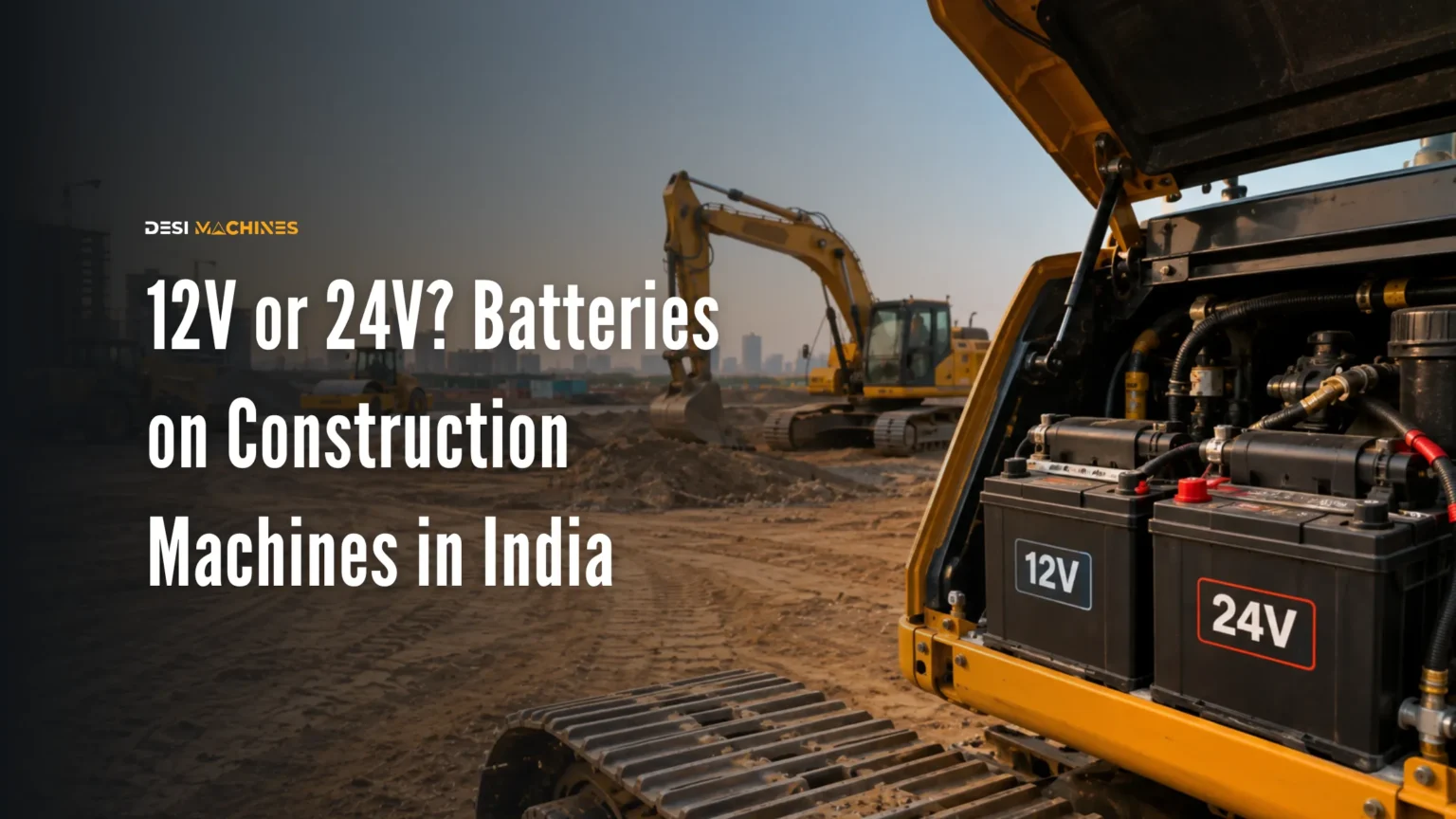
A construction machine battery has one main job: turning a large diesel engine over fast enough to fire, every time, in the heat and dust of an Indian site. Machines do that in one of two ways – a single 12 volt battery, or two 12 volt batteries wired together to give 24 volts. Which one your machine has decides what you buy at replacement time, whether another vehicle can jump-start it, and how much a dead battery costs you in downtime.
Across the 479 machines on DesiMachines that publish a battery specification, the split is almost even – 246 run a 24 volt system and 233 run a single 12 volt battery – but it is not random. It follows the machine type almost perfectly: every backhoe loader listed runs 12 volt, while 46 of 49 wheel loaders run 24 volt. This guide explains the split, what the Ah number means, and how to keep a battery alive on an Indian site.
Does my machine run on 12V or 24V?
Check the spec sheet, or open the battery box and count. One battery means a 12 volt system. Two batteries wired together means 24 volt, and spec sheets write that as “2 x 12V”, “12V x 2” or simply “24V”. The machine’s alternator matches the system – a 24 volt machine carries a 24 volt alternator.
Here is how the catalogue splits by machine type:
| Machine type | Machines publishing a battery spec | 24 volt system | Single 12 volt |
|---|---|---|---|
| Backhoe loader | 49 | 0 | 49 |
| Pick and carry crane (Hydra) | 67 | 3 | 64 |
| Compactor (road roller) | 31 | 3 | 28 |
| Skid steer loader | 7 | 0 | 7 |
| Excavator | 226 | 162 | 64 |
| Wheel loader | 49 | 46 | 3 |
| Motor grader | 29 | 20 | 9 |
| Telehandler | 11 | 5 | 6 |
| Transit and self-loading mixer | 10 | 7 | 3 |
Figures as per the current August 2026 spec sheets on DesiMachines. Concrete pumps and dozers publish no battery data at all, so ask the dealer for those.
Real examples make the pattern clear. The JCB 3DX runs a single 12 V battery with a 130 A alternator. The JCB NXT 215 LC Fuel Master, from the same maker, runs 24 V. The JCB 440-5 wheel loader runs two 12 V batteries of 110 Ah each with a 28 V alternator.
Why do some machines need 24 volts?
A bigger diesel engine is harder to turn over, especially cold, and turning it faster takes more electrical power. Doubling the voltage lets the starter draw the same power through half the current, so the cables can be thinner and less energy is lost as heat on the way to the starter motor.
That is why the split follows engine size rather than brand. Backhoe loaders and pick and carry cranes sit around 50 to 100 HP and start comfortably on 12 volts. Tracked excavators, wheel loaders and motor graders carry larger engines and more electronics, and mostly move to 24 volts. Machine power by class is set out in the guides to excavator engine power and wheel loader engine power.
The exceptions in the table are worth noting rather than worrying about. Three pick and carry cranes and three compactors run 24 volt, and 64 excavators – mostly the smaller ones – are content with a single 12 volt battery. A mini excavator has an engine no larger than a backhoe’s, so it needs no more starting power than one.
Which engine is fitted to which machine, and by whom, is covered in the guide to engine brands in construction equipment.
What does the Ah number on a battery mean?
Ah stands for ampere-hours, and it is how much charge the battery holds – the size of the tank, not the strength of the push. A 150 Ah battery holds more than a 100 Ah one, so it survives more starting attempts, more idle days and more load from lights and electronics before it goes flat.
Across the machines that publish a figure, batteries run from 55 Ah to 380 Ah, with 120 Ah the most typical size. Small machines and cranes sit at the lower end – the ACE Rhino 90C lists 12V and 75 Ah – while a large excavator can carry two batteries of 180 Ah or more each.
Two more numbers appear on spec sheets and on the battery itself:
- CCA (cold cranking amps) – how hard the battery can push for a few seconds to turn the engine. The CAT 950GC class of machine quotes this alongside the Ah rating.
- Alternator output in amps – how fast the machine recharges the battery while running. A 130 A alternator refills a flat battery far quicker than a 35 A one, which is why a machine that only does short trips with a small alternator slowly loses charge.
When you replace a battery, match the voltage exactly and do not go below the machine’s stated Ah. Going slightly above is usually fine if it physically fits the tray and the terminals are on the same side.
Can you jump-start a 24 volt machine from a car?
No. A car or a pickup is a 12 volt vehicle, and connecting it directly to a 24 volt machine will not turn the engine and can damage electronics on both sides. To jump a 24 volt machine you need another 24 volt machine, or two 12 volt batteries connected in series to make 24 volts, with the connections made by someone who knows the sequence.
A 12 volt machine – a backhoe, a Hydra, most rollers – can be jumped from a truck or another 12 volt machine, which is one practical advantage of the smaller system on a remote site.
On a backhoe loader a flat battery is only one of the reasons a machine will not turn over, and the backhoe loader starting problem guide works through the shuttle lever, the connections and the fuel side by symptom.
Three habits prevent most of these situations in the first place:
- Use the battery isolator switch when the machine will stand for days. It cuts the slow drain that empties a battery over a long idle period, and it also makes battery theft harder.
- Keep the terminals clean and tight. Corrosion on the terminals looks like a dead battery and is a five-minute fix.
- Replace both batteries together on a 24 volt machine. A new battery paired with an old one is dragged down to the weaker one’s condition, so the money spent on the new one is wasted.
What kills batteries on Indian sites?
Heat and vibration do most of the damage, and both are worse here than in the conditions machines are designed and tested in. Summer heat evaporates the electrolyte in a serviceable battery, and constant vibration on a rough site shakes the internal plates and works the terminals loose.
The other big one is standing idle. A machine parked between jobs for a few weeks, with the isolator left on, will often refuse to start when the work comes – and the batteries then get blamed for failing when they were simply drained flat and left there. Monsoon adds a third: water and mud around the battery box speed up terminal corrosion.
Simple things that help: park the machine where the battery box is out of direct sun where possible, check terminal tightness during regular greasing rounds, and keep the top of the battery dry and clean. The wider service routine these checks belong in is in the guide to construction equipment service schedules, and the greasing round itself in the guide to greasing and lubrication.
If a battery goes flat repeatedly and holds no charge after a proper recharge, it has reached the end of its life. What to check before you fit a replacement is covered in the guide to construction equipment spare parts.
What should you check before buying a used machine?
A construction machine battery is a cheap item, so it is not the reason to reject a machine. What it tells you about the machine is worth far more than the battery is.
- Does it start on the first turn, cold? Ask to start the machine before it has been warmed up for you. A machine started an hour before you arrive is hiding something.
- Are both batteries on a 24 volt machine the same age and make? Mismatched batteries usually mean one failed early, and that can point to a charging fault rather than a battery fault.
- Is the alternator charging? If the dashboard charge light stays on with the engine running, the fault is in the charging system, not in the battery.
- Any signs of repeated jump-starting – burnt terminal clamps, wires added across the battery, an isolator that has been bypassed – suggest a long-running electrical problem.
That last point is worth following up, because added wires and bypassed isolators usually mean the loom has been worked on before. The guide to wiring kits and harnesses covers what those repairs do to a machine and what a replacement harness involves.
These fit into the wider inspection routine in the guide to checking a used machine before you buy.
Compare live excavator models and backhoe loader models to see the published electrical specification for each machine before you shortlist.
Machine batteries, in short
Count the batteries: one means 12 volt, two means 24 volt. Every listed backhoe loader and nearly every Hydra runs 12 volt; nearly every wheel loader and most excavators run 24 volt, because bigger engines need more starting power. Batteries in the catalogue run from 55 Ah to 380 Ah, with 120 Ah typical. A 24 volt machine cannot be jumped from a car, both its batteries are replaced together, and the isolator switch is what saves you the call-out in the first place.
A red battery lamp on the dash is the machine telling you the alternator has stopped charging, and excavator warning lights covers that symbol alongside the rest of the display.
When a machine clicks once and refuses to turn over, the batteries are the first suspect but not the only one, and why an excavator will not start runs through the checks in the order an operator should do them.
On a backhoe loader that same charging symbol sits alongside road and transmission lamps that a tracked machine never carries, and backhoe loader warning lights explains the full cluster symbol by symbol.
For what a replacement costs, the JCB battery price guide lists current prices by Ah rating and machine.
Traction batteries work on a completely different scale: a heavy electric truck pack is measured in hundreds of kWh, and that size is what sets both its range and its subsidy, as the guide to electric truck prices and the PM E-DRIVE scheme in India explains.
Prices, specifications and features are indicative, vary by variant, location and date, and should always be confirmed with the official OEM or authorised dealer before any purchase decision. DesiMachines is not liable for decisions taken on the basis of information that may have changed after publication.