
 Excavator
294 models
Excavator
294 models  Backhoe Loader
51 models
Backhoe Loader
51 models  Crane
68 models
Crane
68 models  Concrete Mixer
79 models
Concrete Mixer
79 models  Wheel Loader
54 models
Wheel Loader
54 models  Compactor / Roller
45 models
Compactor / Roller
45 models  Motor Grader
42 models
Motor Grader
42 models  Dozer
41 models
Dozer
41 models  Concrete Pump
66 models
Concrete Pump
66 models  Skid Steer Loader
11 models
Skid Steer Loader
11 models  Telehandler
13 models
Telehandler
13 models 


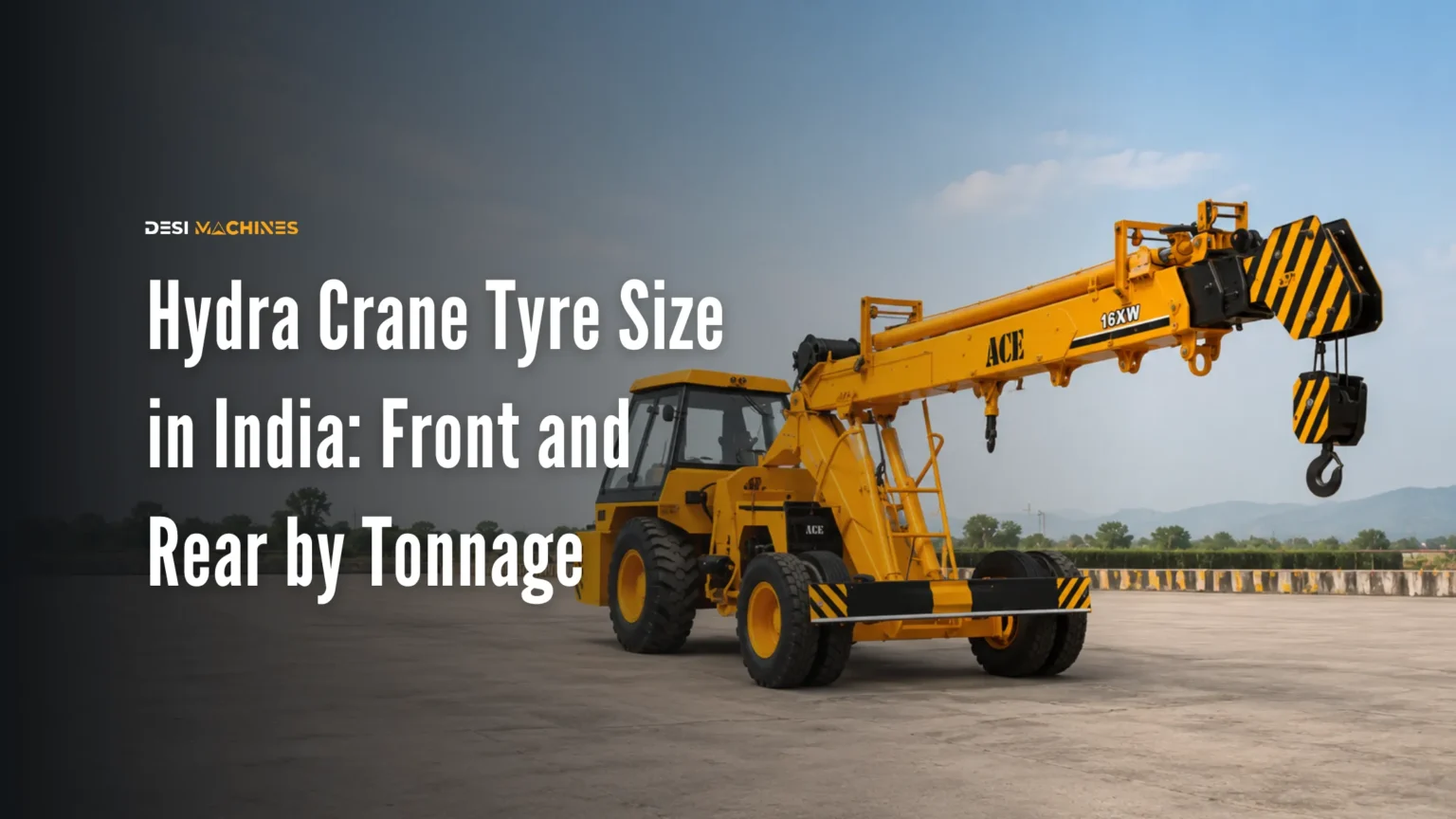
A hydra crane tyre size is the code printed on the sidewall, such as 11.00 x 20 – 16 PR, that tells you the width of the tyre, the rim it fits, and how strong its casing is. On a pick and carry crane it is a lifting spec and not just a fitment detail, because these machines lift while standing on their tyres instead of on outriggers (the steel legs a bigger crane lowers to take its weight off the wheels). Across the 67 pick and carry cranes listed on DesiMachines, 60 publish a full front and rear tyre specification, and between them they use only five different front sizes.
This guide sets out what those sizes are, how they change as the crane gets bigger, and the one thing most first-time buyers miss: on well over half these machines, the front and rear tyres are not the same size, so you end up buying and storing two different tyres for one crane.
What tyre size does a hydra crane use?
Of the 60 machines that publish the figure, the front tyre is one of just five sizes. The most common by a wide margin is 11.00 x 20, fitted to 35 of the 60 cranes, covering everything from 11 Ton (11,000 kg) up to 20 Ton (20,000 kg) of rated lifting capacity.
The full front range runs from 10.00 x 20 on the smallest machines to 14.00 x 25 on the largest. That is a narrow ladder for a class that spans 9 Ton to 35 Ton, and it is good news for an owner. Tyres in these sizes are stocked widely in India because the same fitments are used on trucks and other site machines.
Rear tyres are a different story. There are nine rear sizes across the same 60 machines, and the reason for that spread is the subject of the next two sections.
What do the numbers in 11.00 x 20 – 16 PR mean?
The code breaks into three parts, and all three matter when you order a replacement.
11.00 is the section width, measured in inches across the widest part of the tyre. Eleven inches is about 279 mm. A wider tyre spreads the machine’s weight over more ground.
20 is the rim diameter in inches, again about 508 mm. This one is not negotiable. A 20 inch tyre only fits a 20 inch rim, so a size with a different second number is not an option unless you change the wheel itself.
16 PR is the ply rating. Ply rating describes how strong the casing is, using the number of fabric layers an old cotton-ply tyre would have needed to carry the same load. Modern tyres reach the same strength with fewer, stronger layers, so the number is a load rating rather than a literal count. Some makers print PLY instead of PR, which means the same thing.
You will see this style of code on cross-ply tyres, which is what almost every machine in this class runs. If you want the longer explanation of tyre codes, including the radial sizes written like 23.5R25, we cover the notation in detail in the guide to wheel loader tyre sizes and types. The backhoe loader runs the same small-front, large-rear pattern, and its fitments are listed in backhoe loader tyre size.
How many tyres does a hydra crane have?
Every single machine that publishes a wheel count, all 58 of them, runs four tyres at the front. There is no exception anywhere in the class.
The rear is where machines differ, and it splits the class cleanly in two:
- Six-wheelers carry four front tyres and two at the rear. This is the larger group: 34 of the 58 machines.
- Eight-wheelers carry four front and four rear. That is the other 24 machines.
The split follows the drivetrain closely. Of the 35 two wheel drive cranes, 32 are six-wheelers. Of the 20 four wheel drive cranes, 18 are eight-wheelers. So a four wheel drive machine, which on Indian sites is usually sold as a Farana, almost always has eight wheels under it.
It is worth counting rather than assuming here. The four-and-four layout looks like the standard one because it is what you see on the heavier machines and in most maker photographs, but across the whole class the six-wheeler is the more common build. What the wheels are attached to is covered part by part in the guide to hydra and farana crane parts.
Why are the rear tyres bigger than the front on most hydras?
On a six-wheeler, the two rear tyres are almost always a bigger size than the four at the front. This holds on 33 of the 34 six-wheelers in the list. Not one of them runs a rear tyre smaller than its front.
The arithmetic explains it. The rear axle’s share of the weight has to be carried by two tyres instead of four, so each of those two has to be physically larger to take it. A typical 15 Ton six-wheeler runs 11.00 x 20 at the front and 13.00 x 24 at the rear. The Escorts HYDRA 15 and the ACE 15XW both do exactly this.
On eight-wheelers the opposite is true. Because four tyres share the rear load, the same size works at both ends, and 22 of the 24 eight-wheelers run one size all round. The ACE F150 runs 11.00 x 20 – 16 PR at both ends, and the 23 Ton Escorts F23 runs 12 x 24 – 20 PLY on all eight.
This is the buying point. A six-wheel crane means two different tyres to source, price and keep as spares. An eight-wheel crane means one. Over a machine’s life that difference shows up every time a tyre is damaged on site and you need a replacement the same week. It belongs in the running-cost sum you do before you buy, alongside rope, brakes and hydraulic service, which we set out in the used hydra crane buying guide.
Hydra crane tyre size by tonnage class
The table below is built from the published specifications of the 60 pick and carry cranes that state both front and rear tyres. Sizes are the front fitment, since that is the one every machine in the class shares.
| Front tyre size | Ply rating | Machines | Rated capacity range | Example |
|---|---|---|---|---|
| 10.00 x 20 | 16 PR | 3 | 9 to 13 Ton | ACE Rhino 90C (9 Ton) |
| 11.00 x 20 | 16 PR | 35 | 11 to 20 Ton | Escorts HYDRA 15 (15 Ton) |
| 12.00 x 20 | 18 PR | 11 | 18 to 25 Ton | ACE 18XW (18 Ton) |
| 12.00 x 24 | 18 to 20 PR | 10 | 20 to 30 Ton | Escorts F23 (23 Ton) |
| 14.00 x 25 | 28 PR | 1 | 35 Ton | ACE F350 (35 Ton) |
Two things stand out. First, the bands overlap. An 18 Ton machine might run 11.00 x 20 or 12.00 x 20 depending on the maker, so tonnage alone does not tell you the size. Always read the specification for the exact model.
Second, the ply rating climbs in step with the size rather than separately from it. Every 11.00 x 20 in the list is 16 PR and every 12.00 x 20 is 18 PR. So as the crane gets heavier the tyre gets both wider and stronger at the same time. You can see the matching climb in operating weight in the guide to hydra crane weight by tonnage class.
What rear tyre sizes are used?
Among the six-wheelers, where the rear is a size of its own, two fitments dominate: 13.00 x 24 and 14.00 x 25, on 15 machines each. They divide by machine size rather than by maker. The 13.00 x 24 rear appears on smaller six-wheelers, from 9 Ton to 15 Ton. The 14.00 x 25 rear takes over from 15 Ton upward and runs all the way to the top of the class.
The ACE Rhino 90C at 9 Ton sits at the bottom of that pattern with 10.00 x 20 front and 13.00 x 24 rear. The ACE 25XW at 25 Ton sits near the top with 12.00 x 24 front and 14.00 x 25 rear.
The remaining rear sizes are one-offs. Single machines use 17.00 x 25, 17.50 x 25, 14.00 x 24 and 14.00 x 20. If you own one of these, check the specification before ordering rather than assuming a common size, because a one-off fitment is the one your local dealer is least likely to have on the shelf.
Why does tyre condition change what the crane can lift?
Because there are no outriggers, the tyres are load-bearing parts of the lifting system. Of the 67 pick and carry cranes listed, exactly one publishes outrigger cylinders in its specification. The other 66 lift on their wheels, full stop.
That has three practical effects an operator feels every day.
Pressure is a lifting spec. A soft tyre lets that corner of the machine settle. The boom tips further out, the load moves further from the machine’s centre, and the crane becomes less stable at exactly the moment you do not want it to. Check pressures cold, before the day starts, not after a few hours of travel.
A lower ply rating is not a cheaper tyre. Fitting a 12 PR where the specification says 16 PR reduces what the machine can safely carry. You have not saved money, you have made a smaller crane. Match the ply rating exactly.
Ground condition does the job outrigger pads would do. Nothing spreads the weight beyond the tyre’s own contact patch, so loose fill, a covered drain or fresh backfill under one wheel is a genuine risk. This is covered further in our guides to reading a crane load chart and crane safety rules and operator training.
If you are still deciding which machine suits your work, start with what a pick and carry crane is built to do in the guide to hydra and farana cranes, then compare live pick and carry crane models and specifications and speak to a dealer.
What should you check before ordering replacement tyres?
Five checks, in order.
- Read the specification, not the tonnage. The size bands overlap, so two 20 Ton cranes from different makers can take different tyres.
- Check front and rear separately. On a six-wheeler they are almost certainly different sizes. Ordering a matched set of four is the classic mistake.
- Match the ply rating. Same size and a lower PR is a downgrade in lifting capability, not a saving.
- Count the wheels before you order. Six-wheel machines need four of one size and two of another. Eight-wheel machines usually need eight of one size.
- Replace across an axle, not one corner. A new tyre next to a worn one on the same axle sits at a slightly different height, which tilts the machine and shifts the load.
For the wider picture on what wears out on these machines and what it costs to keep one running, see the guides to hydra crane engine power and fuel tank and oil capacities. To see what is available now, browse the full range of cranes and send an enquiry.
Which tyre sizes fit hydra cranes by tonnage?
Hydra crane tyre size comes down to a handful of rules. Four tyres at the front on every machine in the class. Five front sizes in total, with 11.00 x 20 covering more than half of them. Six-wheelers, which are the majority, run a bigger tyre at the rear and need two sizes in stock. Eight-wheelers, usually four wheel drive, run one size all round. Read the model’s own specification before you order, and match the ply rating exactly.
Current prices for these sizes are listed in the construction machine tyre price guide.
Tyre specifications above are taken from the published specifications of the pick and carry cranes listed on DesiMachines at the time of writing, August 2026. Prices, specifications and features are indicative, vary by variant, location and date, and should always be confirmed with the official OEM or authorised dealer before any purchase decision. DesiMachines is not liable for decisions taken on the basis of information that may have changed after publication.