Excavator
294 models
Excavator
294 models  Backhoe Loader
51 models
Backhoe Loader
51 models  Crane
68 models
Crane
68 models  Concrete Mixer
79 models
Concrete Mixer
79 models  Wheel Loader
54 models
Wheel Loader
54 models  Compactor / Roller
45 models
Compactor / Roller
45 models  Motor Grader
42 models
Motor Grader
42 models  Dozer
41 models
Dozer
41 models  Concrete Pump
66 models
Concrete Pump
66 models  Skid Steer Loader
11 models
Skid Steer Loader
11 models  Telehandler
13 models
Telehandler
13 models 


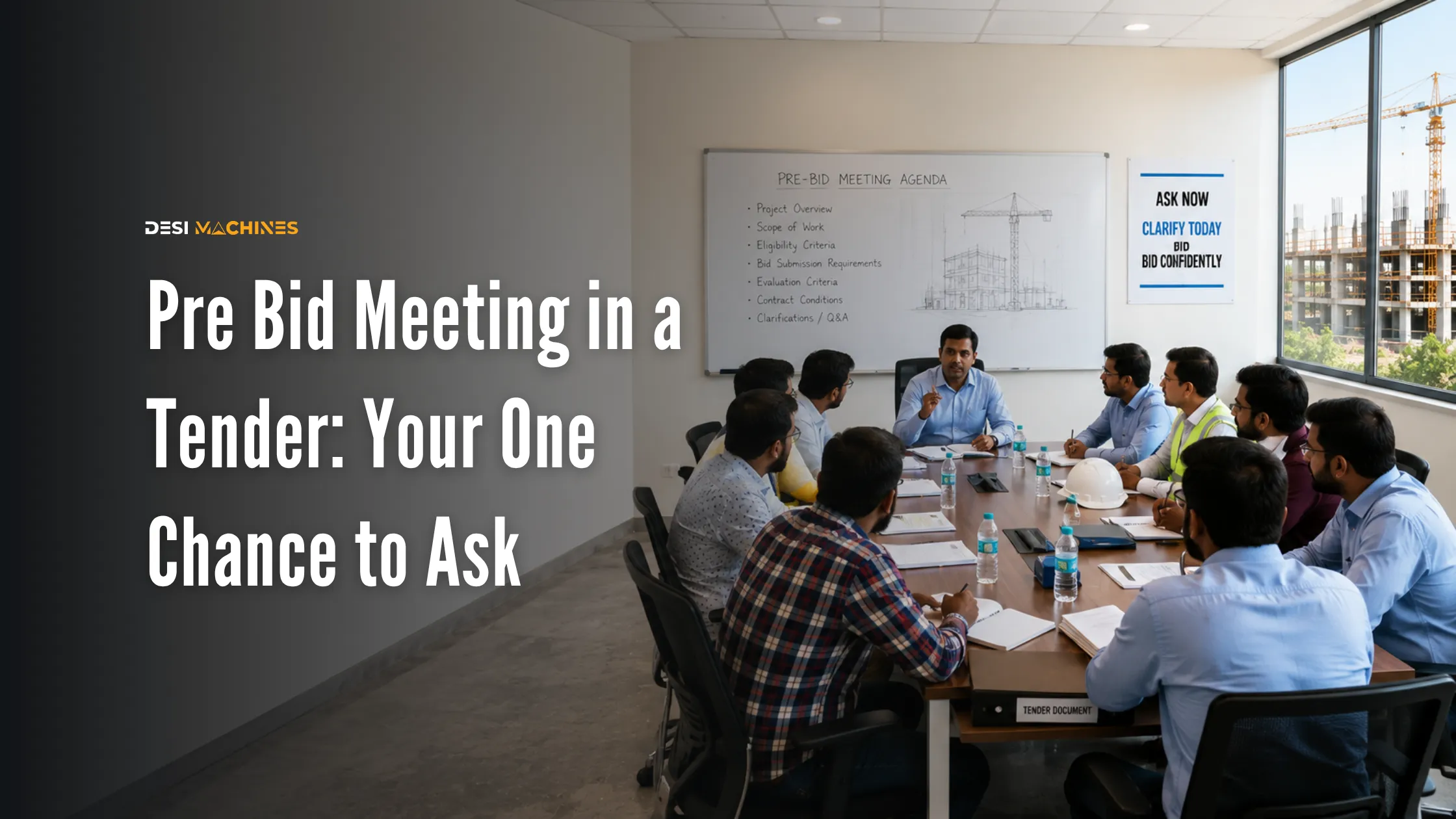
A pre bid meeting is the scheduled point between publication and the bid deadline at which you can question the tender’s conditions. It is the only stage where an unworkable clause can still be changed. What makes the change real is not the discussion in the room — it is the corrigendum issued afterwards. Anything not carried into a written corrigendum did not change, and bids are evaluated against the amended document, so re-check the portal before you submit.
Owners read a tender, find a condition that makes the job unattractive — an age limit on machines, a payment cycle that runs to ninety days, a deployment schedule with no allowance for idle time — and quietly decide not to bid.
Sometimes that is the right call. Often the condition was drafted from a template, nobody has questioned it, and a written query from one bidder is all it would take.
What a pre bid meeting is for
The buyer publishes the tender. Somewhere between that date and the deadline, a meeting is scheduled at which prospective bidders raise queries about the conditions, specifications, quantities and schedules.
Most tenders ask for queries in writing by a date ahead of the meeting, often in a prescribed format that lists the clause number, the existing text and the change you are seeking. Send them in that shape. A query that does not identify the clause is easy to answer without answering.
The meeting itself is not a negotiation, and it is not where you find out whether you will win. It is where the buyer decides which of its own conditions it is prepared to reconsider.
The corrigendum is the only thing that binds
This is the part that costs bidders money, so it is worth being blunt about.
What binds is the tender document as amended by written corrigenda. Nothing else. A helpful reply across the table, a nod from an officer, a note somebody made in the minutes — none of these amend the tender.
If an answer matters to your bid, it must appear in a published corrigendum. If it does not appear, work on the assumption that the original condition stands, and price it or walk away accordingly.
A corrigendum can change the eligibility conditions, the specifications, the bill of quantities, a format, or the deadline. Once issued it becomes part of the document, and evaluation runs against the amended version — which is then ranked the way L1, L2 and L3 describes.
Which produces the practical rule that catches out even experienced bidders: re-check the portal before you upload. A bid prepared on the original bill of quantities, submitted after a corrigendum revised it, is a bid prepared on a superseded document.
What a machine owner should actually ask
The questions worth asking are the ones that decide whether the work pays, not the ones that display how much you know.
| Ask about | Why it decides the bid |
|---|---|
| Deployment schedule and idle time | Machines held on site between fronts earn nothing while the EMI runs. Ask who bears standing time. |
| Owned versus hired machines | A condition requiring ownership can rule out a bidder who would otherwise hire in capacity for the peak. |
| Age limit on equipment | A limit drafted for one class of work can quietly exclude a perfectly capable fleet. |
| Payment cycle and running bills | Decides your working capital need for the whole job, not just the first month. |
| Mobilisation advance | Whether it is available at all, against what security, and how it is recovered. |
| Delay and defect clauses | The rate, the ceiling and the extension route — these price the risk you are taking. |
Two of those deserve a closer look before you attend. Our note on liquidated damages and extension of time covers what to look for in the delay clause, and the piece on the defect liability period covers how long your money stays with the client after the work is done.
What not to raise
Queries are usually circulated to all bidders along with the replies. So treat the meeting as public, because it is.
Do not signal your pricing approach — a question about how a particular item will be measured tells competitors where you think the money is. Do not ask for a relaxation that advertises you cannot meet the eligibility bar as it stands; if you cannot qualify, the honest routes are the ones built into the rules, which our note on the bid capacity formula and the solvency certificate piece both cover.
And do not ask a question the tender already answers. It uses up the goodwill you may need for the query that matters.
Between the meeting and the deadline
Three habits are worth building, and none of them takes long.
Read the published replies against your own queries, one by one. An answer that restates the clause without changing it is a refusal, and should be read as one.
Diarise a portal check for the day before submission, and again on the morning of it. Corrigenda arrive late more often than they arrive early.
Rebuild the bid on the amended documents if anything substantive moved — the formats, the bill of quantities, the declarations. Editing yesterday’s file is how a superseded annexure survives into a submitted bid.
Put every pre bid query in writing against a clause
The pre bid meeting is the one stage where a tender is still capable of changing shape. Use it on the commercial conditions that decide whether the machines earn, put every query in writing against a clause number, and treat only a published corrigendum as an amendment.
Then check the portal again before you upload. If you are choosing which tenders to take to this stage, our guide to bidding for government construction tenders covers the groundwork, and current work is listed on the tender opportunities page.
Rates, schemes, specifications and prices change — confirm current terms with the OEM, dealer, bank or insurer before deciding. Query formats, meeting procedure and corrigendum practice differ between buyers and portals; confirm them in the tender document that applies to you.