Excavator
294 models
Excavator
294 models  Backhoe Loader
51 models
Backhoe Loader
51 models  Crane
68 models
Crane
68 models  Concrete Mixer
79 models
Concrete Mixer
79 models  Wheel Loader
54 models
Wheel Loader
54 models  Compactor / Roller
45 models
Compactor / Roller
45 models  Motor Grader
42 models
Motor Grader
42 models  Dozer
41 models
Dozer
41 models  Concrete Pump
66 models
Concrete Pump
66 models  Skid Steer Loader
11 models
Skid Steer Loader
11 models  Telehandler
13 models
Telehandler
13 models 


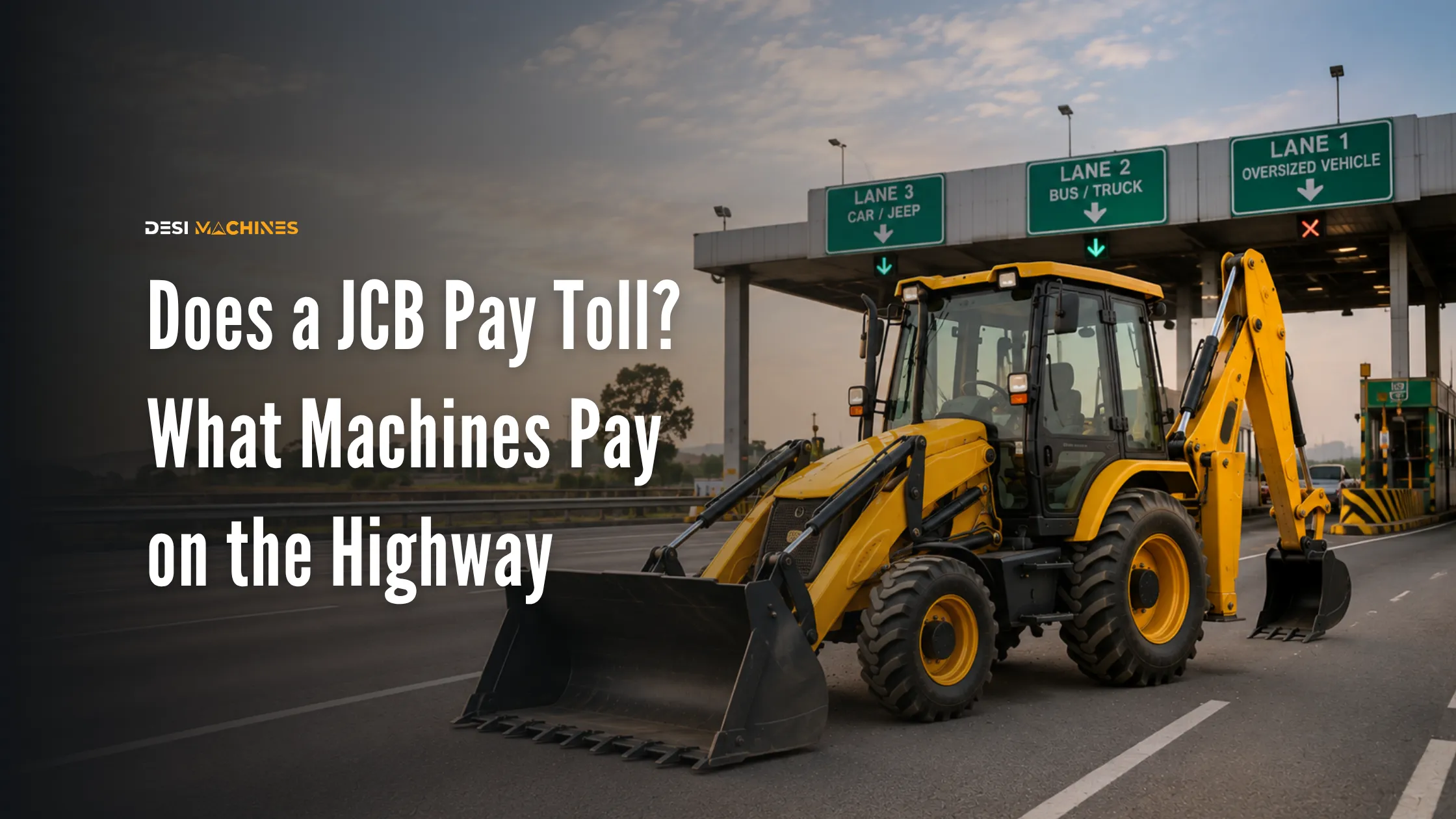
JCB toll tax is not a separate levy — a machine driving on a tolled national highway under its own power is a mechanical vehicle and pays the fee like anything else. The catch is the class: the rules put Heavy Construction Machinery and Earth Moving Equipment in the same band as four-to-six-axle multi-axle vehicles, second only to oversized vehicles. The exemption for highway construction work is written for Government organisations, not for private contractors.
The question comes up the first time somebody drives a backhoe loader thirty kilometres to a new site instead of putting it on a trailer, reaches the plaza, and gets asked for a figure that seems far too high for a machine that is slower than everything else in the queue.
It is not an error, and it is not the operator being taken advantage of. The classification is deliberate.
Why a machine pays at all
Fees on national highways are levied under the National Highways Fee (Determination of Rates and Collection) Rules, 2008. The Rules do not talk about cars, trucks or machines. They talk about a mechanical vehicle, which is defined as any vehicle driven under its own power, including a motor vehicle as defined under the Motor Vehicles Act, 1988.
That definition decides the whole question. A backhoe loader driving itself down the highway is driven under its own power, so it is a mechanical vehicle. The Rules then say that every driver, owner or person in charge of a mechanical vehicle shall, for the use of the section of national highway, permanent bridge, by-pass or tunnel, pay the fee before crossing the fee plaza.
Note what is not in that test. It does not matter whether your machine is registered, whether it carries a load, or whether it is a transport vehicle for other purposes. Registration and road tax are separate obligations with separate triggers — worked through in our note on JCB road tax in India, which is a state levy on the machine, not a charge for using a particular stretch of road.
The class your machine sits in
The fee table sets a base rate per kilometre for each type of vehicle. The classes, in order, are cars and light motor vehicles, then light commercial vehicles and mini buses, then two-axle buses and trucks, then three-axle commercial vehicles, then a combined class of Heavy Construction Machinery (HCM), Earth Moving Equipment (EME) or Multi-Axle Vehicles (MAV) of four to six axles, and finally oversized vehicles of seven or more axles.
| Vehicle class | Where it sits |
|---|---|
| Car, jeep, van or light motor vehicle | Lowest |
| Light commercial vehicle, light goods vehicle, mini bus | Second lowest |
| Bus or truck (two axles) | Middle |
| Three-axle commercial vehicle | Above trucks |
| Heavy Construction Machinery, Earth Moving Equipment or MAV (four to six axles) | Second highest |
| Oversized vehicle (seven or more axles) | Highest |
This is the part owners find counter-intuitive. Your two-axle backhoe loader is charged in the same band as a six-axle trailer, because the class is defined by what the vehicle is, not by how many axles it happens to have. A machine and a multi-axle truck were put in one bracket, and a machine cannot argue its way down into the two-axle truck rate.
Bridges and tunnels built above a threshold cost are charged per trip rather than per kilometre, on their own table, and construction machinery again shares a column with multi-axle vehicles.
Why no JCB toll tax rate per kilometre is quoted here
The Rules do contain a number for each class. It is expressed as a base rate for the base year 2007-08, and it has not been the payable figure for a very long time.
Rule 5 does two things to it. First, the rates were increased without compounding by three per cent each year from 1 April 2008, with each increased rate becoming the base for the following year. Second, the base rates are revised annually with effect from 1 April to reflect the increase in the wholesale price index measured from the week ending 6 January 2007, with the revision restricted to forty per cent of that increase.
On top of that, the rate depends on the road. A section with four or more lanes is charged differently from a two-lane section with paved shoulders that has been substantially improved, which is charged at a reduced proportion of the four-lane rate.
So a single per-kilometre figure would be wrong on two counts at once: wrong for the year, and wrong for the particular stretch. We publish the class and the mechanism, which do not change, and leave the number to the plaza that notified it. This is the same reason we do not publish a per-kilometre figure in excavator transport cost.
Who is actually exempt
Rule 11 lists the exemptions, and it is worth reading closely because the version circulating on sites is usually a garbled summary.
One limb covers vehicles transporting and accompanying named constitutional and public office holders, and decorated servicemen holding a photo identity card for the award. That limb has nothing to do with a working contractor.
The second limb is the one that raises hopes. It exempts vehicles used for official purposes by the Ministry of Defence, the central and state armed forces in uniform including paramilitary forces and police, an executive magistrate, the fire-fighting department, and — the important one — the National Highways Authority of India or any other Government organisation using such vehicle for inspection, survey, construction or operation of national highways and maintenance thereof. Ambulances and funeral vans are exempt, as are vehicles specially designed and constructed for a person with a physical disability.
Read the construction limb again. The exemption attaches to a vehicle used for official purposes by NHAI or another Government organisation. A private contractor executing a highway package is not a Government organisation, and its machines are its own. That is why contractors routinely find themselves paying the fee while working on the very highway they are widening.
If your contract puts the cost somewhere else, that is a matter of the contract, not of the Rules. Where tolls and similar charges land is a question for the rate you quoted and the reimbursement clause you signed — the same category of question as the ones covered in liquidated damages in construction contracts.
Drive it or carry it
Once you know the class, the old argument about driving a machine to site rather than trailering it looks different.
At the plaza, the fee follows the vehicle that is using the highway. Drive the machine and it is assessed as construction machinery. Put it on a trailer and the combination is assessed on its own class, with the machine as cargo rather than as a vehicle.
The toll is rarely the deciding factor, though. Driving a machine any real distance costs you in fuel at working consumption rather than highway consumption, in undercarriage or tyre wear, and in hours on the clock that produce nothing. There are also limits on what may travel on a public road and in what condition, which is why the transport decision is usually settled long before anyone thinks about the fee plaza. Our note on trailer types for excavator transport covers which combination your machine actually needs, and the over-dimensional cargo permit covers when the load needs its own clearance.
Checking the rate before you get to the booth
You are not supposed to discover the figure at the window. Rule 12 requires the executing authority or the concessionaire to publish a notice of the fee in at least one newspaper each in English and the vernacular language with wide circulation in the area, and to display it prominently one thousand metres ahead of the fee plaza in Hindi and English, and five hundred metres ahead in English and the local language.
There is also a rule about where a plaza can be at all. It is to be established beyond ten kilometres from municipal or local town area limits, and while that may be relaxed for reasons recorded in writing, it may in no case be within five kilometres of those limits.
If you are running machines on a fixed route, read the notified board once and build the figure into your rate. It is a predictable cost, and it is easier to price in than to argue about later.
Plan toll as a running cost of moving a JCB
A machine on a tolled national highway pays, it pays in one of the higher classes, and being on a highway job does not by itself exempt it. The exemption for highway construction is written for Government organisations, and a contractor’s own machine sits outside it.
Treat the fee the way you treat diesel: a known cost of moving a machine, which belongs in the quoted rate rather than in a dispute afterwards. If the machine is making these trips often enough for the tolls to matter, the real question is whether the work justifies a second machine closer to it. Compare backhoe loader models and prices and excavators, and connect with a dealer before you decide.
Rates, schemes, specifications and prices change — confirm current terms with the OEM, dealer, bank or insurer before deciding. Fee classes and exemptions are summarised here from the National Highways Fee (Determination of Rates and Collection) Rules, 2008 as they stood at the time of writing; the applicable rate at any plaza is the one notified for that plaza, and should be confirmed there.