
 Excavator
294 models
Excavator
294 models  Backhoe Loader
51 models
Backhoe Loader
51 models  Crane
68 models
Crane
68 models  Concrete Mixer
79 models
Concrete Mixer
79 models  Wheel Loader
54 models
Wheel Loader
54 models  Compactor / Roller
45 models
Compactor / Roller
45 models  Motor Grader
42 models
Motor Grader
42 models  Concrete Pump
66 models
Concrete Pump
66 models  Skid Steer Loader
11 models
Skid Steer Loader
11 models  Telehandler
13 models
Telehandler
13 models  Dozer
Dozer 



Under the black surface of an Indian highway sit four or five more layers, and that surface is the thinnest of them: usually 30 to 50 mm, on a road crust that can run 600 to 800 mm deep. Everything below it does the real work. Each layer takes the wheel load, spreads it wider, and passes a weaker version of it down to the layer beneath, until what reaches the soil is small enough for the soil to carry.
That stack is what engineers mean by the road construction layers, or simply the crust. Strong, expensive material at the top where the load is sharp; cheap local material at the bottom where the load has spread out. Get the order or the thickness wrong and the road does not fail at the surface, even though the surface is where you see it.
What are the road construction layers, from the bottom up?
A normal Indian bitumen road has five parts: the subgrade (the prepared soil), the granular sub-base or GSB, the base course of wet mix macadam or WMM, a binder course of dense bituminous macadam or DBM, and the wearing course of bituminous concrete or BC on top. Small roads leave out one or two of these. A village road may be soil, GSB and a thin surface, nothing more.
Reading the section
Thicknesses shown are the normal laid thickness of each layer, not a design. The real figures for any one road come from its own pavement design, worked out from the strength of the soil and the traffic the road must carry. On a designed national highway the five layers together commonly total 600 to 800 mm.
The bottom two layers are stone and soil. The top two are stone held together with bitumen, the black binder most people call tar. WMM in the middle is the change-over point: it is the last layer that is only stone and water.
| Layer | Full form | What it is made of | Normal laid thickness |
|---|---|---|---|
| Subgrade | – | Existing or imported soil, compacted | Top 500 mm is treated as subgrade |
| GSB | Granular sub-base | Graded stone, gravel and sand | 200-300 mm |
| WMM | Wet mix macadam | Crushed stone mixed with water, no binder | 75-100 mm per layer, minimum 75 mm |
| DBM | Dense bituminous macadam | Graded stone coated with bitumen | 50-100 mm per layer |
| BC | Bituminous concrete | Fine graded stone with more bitumen | 30-50 mm |
Two older names still come up on site. WBM is water bound macadam, the hand-packed stone layer that WMM replaced on most work, and it is still laid on rural roads in 75 mm compacted courses. BM is bituminous macadam, an open, cheaper version of DBM used on lighter roads.
What is the subgrade, and why does it decide everything above it?
The subgrade is the compacted soil the whole road sits on, and its strength decides how thick every layer above it has to be. It is not a material you buy: it is the ground you already have, cleaned of topsoil, brought to the right moisture and rolled until it is dense.
Soil strength here is measured as CBR, short for California bearing ratio. It is a laboratory test that pushes a plunger into a soil sample and compares the force needed against the force a standard crushed stone needs. The answer is a percentage. Weak black cotton soil may test at 2 or 3 per cent. Good gravelly soil can reach 10 or more.
The Indian Roads Congress guideline for flexible pavement design, IRC:37, works from a subgrade of at least 5 per cent CBR compacted to 97 per cent of its maximum dry density. Below that the soil is not rejected, it is improved: dug out and replaced, mixed with granular material, or treated with lime or cement. Simply adding more stone on top is the expensive answer, because a low CBR pushes up the thickness of every layer above it.
Two compaction figures get checked on site. The embankment below the road is rolled to at least 95 per cent of maximum dry density; the top 500 mm, the part treated as subgrade, goes to 97 per cent. Maximum dry density is the densest that particular soil can be packed at its best moisture content, found in the lab by the modified Proctor test in IS 2720 (Part 8). Moisture is held within about 2 per cent either side of that value, which is why you see water tankers on an earthwork job in summer.
On clay, the roller that gets you there is usually a sheepsfoot roller, whose studded drum kneads the soil instead of bridging over it. How passes and lift thickness interact is covered in the guide to soil compaction.
What is GSB, and how thick does it go?
GSB stands for granular sub-base, and it is the first engineered layer above the soil, normally 200 to 300 mm thick. It is a graded mix of stone, gravel and sand. Graded means the sizes are deliberately mixed, from about 50 mm stone down to fine sand, so that the small particles fill the gaps between the big ones and the layer locks up tight when rolled.
GSB has a second job that nothing else in the stack does. It drains. Water that gets through the surface has to leave the pavement sideways, and the GSB is the layer that lets it out. A sub-base built with too much fine material holds water against the subgrade, and a wet subgrade is a weak subgrade.
The material is tested for strength too: a sub-base is expected to reach at least 20 per cent CBR for traffic up to 2 million standard axles and 30 per cent above that, which is why pit-run gravel often has to be crushed and blended before it qualifies. GSB is spread by a motor grader and compacted by a single drum soil compactor. On rural roads it may be the only granular layer, with the surface laid straight on it.
What is WMM in road construction?
WMM is wet mix macadam, a base course of crushed stone mixed with water in a plant and laid in compacted layers of 75 to 100 mm. The word macadam comes from the old practice of building roads from layers of broken stone. Wet mix means the aggregate is brought to the correct moisture in a mixing plant before it ever reaches the road, instead of being watered and packed by hand on site.
There is no bitumen and no cement in WMM. It holds together purely by mechanical interlock: the stones are graded so that they wedge against each other under the roller. That is also what limits the layer thickness. A single compacted WMM layer is not laid thinner than 75 mm, because a thinner mat has no room for the stones to key together, and normally not thicker than 100 mm with a conventional roller, because the compaction effort cannot reach the bottom of a deeper lift. Heavy vibrating equipment can take that to about 200 mm. Where a design calls for 250 mm of WMM, it is built in three layers, not one.
The older hand-laid version, WBM or water bound macadam, is still specified on village roads, also in 75 mm compacted courses. It uses larger stone packed by hand with stone dust and water brushed into the gaps. It is slower and needs more labour, which is why plant-mixed WMM took over wherever there is a machine on the job.
What is the difference between DBM and BC?
Both are stone coated with bitumen, but DBM is the thicker structural layer underneath and BC is the thin, fine, weather-tight layer you drive on. DBM stands for dense bituminous macadam and is laid in compacted layers of 50 to 100 mm. BC is bituminous concrete, laid 30 to 50 mm thick.
The difference is in the stone grading and the amount of bitumen. DBM uses larger aggregate and less binder, so it is strong, stiff and cheap by the tonne, but its surface is too coarse and too open to leave exposed. BC uses finer aggregate and more bitumen, which gives a dense, closed surface that keeps rain out of the layers below and gives tyres their grip. They are not competing choices. On a highway you get both, because one mix asked to be structurally deep and finely finished at once would cost more and do both jobs worse.
Between these layers you will see a sprayed coat of bitumen. A prime coat goes on the granular base to seal it and bond it to the first bituminous layer. A tack coat goes between two bituminous layers so they act as one. Both are sprayed rather than laid, and are measured in kilograms per square metre rather than millimetres.
How is a concrete road layered differently?
A concrete road replaces the two bitumen layers with one thick concrete slab, and adds a lean concrete layer under it. Engineers call it a rigid pavement, against the flexible pavement described above.
The stack becomes subgrade, then GSB, then DLC, then PQC. DLC is dry lean concrete, a low-cement concrete laid as an upper sub-base, normally at least 150 mm; PQC is pavement quality concrete, the slab that carries the traffic. The GSB below is also kept to a minimum of 150 mm.
The two behave differently under a wheel. A flexible pavement passes the load down through each granular layer to the soil, so the soil’s strength matters enormously. A concrete slab is stiff enough to bridge a soft patch and spread the load much wider, which is why concrete is chosen for heavy, slow, channelised traffic such as ports, toll plazas and mining haul roads. Which cement goes into that slab is a separate decision, covered in the guide to the best cement in India.
Which machine builds each layer?
Every layer is spread by a grader or a paver and compacted by a roller, and the roller changes as you go up the stack. The pattern is simple once you see it: heavy and wide at the bottom, light and narrow at the top.
| Layer | Spread by | Compacted by | Class weight of the roller |
|---|---|---|---|
| Subgrade | Motor grader | Single drum soil compactor, padfoot drum on clay | 9.7-22 tonnes (9,700-22,000 kg) |
| GSB | Motor grader | Single drum soil compactor | 9.7-22 tonnes (9,700-22,000 kg) |
| WMM | Motor grader or paver | Single drum soil compactor | 9.7-22 tonnes (9,700-22,000 kg) |
| DBM | Paver | Tandem roller, then pneumatic tyred roller | 1.6-10.1 / 10.5-18 tonnes |
| BC | Paver | Tandem roller, then pneumatic tyred roller | 1.6-10.1 / 10.5-18 tonnes |
Those spans are measured, not estimated. Twenty-one soil compactors run from 9,700 kg to 22,000 kg, twenty tandem rollers from 1,575 kg to 10,060 kg, and four pneumatic tyred rollers from 10,500 kg to 18,000 kg. Motor graders span 7,160 kg to 65,840 kg, with blades from 2,600 mm to 7,300 mm wide.
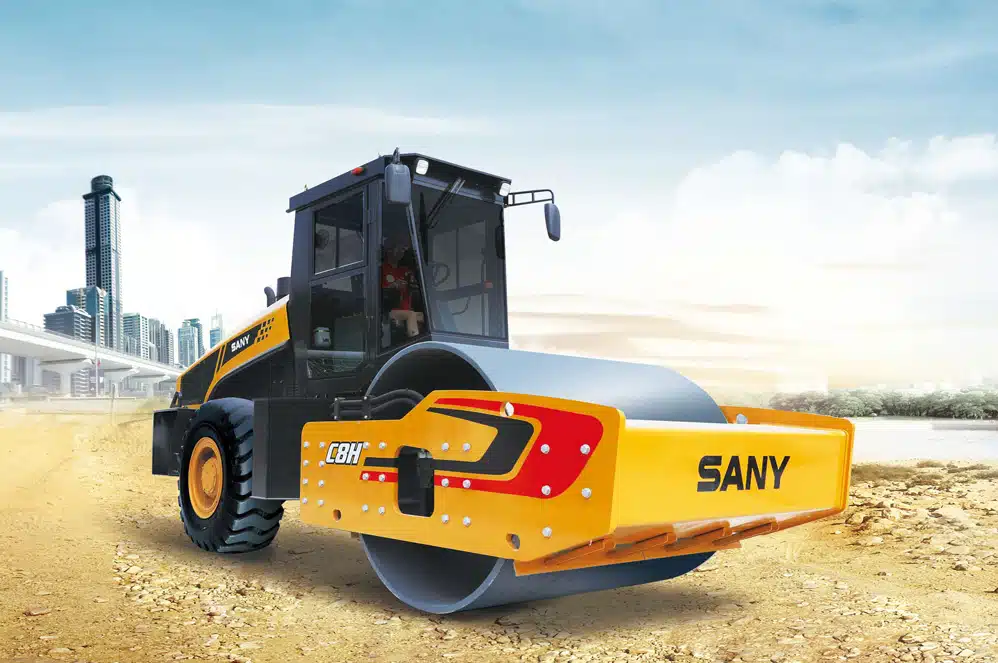
One number gives the split away. Every one of those 21 soil compactors carries a drum between 2,100 mm and 2,150 mm wide, while the tandem rollers run drums from 800 mm to 1,750 mm. The soil compactor is built to cover ground on wide earthwork layers. The tandem roller is built to finish a bitumen mat behind a paver, where the width that decides the job is the paver’s and not the roller’s.
A paver lays the two bituminous layers and sits outside the roller and grader range covered in these guides. For the machines that are, the guide to road construction equipment sets out which machine does what over a whole job, and motor grader applications covers the grading side in detail.
Compare live roller and compactor models with prices and connect with a dealer, or look at a worked example such as the SANY SSR220C-8H at the top of the soil compactor class.
How thick should the layers be on your road?
Nobody can answer that from a table, including this one, because the thickness is designed and not chosen. It comes out of two inputs: the strength of your subgrade, measured as CBR, and the traffic the road must carry over its life, counted in million standard axles or MSA.
A standard axle is a reference load of 80 kN, and every commercial vehicle expected on the road is converted into a number of those. The design reads a thickness for each layer off the IRC:37 charts and checks it against two failure modes: cracking of the bitumen layers from repeated bending, and rutting, which is the wheel track sinking into the layers below. Across the normal range of soil strength and traffic, the total designed crust lands between about 600 and 800 mm. Rural roads follow the same logic from a different book, with lighter traffic and thinner sections: the rural guidance sets a minimum granular base of 225 mm for traffic up to 2 MSA.
For a contractor the practical lesson is narrow. You do not get to trade thickness for compaction. A 100 mm WMM layer rolled to 95 per cent of what it should be is not a 95 mm layer, it is a layer that will rut.
What goes wrong when a layer is skipped?
Almost every early road failure traces back to water, compaction or thickness in one of the lower layers, not to the surface that shows the damage. Three patterns repeat on Indian jobs.
Potholes inside a monsoon or two mean water has reached a granular layer and has nowhere to leave from, usually because the sub-base carried too many fines or the shoulder drain was never cut. The layer softens, traffic pumps the fines upward, and the surface breaks over the soft patch.
Rutting in the wheel paths of a road that still looks new points somewhere else. A layer was rolled at the wrong moisture, or in too deep a lift, so the density target was never reached at the bottom of that lift. Nothing shows at handover. The rut arrives with the first loaded season.
Cracking along the joint between two days’ work is the third: a cold joint between bituminous layers that was never tacked, or a longitudinal joint that was not cut back and sealed, lets water straight into the DBM.
None of these are fixed from the top. Resurfacing over a wet, under-compacted base buys one season, which is why a proper investigation cuts a test pit before anyone orders bitumen. Roller productivity and output covers how many passes a machine needs to reach the target density.
Road construction layers in short
Five layers, each weaker and cheaper than the one above it, resting on soil whose strength sets the thickness of everything else. Subgrade compacted to 97 per cent, GSB 200 to 300 mm for strength and drainage, WMM in 75 to 100 mm locked-stone courses, DBM 50 to 100 mm for structure, BC 30 to 50 mm for the weather and the grip. Concrete roads swap the last two for DLC and a PQC slab.
The standards behind these figures are Indian Roads Congress guideline IRC:37 for flexible pavement design, the Rural Roads Manual for village roads, the Ministry of Road Transport and Highways Specifications for Road and Bridge Works for how each layer is built and tested, and IS 2720 for the soil tests. Codes get revised. Ask your consultant for the current revision before you rely on any figure in a tender.
Read next: the road construction guide for the rest of this series, and the road roller guide for the machine that touches every layer on this list. To see what is available now, browse compactors and road rollers and motor graders and talk to a dealer.
Prices, specifications and features are indicative, vary by variant, location and date, and should always be confirmed with the official OEM or authorised dealer before any purchase decision. DesiMachines is not liable for decisions taken on the basis of information that may have changed after publication. Layer thicknesses quoted here are normal laid thicknesses under Indian specifications and are not a substitute for a pavement design; machine figures are taken from our listings at the time of writing.