

 Excavator
  Backhoe Loader
  Motor Grader
  Wheel Loader
  Crane
Crane  Concrete Mixer
  Compactor
  Skid Steer Loader
  Concrete Pump
  Telehandler


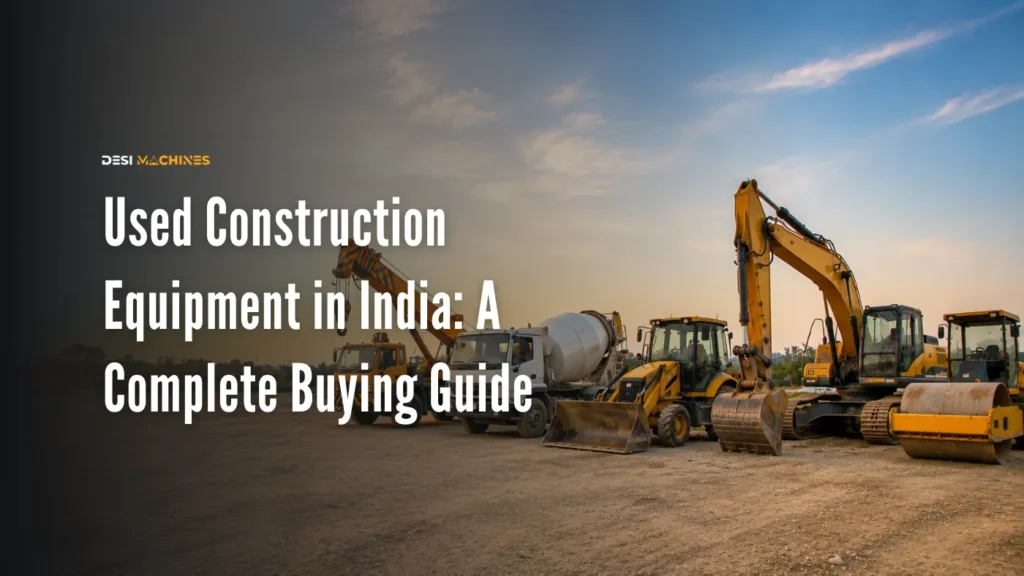
Used construction equipment means a machine that has already worked on a site and is being sold again by its owner, a dealer or a financier. It covers everything from a five-year-old backhoe loader that has dug water lines in a district town, to a twenty-ton excavator coming out of a highway package, to a pick-and-carry crane that has finished its work at a factory. In India most people simply call it a purani machine, and for thousands of small contractors it is the first machine they ever own.
Buying used is not a smaller version of buying new. The machine has no warranty behind it, the seller knows things you do not, and the price you are quoted has very little to do with what the machine is actually worth. This guide walks through the whole decision in plain language: whether used makes sense for your work, how a used price is built, what to inspect before you pay anything, which papers must come with the machine, and how a loan on a second-hand machine is different.
Last updated: July 2026.
Is buying used construction equipment a good idea?
Buying used is a good idea when your work is steady but your cash is tight, and a bad idea when you cannot afford a machine standing idle. A used machine lets you start earning with a much smaller payment upfront. The trade is that repair bills arrive earlier and without warning, and a machine that stops on a rented site costs you money every hour it sits.
Here is the honest picture, both sides:
- What you gain: a much lower entry price for the same class of machine, no waiting for delivery, and a machine whose weak points are already visible if you know where to look. For seasonal work, a used machine also frees up money for diesel, operator wages and site running costs.
- What you take on: no manufacturer warranty, no free service coupons, and unknown history. Wear parts like the undercarriage, tyres and hydraulic hoses may be close to replacement, and those bills land in the first year.
A simple test works well. If your machine will run most days on committed work, a new machine with warranty and a service contract usually wins, because downtime hurts more than the extra EMI. If your work is on and off, or you are entering the business for the first time, a sound used machine at the right price is the safer bet. Contractors weighing exactly this choice for digging work will find the numbers laid out in our comparison of buying a new versus a used excavator.
How much does a used machine cost compared to a new one?
A used machine is always priced downward from what the same new model costs today, so the new price is your starting reference for every negotiation. Ask the price of the current new model first, then judge whether the discount you are being offered matches the age, hours and condition in front of you. Below are current new-machine price bands for common machine classes in India, so you know the ceiling before you talk to any seller.
| Machine class | Example model (new) | New price band (indicative, July 2026) | Typical work |
|---|---|---|---|
| Mini excavator (about 2 Ton / 2,000 kg) | XCMG XE20U | ₹19.0–21.0 Lakh | Narrow lanes, pipeline trenches, farm and orchard work |
| Backhoe loader (the machine everyone calls a JCB) | JCB 3DX Plus | ₹33.3–36.8 Lakh | Municipal work, water lines, loading, small earthwork |
| 20-ton class excavator (20,000 kg) | SANY SY210C-9 | ₹48.5–53.6 Lakh | Highway packages, canals, quarry and bulk earthwork |
| 20-ton class excavator (20,000 kg) | Tata Hitachi EX 210 Infra | ₹57.0–63.0 Lakh | Same class, heavier build for continuous infra work |
| Pick-and-carry crane (14 Ton / 14,000 kg) | ACE 14XW | ₹17.1–18.9 Lakh | Site lifting, shifting material, plant and factory work |
| Soil compactor (single drum roller) | JCB VM117 | ₹34.2–37.8 Lakh | Road embankments, PMGSY and rural road layers |
Second-hand asking prices are not published anywhere and no two machines of the same year are worth the same amount, so treat any number you are shown as an opening position. Four things move a used price more than anything else:
- Hours on the meter: the hour meter is the machine’s odometer, counting engine running hours instead of kilometres. It is the single biggest price factor.
- Age and emission norm: an older machine may not meet the emission rules a government or large contract site demands, which quietly limits where you can deploy it.
- Wear-part condition: undercarriage on a crawler machine, tyres on a wheeled one, plus bucket, teeth and hydraulic hoses. These are the parts that turn a cheap machine into an expensive one.
- Papers: a machine with clean registration, a settled loan and a full service file sells for more, and it deserves to.
Get three separate quotes for the same class of machine before deciding anything. If a seller’s price sits far below every other quote, that gap is usually the repair bill you have not seen yet.
What should you check before buying a used machine?
Check the machine cold, check it working, and check its papers, in that order. A running machine hides many faults, so reaching the site before the seller starts the engine is worth the early morning. Take a mechanic you trust; the fee is small next to the mistake it prevents.
With the engine off, walk around and look for these:
- Oil leaks under the machine and wet patches around hydraulic cylinders and hoses. A cylinder that weeps oil will need reseal work.
- Undercarriage wear on crawler machines, meaning the tracks, rollers, idlers and sprockets the machine runs on. Replacing a full undercarriage is one of the largest bills an excavator owner ever faces, so it deserves its own inspection. Our guide to the excavator undercarriage and how it wears shows what a worn set actually looks like.
- Cracks and weld repairs on the boom, arm, bucket and chassis. Fresh paint in one area often hides a repair.
- Pin and bushing play: shake the bucket and attachments by hand. Loose joints mean the machine has done heavy hours.
- Tyres on backhoes, cranes and wheel loaders, including the spare. A set of large tyres is a serious cost on its own.
- Machine-specific wear: each type hides its cost somewhere different, set out in the used wheel loader buying guide for payloaders and in the used hydra crane buying guide for pick and carry cranes, where the boom and the wire rope carry the risk instead.
With the engine running, stand back and watch:
- Starting behaviour: a healthy engine should start without repeated cranking or ether spray.
- Exhaust smoke: thick black or blue smoke that continues after warm-up points to engine trouble.
- Hydraulic speed and drift: raise the boom fully and hold it. If the boom or bucket sinks on its own, the hydraulic system is worn. Slow, jerky movement means the same. The parts behind that movement are explained in our breakdown of excavator components and how they work.
- Steering, brakes and travel: drive the machine forward, reverse and turn both ways. A crawler that pulls to one side has an uneven final drive or track tension.
- Warning lights and gauges: a taped-over or dead panel is a warning in itself.
Finally, match the numbers. The chassis and engine numbers stamped on the machine must match the papers exactly. If they do not, walk away, however good the price looks. A written checklist covering the same ground point by point is in our note on what to check while buying second-hand construction equipment.
How many hours on a used machine is too many?
There is no single hour number that makes a machine bad, so judge hours against the machine’s age and its service record instead of against a fixed limit. Divide the meter reading by the age in years to get hours worked per year. A machine that has run gently for many years is often in better shape than a young machine that was pushed hard in a quarry every day.
Three questions settle it:
- How were the hours earned? Rock and quarry work is far harder on a machine than levelling soil or municipal digging. Ask what sites it worked on and check whether the wear you see matches that story.
- Was service done on time? Ask for the service file with dated entries and the parts replaced. A machine with no service record should be priced as if nothing was ever done.
- What is due next? Ask the authorised dealer for that model what the next major service or overhaul point is, and how far this machine is from it. That answer belongs in your price negotiation, because it is your bill, not the seller’s.
Also check the hour meter itself. If the meter is replaced, disconnected or reading impossibly low for the wear on the machine, treat the hours as unknown and price the machine on condition alone.
Which papers must come with a used machine?
Every used machine must come with proof of ownership, proof that any loan on it is cleared, and its service history. Paperwork is where most second-hand deals go wrong in India, and it is the one part you can verify before spending a rupee.
| Document | Why it matters | What to check |
|---|---|---|
| Registration Certificate (RC) | Proof of ownership for machines registered to move on roads, such as backhoe loaders and pick-and-carry cranes | Owner name, chassis and engine number, and that the RC is not expired |
| Original purchase invoice | Establishes the first sale and the machine’s true year | Model, year and dealer name match what you were told |
| Hypothecation NOC and Form 35 | Shows a bank or NBFC loan on the machine is fully closed | Get these before payment if the machine was ever financed; an open loan follows the machine, not the old owner |
| Insurance policy | Shows cover status and past claims | Validity, and whether large claims suggest an accident history |
| Service and repair records | The machine’s medical file | Dated entries, parts replaced, and who did the work |
| Sale agreement or delivery note | Records what you agreed, in writing | Price, machine identity, condition stated, and both signatures |
Two habits protect you. Pay through the bank so there is a trail, and never take delivery on a promise that a paper will follow later. If the machine is currently under a loan, the safe order is to settle the financier first, collect the NOC, and then pay the seller the balance. New buyers should also arrange fresh cover on their own name from day one, and the options are set out on our equipment insurance page.
Where do people buy used construction equipment in India?
Used machines in India change hands mainly through four routes, and each one trades price against safety. Knowing which route a machine came from tells you how much checking you still have to do yourself.
- Manufacturer certified used programmes: several OEMs sell inspected and refurbished machines with a limited warranty. This is the costliest route and the least risky, and it suits a first-time buyer who cannot judge condition alone.
- Authorised dealers: dealers take machines in exchange when a customer upgrades. They usually know the machine’s service history because they serviced it, which is worth paying a little more for.
- Financier repossession sales and auctions: banks and NBFCs sell machines recovered from defaulting owners. Prices can be low, but machines are usually sold as they stand, often after months of sitting idle, and inspection time is short.
- Directly from another contractor: the cheapest route and the most common one in smaller towns. Everything depends on your own inspection and on the papers being clean.
Whichever route you use, insist on seeing the machine work on a real job, not just idling in a yard. Ten minutes of digging, lifting or rolling shows more than an hour of conversation.
Can you get a loan on a used construction machine?
Yes, banks and NBFCs do finance used machines, but the terms are tighter than on a new one. Lenders fund a smaller share of the value, run shorter tenures, charge higher interest, and set an age limit beyond which they will not fund the machine at all. They also value the machine themselves, and their valuation, not the seller’s asking price, decides how much you get.
Plan for a bigger down payment than you would need on a new machine, and get the loan approved before you commit to a seller. How lenders treat second-hand machines, and why the rate sits above a new-machine loan, is explained in our note on the used construction equipment loan, while the wider choice between funding a new or a used machine is covered in new versus used equipment financing. If you are comparing EMIs across both routes, start from the equipment finance options available in India.
Before you sign anything, price the new machine too. Compare live excavator models and prices and backhoe loader models and prices so you know exactly what the new-machine EMI would be. Sometimes the gap is smaller than expected once the used machine’s early repairs are counted.
Which used machines hold their value best?
Machines with wide dealer networks, easy parts availability and strong demand in the resale market hold value best, which is why brand matters more on a used machine than on a new one. A model that every mechanic in your district can repair keeps working and keeps its price. A rare model may be cheap to buy and painful to own, because a single part on back-order can idle it for weeks.
Before buying, ask three local questions: is there a service dealer within reach, are common parts available in the nearest market, and do other contractors around you run the same model? Brand-by-brand resale patterns among digging machines are set out in our note on which excavator brands hold resale value in India.
The same thinking applies when you eventually sell. Keeping the service file complete, the papers clean and the hour meter honest is what lets you ask a fair price later.
New or used: how to decide
Decide on your work calendar first and your budget second. Committed, everyday work rewards a new machine with warranty and dealer backing; irregular or seasonal work rewards a sound used machine bought at a fair price. Then add the two costs buyers usually forget: the repairs due in the first year, and the days the machine will not earn while it is being fixed.
Whichever way you lean, know the new price before you judge a used one. Compare live excavator models, backhoe loaders, pick-and-carry cranes and soil compactors and ask our team for a current quote.
Used construction equipment in short
A used machine is bought on condition and papers, not on the asking price. Check it cold and then working, read the hours against the machine’s age and service file, insist on clean ownership and a closed loan, and always measure the deal against what the same machine costs new today. Get the finance approved before you commit, and buy a model your local market can actually repair.
To go deeper into the machines themselves, start with the backhoe loader guide, the crane guide and the compactor guide, or browse every topic in one place in the DesiMachines equipment guides.
For concrete work specifically, the used self-loading concrete mixer guide covers drum and blade wear, which is where the money hides on those machines.
Once you have decided that used is right for you, the order in which you actually do the deal matters just as much: our step-by-step guide to how to buy used construction equipment walks through screening the seller, inspecting the machine, verifying the papers and paying safely.
Disclaimer: Prices, specifications and features are indicative, vary by variant, location and date, and should always be confirmed with the official OEM or authorised dealer before any purchase decision. Prices shown are taken from our listings at the time of writing. DesiMachines is not liable for decisions taken on the basis of information that may have changed after publication.