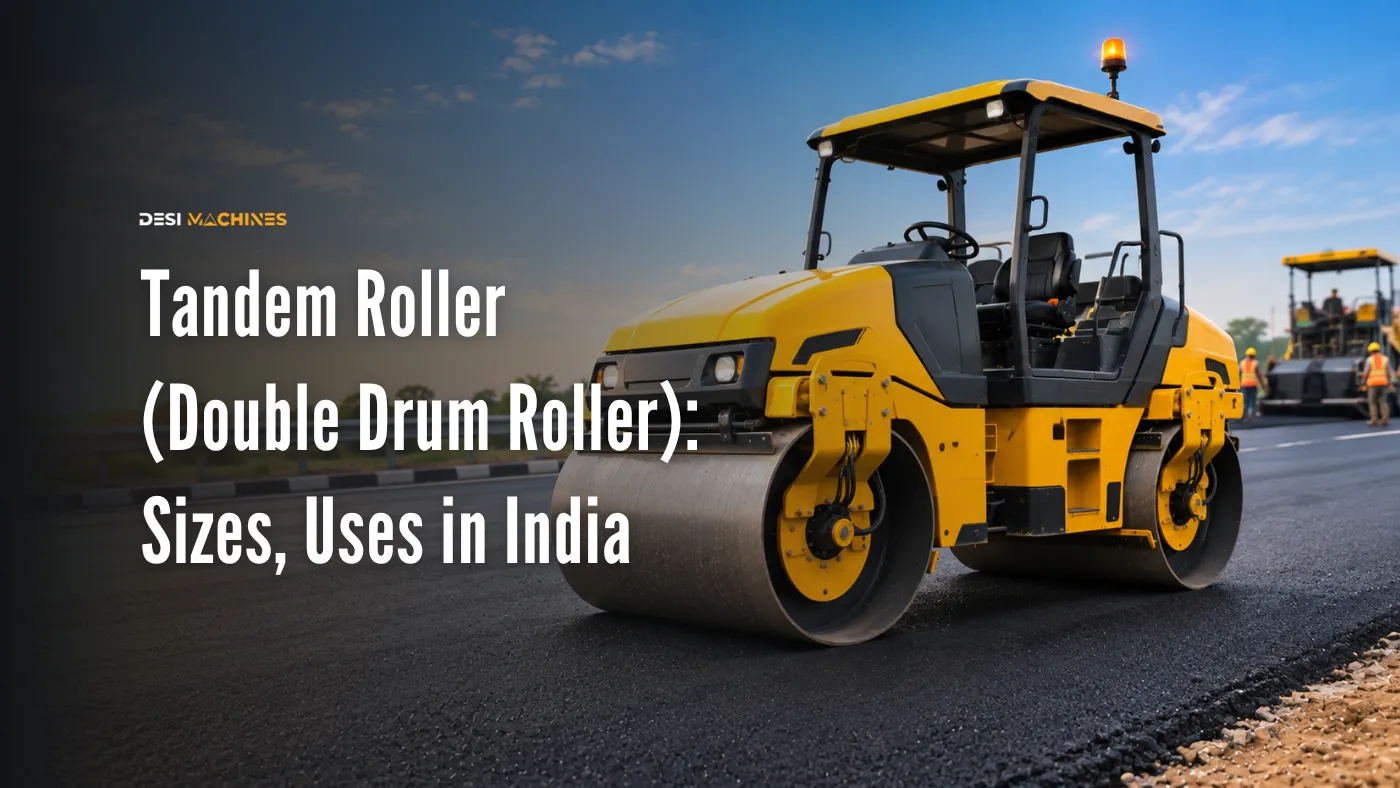
A tandem roller is a road roller with two smooth steel drums, one at the front and one at the back, which roll over the same strip of ground to press it flat and hard. Because it carries two drums instead of one drum and two rubber tyres, it is also called a double drum roller. It is the machine you see finishing a black-top road, working the hot bitumen until the surface is smooth enough to drive on. Which grade of bitumen is under the drum is decided before the roller arrives, from the site’s design air temperature, and the four Indian paving grades are set out in the guide to bitumen road construction.
In India these machines are sold in two clearly separated sizes: small ones of about 1,575 to 3,450 kg (1.6 to 3.5 Tonne) and full-size ones of about 8,700 to 10,060 kg (8.7 to 10.1 Tonne). There is almost nothing sold in between. This guide explains how the machine works, which size suits which job, how many passes a layer needs, and what each class costs.
What is a tandem roller, and why is it called a double drum roller?
A tandem roller is a self-propelled roller with a steel drum at each end, both of them driving the machine and both of them compacting. “Tandem” simply means one behind the other. Since both drums are smooth steel cylinders of the same width, the second name for the class is double drum roller.
That layout is what separates it from the other rollers on an Indian site. A soil compactor has one big drum in front and two rubber tyres at the back, so only the front half of the machine compacts. A pneumatic tyre roller has no drum at all and compacts through rows of rubber tyres. A tandem roller compacts with its whole footprint, front and rear, and leaves a smooth steel-finished surface behind it.
That smooth finish is the point. Steel drums do not leave tyre marks or push ridges into a soft bituminous layer, which is why the tandem is the machine that finishes roads. In the catalogue the class sits as its own family alongside soil and pneumatic rollers, and the types of compactors guide lays the whole family out side by side.
How does a tandem roller compact a road?
Two forces do the work. The first is plain dead weight: the mass of each drum pressing down on the surface. That is measured as static linear load, the kilograms pressing on each centimetre of drum width. On the small machines sold here it runs about 9.3 to 14.8 kg/cm; on the full-size machines it is roughly 25.8 to 30.9 kg/cm, which is why a big tandem does in three passes what a small one cannot finish in eight.
The second force is vibration. Inside each drum sits a heavy weight mounted off-centre on a spinning shaft. As that shaft turns, it throws the drum up and down hundreds of times a second. Two numbers describe the shaking. Amplitude is how far the drum moves each time, measured in millimetres. Frequency is how many times a second it moves, measured in Hertz (Hz).
Most tandem rollers give you a high and a low setting for both. The full-size machines here run roughly 0.35 to 1.3 mm of amplitude at 30 to 60 Hz; the small ones run about 0.4 to 0.6 mm at a faster 55 to 70 Hz. The rule of thumb on site is simple: high amplitude and low frequency for a thick layer you are trying to push down, low amplitude and high frequency for a thin finishing layer you are trying to close up and smooth. Using a heavy shake on a thin bituminous mat crushes the stone and shoves the surface around. The vibratory roller guide covers amplitude and frequency properly, and static vs vibratory rollers explains when to switch the vibration off entirely.
One part of a tandem roller that a first-time buyer overlooks is the water system. Hot bitumen sticks to dry steel and tears the new surface open. A sprinkler system keeps a thin film of water on both drums the whole time the machine is working, so the tank size decides how long you can roll before refilling. On these machines it runs from about 110 litres on the smallest roller up to 1,000 litres on the Ammann ARX 90.2. On a hot Rajasthan afternoon that difference is the difference between rolling all morning and stopping every hour for a tanker.
What sizes of tandem roller are sold in India?
Tandem rollers in India come in two size classes with a wide, empty gap between them. Small machines weigh 1.6 to 3.5 Tonne with a drum around 0.8 to 1.25 m wide. Full-size machines weigh 8.7 to 10.1 Tonne with a drum around 1.675 to 1.75 m wide. Almost nothing is sold between 3.5 and 8.7 Tonne, so in practice the size decision is a straight choice between the two classes rather than a sliding scale.
Table 1: Tandem rollers available in India, by operating weight (figures as per current August 2026 specifications)
Notice how little the engine matters inside the full-size class. Every full-size machine here sits between 73 and 75 HP, with the single exception of the 99 HP Dynapac CC425 T3 ROPS, which weighs the same 9,200 kg as its 74.5 HP sibling. The differences that count are drum width, amplitude settings and water capacity, not horsepower, because a roller does not need power to push earth the way a backhoe loader does. It needs weight and controlled shaking.
Tandem roller or soil compactor: which job needs which?
A soil compactor is for earth and stone; a tandem roller is for the finished surface on top of it. On a highway job the two work in sequence, not in competition.
The single drum soil compactor goes first, pressing the subgrade, the granular sub-base and the wet mix macadam (WMM, a compacted layer of graded stone) into a solid platform. Its drum is heavy and narrow enough to bite into loose mitti and stone. Then the bituminous layers go down, and the tandem roller takes over, because a smooth two-drum machine leaves a flat sealed surface where a single drum and two tyres would leave marks.
If you are choosing between the two for one machine that has to do everything, buy on the work that will fill most of your year. A contractor doing village roads, embankments and building foundations needs the soil compactor. A contractor laying black-top and doing repair overlays needs the tandem. The soil compactor guide sets the two side by side on specification and price.
Where is a tandem roller used on an Indian site?
The full-size 9 to 10 Tonne tandem is a highway and city road machine. It does the breakdown rolling right behind the paver on dense bituminous macadam (DBM) and bituminous concrete (BC) layers, then the finish rolling that closes the surface. On PMGSY village roads and municipal resurfacing contracts it is the standard machine for the final layer. It also does good work on WMM where a smooth, tight finish is wanted before the bitumen goes down. The gap between a PMGSY stretch and a new highway shows up in the road construction cost per km figures.
The small 1.6 to 3.5 Tonne tandem earns its money where the big machine cannot fit or cannot be justified. Footpaths, cycle tracks, parking areas, colony roads, factory yards, patch repairs, trench reinstatement after a pipeline or cable job, and the edges and corners of a bigger road where the full-size roller cannot reach the kerb. Municipal contractors and small road contractors buy this class far more often than the big one.
These small machines overlap with the walk-behind and ride-on mini roller or baby roller class, and the line between them is genuinely blurred. A 1.6 Tonne double drum machine is a mini tandem roller and a baby roller at the same time, depending on who is speaking.
Where a tandem roller is the wrong tool is deep earthwork. It has smooth drums and no tyres, so it has poor grip on a loose embankment and cannot climb a steep slope with any confidence. Tandem gradeability is published with the drum vibrating, at 25 to 45% against 26 to 53% for a single drum machine. It also compacts a much thinner layer than a heavy single drum machine. Spreading 300 mm of loose earth and expecting a tandem to settle it will leave the bottom half loose.
How many passes does a tandem roller need?
A pass is one trip of the drums over the same strip of ground. On a bituminous layer the honest answer is that the number comes from a test strip at the start of the job, not from a table, and the layer will usually take fewer passes than an equivalent thickness of soil.
What makes bitumen work different from soil work is that you are racing the temperature. A hot mat compacts easily; once it cools, the stone stops moving and further rolling only polishes the surface and can crack the aggregate. So the sequence matters more than the count. Roll the breakdown passes close behind the paver while the mat is hot, follow with the intermediate passes, and finish with the vibration switched off so the drums iron out the drum marks without shaking the surface loose again.
Three habits separate a good finish from a wasted load of bitumen:
Keep the drums wet. A dry drum lifts the new surface and tears it. Check the sprinklers and the water level before every stretch, not after the damage shows.
Never stop the roller on a hot mat. A standing drum sinks and leaves a dent you cannot roll out. Stop on cold, finished surface or off the mat entirely.
Reverse gently. Sharp starts, stops and turns on a hot layer shove the material sideways and open up cracks in the surface.
On highway and metro contracts the pass count and the rolling pattern are not left to the operator’s judgement. A test strip is rolled, the density is checked, and the pattern that achieved it becomes the rule for the rest of the layer.
What does a tandem roller cost in India?
The two size classes are also two price classes, and the gap between them is wide. A small 1.6 to 3.5 Tonne tandem roller runs roughly ₹12 Lakh to ₹20 Lakh (indicative, as of August 2026). A full-size 8.7 to 10.1 Tonne machine runs roughly ₹32 Lakh to ₹44 Lakh (indicative, as of August 2026).
Table 2: Indicative tandem roller prices in India (as of August 2026)
Within the full-size class the Indian brands sit at the lower end and the European brands at the upper, which is the same pattern as every other roller class. These are ex-factory figures. A tandem roller is a wheeled machine that gets registered, so the on-road cost adds transportation, RTO registration, TCS, warranty, insurance and FOC where applicable, and the final number varies by state.
Mini tandem roller or full-size: which one should you buy?
Buy the class that matches the width of the work you actually win, not the class that looks more capable in the yard.
The full-size 9 Tonne machine makes sense if you are laying bituminous layers behind a paver on roads wide enough to justify a 1.7 m drum, and if you have enough black-top work in a year to keep it busy. It is a productive machine on a wide road and an expensive machine standing idle. Under that black-top, geotextile and geogrid for roads keep soft subgrade from mixing into the granular layer.
The small 3 Tonne machine makes sense for municipal work, colony roads, footpaths, yards, patch repairs and trench reinstatement. It costs roughly a third of the big machine, it can be moved on a small trailer instead of a proper low-bed, and it fits into places the full-size roller cannot enter. For most first-time buyers doing local contracts, this is the honest choice.
Three practical points decide it in the end. First, drum width against the width of a typical strip you lay: a 0.8 to 1.25 m drum needs many more runs to cover a 7 m carriageway. Second, transport: a 9 Tonne machine needs a low-bed trailer and a permit for every shift between sites, and if your work is scattered across small sites that cost adds up fast. The road roller dimensions guide gives the length, width, height and ground clearance you will need for that conversation. Third, the water tank, because a 110 litre tank on a hot day means a refill every hour or two.
What to check before you buy your first tandem roller
Check the drum surface first. A steel drum that is dented, pitted or worn out of round will print its faults into every surface you roll, and re-machining or replacing a drum is expensive. Run your hand along it and sight down its length.
Check the water system properly, not casually. Ask to see the sprinklers running across the full drum width, look at the filters, and check the tank for rust and leaks. A blocked sprinkler bar is a common and irritating fault on a used machine, and it will tear a new bituminous surface.
Check that both vibration settings work. Switch between high and low amplitude and feel the difference through the machine. On many used rollers one setting has quietly failed, and a machine stuck on high amplitude is close to useless for finish rolling.
Check the emission norm on the machine you are quoted, since CEV Stage V compliance affects what you can legally run on public contracts. Ask about dealer support and parts in your district as well; a roller down for two weeks waiting for a part costs more than the price difference between two brands. For the mechanical side of the same machine, the guide to road roller parts and components covers the drum shell, the eccentric shaft sealed inside the drum and the hydrostatic drive.
If you are still weighing up machine types, road rollers explained covers the whole family, and soil compaction methods covers the earthwork side. Browse the full range of tandem rollers when you are ready to compare live listings and prices. Check the water tank size against how far your water source is from the job, since on these machines the water empties well before the diesel does; capacities by roller type are listed in the road roller fuel and water capacity guide.
Prices, specifications and features are indicative, vary by variant, location and date, and should always be confirmed with the official OEM or authorised dealer before any purchase decision. DesiMachines is not liable for decisions taken on the basis of information that may have changed after publication. Figures are taken from our listings at the time of writing.
A soil compactor has one big drum at the front and two rubber tyres at the back, and it is used on earth, granular sub-base and wet mix macadam. A tandem roller has two smooth steel drums and is used on the bituminous layers laid on top. On a highway job they work in sequence: the soil compactor builds the platform, and the tandem roller finishes the surface.
Ans.
From about 1,575 kg (1.6 Tonne) on the Dynapac CC800 up to about 10,060 kg (10.1 Tonne) on the HAMM HD 109i VV, as per current August 2026 specifications. The class splits into a 1.6 to 3.5 Tonne mini group and an 8.7 to 10.1 Tonne full-size group, with almost nothing sold in between the two.
Ans.
A mini tandem roller is a small double drum machine of roughly 1.6 to 3.5 Tonne with a drum about 0.8 to 1.25 m wide. On site people often call it a baby roller. It is used on footpaths, colony roads, parking areas, factory yards, patch repairs and trench reinstatement, and it costs roughly a third of what a full-size machine costs.
Ans.
The pass count comes from a test strip rolled at the start of the job, not from a table. What matters more than the count is temperature. Roll the breakdown passes close behind the paver while the mat is still hot, then finish with the vibration switched off. Rolling a mat that has already cooled only polishes the surface and can crack the aggregate.
Ans.
A small 1.6 to 3.5 Tonne tandem roller runs roughly Rs 12 Lakh to Rs 20 Lakh, and a full-size 8.7 to 10.1 Tonne machine roughly Rs 32 Lakh to Rs 44 Lakh (indicative, as of August 2026). These are ex-factory figures; the on-road cost adds transportation, RTO registration, TCS, warranty, insurance and FOC where applicable. Confirm the current figure with an authorised dealer.
Desi Machines is a platform where you can see and compare construction equipment. It showcases images, brochures, features, technical specifications, brand details & dealer information. All these are taken from respective brand websites, brochures, and other public resources. We do not claim ownership of these materials and strive to ensure their accuracy. However, the disparity may happen and we advise users to verify directly with respective brands and dealers. Desi Machines is not liable for any inaccuracies or reliance on the information provided. Use of this website is at your own discretion.

 Excavator
294 models
Excavator
294 models  Backhoe Loader
51 models
Backhoe Loader
51 models  Crane
68 models
Crane
68 models  Concrete Mixer
79 models
Concrete Mixer
79 models  Wheel Loader
54 models
Wheel Loader
54 models  Compactor / Roller
45 models
Compactor / Roller
45 models  Motor Grader
42 models
Motor Grader
42 models  Dozer
41 models
Dozer
41 models  Concrete Pump
66 models
Concrete Pump
66 models  Skid Steer Loader
11 models
Skid Steer Loader
11 models  Telehandler
13 models
Telehandler
13 models