Excavator
294 models
Excavator
294 models  Backhoe Loader
51 models
Backhoe Loader
51 models  Crane
68 models
Crane
68 models  Concrete Mixer
79 models
Concrete Mixer
79 models  Wheel Loader
54 models
Wheel Loader
54 models  Compactor / Roller
45 models
Compactor / Roller
45 models  Motor Grader
42 models
Motor Grader
42 models  Dozer
41 models
Dozer
41 models  Concrete Pump
66 models
Concrete Pump
66 models  Skid Steer Loader
11 models
Skid Steer Loader
11 models  Telehandler
13 models
Telehandler
13 models 


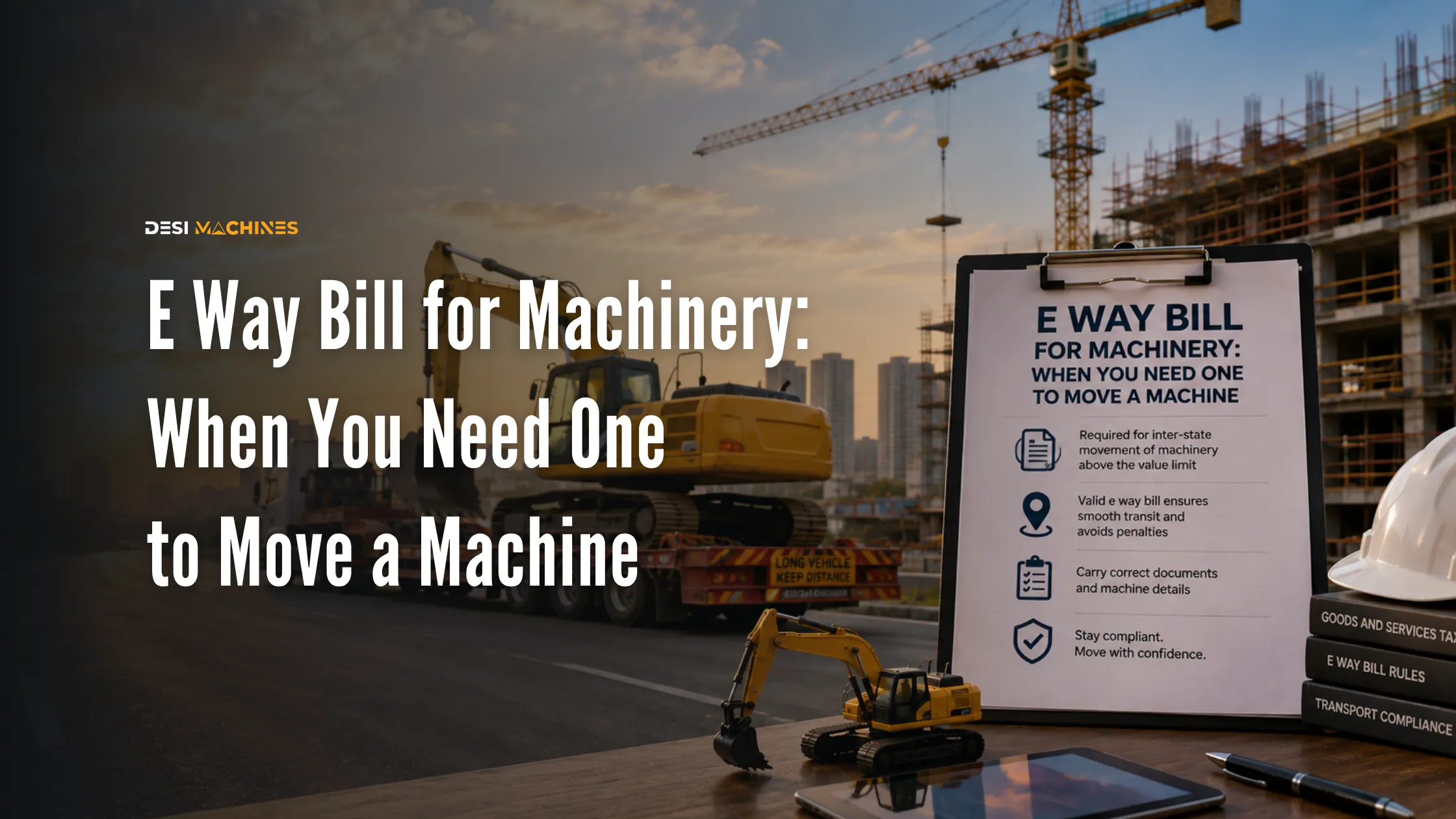
An e way bill for machinery is required where the consignment value exceeds ₹50,000 — and the rule is not limited to sales. Moving a machine for reasons other than supply, which is what shifting it between your own sites or sending it for repair is, sits inside the same rule. Where there is no sale there is no invoice, so the movement travels on a delivery challan instead. Validity runs at roughly one day per 200 km.
Most owners meet this rule in the least convenient way: a machine is stopped, the trailer driver has an invoice or nothing at all, and the person asking wants a document that was supposed to be generated before the movement started.
The confusion is nearly always the same. People read the rule as a sales rule. It is not. It is a movement rule, and three of the four things a machine owner does with a machine are movements without a sale.
What triggers an e way bill for machinery
Rule 138 of the Central Goods and Services Tax Rules, 2017 opens by saying that every registered person who causes movement of goods of consignment value exceeding fifty thousand rupees must furnish information about the goods in Part A of the prescribed form, electronically, before the commencement of such movement.
It then lists three occasions:
| The move | Which trigger it falls under | Document with the machine |
|---|---|---|
| You sell the machine to a buyer | In relation to a supply | Tax invoice |
| You shift it between your own sites | For reasons other than supply | Delivery challan under Rule 55 |
| You send it to a workshop for repair | For reasons other than supply | Delivery challan under Rule 55 |
| You buy from an unregistered seller | Inward supply from an unregistered person | As applicable to that purchase |
The second and third rows are where owners get caught, because nothing is being sold and it does not feel like a GST event. The rule does not ask whether money changed hands. It asks whether goods moved.
On value, Explanation 2 defines consignment value as the value determined under Section 15, declared in the invoice, bill of supply or delivery challan issued for that consignment, and it includes the central, state or union territory tax, integrated tax and cess charged in the document. For any working machine, that figure is going to clear ₹50,000 comfortably — which means for practical purposes the threshold filters out spare parts and consumables, not machines.
The two-part form, and who fills which half
The form has two parts, and the split explains most of the friction between an owner and a transporter.
Part A carries the details of the goods and is furnished by the registered person causing the movement. That is you.
Part B carries the conveyance details. Where you transport in your own conveyance, a hired one, or a public conveyance by road, you furnish Part B and generate the e-way bill. Where you hand the machine to a transporter for carriage by road and the bill has not already been generated, the rule moves the obligation along: you furnish Part A, and the transporter generates the e-way bill on the basis of what you furnished.
Two consequences follow. If you fill Part A and assume the transporter will finish the job, confirm that they did — the machine moves on their number, but the movement is yours. And if the machine is transhipped to another vehicle mid-journey, Part B has to be updated, which is a transporter’s task that has to actually happen rather than be assumed.
There are separate routes for movement by rail, air or vessel, where the information in Part B may be furnished either before or after the movement commences — with the notable condition that railways will not deliver the goods unless the e-way bill is produced at delivery.
How long it lasts, and the eight-hour window
Validity is set by distance, not by a fixed number of days:
| Distance | Validity (other than over dimensional cargo) |
|---|---|
| Up to 200 km | One day |
| Every 200 km or part thereafter | One additional day |
Over dimensional cargo runs on its own, shorter distance bands. That matters here more than it does for most goods, because a large machine on a trailer is frequently over dimensional in its own right — which brings its own permit question, covered in the over-dimensional cargo permit.
Two reliefs are built in. Where goods cannot be moved within the validity period because of an exceptional circumstance, including transhipment, the transporter may extend the validity after updating the details. And the validity may be extended within eight hours of its expiry — a genuinely useful provision when a machine is stuck at a check post or a breakdown eats a day.
One more line saves an argument at a state border: an e-way bill generated under this rule, or under the corresponding rule of any State or Union Territory, is valid in every State and Union Territory. You do not generate a fresh one per state. If the movement is a purchase from a dealer in another state, the same document sits inside a longer checklist — see buying heavy machinery across states for the invoice, permit and service-network questions that travel with it.
What is exempt, and what is not
The rule carries a long list of cases where no e-way bill is required. Most of it is irrelevant to a machine owner: goods moved by non-motorised conveyance, customs-bonded movements, empty cargo containers, transit cargo to Nepal or Bhutan, movement caused by a defence formation, specified exempt goods.
What is worth noticing is what the list does not contain. There is no exemption for construction machinery, none for capital goods, and none for a machine you already own moving to a site you already work on.
There is one entry with a peculiar relevance to this industry. High speed diesel, petrol, petroleum crude, natural gas and aviation turbine fuel are outside the rule. So the fuel is exempt and the machine that burns it is not.
The state-level catch
The central rule is the floor, not the whole picture. The exemptions include movement of goods within areas notified under the corresponding provision of the State or Union Territory GST Rules, and states have taken different positions on movement inside the state — different thresholds, and in some cases notified areas where no bill is needed at all.
So the ₹50,000 test is safe to rely on for inter-state movement, and is the starting point rather than the answer for movement within your own state. Confirm your state’s notification with your accountant before you build a practice around a number. This is the same care we take with the input credit question in GST input credit on a construction machine.
Getting it right on a hire movement
Putting a machine on hire is where the paperwork most often goes wrong, because two different things are happening. The service is the hire. The movement is the machine physically going to the customer’s site and coming back.
The machine is not being sold, so the movement is for reasons other than supply and travels on a delivery challan, both ways. Owners commonly document the outbound leg and forget the return, which is the leg that tends to be stopped, because a machine coming back on an empty-looking trailer attracts more questions than one going out.
Build the challan into the hire process rather than the transport process, and keep it with the hire documentation. What that documentation should contain in the first place is set out in the equipment rental agreement, and what the movement itself costs is in excavator transport cost.
If a move has already gone wrong and the machine is standing detained, the amount at stake is set by section 129 of the CGST Act; we have set out the current figures and the release route in e-way bill penalty and detention.
Generate the e-way bill for every machine movement
Treat every machine movement as a documented movement, not just the ones where money changes hands. Sale, site shift, workshop trip, hire out and hire back — four movements, one rule, and only the first has an invoice attached.
The cheapest habit here is to generate the bill even when you think you are under the line. The rule expressly permits it, it costs nothing, and it removes the argument entirely. A machine detained at a check post costs a day of hire and a day of goodwill, and neither is recoverable — the same arithmetic as any other idle day, which we work through in the cost of equipment downtime.
If these movements are frequent enough to be a real cost, the question is whether the work justifies a machine stationed closer to it. Compare excavator models and prices and backhoe loaders, and connect with a dealer before committing.
Rates, schemes, specifications and prices change — confirm current terms with the OEM, dealer, bank or insurer before deciding. The position here is summarised from Rule 138 of the Central Goods and Services Tax Rules, 2017 as it stood at the time of writing; state notifications differ and tax positions turn on facts, so confirm yours with a qualified professional.