
 Excavator
294 models
Excavator
294 models  Backhoe Loader
51 models
Backhoe Loader
51 models  Crane
68 models
Crane
68 models  Concrete Mixer
79 models
Concrete Mixer
79 models  Wheel Loader
54 models
Wheel Loader
54 models  Compactor / Roller
45 models
Compactor / Roller
45 models  Motor Grader
42 models
Motor Grader
42 models  Dozer
41 models
Dozer
41 models  Concrete Pump
66 models
Concrete Pump
66 models  Skid Steer Loader
11 models
Skid Steer Loader
11 models  Telehandler
13 models
Telehandler
13 models 


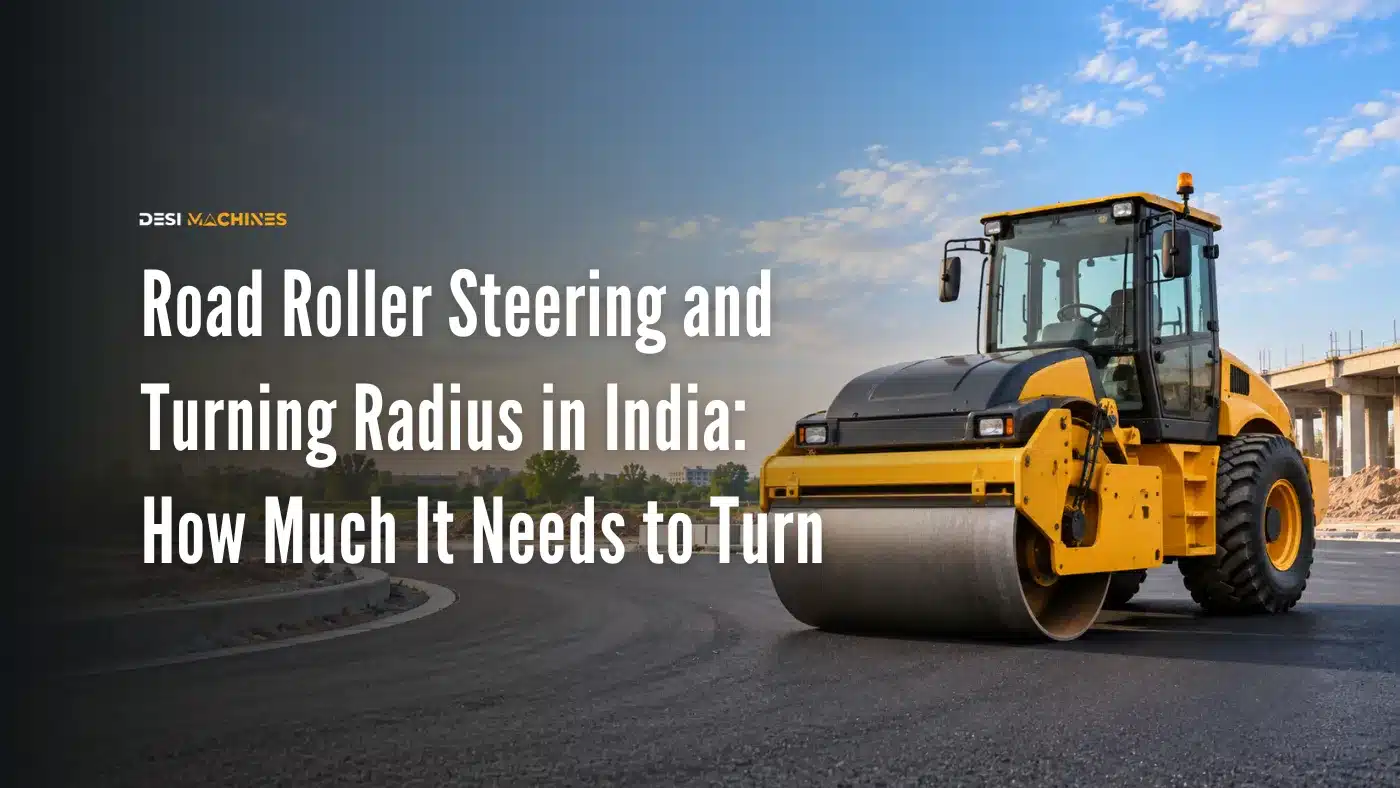
Road roller steering on almost every machine sold in India works by bending the roller in the middle rather than by turning its wheels. The front half carries the drum, the rear half carries the engine and the wheels, and a joint between them lets the two halves swing apart. That joint is what sets the turning radius, which is the amount of ground the machine needs to get round a bend.
This matters more on a roller than on most machines. A roller works on a strip, so if it cannot follow the bend, the bend does not get compacted, and that is exactly where a new road starts to break up first.
This guide uses the published steering and turning figures of the 45 compactors listed on DesiMachines: 21 single drum soil compactors, 20 tandem rollers and 4 pneumatic tyre rollers. It gives you the steering angle, the oscillation figure, both turning radius figures and, most usefully, what the gap between those two radius figures is actually telling you.
How does a road roller steer?
It steers by articulating, which means the machine hinges in the middle so the front and rear halves point in different directions. There is no steering rack turning a pair of wheels the way a car or a backhoe loader does. The operator turns a wheel, oil is pushed into two rams either side of the centre joint, one ram pushes and the other pulls, and the whole front of the machine swings across.
The reason is the drum. If the front wheels turned and the drum stayed square to the frame, the drum would be dragged sideways across a fresh layer and would tear it. Bending the machine at the waist keeps the drum rolling straight along its own path the whole way round the bend.
All 45 machines publish a steering type, but they do not all answer the same question. Twenty of them name the joint, with wording like articulated frame steering, centre point articulation or servo assisted centre articulation. The other twenty five name only what powers the steering, with wording like hydrostatic, gear pump or hydraulic power assisted. That is worth knowing when you read a spec sheet: “gear pump” is telling you about the oil supply, not about the geometry, and a machine listed that way is still an articulated machine.
The one group that behaves differently is the pneumatic tyre roller. It has no drum and it runs two rows of rubber tyres, so it is built more like a truck. Of the four listed, only one names articulated steering outright and three publish no steering angle at all. The pneumatic tyre roller guide covers how that machine works.
What is the steering angle on a road roller?
Steering angle is how far the machine can bend at the centre joint, measured in degrees each side of straight, and on the rollers listed here it runs from 27 degrees to 40 degrees. It is written on a spec sheet with a plus or minus sign, so an entry of plus or minus 35 degrees means the machine can swing 35 degrees left or 35 degrees right of straight ahead.
Forty two of the 45 machines publish it.
Table 1: Published steering angle and oscillation, by roller type
| Roller type | Machines publishing steering angle | Steering angle range | Machines publishing oscillation | Oscillation range |
|---|---|---|---|---|
| Single drum soil compactor | 21 of 21 | ±33° to ±40° | 20 of 21 | ±9° to ±17° |
| Tandem roller (both sizes) | 20 of 20 | ±27° to ±40° | 20 of 20 | ±6° to ±13° |
| Pneumatic tyre roller | 1 of 4 | ±32° | 1 of 4 | ±4° |
The useful finding here is that the angle has nothing to do with the size of the machine. The smallest roller listed, the Dynapac CC800 at 1,575 kg (1.6 tonne), bends to plus or minus 34 degrees. The heaviest, the SANY SSR220C-8H at 22,000 kg (22 tonne), bends to plus or minus 35 degrees. The widest angle on the whole list, plus or minus 40 degrees, is shared by the 3,450 kg L&T 491 mini tandem and the 11,150 kg Volvo SD110 soil compactor. The narrowest, plus or minus 27 degrees, belongs to the 2,900 kg CASE 450NX.
So a bigger roller is not a clumsier roller because of its joint. What makes a big roller harder to turn is its length, and length is a separate figure covered in the road roller dimensions guide.
What does oscillation mean on a road roller spec sheet?
Oscillation is the small twist the centre joint allows, so that the front and rear halves of the machine can roll a little independently of each other. It is published in degrees each side, and on these machines it runs from 4 degrees to 17 degrees.
Picture the machine crossing a stone with one rear wheel. Without oscillation, the whole frame would tilt and one edge of the drum would lift off the ground, leaving a strip that never got pressed. With oscillation, the rear half tilts over the stone and the front half stays flat, so the drum keeps full contact for its whole width. The road roller parts guide explains where that joint sits in the machine.
Soil compactors get the most twist, 9 to 17 degrees, because they work on rough, unfinished earth. Tandem rollers get 6 to 13 degrees, because they mostly work on ground that has already been shaped. It is a small number that is easy to skip past, and on village roads and embankments it is one of the figures that decides whether the finish is even.
Compare live road roller models and prices and speak to a dealer about the exact machine you are considering.
What is the turning radius of a road roller?
Turning radius is the distance from the centre of the turn to the machine as it goes round, and rollers publish two of them: an inside figure and an outside figure. The inside radius is to the near edge of the drum’s path, and the outside radius is to the far edge of it.
Thirty three of the 45 machines publish an inside radius and 26 publish an outside radius, so this is the thinnest of the four figures here. The ranges below leave out five machines whose figures do not sit with the rest of their class, and all five are named further down.
Table 2: Published turning radius by roller type (machines counted after exclusions)
| Roller type | Inside turning radius | Outside turning radius |
|---|---|---|
| Single drum soil compactor | 3,250 to 4,260 mm (3.3 to 4.3 m), 15 machines | 5,500 to 6,750 mm (5.5 to 6.8 m), 11 machines |
| Mini tandem roller, up to 3,450 kg | 2,300 to 3,320 mm (2.3 to 3.3 m), 6 machines | 2,650 to 4,142 mm (2.7 to 4.1 m), 5 machines |
| Full size tandem roller, 8,700 to 10,060 kg | 4,151 to 5,900 mm (4.2 to 5.9 m), 8 machines | 6,475 to 7,285 mm (6.5 to 7.3 m), 4 machines |
| Pneumatic tyre roller | 5,420 and 6,800 mm, 2 machines | 8,630 and 9,000 mm, 2 machines |
Read the tandem row carefully, because it is the one that changes a buying decision. A mini tandem such as the 3,300 kg JCB VMT330 turns inside a 2,326 mm radius, and the 3,450 kg L&T 491 inside 2,300 mm. A full size tandem of the same shape needs 4,151 mm at the tightest and 5,900 mm at the widest. That is roughly double, for a machine that looks like the same thing with a bigger drum. If your work is lanes, colony roads, footpaths and patch repairs, the small machine is not just cheaper to run, it physically reaches corners the big one cannot. The mini roller guide and the tandem roller guide go through the rest of that comparison.
The pneumatic tyre roller is the least manoeuvrable machine on the list, and its own figures say so: the two that publish an inside radius need 5,420 mm and 6,800 mm, more than any soil compactor listed.
Why are two turning radius figures published, and what is the gap between them?
The gap between the outside and the inside radius is the width of the strip the drum presses as it goes round. That is not a rule of thumb. It is what the catalogue figures themselves show.
Sixteen drum machines publish both radii. On fourteen of them, the outside figure minus the inside figure comes to the machine’s own drum width, to within 90 mm.
Table 3: Outside radius minus inside radius, against the machine’s own drum width
| Machine | Inside radius | Outside radius | Difference | Drum width |
|---|---|---|---|---|
| Dynapac CA245 CEV-V (soil, 9,700 kg) | 3,385 mm | 5,515 mm | 2,130 mm | 2,130 mm |
| Escorts EC 5250 (soil, 10,350 kg) | 3,370 mm | 5,500 mm | 2,130 mm | 2,130 mm |
| ACE ASD 115 (soil, 11,000 kg) | 3,950 mm | 6,050 mm | 2,100 mm | 2,130 mm |
| Volvo DD90 (tandem, 8,700 kg) | 5,605 mm | 7,285 mm | 1,680 mm | 1,676 mm |
| Escorts HD 85 PLUS (tandem, 9,120 kg) | 4,750 mm | 6,475 mm | 1,725 mm | 1,680 mm |
| Dynapac CC125 CEV-V (mini tandem, 2,800 kg) | 2,900 mm | 4,100 mm | 1,200 mm | 1,200 mm |
Six examples are shown; the pattern holds on fourteen of the sixteen machines that publish both figures.
Two things follow from that, and both are useful on site.
First, the outside radius is the number to hold against your road. If a soil compactor needs 5,500 to 6,750 mm to the outer edge of its drum path, you need at least that much clear ground measured from wherever the machine is pivoting. The body of a single drum machine is a little wider than its drum, by roughly 110 to 280 mm on the machines listed here, so leave a small margin beyond the published figure rather than treating it as exact.
Second, and this is the part people learn the hard way, nothing inside the inside radius gets compacted. On a tight bend the drum simply never reaches the inner kerb line. A soil compactor leaves a strip 3.3 to 4.3 m across untouched in the middle of its own turn. That corner has to be finished with something small, which in practice means a baby roller or a plate compactor, and it should be in your plan before the layer is laid, not after the engineer rejects the density test.
How much room does a roller need on an Indian site?
Work from the outside radius, then check the machine’s length separately.
For a full turn the machine sweeps a circle, and that circle is twice the outside radius across. A mini tandem at 2,650 to 4,142 mm sweeps a circle of roughly 5.3 to 8.3 m. A soil compactor at 5,500 to 6,750 mm sweeps roughly 11 to 13.5 m. A pneumatic tyre roller at 8,630 to 9,000 mm sweeps roughly 17 to 18 m, which is why it belongs on highway work and not in a colony.
Set that against the job. A village road or a PMGSY link road built to a 3.75 m carriageway does not let a soil compactor turn on the road itself. It turns at a junction, in a field entrance or on the shoulder, and if there is no such place along a stretch, the machine reverses. Rollers work forward and backward equally well, so reversing is normal practice rather than a problem, but it costs time and the output per hour figures assume you are moving.
Two more checks belong with this one. The machine’s length and wheelbase decide whether it can make a right angle turn from a lane into a narrower gate, and those figures are in the road roller dimensions and transport guide. Travel speed and gradeability decide whether it can climb out of the place you turned it around in, and those are in the road roller speed guide.
A note on the figures in this guide
Five machines were left out of the turning radius ranges above. They are named here rather than dropped quietly, because if you are looking at one of them you should know what its spec sheet says.
CASE 1107NX publishes an inside radius larger than its outside radius. Both spec stores on the product page agree, so this is not a reading error at our end, but the two figures contradict each other and neither has been used. It has been raised for checking with the catalogue.
JCB VM117 publishes an inside and an outside radius only 70 mm apart, on a machine with a 2,100 mm drum. Every other machine that publishes both shows a gap equal to its drum width, so this pair has been left out of both the range and the drum width comparison.
SANY SSR110C-10 PRO, SANY SSR220C-8H and SANY SPR260C-10 PRO publish outside radius figures of 11,700 mm, 12,350 mm and 18,500 mm. Each is close to exactly twice the figure published by comparable machines on the same list, which usually means a different measurement is being quoted under the same label. Rather than guess which one, all three are left out of the range and flagged for checking.
Two more honest gaps are worth stating. Twelve machines publish no inside radius and nineteen publish no outside radius, so the ranges here describe the machines that publish, not the whole class. And three of the four pneumatic tyre rollers publish no steering angle or oscillation figure at all.
Where a figure you need is not published, ask the dealer for the machine’s own dimension drawing before you commit. Every figure here is taken from the specifications published on our own listings for these machines at the time of writing.
Road roller steering and turning radius: the short version
Four figures describe road roller steering on a spec sheet: the steering type, the steering angle, the oscillation and the two turning radii.
A roller steers by bending in the middle, not by turning its wheels, and the bend is worth 27 to 40 degrees each side on the machines listed here. The angle does not grow or shrink with machine size, so do not read a big machine’s spec sheet expecting a worse figure.
Oscillation, 4 to 17 degrees, is the twist that keeps the drum flat when one wheel rides over a stone. Soil compactors get more of it than tandem rollers because they work on rougher ground.
The two turning radius figures bracket the strip the drum presses, and the gap between them is the drum width. Use the outside figure to check whether the machine fits your turn, and remember that everything inside the inside figure needs a smaller machine to finish it.
If your work is lanes and colony roads, the inside radius is the single figure that should decide between a mini tandem and a full size one: roughly 2.3 to 3.3 m against 4.2 to 5.9 m. The compactor buying guide puts that alongside the other choices, and the soil compactor guide covers the single drum machines in full.
Ready to shortlist? Browse live soil compactors and tandem rollers with current specifications, or start from the full compactor guide.
Read next
Turning is one of several figures that decide where a machine can work. Road roller dimensions covers width, height and ground clearance, fuel and water tank capacity covers how long it runs between fills, and road roller parts and components explains the articulation joint and the rest of the machine.
For the same question on other machines, see backhoe loader dimensions and turning circle and hydra crane turning radius and size.
Prices, specifications and features are indicative, vary by variant, location and date, and should always be confirmed with the official OEM or authorised dealer before any purchase decision. DesiMachines is not liable for decisions taken on the basis of information that may have changed after publication.