
 Excavator
294 models
Excavator
294 models  Backhoe Loader
51 models
Backhoe Loader
51 models  Crane
68 models
Crane
68 models  Concrete Mixer
79 models
Concrete Mixer
79 models  Wheel Loader
54 models
Wheel Loader
54 models  Compactor / Roller
45 models
Compactor / Roller
45 models  Motor Grader
42 models
Motor Grader
42 models 
 Concrete Pump
66 models
Concrete Pump
66 models  Skid Steer Loader
11 models
Skid Steer Loader
11 models 


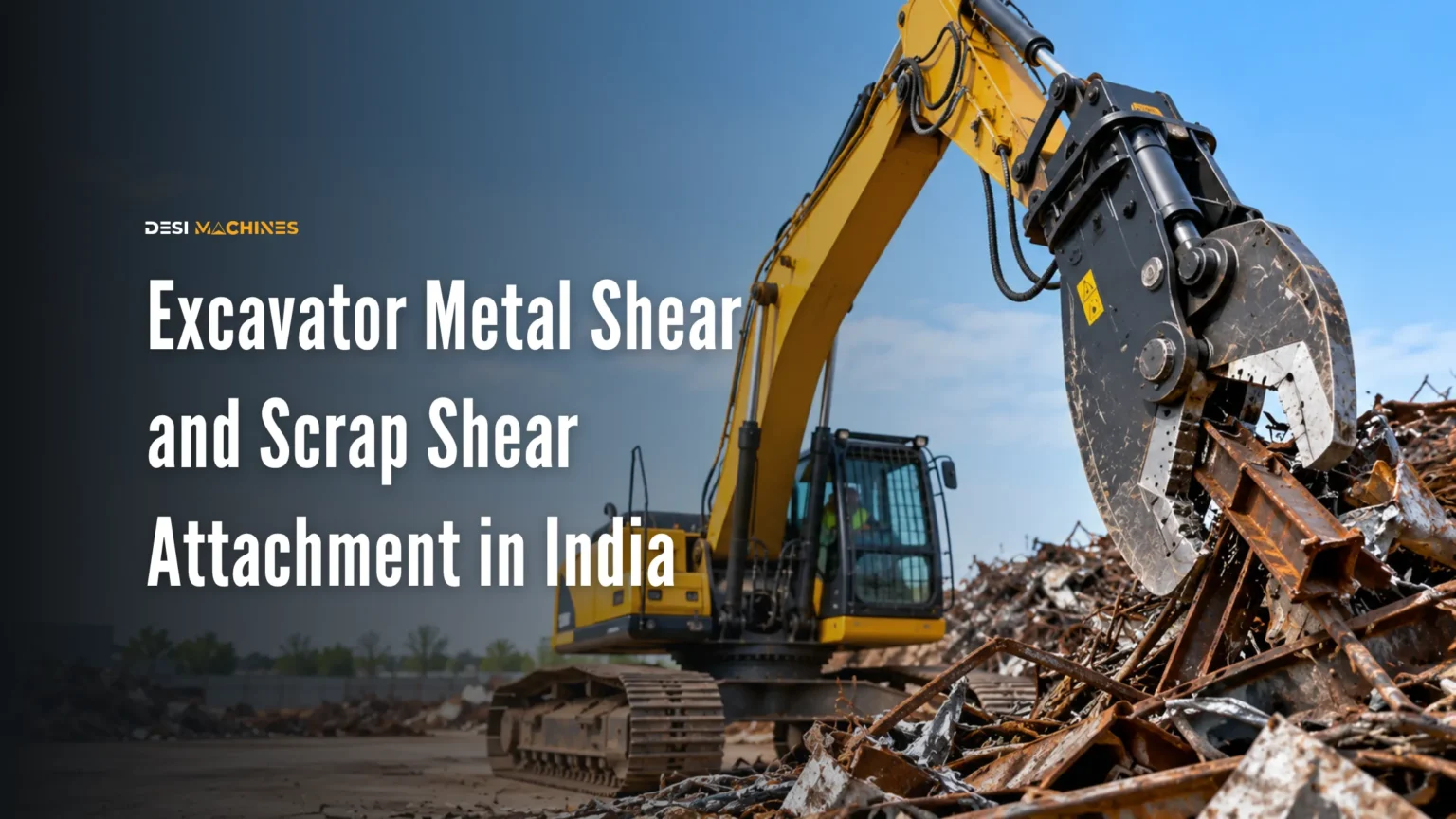
An excavator metal shear is a hydraulic attachment that replaces the bucket and cuts steel. It has two jaws — one fixed jaw carrying a cutting blade, one moving jaw driven by a large hydraulic cylinder — and it cuts by shearing, sliding one hardened edge past another, the way a pair of scissors cuts paper. A scrap shear is the same tool used mainly on scrap steel rather than on buildings. It lets one excavator cut beams, plate, pipe, car bodies and ship steel down to sizes that fit a furnace or a truck, without gas cutting and without a team of men with torches.
This guide explains what the tool does, what size machine carries one, what your excavator needs to run it, and what to check before you buy or hire. Every machine weight quoted here is taken from the excavators we list, so the sizing advice matches machines you can actually buy in India.
How does a hydraulic metal shear work?
A metal shear works by closing one blade past another with enormous force, so the steel between them fails in shear rather than being crushed or torn. The moving jaw is pushed by a single large hydraulic cylinder fed from the excavator’s own hydraulic system. The operator opens the jaw, places the steel in the throat, and closes it. The cut takes a few seconds.
Three parts of the tool decide what it can do:
- The blades. These are the wear parts. They are bolted-on blocks of hardened steel, usually square or rectangular so that each block has four usable cutting edges. When one edge goes blunt, the block is unbolted, turned to a fresh edge and refitted. When all the edges are used, the block is replaced. Blade condition, not engine power, is what decides whether a shear cuts cleanly or chews.
- The throat. This is the gap between the jaws — how wide it opens and how deep the steel can sit. The throat sets the biggest section you can take in one bite. A beam that does not fit the throat has to be cut in stages from the flange inward.
- The cylinder. One cylinder does all the work, and it is large in relation to the tool. This is why a shear feels slow compared with a rock breaker: it is a squeezing tool, not a hammering one.
Shear (attachment) here means the tool on the end of the arm. It is not the same as shear force, which is a way of describing loads in engineering. If you want to understand the forces the machine itself produces at the bucket, that is covered in our guide to excavator digging force and how it is measured.
Metal shear, rock breaker or pulveriser — which tool cuts what?
These three attachments look related and do quite different jobs. Choosing the wrong one is the most common and most expensive mistake on a demolition or scrap job.
| Attachment | What it is good at | What it is bad at | How it works |
|---|---|---|---|
| Metal shear | Steel beams, plate, pipe, car bodies, ship sections, rebar | Mass concrete, rock | Cuts by sliding one blade past another |
| Rock breaker (hammer) | Rock, mass concrete, foundations, road slab | Steel — it bends and springs, it does not break | Hammers a chisel repeatedly |
| Concrete pulveriser | Reinforced concrete: crushes concrete off, leaves rebar | Thick structural steel | Crushes between toothed jaws |
| Grapple | Picking up and sorting cut material | Cutting anything | Grips and lifts |
On a real demolition of a reinforced concrete building, two or three of these get used in sequence: a breaker or pulveriser takes the concrete off, and the shear then cuts the exposed reinforcement and any steel framing into liftable lengths. Our separate guides cover the hydraulic rock breaker and how to size one and the compaction wheel for trench work. The full family of tools that fit an excavator arm is set out in the guide to excavator attachments and what each one is for.
One point worth being clear about: a rock breaker will not cut steel. Buyers who own a breaker often try it on a steel section first, because it is the attachment already sitting in the yard. The chisel bends the steel and slides off it, and the wasted hours cost more than hiring the right tool would have.
What size excavator do you need for a metal shear?
A metal shear is matched to the carrier’s operating weight — the total working weight of the excavator with its standard bucket, operator and full tanks. A shear is heavy and dense for its size, much heavier than the bucket it replaces, so it asks more of the machine than a bucket does at the same reach. Too big a shear on too small a machine makes the excavator front-heavy and unstable; too small a shear on a big machine simply cannot bite the sections that machine was brought in to handle.
Dealers quote a shear model against a carrier weight range rather than against a brand or a model name, so the useful number to give a dealer is your machine’s operating weight in kilograms. Here is what the excavators we list actually weigh, so you can place your own machine:
| Carrier band | Machines we list | Operating weight span | Example machine | Typical shear work |
|---|---|---|---|---|
| Mini | 50 | 1,800–5,780 kg (1.8–5.8 Ton) | JCB 55Z, 5,642 kg | Light sheet, thin pipe, indoor strip-out |
| 7–15 Ton | 48 | 7,050–14,700 kg (7.1–14.7 Ton) | Tata Hitachi EX 70 Prime, 7,200 kg | Light structural steel, small scrap yards |
| 15–25 Ton | 83 | 19,300–24,600 kg (19.3–24.6 Ton) | Tata Hitachi EX 210 Infra Super+ Series, 20,300 kg | The common scrap and demolition carrier in India |
| 25–50 Ton | 52 | 25,400–49,500 kg (25.4–49.5 Ton) | SANY SY500C-10HD, 49,500 kg | Heavy beams, thick plate, ship sections |
| Over 50 Ton | 60 | 50,000 kg and above (50 Ton and above) | Tata Hitachi EX 1200V, 109,000 kg | Dedicated scrap handling and ship recycling |
The 15 to 25 Ton band is where most Indian shear work sits, and it is also the deepest part of our range at 83 machines. Machines such as the SANY SY210C-9 at 20,900 kg (20.9 Ton) and the JCB NXT 205 at 20,500 kg (20.5 Ton) sit squarely in it. If you are still choosing the machine, start with our guide to excavator size classes in India, and if the work is small and indoors, read the mini excavator guide first.
Which machines a scrap yard, a metal recycling plant or a ship recycling plot runs on, and where that work sits in India, is covered under scrap handling equipment.
Two cautions on weight. First, a shear changes where the machine’s weight sits, so check the lift capacity at the reach you actually work at, not just the machine’s headline weight. Second, a heavier front tool makes tail swing and machine footprint matter more in a tight yard; the numbers for that are in our guide to excavator dimensions and tail swing.
What hydraulic connections does an excavator metal shear need?
A shear runs off the excavator’s auxiliary hydraulic circuit, the spare oil line run out along the boom and arm for attachments. If your machine has never carried an attachment, that line and its control may not be fitted, and fitting it is a dealer job, not a site job.
Three things have to match, and all three are the dealer’s to confirm in writing against the specific shear:
- Oil flow, measured in litres per minute. This sets how fast the jaw closes. Too little flow and every cut is slow, which is what makes an underfed shear feel useless.
- Circuit pressure, measured in bar or MPa. This sets how hard the jaw closes, and therefore what thickness of steel the tool will actually cut.
- Piping and control. A shear that rotates needs a second line for the rotation motor and a control for it in the cab.
You do not have to guess at any of this. Every excavator publishes its own pump flow and implement-circuit pressure on its specification sheet, and those two figures are what a dealer needs from you before quoting a shear. Our guide to reading an excavator spec sheet shows where each number sits and what it means, and the guide to excavator parts and hydraulics explains how the implement circuit feeds the front tools.
Ask for the shear’s required flow and pressure range as a written figure, and put it beside your own machine’s published figures before you commit. A tool that needs more oil than your machine makes will not improve with use.
Where does a metal shear earn its money in India?
A metal shear pays for itself where steel has to be reduced in size, repeatedly, in volume. Four settings account for most of the work in India.
Scrap yards and steel recycling. Furnaces and re-rolling mills buy scrap in specified sizes, and long or bulky steel has to be cut down before it is worth anything to them. A shear does in seconds what a gas cutter does in minutes, without consumables and without the fire risk of open flame in a yard full of oil-soaked material.
Ship recycling. Alang in Gujarat is India’s main ship-recycling centre, and cutting steel down from hull sections to furnace-sized pieces is the core activity there. This is heavy, continuous work and it sits at the top of the carrier range.
Demolition of steel structures. Factory sheds, warehouses, godowns and industrial frames are steel, and a shear cuts columns and trusses into lengths a truck can take away. It also lets material come down in a controlled way rather than being pulled over.
Vehicle and equipment scrapping. Registered vehicle scrapping facilities have been coming up across the country, and a shear is the tool that reduces a body shell to sorted, transportable steel.
The common thread is transport cost. Uncut steel is mostly air on a truck, so the value of the tool often shows up in fewer trips rather than in the cutting itself. That is the calculation worth doing before you buy: how many truckloads does cutting save you in a month.
What does an excavator metal shear cost in India?
There are two separate costs and buyers regularly mix them up.
The shear itself is bought from an attachment dealer and is quoted on request. The figure depends on the shear class, whether it rotates, and the brand, and it is not something we list, so ask a dealer for a current written quote rather than working from a number found online. Prices for this kind of tool move with steel prices and with the exchange rate, and an old quote is not a guide to a current one.
The carrier machine is the larger cost, and it is a machine that keeps earning with or without the shear. You can see current prices for the machines named above on their own pages, and browse the full range of excavators and prices to compare classes. Most buyers do not pay for a carrier outright; our guide to equipment finance in India explains how excavator loans and monthly instalments work.
There is a third cost that is easy to forget and worth budgeting for: blades. Blades are consumable. On steady scrap work they are turned and eventually replaced on a schedule, and a shear used on dirty or reinforced material eats them faster. Ask the dealer for the blade cost and the expected life in tonnes before you sign anything — that number, not the purchase price, is what decides whether the tool makes money over a year.
Hiring is the sensible first move if the work is a single job rather than a steady line of business. A shear plus carrier can be hired together, and one job will tell you more about whether you need to own one than any calculation will.
What should you check before buying or hiring a metal shear?
Run through this before money changes hands:
- Carrier weight match, in writing. Give the dealer your machine’s operating weight in kilograms and get back the shear model rated for it. Do not accept a match made on the model name alone.
- Blade condition. On a used or hired tool, look at all the cutting edges. Rounded, chipped or cracked edges mean the tool will chew rather than cut, and blades are the expensive part.
- Jaw play and pivot wear. The blades have to pass each other closely. A worn main pivot lets the jaws spread under load, and a shear with sloppy jaws will never cut cleanly however good the blades are.
- Cylinder and hoses. Look for weeping seals, scored rod surfaces and chafed hoses. A shear cylinder works at high pressure and is not a cheap repair.
- Cab protection. Cutting steel throws fragments. The carrier should have front screen guarding suited to demolition work before the tool is put to work.
- Auxiliary circuit fitted and tested. Confirm the line, valve and cab control exist and work, not just that the machine “can take an attachment”.
- Blade supply. Check that replacement blades for that exact model are available in India and ask what the lead time is. An orphan tool with no blade supply is scrap itself.
- Operator briefing. A shear rewards patience — positioning the section properly in the throat and letting the tool do the work. An operator used to a bucket will try to cut at the jaw tips, which damages blades quickly.
Excavator metal shears, in short
An excavator metal shear is the right tool when the job is cutting steel in volume, and it is the wrong tool for concrete or rock. It is sized to the carrier’s operating weight, it needs an auxiliary hydraulic circuit with enough flow and pressure to feed it, and its running cost sits mainly in blades rather than in fuel. The 15 to 25 Ton class is where most Indian shear work happens and where our range is deepest, at 83 machines.
If you are choosing a carrier first, compare classes in the guide to types of excavators and what each is used for, then browse live excavator models and prices and ask our team about attachment options for the machine you pick. If the tool you actually need turns out to be for concrete rather than steel, start instead with the excavator bucket types guide.
Specifications and machine weights quoted here are taken from our listings at the time of writing. Prices, specifications and features are indicative, vary by variant, location and date, and should always be confirmed with the official OEM or authorised dealer before any purchase decision. DesiMachines is not liable for decisions taken on the basis of information that may have changed after publication.
Machines, tenders and news for this industry: Demolition