
 Excavator
294 models
Excavator
294 models  Backhoe Loader
51 models
Backhoe Loader
51 models  Crane
68 models
Crane
68 models  Concrete Mixer
79 models
Concrete Mixer
79 models  Wheel Loader
54 models
Wheel Loader
54 models  Compactor / Roller
45 models
Compactor / Roller
45 models  Motor Grader
42 models
Motor Grader
42 models  Concrete Pump
66 models
Concrete Pump
66 models  Skid Steer Loader
11 models
Skid Steer Loader
11 models  Telehandler
13 models
Telehandler
13 models 


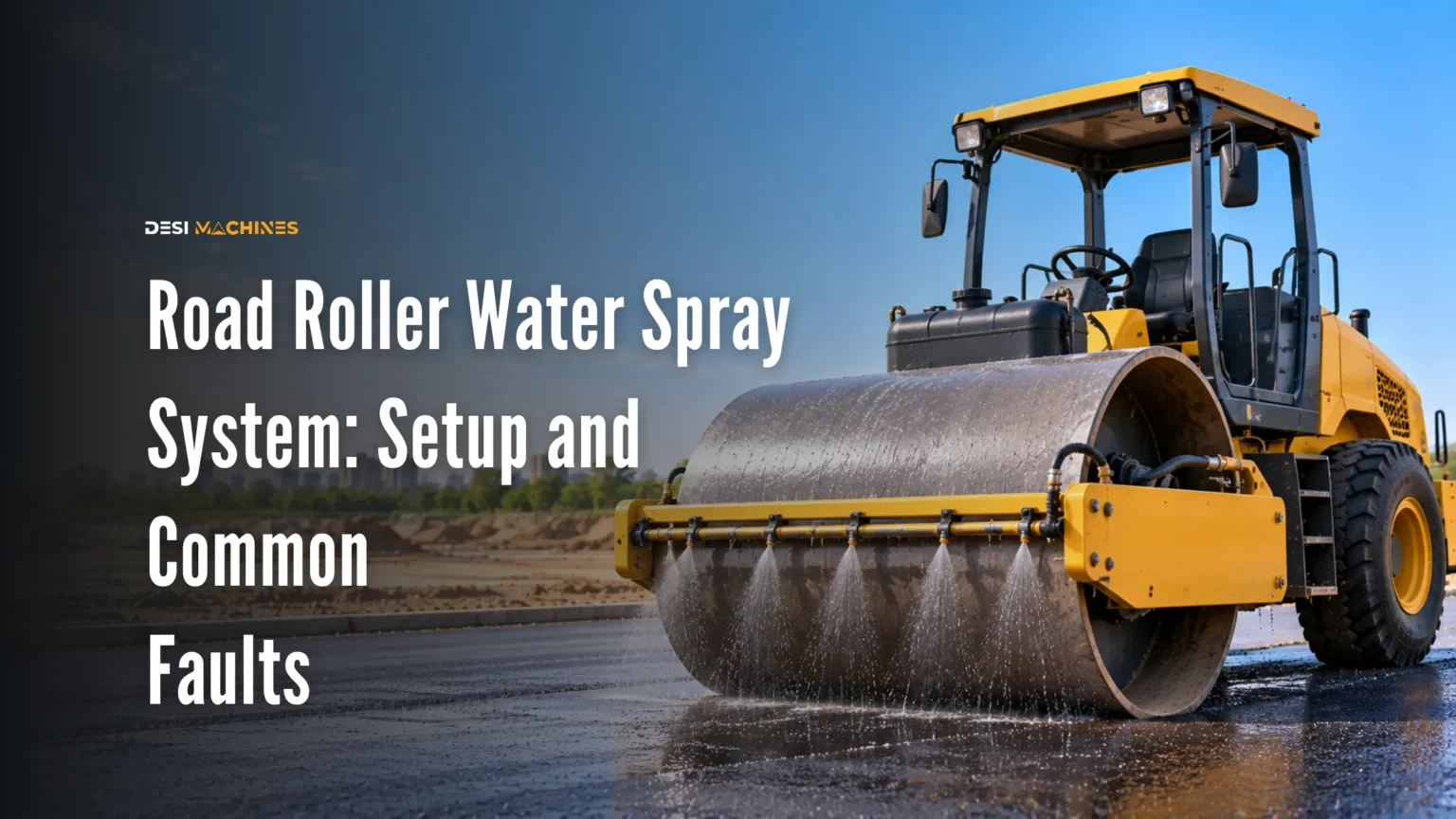
A tandem roller that has gone dry halfway through an asphalt run, with the hot material starting to lift off the road and stick to the drum, has one of four things wrong with it. The tank is empty, a filter is blocked, a nozzle is blocked, or the spray pump has stopped running. The road roller water spray system is the simplest circuit on the whole machine, and that is why most of its faults are a ten-minute job beside the road rather than a workshop visit.
This guide sets out what the system is made of, how to set it up before a bituminous run, and what to check, in order, when the water stops. Two words are used throughout. The mat is the layer of hot asphalt the paver has just laid. Bitumen is the black binder inside that mat, and it turns sticky as soon as it is hot.
Why does a road roller spray water on its drum?
Hot bitumen sticks to bare steel. Without a thin film of water on the drum, the roller lifts material off the surface on every pass. That is called pickup, and it leaves torn patches and drag marks in a mat that was smooth a minute earlier. Fixing those patches means cutting them out and relaying them, so the water film is not a comfort feature. It is what keeps the surface saleable.
The film has to be thin. Water also cools the mat, and asphalt only compacts properly while it is hot, so a roller that floods the drum loses density just as surely as one that runs dry. The standard practice on Indian highway work, set out in the Ministry of Road Transport and Highways Specifications for Road and Bridge Works, is to roll the layer inside its temperature window. A spray that is heavy enough to pull the surface temperature down is working against the pass you are making.
This is why the spray system belongs to asphalt machines. Of the 45 compactors listed on DesiMachines, 18 of the 20 tandem rollers and all four pneumatic tyre rollers publish a water system in their specifications. Not one of the 21 soil compactors does, because a single drum working on earth and murrum has no bitumen to pick up. If you own a soil compactor and cannot find a spray system on it, nothing is missing.
On a pneumatic tyre roller the same idea is applied to rubber instead of steel. Water, sometimes with a release agent mixed in, is sprayed onto the tyres, and wiper mats rub the film even across the tread. The Volvo PT220 lists a coco mat at the front and rear of every tyre for exactly that job.
What is inside a road roller’s water spray system?
Five parts, in a line, and the water passes through all of them in that order.
The water path on a tandem roller
The tank holds the water, and on most machines it is moulded plastic rather than steel so it cannot rust from the inside. Volvo and L&T both name the plastic in their published specifications. Tank sizes across the compactors on DesiMachines run from 110 litres on the Dynapac CC800 to 1,000 litres on the Ammann ARX 90.2, and the full set of tank figures by machine class is in the reference on road roller fuel and water tank capacity.
The filters are the part owners forget. Good systems filter the water more than once. The JCB VMT330 lists multi-stage filtration at the fill point, the pump and the nozzle. The CASE 952NX lists triple filtration, the Ammann ARX 90.2 a three-stage system, and the Volvo PT220 spells out the whole chain: filter baskets in the fill necks, a primary filter at the pump, and a fine filter for each nozzle. Every one of those stages exists because site water carries grit.
The pump is usually a diaphragm pump, which is a small electric pump that pushes water with a flexing rubber sheet instead of a spinning impeller. It is the part that gives a pressurised system its name. Larger tandem rollers often carry two, one for each drum, so a single pump failure leaves you with half a machine instead of none. The Volvo DD90 and the JCB VMT330 both list one pump per drum, and the Escorts HD 85 PLUS lists a double water pump.
The spray bar and nozzles spread the water across the drum width. Nozzle count is fixed by the bar, and the bars are duplicated front and rear on a tandem roller. On a pneumatic roller the arrangement follows the tyres instead: the Dynapac CP275 lists one nozzle per tyre, and the L&T 2490 HD lists front and rear bars with four nozzles on each.
The scraper bar sits against the drum behind the spray and wipes off whatever the water did not stop. It is a wear part, and it is listed among the first parts to go on a roller in the road roller parts and components reference.
Which rollers use which spray system?
These are the systems as published in the specifications of machines listed on DesiMachines. The wording is the manufacturer’s own, which is worth reading closely, because “pressurised” with two pumps and three filters is a different machine from “sprinkling system with 1 pump”.
| Machine | Type | Spray system as listed | Water tank |
|---|---|---|---|
| JCB VMT330 | Tandem | Pressurised sprinkler, two pumps (one per drum), multi-stage filtration at fill, pump and nozzle | 210 L |
| CASE 952NX | Tandem | Pressurised sprinkler, dual pumps, triple filtration | 780 L |
| L&T 990HFi | Tandem | Pressure spray drum wetting system with diaphragm water pumps | 750 L |
| Ammann ARX 90.2 | Tandem | Three-stage filtration on the sprinkling system | 1,000 L |
| Volvo DD90 | Tandem | Pressure spray drum wetting, LDPE tank, two water pumps, one per drum | 700 L |
| LiuGong 6210E | Tandem | Pressurised sprinkling with three modes | 800 L |
| ACE ADD-95 | Tandem | Pressurised, automatic, interval switch on the dashboard | 350 L |
| Dynapac CC1250 CEV-V | Tandem | Sprinkler system with pump and non-clogging nozzles | 160 L |
| Escorts EC 3664 | Tandem | Spray system with a sprinkler indicator | 200 L |
| Volvo PT220 | Pneumatic | Pressure spray tyre wetting, hand-serviceable nozzles, filter baskets plus pump and per-nozzle filters, coco mats front and rear | 550 L |
Specifications are as published at the time of writing and can change by variant and model year. Two things in that table matter more than the rest when you are choosing a machine for continuous bituminous work: how many pumps it carries, and how many filter stages sit between the tank and the nozzle. Compare live tandem roller models and prices and talk to a dealer before you commit.
How do you set up the spray before a bituminous run?
Do all of this before the paver starts, not after the mat is down and cooling.
- Fill with clean water only. Canal, pond or tanker water carries silt, and silt is what blocks nozzles. Fill through the filter basket in the neck and never by lifting the basket out to fill faster.
- Fill the tank full. A tandem roller on a hot day empties a small tank quickly, and running out mid-pass is how pickup starts. There is a working estimate of how long a tank lasts in the tank capacity guide.
- Run the pump and watch every nozzle. Stand at the drum with the spray on and look for a fan from each hole. One dead nozzle in the middle of the bar leaves a dry stripe, and that stripe is where the mat will tear.
- Set the interval, not the maximum. Machines with an interval or mode switch, like the ACE ADD-95 or the three-mode LiuGong 6210E, are asking you to choose how often the spray pulses. Start low on a hot mat and increase only if the drum begins to pick up.
- Check the scraper bars. A worn scraper leaves a ridge of material on the drum that the water cannot shift.
- Keep a spare set of nozzles in the toolbox. They are the smallest part on the system and the one most likely to stop your day.
Why has the water spray stopped working?
Work down this list in order. The first three lines cover the large majority of spray failures on site, and none of them needs a mechanic.
| What you see | Most likely cause | What to check |
|---|---|---|
| No water from any nozzle, pump silent | Empty tank, blown fuse, or pump switch off | Sight glass or tank level first, then the fuse and the cab switch before anything else |
| No water from any nozzle, pump running | Blocked fill or in-line filter, or the pump is drawing air | Pull and wash the filter. If it is clean, look for a loose hose clip letting air into the suction side |
| Water from some nozzles, dry stripe on the drum | One or more blocked nozzles | Remove the blocked nozzle and clear it. Grit in one nozzle usually means the filter is past its life |
| Spray weak and uneven across the bar | Partly blocked filter, low pump pressure, or a split hose | Filter first, then look along the bar for a wet patch that shows a leak |
| Water comes for a minute, then stops | Interval or pulse mode is set too slow | The mode switch on the dashboard, before assuming a fault |
| One drum sprays, the other does not | Failed pump on a two-pump machine, or a blocked feed to that bar | Listen at each pump. On a one-pump-per-drum machine this narrows it immediately |
| Spray works but the drum still picks up | Worn scraper bar, or a mat that is too hot for the spray rate | Scraper contact along the full drum width, then raise the spray interval a step |
| Nozzles block again within a day | Dirty water, or a filter that was refitted wrongly | Water source and filter seating. A filter that is not seated lets everything past it |
The two faults that do need a workshop are a pump that has failed electrically and a tank that has cracked at a mounting point. Both are fixable, but neither is a roadside job, and both are worth quoting from a dealer before you buy parts anywhere else. Hour-based servicing catches most of this before it becomes a breakdown, and the intervals are set out in the construction equipment service schedule.
If the water is fine but the drum has stopped shaking, that is a different circuit altogether and it is covered in the guide to a road roller vibration problem.
How do you clear a blocked spray nozzle?
Switch the pump off first so you are not fighting the pressure. Unscrew the nozzle by hand, or with the small spanner most machines ship with, and hold it up to the light. If you cannot see through it, it is blocked.
Soak it in clean water and clear the hole from the back with a soft brass wire or a compressed-air line. Do not use a steel nail or a drill bit. The hole size is what sets the spray pattern, and a hole that has been opened out by a nail sprays a jet instead of a fan for the rest of its life. Refit the nozzle finger tight, run the pump, and look again for an even fan.
If nozzles block repeatedly, the problem is upstream. Wash the filters, check that each one is seated in its housing, and change where the tank water comes from. Machines like the Dynapac CC1250 CEV-V are sold with non-clogging nozzles, and even those depend on clean water reaching them.
What happens if you keep rolling with a dry drum?
The mat pays for it first. Bitumen lifts onto the steel, builds into a ridge, and that ridge then presses lines into every following pass. Torn and scarred areas have to be cut out and relaid, which costs material, machine hours and a second closure of the lane.
The machine pays for it next. Built-up material loads the scraper bar until it wears through or bends, and hardened bitumen on a drum takes hours of diesel and scraping to remove. Output drops while all of this is happening, and the numbers behind that are in the guide to road roller productivity and output.
The honest answer to “can I finish this stretch and fix it later” is usually no, and any operator who has cleaned a drum by hand will say the same.
Road roller water spray: the short version
- The spray keeps hot bitumen from sticking to the drum. It is an asphalt-machine system, which is why tandem and pneumatic rollers carry it and soil compactors do not.
- The circuit is tank, filter, pump, filter, spray bar, nozzles, with a scraper bar behind the drum.
- Water tanks on machines listed here run from 110 litres to 1,000 litres.
- Check the tank, the fuse and the switch first, the filters second, the nozzles third. That order settles most failures without a mechanic.
- Clean water and a seated filter prevent more spray faults than any part you can buy.
Ready to choose a machine rather than repair one? Browse the full range of compactors and road rollers listed in India, or read the compactor buying guide before you shortlist. If a second-hand machine is on the table, the used road roller checks include the spray system for good reason.
Prices, specifications and features are indicative, vary by variant, location and date, and should always be confirmed with the official OEM or authorised dealer before any purchase decision. DesiMachines is not liable for decisions taken on the basis of information that may have changed after publication.