
 Excavator
294 models
Excavator
294 models  Backhoe Loader
51 models
Backhoe Loader
51 models  Crane
68 models
Crane
68 models  Concrete Mixer
79 models
Concrete Mixer
79 models  Wheel Loader
54 models
Wheel Loader
54 models  Compactor / Roller
45 models
Compactor / Roller
45 models  Motor Grader
42 models
Motor Grader
42 models  Concrete Pump
66 models
Concrete Pump
66 models  Skid Steer Loader
11 models
Skid Steer Loader
11 models  Telehandler
13 models
Telehandler
13 models 


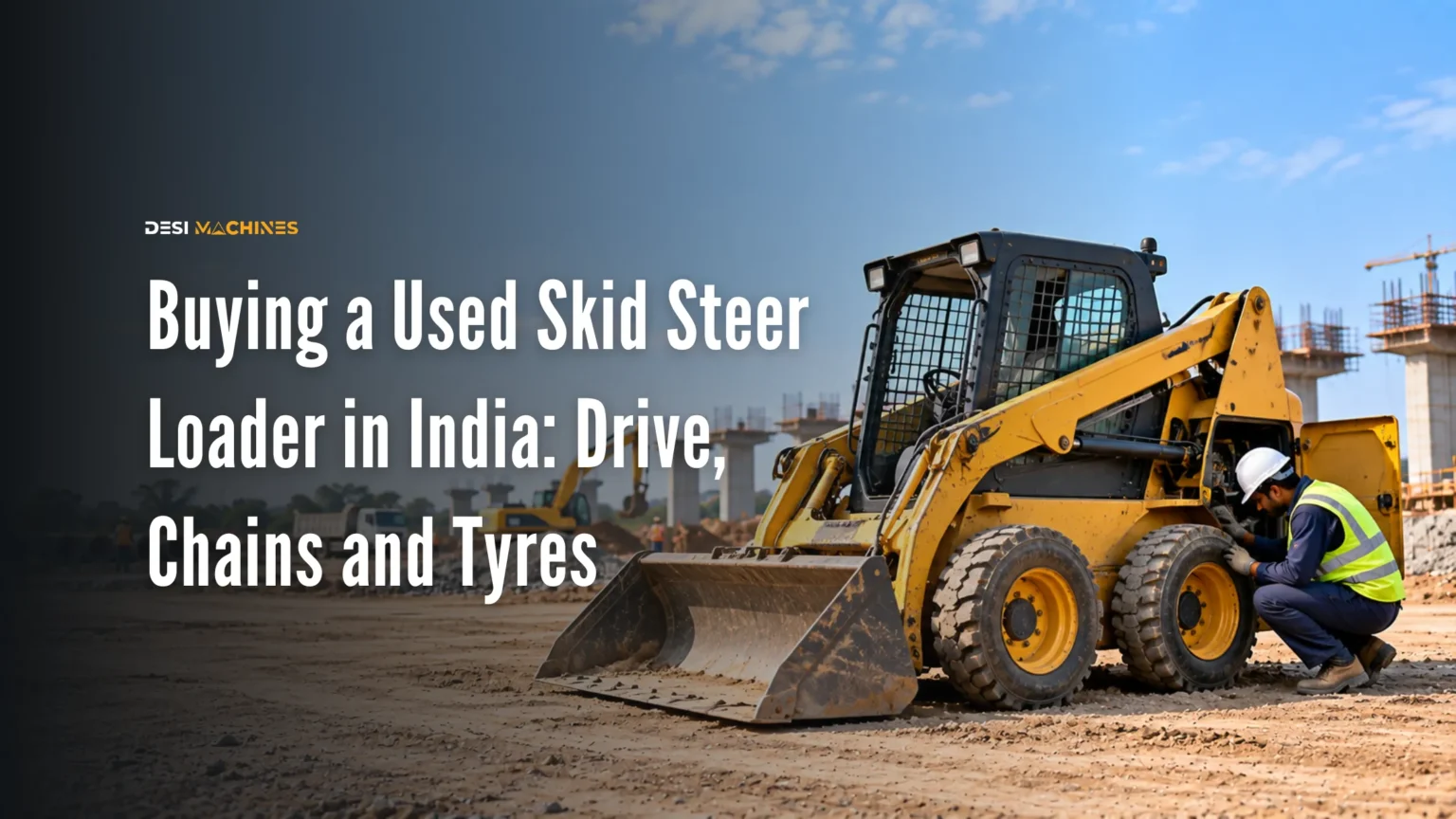
Drive a used skid steer loader one side at a time before you look at anything else on it. If it crawls on the left and runs on the right, or drifts off a straight line on level ground, the fault sits in a drive chain, a chain case or a hydrostatic drive motor, and those are the three most expensive things on this machine.
This guide covers that drive test, what the chain cases are and why most first-time buyers have never heard of them, what the hour meter is worth on a machine like this, why the lifting figure a seller quotes is usually double the real one, and what the tyres will cost you. The class figures come from the eleven skid steer loader models and prices listed on DesiMachines, and each figure says how many of the eleven it is built from.
What should you check first on a used skid steer loader?
Start with the drive, because a skid steer steers by driving one side faster than the other. There is no steering wheel and no steering linkage. If one side is weak, the machine will not track straight, will not turn evenly, and will chew its tyres on one flank.
Find a flat piece of ground and do this in order.
- One side at a time. With the machine warm, push one lever forward on its own and watch how the wheels on that side pull. Repeat on the other side. The two sides should feel the same and sound the same.
- Straight line, both directions. Run it thirty metres forward and thirty back. A machine that wanders on level ground has a drive fault, not a driver fault.
- Lift arm pins and bushes. Raise the arms halfway, then push the bucket sideways by hand at the corner. Play you can see with your eye is play worth money.
- Hydraulic drift. Raise the arms, tilt the bucket back, shut the engine off and mark where the bucket edge sits. If it keeps sinking, that is a cylinder or a valve, and it is a workshop job.
- The seat bar interlock. Lift the seat bar with the engine running. The lift arms and the drive should both lock out. Many second-hand machines reach the market with this defeated, and a defeated interlock tells you two things at once: the machine is unsafe, and somebody preferred a shortcut to a repair.
- The cage. Look along the welds of the operator cage, especially where it meets the frame. Cracks there are structural.
If the machine does pull to one side or crawl on one track, skid steer drive problems sets out what causes it and what each cause costs to put right. Read that before you agree a number, not after. The ordinary second-hand checks, cold starting, oil condition, smoke, cracked welds and a tampered hour meter, are all in the used equipment inspection checklist.
What are the chain cases, and why do they decide the price?
A skid steer loader has no gearbox and no axle. Each side of the machine has its own hydrostatic drive motor, which means a pump sends oil to a motor and that motor turns the wheels, with no gears to select. That motor drives the front and rear wheel on its side through a heavy chain, and the chain runs inside the frame rail in a bath of oil. That oil bath is the chain case, and there is one on each side.
It matters because it is the part nobody services. Engine oil gets changed because everyone knows it exists. Chain case oil often sits untouched for the life of the machine, and when a chain and its sprockets wear, they shed metal into that oil.
Six of the eleven skid steers listed here publish a chain case oil capacity, and on all six the left and right sides hold exactly the same amount: 6 litres each side on the CAT 216B Series 3, 8.25 litres on the MANITOU 1340R, 8.3 litres on the L&T S315R, 10 litres on the Bull AV490, and 19 litres each side on the JCB SSL 155 and its smaller SSL 135. The other five carry the field on their specification sheet and leave it blank, so ask the dealer for the figure rather than assuming the machine has no chain case. Every one of them does.
On the machine in front of you, find the level plug on the side of the frame, take it out, and look at what comes off the end of your finger. Clean oil is a good sign about the whole machine, because an owner who changed that oil changed everything else too. Grey, gritty oil means the chains and sprockets are wearing, and that repair means splitting the frame. The full service volumes for this class are in the skid steer loader fuel tank and oil capacities reference, and how skid steer loaders work explains the drive layout in full.
How many hours is too many on a used skid steer loader?
There is no honest hour number that makes a machine a buy or a walk-away, and anyone who gives you one is guessing. What the meter tells you depends on what the machine was doing for those hours, and on a skid steer that varies more than on almost any other machine, because the same loader is sold to a poultry shed, a paver crew and a scrap yard.
So ask a different question: which attachment lived on it? A machine that carried a bucket around a yard worked its engine and very little else. A machine that ran a breaker, an auger or a cold planer had its hydraulic pump loaded at full pressure for most of those hours, and the pump, the motors and the hoses have aged accordingly. A machine that worked in slurry or manure has corrosion in places you cannot see from the seat.
Treat the hours as a question and the service records as the answer. Job cards, a dated oil change history and the same owner’s name throughout are worth more than a low reading on a meter that can be replaced for very little. What a tampered meter looks like, and how to cross-check it, is covered in the inspection checklist.
What does rated operating capacity mean on a used machine?
Rated operating capacity is the load the machine is rated to carry and work with. Tipping load is the load at which the back wheels start to lift off the ground. They are not the same number, and the gap between them is a fixed rule rather than a manufacturer’s opinion.
On a wheeled skid steer loader, rated operating capacity is defined as half the tipping load. The test comes from the SAE standard J818: the bucket is raised and loaded until the rear wheels just lift, that weight is the tipping load, and the rated figure is half of it. Our own catalogue confirms it without needing the standard at all. All eleven machines listed here publish both numbers, and on all eleven the rated operating capacity is exactly 50% of the tipping load, from the 318 kg and 642 kg of the Bobcat S70 to the 1,520 kg and 3,039 kg of the Bobcat S770.
This is the single most useful thing to know when a seller is talking. A dealer who tells you the machine “lifts 1.2 tonne” is almost always quoting the tipping load, because it is the bigger number. The load that machine will actually pick up and carry across a site is 600 kg.
One warning. The same standard rates a tracked machine at 35% of tipping load, not 50%, because tracks put the tipping point further forward. So a compact track loader and a wheeled skid steer with the same tipping load carry different rated figures, and comparing the two rated numbers directly will mislead you. The compact track loader guide covers where tracks earn their extra cost.
| Machine | Operating weight | Rated operating capacity | Tipping load | Max pump flow | New price band, indicative, as of September 2026 |
|---|---|---|---|---|---|
| Bobcat S70 | 1,291 kg (1.3 tonnes) | 318 kg | 642 kg | 37 L/min | ₹13–15 Lakh |
| ACE SS75 | 2,850 kg (2.9 tonnes) | 750 kg | 1,500 kg | 82 L/min | ₹16–23 Lakh |
| JCB SSL 135 | 2,950 kg (3.0 tonnes) | 612 kg | 1,224 kg | 68.6 L/min | ₹17–23 Lakh |
| MANITOU 1340R | 2,200 kg (2.2 tonnes) | 612 kg | 1,224 kg | 63.4 L/min | ₹17–23 Lakh |
| JCB SSL 155 | 3,050 kg (3.1 tonnes) | 703 kg | 1,406 kg | 68.6 L/min | ₹18–25 Lakh |
| L&T S315R | 3,275 kg (3.3 tonnes) | 750 kg | 1,500 kg | 76.8 L/min | ₹19–23 Lakh |
| Bull AV490 | 2,700 kg (2.7 tonnes) | 655 kg | 1,310 kg | 60 L/min | ₹20–25 Lakh |
| Bobcat S450 | 2,365 kg (2.4 tonnes) | 608 kg | 1,215 kg | 63.21 L/min | ₹21–28 Lakh |
| CAT 216B Series 3 | 2,581 kg (2.6 tonnes) | 635 kg | 1,270 kg | 61 L/min | ₹26–30 Lakh |
| Bobcat S590 | 3,069 kg (3.1 tonnes) | 907 kg | 1,814 kg | 64.7 L/min | ₹26–30 Lakh |
| Bobcat S770 | 4,225 kg (4.2 tonnes) | 1,520 kg | 3,039 kg | 87.1 L/min | ₹30–32 Lakh |
Figures as published on the eleven listings, September 2026. Compare the current skid steer loader range and prices before you settle a second-hand number, and talk to a dealer about what a comparable used machine of that model should fetch.
Will a used skid steer run the attachment you want?
Most people buy a skid steer for what it can hold rather than for the bucket, so this question decides whether the machine is any use to you. The answer is in one figure: maximum pump flow, which is how much oil per minute the machine can send out to an attachment.
Across the eleven machines listed here, maximum pump flow runs from 37 litres a minute on the Bobcat S70 to 87.1 litres a minute on the Bobcat S770, and system pressure runs from 190 to 238 bar on the nine that publish it. Engine power over the same eleven runs from 23.5 HP (17.5 kW) to 93.3 HP (69.7 kW). A bucket, a pallet fork or a light sweeper will work on anything in that span. A rock breaker, a cold planer, a mulcher or a trencher wants oil, and a machine at the bottom of that flow range will run one slowly or not at all.
So do three things before you pay. Find the flow figure for that exact model rather than for the brand. Couple the attachment you intend to use and run it under load, not in the air. Then check the auxiliary couplers on the arm for weeping. Skid steer attachments sets out which tools suit which flow, and if the machine is going onto a farm, skid steer loaders for agriculture covers the sizes and tools that work there.
What do the tyres cost on a used skid steer loader?
More than you expect, and sooner than you expect. A skid steer turns by dragging its tyres sideways across the ground, so it scrubs rubber off in a way that a wheel loader never does. Tyres are a running cost on this machine, not a once-a-decade item, and they are replaced as a set of four because uneven diameters make the machine pull.
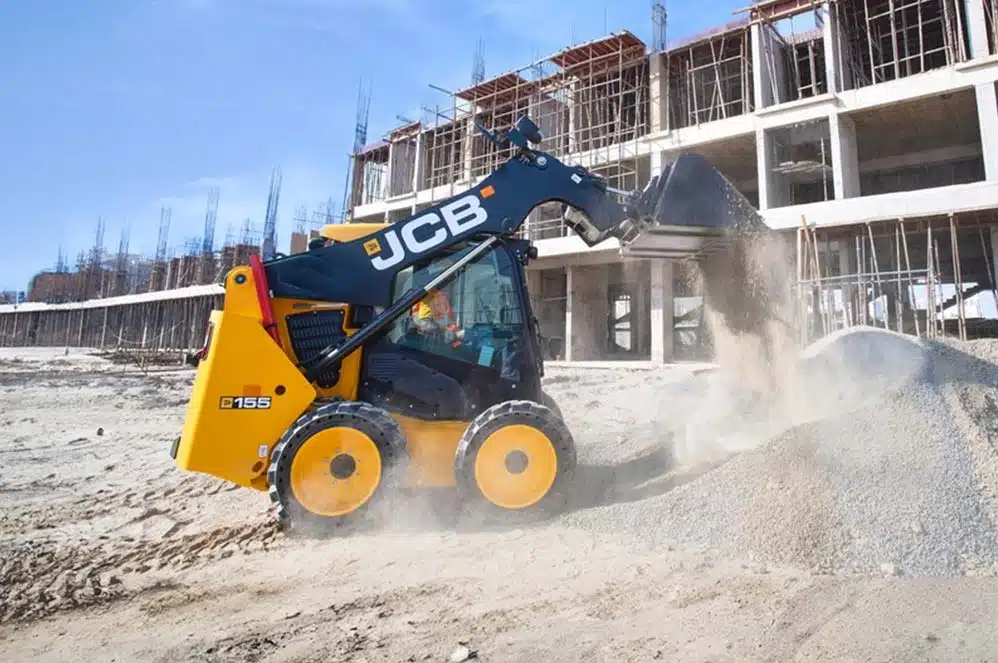
The good news for an Indian buyer is that the class has settled on one size. Ten of the eleven listings publish a tyre size, and eight of those ten run the same 10 × 16.5 tyre in a 10-ply rating. Two of the eight, the JCB SSL 135 and SSL 155, publish it in millimetres as 25.4 cm by 41.9 cm, which is the same 10 × 16.5 written in metric. The exceptions are the Bobcat S70, a much smaller machine on 5.70-12 tyres, and the Bobcat S770, which runs a wider 12 × 16.5 at 12-ply. The CAT 216B Series 3 listing does not publish a tyre size, so measure the ones on the machine.
Price a set of four from your local tyre dealer before you negotiate, and take the cost off your offer if the ones fitted are down to the last of their tread. A worn set is a known, fixed number. Use it.
What should a used skid steer loader cost in India?
Work down from the new price for the same model. New, the eleven machines listed here run from the Bobcat S70 at ₹13–15 Lakh to the Bobcat S770 at ₹30–32 Lakh, both indicative as of September 2026 and quoted as published rather than rounded. The full ladder is in the table above.
We do not publish used prices, because a used price is set by one machine’s history and not by its model. Four things move the number, roughly in this order.
- The two drive sides. A machine that tracks straight and pulls evenly on both levers is worth a premium over one that does not, and the difference is larger than most sellers admit.
- The chain cases. Clean oil belongs in the price. Grey, metal-flecked oil belongs in the decision, because the repair means splitting the frame.
- Tyres. Four tyres, one common size, replaced together. A known cost you can quote before you talk money.
- The attachment package. A machine that comes with the quick hitch and one or two good tools attached is worth real money over a bare machine, because those tools cost the same second-hand as they do new.
If you are borrowing against the machine, understand what changes on a second-hand purchase first. Used construction equipment loans carry lower loan-to-value and shorter tenures than a new-machine loan, which changes the deposit you need to have ready.
What paperwork must change hands?
Settle the papers before the final payment, never after it. Photograph the original invoice and the machine’s identification plate, confirm the serial number on the frame matches the papers in your hand, and check whether the machine carries a finance charge against it. A machine still hypothecated to a lender is not the seller’s to sell outright, and clearing it afterwards becomes the buyer’s problem.
If the machine is registered, the registration certificate has to transfer into your name and the hypothecation has to be removed first. RC transfer and hypothecation removal sets out the forms and the order to do them in, and how to buy used construction equipment in India covers the sequence from shortlisting to payment.
What it comes down to
Buy the drive and buy the chain cases. Everything else on a skid steer loader, the engine, the tyres, the couplers, the seat, is ordinary maintenance with a price you can look up. The two drive sides are the machine, and they are the only part a short demo can hide from you. So drive each side on its own, drive it straight in both directions, pull the chain case plugs, and treat a seller’s lifting figure as the tipping load until he shows you the specification sheet that says otherwise.
Ready to compare real machines? Browse the current skid steer loader models and prices and ask a dealer what a comparable second-hand machine of that model is fetching. Still deciding whether this is the right machine at all? Skid steer versus backhoe loader sets the two side by side.
Other machines in this series: used telehandler, used wheel loader, used backhoe loader, and the rest of the used equipment guides.
Prices, specifications and features are indicative, vary by variant, location and date, and should always be confirmed with the official OEM or authorised dealer before any purchase decision. DesiMachines is not liable for decisions taken on the basis of information that may have changed after publication.