
 Excavator
294 models
Excavator
294 models  Backhoe Loader
51 models
Backhoe Loader
51 models  Crane
68 models
Crane
68 models  Concrete Mixer
79 models
Concrete Mixer
79 models  Wheel Loader
54 models
Wheel Loader
54 models  Compactor / Roller
45 models
Compactor / Roller
45 models  Motor Grader
42 models
Motor Grader
42 models  Concrete Pump
66 models
Concrete Pump
66 models  Skid Steer Loader
11 models
Skid Steer Loader
11 models  Telehandler
13 models
Telehandler
13 models 


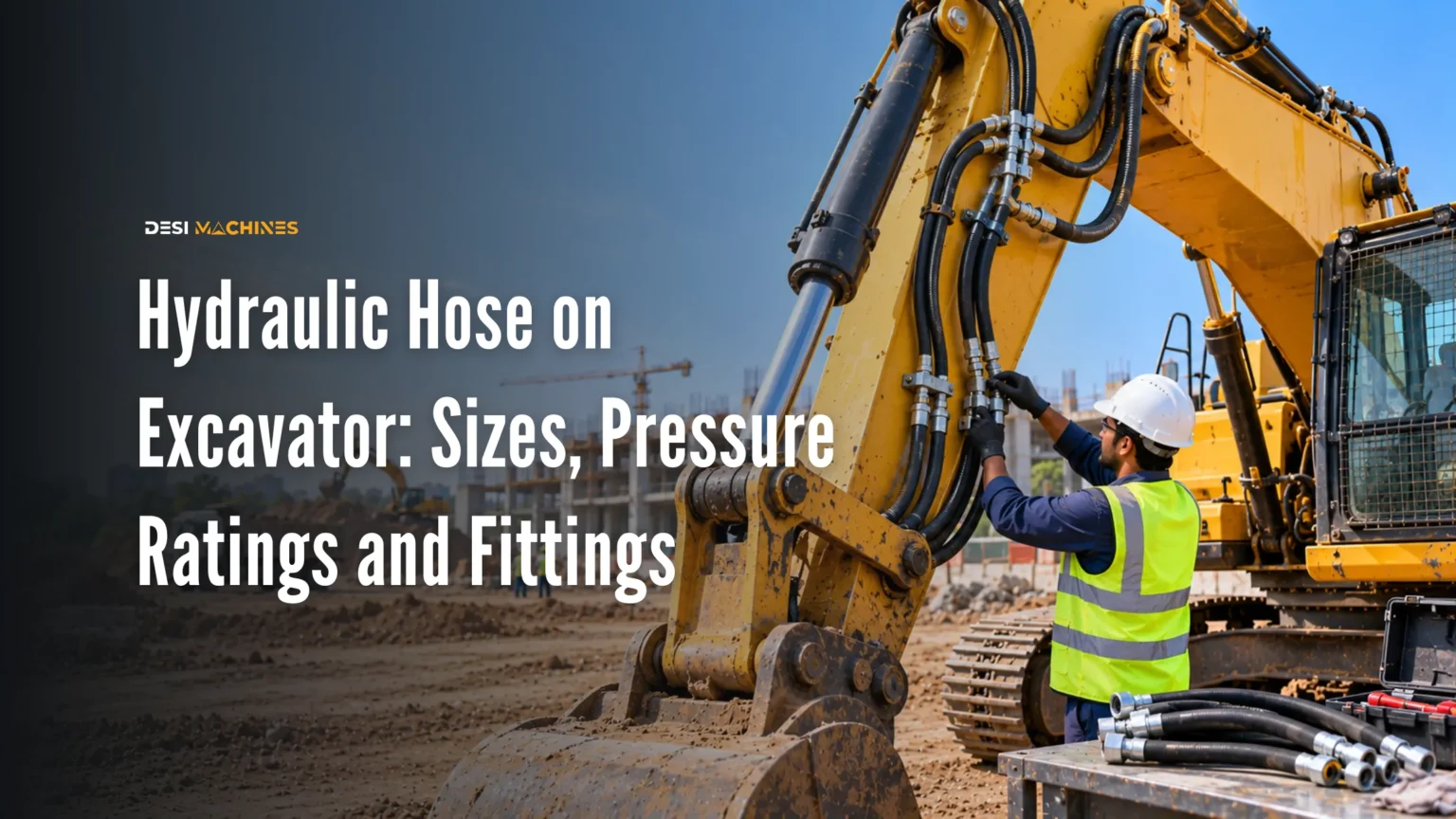
If a hose has burst on your excavator, the replacement is decided by the circuit it came off, not by the brand of the machine. On the same excavator a pilot line and a boom line carry oil at pressures that differ by roughly eight times, so a hose that is right for one is dangerous on the other.
That is the whole problem with buying an excavator hydraulic hose. The shop will ask you questions you did not expect, and a wrong answer gets you either a hose that fails in a month or one that costs far more than the job needed. This page covers what each number on a hose means, how much pressure your machine actually runs at, and what to carry with you.
What do the numbers printed on a hydraulic hose mean?
Every hydraulic hose has a line of text printed along its length. This is called the layline. It carries the maker’s name, the hose type, the size and usually the working pressure. When a hose fails, the layline is the first thing to read, because it tells you exactly what to replace it with.
The size is given as a dash size. A dash size is simply the inside diameter of the hose counted in sixteenths of an inch. A hose marked -08 has an inside diameter of 8/16 of an inch, which is half an inch, or 12.7 mm. Once you know that, the whole system reads easily.
| Dash size | Inside diameter (inch) | Inside diameter (mm) | Where you usually see it |
|---|---|---|---|
| -04 | 1/4″ | 6.4 mm | Pilot and control lines |
| -06 | 3/8″ | 9.5 mm | Pilot lines, small service lines |
| -08 | 1/2″ | 12.7 mm | Bucket and small cylinder lines |
| -10 | 5/8″ | 15.9 mm | Arm and bucket lines |
| -12 | 3/4″ | 19.1 mm | Boom and arm lines |
| -16 | 1″ | 25.4 mm | Main pump and boom lines |
| -20 | 1.1/4″ | 31.8 mm | Pump delivery on larger machines |
| -24 | 1.1/2″ | 38.1 mm | Suction and return lines |
The one mistake to avoid here is measuring the outside of the hose. The dash size is the hole the oil travels through, not the rubber around it. Two hoses with the same inside diameter can have very different outside diameters, because one has more steel reinforcement in the wall than the other.
How much pressure does an excavator hydraulic hose have to hold?
It depends entirely on which circuit the hose sits on. An excavator does not run one pressure throughout. The oil leaves the pump and splits into separate circuits, and each of those works at its own pressure.
Of the 294 excavators listed on DesiMachines, 290 publish their implement circuit pressure, which is the circuit that feeds the boom, arm and bucket cylinders. Grouped by operating weight, the published figures fall out like this.
| Machine class (operating weight) | Machines publishing the figure | Implement circuit pressure | Typical (median) |
|---|---|---|---|
| Mini, under 7 tonnes | 46 | 147 – 265 bar (14.7 – 26.5 MPa) | 230 bar |
| 7 – 15 tonnes | 47 | 240 – 350 bar (24.0 – 35.0 MPa) | 314 bar |
| 15 – 25 tonnes | 82 | 279 – 373 bar (27.9 – 37.3 MPa) | 343 bar |
| 25 – 40 tonnes | 42 | 314 – 380 bar (31.4 – 38.0 MPa) | 343 bar |
| Over 40 tonnes | 69 | 294 – 380 bar (29.4 – 38.0 MPa) | 324 bar |
Specifications as published on the listed machines, September 2026. MPa means megapascal, and one MPa is about 10 bar, so 34.3 MPa is roughly 343 bar. Pressure is where the two units matter most, because Indian spec sheets mix them freely.
Now compare that with the pilot circuit, the low-pressure oil that makes the joysticks work. Of the machines that publish it, the pilot circuit runs between 24 and 50 bar, with 39 bar being typical. That is the eight-to-one gap mentioned at the top, and it is why a thin control-line hose and a thick boom hose are not interchangeable even though they sit a few inches apart on the same machine.
Other machine types sit in a similar band. Every one of the 51 backhoe loaders listed publishes a system pressure, running from 180 to 270 bar. Wheel loaders run from 160 to 380 bar. Skid steer loaders sit between 190 and 238 bar. A full breakdown of what each excavator circuit does, and how the pumps feed them, is in the guide to excavator parts and components, and the swing and travel circuits are covered in excavator hydraulic motors.
The rule you need from all this is short. The hose you fit must be rated at or above the working pressure of the circuit it goes on. Fitting a higher-rated hose is safe and sometimes sensible. Fitting a lower-rated one is not, whatever the shop tells you about it being “the same size”.
What does SAE 100R1 or 100R2 mean on a hose?
Those codes come from SAE J517, the standard that governs hydraulic hose. The number after 100R describes how the hose is built, and the build is what decides how much pressure it holds.
100R1 has a single braid of steel wire wrapped around the inner tube. It is the lighter of the two common types and suits medium-pressure work. 100R2 has two steel wire braids, which makes it stiffer, heavier and able to hold considerably more pressure. Above these sit the spiral-wound types, built with four or six layers of wire laid in a spiral rather than a braid, and those are what the high-pressure lines on a large excavator or a rock breaker need.
Two things about these ratings catch people out. The first is that within any one type, the working pressure falls as the bore rises. A -06 hose in 100R2 holds far more pressure than a -16 hose in the same 100R2 construction, because the larger the hole, the more force the same pressure puts on the wall. So “it is 100R2” is not by itself an answer; the size matters too.
The second is the safety margin. The standard uses a 4:1 design factor, meaning a hose is built to burst at four times its stated working pressure. That margin is not spare capacity for you to use. It covers pressure spikes, age, heat and the knocks a hose takes on a working machine. Treat the working pressure on the layline as the limit.
None of this can be judged by eye. A one-braid and a two-braid hose of the same bore look almost identical from outside. Read the layline, or take the old hose with you.
Why are suction and return hoses different from pressure hoses?
Not every hose on a machine is fighting high pressure. Some are fighting the opposite problem.
The suction hose runs from the oil tank to the pump. The pump pulls oil through it, so the inside of that hose is at less than atmospheric pressure. A normal pressure hose put in this position will slowly collapse inwards and choke the pump, which starves it and ruins it. A proper suction hose has a wire helix moulded into the wall to hold the bore open against that pull. It is usually large in diameter and noticeably soft compared with a pressure hose.
The return hose carries oil back from the circuits to the tank through the filter. It works at low pressure but at high volume, so it is large in bore and lightly reinforced. Fitting an expensive high-pressure hose here wastes money and makes the line stiffer than it needs to be.
If a shop offers you one hose for all three jobs, that is a sign to go elsewhere. The consequences of getting the suction line wrong land on the pump, which is the most expensive single part of the hydraulic system.
How do you know which hydraulic fitting you need?
This is where most people searching for a compatibility guide by machine brand are asking the wrong question. Fittings are not decided by who made the excavator. They are decided by the thread form and the sealing shape at the end of the fitting, and any brand may use several of them on one machine.
The common families in India are these. JIC fittings seal on a 37 degree cone machined into the end. BSP fittings seal on a 60 degree cone and use a British parallel or tapered thread. ORFS, or O-ring face seal, has a flat face with a rubber O-ring set into it, and it seals on that ring rather than on a cone. Metric DIN fittings use metric threads with either a 24 degree cone or a soft seal.
Two fittings can have threads that screw together happily and still leak forever, because the sealing angles do not match. That is the situation people describe as a fitting being “almost right”.
The reliable method needs no chart. Take the failed hose, with both its fittings still attached, to the shop. A hose shop measures the thread, identifies the seal type and matches it in a minute. If the hose has been thrown away or burnt off, take a photograph of the port it screws into and, if you can, the port on the other end too, because the two ends of one hose are often different.
Where a machine is under warranty or the line feeds an attachment such as a hydraulic rock breaker, it is worth asking about a genuine assembly rather than a made-up one. The difference between genuine, OEM and aftermarket parts, and when each is the sensible buy, is covered in the guide to construction equipment spare parts.
What should you tell the hose shop?
Carry the old hose if you have it. If you do not, these six answers will get you the right part.
- The inside diameter, as a dash size or in millimetres. Measure the hole, not the outside.
- The overall length, measured from the sealing face of one fitting to the sealing face of the other, not the rubber only. Getting this short by even 50 mm means the hose is under tension every time the boom moves.
- The fitting at each end: the type, the size, and whether it is straight, 45 degrees or 90 degrees. Note them separately for the two ends.
- The working pressure, or failing that, which circuit the hose came off. The table above turns your machine class into a pressure figure.
- The application, particularly if the line feeds a breaker, a suction port or a return line, because each of those needs a different build.
- The routing, meaning whether the hose has to bend tightly. Every hose has a minimum bend radius, and forcing a tighter bend than the hose allows is one of the commonest causes of an early failure.
One more habit worth building. When a hose is replaced, ask for the assembly to be tagged or note the layline details in your service record. The next failure is then a two-minute conversation instead of a machine standing idle while somebody works out what fits.
How long does a hydraulic hose last in Indian conditions?
There is no fixed hour figure, and any shop quoting one is guessing. What can be said is what shortens hose life on Indian sites, because the same few causes come up again and again.
Heat is the biggest one. Hydraulic oil running hotter than it should ages the rubber from the inside, and hoses routed close to the exhaust or the engine age from the outside as well. If the machine is running hot, the hoses are paying for it along with everything else, and the causes are worth chasing down in the guide to excavator hydraulic oil temperature.
Rubbing is the next. A hose that touches a frame member or another hose will wear a flat on its cover, then through the wire, and then it bursts. Look for shiny patches and bare wire when you walk around the machine.
Dust and water matter less to the hose itself and more to what it carries. Dirty oil scours the inside of hoses and destroys pumps and valves alongside them, which is why filter changes and oil cleanliness sit at the centre of hydraulic system maintenance and why the filters on an excavator earn their keep. Inspection intervals for all of this are set out hour by hour in the construction equipment service schedule.
Watch also for the slow failures rather than only the dramatic ones. A hose weeping at the crimped end, a cover that has gone hard and cracked, or a boom that sinks overnight are all telling you something. That last one has several possible causes and is worked through in the guide to excavator boom drift.
A safety point that matters more than any of this. Never run a hand along a hose to find a leak, and never search for one with the engine running. Oil escaping from a pinhole at 340 bar is invisible and moves fast enough to pass through skin, and an injection injury of that kind is a surgical emergency even when it looks like a small mark. Shut the machine down, release the pressure, and use a piece of cardboard to trace a leak.
The short version
A hydraulic hose is specified by four things: the inside diameter as a dash size, the pressure rating, the fitting at each end, and the length between sealing faces. Get those right and the brand of your machine barely matters. The pressure figure comes from the circuit, and on the excavators listed here that ranges from about 24 bar on a pilot line to 380 bar on the implement circuit of the largest machines.
When it is time to replace the machine rather than the hose, you can compare live excavator models and prices and talk to a dealer directly. More component guides across every machine type are collected in the parts and running costs guides, including the equivalent breakdown for backhoe loader parts and the schedule for greasing a construction machine.
Prices, specifications and features are indicative, vary by variant, location and date, and should always be confirmed with the official OEM or authorised dealer before any purchase decision. DesiMachines is not liable for decisions taken on the basis of information that may have changed after publication.