Excavator
316 models
 Backhoe Loader
54 models
 Crane
68 models
 Concrete Mixer
79 models
 Wheel Loader
65 models
 Compactor / Roller
45 models
 Motor Grader
42 models

 Concrete Pump
66 models
 Skid Steer Loader
11 models


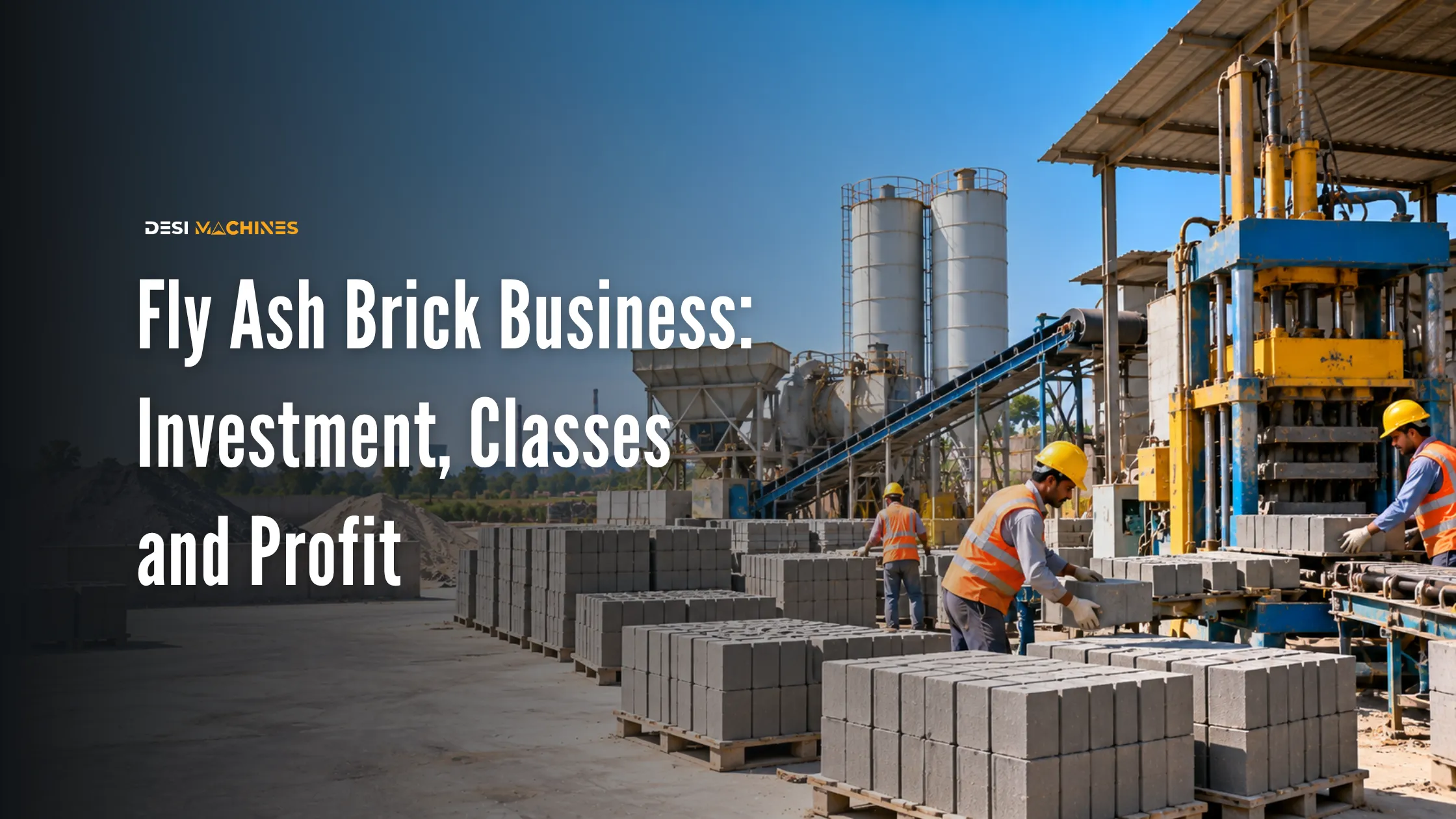
Fly ash bricks, the product a fly ash brick business sells, are pulverized fuel ash-lime bricks: thermal power station ash, lime and sand or bottom ash pressed into a brick that cures without firing, graded under IS 12894:2002. Two products do the same job in a wall and the tax on them differs by six percentage points. That is the quiet advantage a fly ash brick business starts with: a fly ash brick sits inside the brick scheme at 6 per cent GST without input credit or 12 per cent with it, while a concrete block or paver is an article of cement at 18 per cent. What you then have to earn is the strength class. IS 12894:2002 grades these bricks from 3.5 to 30 N/mm² of average wet compressive strength, and the class on your test report is what a departmental buyer actually purchases.
What you are making, and what the standard calls it
The product has a formal name that rarely appears in the market: pulverized fuel ash-lime brick. Ash from a thermal power station reacts with lime in the presence of moisture to form a calcium silicate hydrate, which is the binder. Crushed bottom ash or sand goes in as the coarser material that controls water absorption. The brick is chemically bonded rather than fired, which is why it needs no kiln and no coal.
That single fact is the business case. You are competing with a product whose cost is tied to fuel and to a shrinking licence regime, using a raw material that a power station wants to get rid of. The machines, tenders and news on the fired side of the trade are gathered on the brick kiln equipment page, and how fly ash bricks sit among clay, AAC and concrete bricks is set out in types of bricks used in construction.
It also sets the limit of your ambition. Lime has to conform to Class C hydrated lime of IS 712, and gypsum or cement may be added where they help. Change the ash source and you change the chemistry, which is why units that buy opportunistically from three stations struggle to hold a class.
The class table that decides what you may quote for
IS 12894:2002 classifies the brick purely on average wet compressive strength. There are ten classes, and the designation is the strength.
| Class | Average wet compressive strength, not less than | Typical use |
|---|---|---|
| 3.5 and 5 | 3.5 and 5.0 N/mm² | Non-load-bearing partitions and filler walls |
| 7.5 and 10 | 7.5 and 10.0 N/mm² | Ordinary load-bearing masonry, most residential work |
| 12.5 and 15 | 12.5 and 15.0 N/mm² | Heavier load-bearing walls, multi-storey masonry |
| 17.5 and 20 | 17.5 and 20.0 N/mm² | Engineering masonry and exposed work |
| 25 and 30 | 25.0 and 30.0 N/mm² | Special applications; above 30 N/mm² the standard hands you to IS 1077 and IS 2180 |
Pick the row you can hold through the monsoon, not the one you hit on a good day in April. The class that matters commercially is the one you can certify in a routine test, because an institutional buyer tests the consignment and not the sample you brought to the meeting. For a buyer’s side-by-side of this standard against clay bricks, see fly ash bricks vs red bricks.
The sizes you are allowed to make
Mould sizes are fixed by the standard, which saves you a decision and costs you some flexibility.
The modular sizes are 190 x 90 x 90 mm and 190 x 90 x 40 mm. The non-modular sizes are 230 x 110 x 70 mm and 230 x 110 x 30 mm. Other sizes are allowed by agreement between maker and purchaser, but the tolerance limits stay exactly as they are, measured across twenty bricks laid in a line rather than one brick at a time.
Which family sells depends on your district. Masons who have laid 230 mm country bricks all their lives will resist the modular size, and a unit that ignores that ends up with stock it cannot move.
Where the money goes before the first brick is pressed
We are not going to publish a plant price, because the number depends on a choice you have not made yet: a hand-operated press, a semi-automatic machine, or a fully automatic line with a pallet system. Each is a different business with a different labour model. The makers that name an Indian plant, and the bricks per shift their presses are rated at, are listed in brick making machine manufacturers in India. A figure quoted without that context is how a loan gets sanctioned for the wrong machine.
The heads the money goes into are the same in every case. The press and its moulds, which wear and are a recurring cost. A pan mixer matched to the press. Storage for ash, lime, sand and gypsum, under cover, because wet lime is dead lime. Curing and stacking space, which is land rather than machinery and which new owners consistently under-provide. A connected power load the state board will actually sanction. Yard handling, where a small wheel loader starts paying for itself once daily output passes a few thousand bricks; a compact machine such as the ACE ALN 100 at about ₹18–20 lakh ex-showroom (indicative, November 2026) is the usual starting size. And working capital, because bricks leave your yard well before the money arrives.
Then there is the one head that is unique to this business and larger than any of them: freight on ash.
How to work out profit per month
Profit per month is a short sum, and every term in it is a number only your unit can fill in, which is why this page prints no profit rate for the same reason it prints no plant price.
- Revenue: bricks despatched in the month times your ex-yard price per brick, before GST.
- Variable cost per brick: ash landed at your yard, lime, sand or bottom ash, gypsum or cement, power and loading labour, each divided by the bricks made.
- Fixed cost per month: EMI on the press, mixer and loader, rent on the curing yard, and salaried staff.
- Profit: revenue, minus variable cost per brick times bricks made, minus fixed cost.
Two cautions turn the sum into a real number. Count bricks despatched, not bricks pressed, because stock that has not finished curing or passed its water-absorption test is cost without revenue. And price ash at landed cost, since freight is the term that moves most from one site to the next; plant rates and the free-ash rule are in fly ash price per ton.
Tax works on the price side of the same sum. At the same pre-tax price a buyer pays 6 per cent on your brick under the no-credit option against 18 per cent on a concrete block, so every ₹100 of pre-tax price costs the buyer ₹106 against ₹118: about 10 per cent less on the tax-inclusive bill before you have cut your own price at all. What builders pay for the finished wall is in brick work rate per cubic metre.
Ash supply is what a fly ash brick business really runs on
Everything about this business is easy except getting ash reliably.
A unit sited within a short haul of a thermal power station has a durable cost advantage that no amount of plant efficiency will close for a competitor sixty kilometres further away. Ash is bulky, low in value per tonne and expensive to move, so haul distance goes straight into your cost per brick and stays there. The same freight arithmetic decides an AAC block business, where a much larger autoclave plant has to sell within a few hundred kilometres to pay for itself.
Settle three things before you order a press. Where the ash comes from, what the landed cost per tonne actually is once you have paid for transport and unloading, and whether that source is contracted or informal. A source that depends on goodwill is a source that disappears the month a larger buyer appears. Thermal plant auction rates and the free-ash rules are set out in fly ash price per ton.
If you are weighing the chemistry side of this more closely, the same reasoning about industrial by-products as binders runs through ground granulated blast furnace slag and where it is used, which is the steel industry’s equivalent of the arrangement you are entering into with a power station.
The tax line that works in your favour
Bricks have their own GST scheme and the Council has repeatedly left it alone.
A brick seller charges either 12 per cent with input tax credit, or 6 per cent without it. Fly ash bricks, fly ash aggregates and fly ash blocks are inside that scheme, which is why heading 6815 in the 18 per cent schedule specifically excludes them. Sand lime bricks are the one exception, having moved to 5 per cent and out of the scheme. The full material-by-material picture, with the HSN heading against each, is in the guide to GST and HSN codes on building materials, and the rate schedules themselves are published by the Central Board of Indirect Taxes and Customs.
Two consequences follow, one good and one not.
The good one is the comparison above: 6 or 12 per cent against the 18 per cent a paver block business has to carry on an article of cement. In a price-led market that gap is worth having.
The other is the registration line. A brick supplier must register for GST once turnover crosses Rs 20 lakh, not the Rs 40 lakh that applies to goods generally. Small units come into the tax net earlier than other small traders, so build that into your first-year plan rather than discovering it in month nine.
What fails a load
Three tests account for most rejections, and all three are in the standard rather than in a buyer’s opinion.
Water absorption, measured after 24 hours in cold water, must not exceed 20 per cent by mass up to class 12.5 and 15 per cent for the higher classes. Efflorescence must not be rated worse than moderate up to class 12.5, and not worse than slight above it. Drying shrinkage must stay within 0.15 per cent, and this is the one that does its damage after the wall is built rather than in your yard.
Curing is what decides all three. It is the cheapest line in your cost sheet and the one that quietly separates a class 10 unit from a class 7.5 one.
What decides whether the unit makes money
A fly ash brick business rewards siting and discipline far more than it rewards capital. Put the unit near the ash, contract the supply before you buy the press, pick the strength class you can hold in August rather than April, and let the 6 per cent scheme do the rest of the work on price.
If you are still choosing between this and the other machine-led routes into the trade, the round-up of construction business ideas in India sets them out side by side, and the public-sector housing, drainage and road work that absorbs this kind of volume is listed on the live tenders and project opportunities page. Where the press, mixer or yard equipment is being bought on credit, compare equipment finance options and rates against output in your slowest quarter rather than your best one.
Strength classes, sizes and test limits here are taken from IS 12894:2002, and GST rates from Notification No. 9/2025 as applied from 22 September 2025. Standards, rates, schemes and prices change, and the classification of a particular product depends on its exact description, so confirm current terms with the OEM, dealer, bank or your own tax adviser before deciding.