Excavator
294 models
 Backhoe Loader
51 models
 Crane
68 models
 Concrete Mixer
79 models
 Wheel Loader
54 models
 Compactor / Roller
45 models
 Motor Grader
42 models

 Concrete Pump
66 models
 Skid Steer Loader
11 models


The pipeline trench outside a village runs under a contract with a state agency, because there is no central Jal Jeevan Mission contractor registration. The Department of Drinking Water and Sanitation funds the states, and the work is tendered by PHED, a Jal Nigam, a State Water and Sanitation Mission or a Zilla Parishad on the state’s e-tender portal. Whose register you need depends on the agency: UP Jal Nigam has its own classes (Rs 5 lakh to no limit for pipe laying), Madhya Pradesh uses one statewide PWD registration, and Maharashtra’s Zilla Parishads ask for a class. The three 2026 JJM tenders read for this guide each asked for 1% EMD.
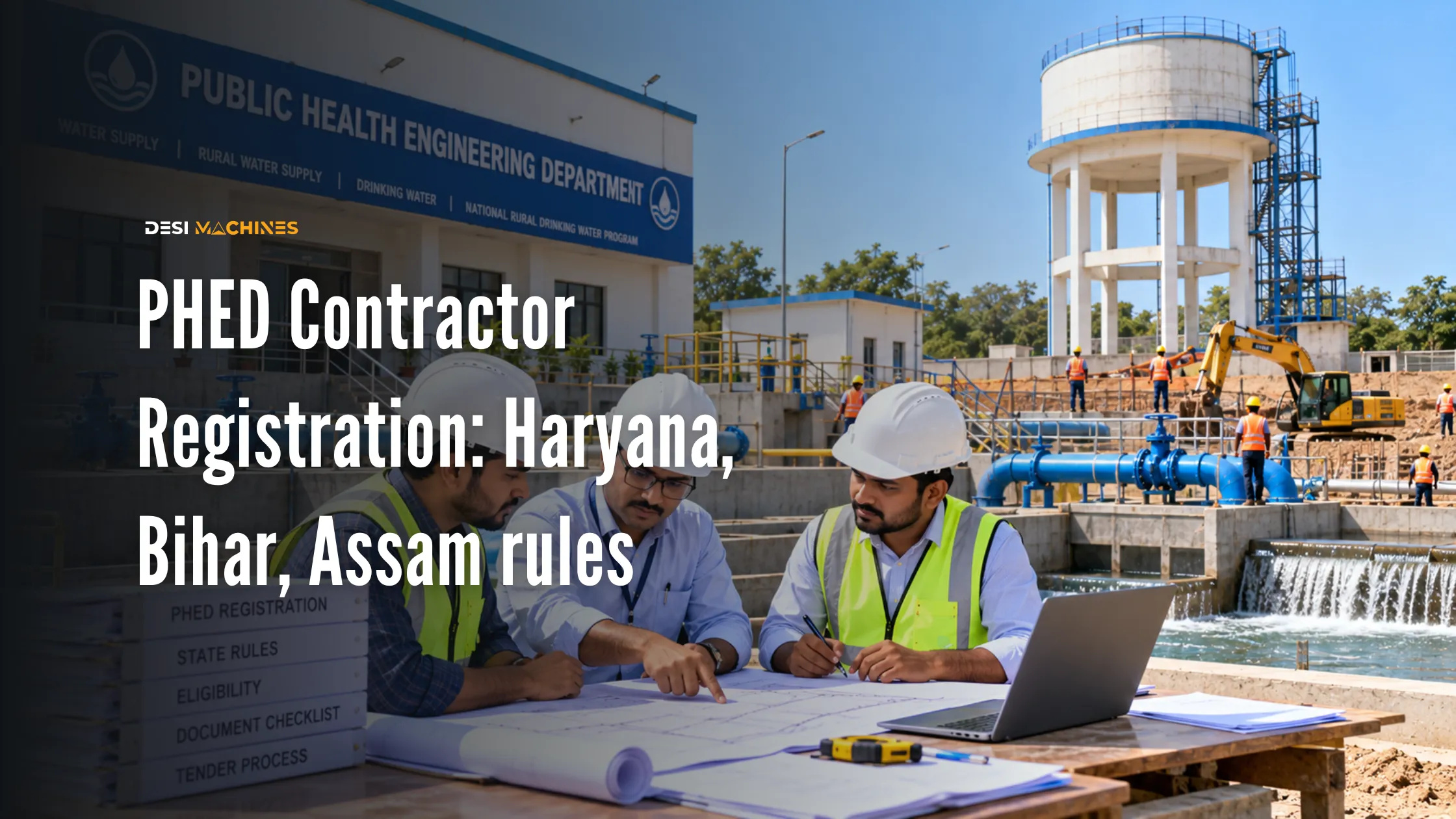
Picture a backhoe opening a trench along a village lane in Morena, a stack of pipe beside it and an overhead tank half built at the edge of the fields. The contract in the site engineer’s file is signed with the Executive Engineer, PHED Morena, and the bid was filed on the Madhya Pradesh e-procurement portal. Jal Jeevan Mission paid for part of it. It did not pick the contractor.
Our PHED contractor registration guide covers the registers in Haryana, Bihar, Assam and Rajasthan. This one answers the question before it: what JJM itself is for a contractor, and who tenders the work in Uttar Pradesh, Madhya Pradesh and Maharashtra in November 2026.
Is there a Jal Jeevan Mission contractor registration?
No. Jal Jeevan Mission is a centrally sponsored scheme of the Department of Drinking Water and Sanitation (DDWS) in the Ministry of Jal Shakti. Under JJM 2.0 the department signs an MoU with each state, issues guidelines, releases central grants scheme by scheme and monitors progress. Building the schemes is the state’s job.
The department’s own tender page shows what it buys. In November 2026 it listed a laundry contract and a campus LAN for its training institute in Kolkata, and IT manpower hired on GeM. There was not one pipeline, tank or tube well. The “vendor registration” people search for does not exist at the national level.
The 2026 JJM 2.0 Operational Guidelines name the bodies that do. A State-level Scheme Sanctioning Committee (SLSSC) approves schemes. The State Water and Sanitation Mission coordinates at state level. Bulk and multi-village systems sit with a “macro utility”, which the guidelines define as a parastatal, a PHED, a Jal Nigam or a specialised utility. The contractor builds for that implementing agency and hands the finished scheme to the Gram Panchayat at a “Jal Arpan” after a trial run of at least 15 days.
What JJM 2.0 means for a contractor’s bill
The Centre extended the mission to December 2028 with a total outlay of Rs 8.69 lakh crore, of which Rs 3.59 lakh crore is central assistance. By 22 March 2026, 15.81 crore rural homes (81.76%) had a tap connection. The money rules for the rest are tighter.
| Rule in the JJM 2.0 guidelines (2026) | What it means on site |
|---|---|
| Central assistance only for schemes sanctioned by an SLSSC on or before 31 March 2024 | New tenders are mostly balance work, revised work or re-tenders of old schemes |
| Works sanctioned but not awarded by 31 March 2024 are re-examined by the National JJM | An announced scheme can stall before it reaches the portal |
| A phase-1 tender premium is admissible only within the initial contract period | After an extension, the central share stops at the original estimate |
| Tender premiums are listed as inadmissible expenses, and “no cost and time overrun shall be supported” | Any excess falls on the state budget, which decides how fast you are paid |
| Multi-village and bulk schemes: central share paid back on actual spend and progress validated on the PM Gati Shakti app | Your measurement book and geo-tagged progress feed the state’s claim |
The budget swings matter too. Union Budget papers show JJM at Rs 67,000 crore in the 2025-26 estimates, cut to Rs 17,000 crore in the revised estimates, then set at Rs 67,670 crore for 2026-27. A state that waits on central releases pays slowly. Ask the division about the scheme’s funding mode before you quote.
Who registers you for JJM work in each state
Register with the agency that issues the tender, under that agency’s rules. For Haryana, Bihar, Assam and Rajasthan see the PHED guide linked above. For the three states below, this is what the official portals and rule books showed on 1 November 2026.
| State | Who tenders JJM work | Register asked for | Portal |
|---|---|---|---|
| Uttar Pradesh | State Water and Sanitation Mission (Namami Gange and Rural Water Supply Department); UP Jal Nigam for its own works | Scheme packages went to EPC firms; UP Jal Nigam enlists in classes A to E | etender.up.nic.in |
| Madhya Pradesh | PHED divisions, such as EE PHED Morena | Statewide PWD centralised registration; the Morena JJM tender listed no class | mptenders.gov.in |
| Maharashtra | Zilla Parishad rural water supply divisions; MJP for its JJM projects | ZP class on the tender (Class-IV, Class-V-(A)); MJP’s own register for MJP work | mahatenders.gov.in |
Uttar Pradesh: packages for EPC firms, classes at Jal Nigam
UP awarded its rural schemes in district packages. The JJM UP dashboard’s agency-wise report lists 42 firm and joint-venture entries holding 72,776 villages and 36,295 schemes. NCC Ltd alone holds 12,832 villages, and Larsen and Toubro, Megha, Afcons and several JVs follow. A small contractor reaches that work as a sub-contractor to the package holder.
Work tendered by UP Jal Nigam itself still follows its Regulations for Classification and Enlistment of Contractors, 2001, which its website links today. Only enlisted contractors can tender, enlistment is per category, and a class lets you bid up to these limits.
| UP Jal Nigam class | Pipe laying limit | Tube wells limit | Registration fee |
|---|---|---|---|
| A | No limit | No limit | Rs 1,500 |
| B | Rs 120 lakh | Rs 120 lakh | Rs 1,200 |
| C | Rs 45 lakh | Rs 9 lakh | Rs 750 |
| D | Rs 24 lakh | Not open | Rs 450 |
| E | Rs 5 lakh | Not open | Not stated |
These are 2001 figures, and the pipe cost counts toward the limit. Regulation 19 lets the Chief Engineer revise fees and financial figures, so ask the enlisting office for any revision before you apply. Applications run from 1 February to 31 March without a late fee. A firm with no past work is enlisted provisionally in the lowest class for two years. This register is separate from the UP PWD contractor list.
The same dashboard shows 2,14,016 km of village road dug up for pipelines and 2,10,556 km restored (98.38%), with 21,965 villages still short of full restoration. Only 52% of the Rs 11,117 crore sanctioned for dismantling and restoration had been spent.
Madhya Pradesh: PHED tenders, one statewide registration
On 1 November 2026, PHED had 83 live tenders on mptenders.gov.in. Twenty mentioned JJM, and 19 of those were “balance and revised work” on piped water schemes in Morena district. Balance work means another contractor started the scheme and did not finish it.
One of them, tender 2026_PHED_544136_1, covers villages in the Ambah and Porsa blocks, including a 100-kilolitre overhead tank on a 12-metre staging. The tender value is Rs 2,19,73,000. EMD is Rs 2,19,730 (1%), with no exemption allowed on the portal, and the fee is Rs 15,000 plus Rs 1,534 processing. The job runs 180 days on a percentage-rate contract in three covers, and the tenderer class field reads “Not Applicable”.
That fits the state’s system. Madhya Pradesh runs one centralised PWD registration for every works department, PHED included, and since August 2016 it has had a single class; the MP contractor registration guide covers the Rs 25,000 fee and the portal. The real test sits in the NIT, which on this tender opens only behind the portal’s captcha. Download it with your login before you price.
Maharashtra: Zilla Parishad classes on JJM tenders
In Maharashtra, village schemes are tendered by the rural water supply division of each Zilla Parishad. Satara’s live list on 1 November 2026 shows how it works, and how hard some schemes are to place.
The Velapur scheme in Mahabaleshwar taluka (Rs 1,42,74,490, 540 days) was first published on 25 March 2026 and is on its 8th call, with a corrigendum titled “43rd Call Date”. The Karale scheme in Patan taluka (Rs 17,87,456, 365 days) is on its 10th call. Both ask 1% EMD (Rs 1,42,745 and Rs 17,875). Velapur names Class-IV and Karale Class-V-(A), which on the Rural Development Department’s Zilla Parishad register match Class 4 (works up to Rs 150 lakh) and Class 5A (up to Rs 30 lakh). The Zilla Parishad contractor registration guide explains those classes and the machinery list from Class V up.
A tender whose latest corrigendum is titled “43rd Call Date” is telling you something about rates, site access or payments. Ask the division why the earlier calls failed. Maharashtra Jeevan Pradhikaran runs its own JJM projects under a separate register, covered in our MJP contractor registration guide.
Machines for JJM pipeline and road restoration work
JJM distribution work is trenching in narrow lanes, then backfill and road repair. A backhoe loader does most of it. The Mahindra Earthmaster SX digs to 4,355 mm with a 0.27 cubic metre bucket and weighs 7,517 kg, at about Rs 28.0–31.0 lakh (indicative, as of Nov 2026). In tighter lanes a 3-tonne machine such as the Kubota U30-6S (1,550 mm wide, 2,805 mm digging depth, 3,195 kg) fits between house walls, at about Rs 24.7–27.3 lakh (indicative, as of Nov 2026).
Restoration needs compaction. A 3.4-tonne tandem roller such as the Ammann ARX 32.2, with a 1,200 mm drum, handles cement and bitumen patches over a refilled trench. Compare compactors and rollers before you commit to a district where restoration is the balance work.
When to chase a state register and when to sub-contract under a JJM package
Get the agency’s own registration when the state tenders village schemes itself and your class matches the values on its portal: a ZP class in Maharashtra, or the single PWD registration in Madhya Pradesh. In Uttar Pradesh, where the rural packages already sit with large EPC firms, approach the package holder in your district for trenching, restoration and O&M work, and keep the completion certificates for your next enlistment. In every state, read the balance-work notices with care, since JJM 2.0 caps the central share at the original estimate. Live JJM and PHED notices, with value, EMD and closing date, are listed on the government tenders and opportunities board.
Figures come from the JJM 2.0 Operational Guidelines (2026), the DDWS tender page, the Union Budget 2026-27 Budget at a Glance, UP Jal Nigam’s 2001 enlistment regulations, the JJM UP agency-wise and road restoration reports, and live tender pages on mptenders.gov.in and mahatenders.gov.in, all read on 1 November 2026. Machine prices are indicative and vary by variant, location and date. Rules, fees, classes and tender terms change. Confirm the current position with the implementing agency and the tender document itself before you apply or bid. DesiMachines is not liable for decisions a contractor takes on information that may have changed after publication.